The name Robert Middlekauf is very familiar to enthusiasts of the American Revolutionary War era. Twenty-three years ago, Middlekauf, Preston Hotchkiss Professor of American History, Emertius, at California-Berkeley, published A Glorious Cause. The book was a finalist for the Pulitizer Prize and was a thorough introduction to the build-up to and through the American Revolution.
Washington’s Revolution, the Making of America’s First Leader by Robert Middlekauff
For fans of Middlekauf, his most recent publication, Washington’s Revolution, the Making of America’s First Leader, will not disappoint.
Washington was the American Revolution according to Middlekauf, whom in the second sentence of the prologue writes that his title “emphasizes his [Washington’s] enormous importance for its course and outcome” (xv). Middlekauf then takes the reader on a very concise, quick-paced, blend of biography and history, journey through Washington’s early years to the culmination of the American Revolution.
“All the time that he served as commander of the Continental Army, he was in fact also the leader of the Revolution” (304). A tall order for a tall man–both literally and figuratively–but Washington was able to succeed because “he understood that the Revolution represented a rare opportunity”
To evaluate, examine, and explain Washington, one has to do a series of reading between the lines and looking at other primary sources of the compatriots. Washington was meticulous in reviewing what he left for posterity about his life achievements.
Middlekauf’s skill blends the reasons Washington embodied the American Revolution–from his daring in the winter of 1776 that culminated in the twin victories of Trenton and Princeton to literally holding the Continental Army together every winter–the Virginian insisted, cajoled, pressured, and through his own strong determination saw the war through.
That success, was due “in large part because he understood the Revolution represented a rare opportunity–something quite new, in fact–to lead a people in defense of principle long honored in conceptions of liberty” (304).
Not only was Washington a military leader, he also understood the political ramifications of his actions and the need to keep the army subjected to the rules of Congress. Even if that body was the cause of his soldiers going hungry and bereft of other necessities.
His “grand imagination, a vision of his new country….set him apart and made him a great leader” (306). Not too bad for just “a general” (306).
This book is a welcome addition to any military historian’s library. The blending of biography and historical monograph allows one to learn about the entire American Revolution and then from the Notes on the Sources have a road-map to delve into longer narratives on specific subjects.
Book Information
Publisher: Alfred Knopf, 2015.
358 pages, including maps, acknowledgments, notes, and sources
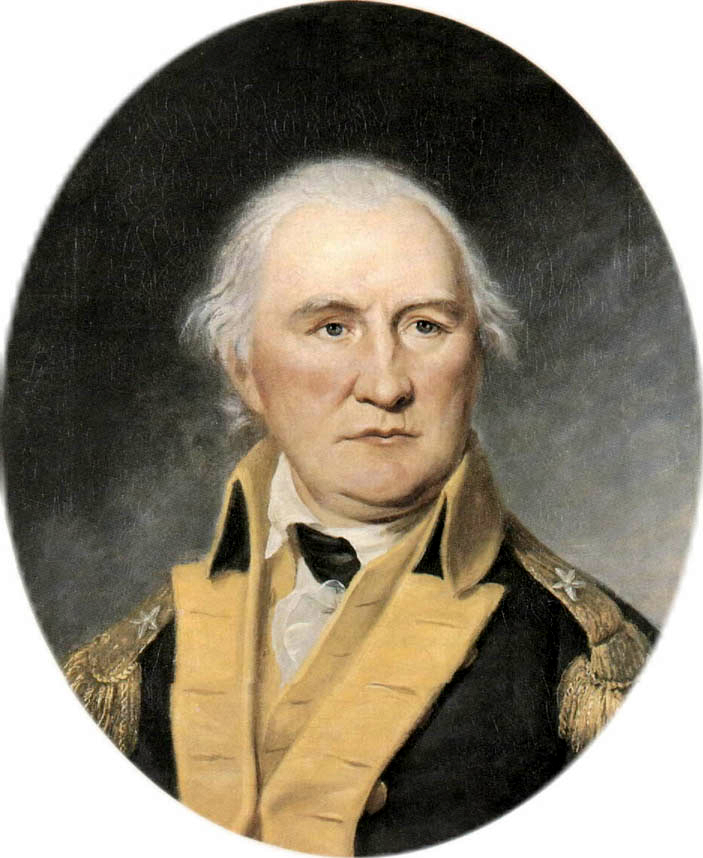
We welcome back guest historian Scott Patchan as he continues his series on Daniel Morgan.
When the situation deteriorated to outright rebellion against the crown, Morgan raised a regiment of crack riflemen from Frederick County, and marched them to Boston in twenty-one days to take part in the siege of Boston. There, he served under his former commander from the French and Indian War, General George Washington. Morgan learned the hard way that orders must be followed. He once allowed his riflemen to exceed orders in firing upon British positions at Boston. Washington called Morgan on the disobedience, and Daniel thought that he would be cashiered from the army. Washington, however, relented the next day, but Morgan had learned a valuable lesson about following orders.
Daniel Morgan in the American Revolution
In the fall of 1775, Washington sent Morgan as commander of three companies of Continental riflemen on a mission to capture Quebec from the British. Morgan’s command marched with the column of Colonel Benedict Arnold. They traversed the Maine wilderness, rowing up stream to the “Great Carrying Place,” where carried their canoes and bateaux for great distances overland to another series of streams and lakes that took them to Quebec. As the cold weather set in, sickness and hunger overtook the column and Arnold sent those unfit for duty back to the rear. After covering 350 miles, the American arrived in front of Quebec in early November, surprising the British.
Although Morgan wanted to attack immediately and utilize the element of surprise, he was overruled and the small American force besieged Quebec, waiting for another column under General Richard Montgomery to arrive from the Hudson Valley. When a British party sallied forth and captured one of Morgan’s riflemen on November 18, Arnold believed the British would come out and fight in the open. As such, Arnold drew up his army in front of the fortifications to meet them. They declined his offer and instead looked down on the ragamuffin Americans from the ramparts and exchanged taunts and catcalls. The overall situation frustrated the irascible Morgan, and when his men complained that Arnold was not giving the riflemen their fair share of rations, the “Old Wagoner” violently argued with Arnold, and nearly came to blows with the future traitor. Morgan departed Arnold, leaving him with angry warning about poor treatment of the riflemen. From that time forward, Morgan’s command always received their fair share of the army’s rations.
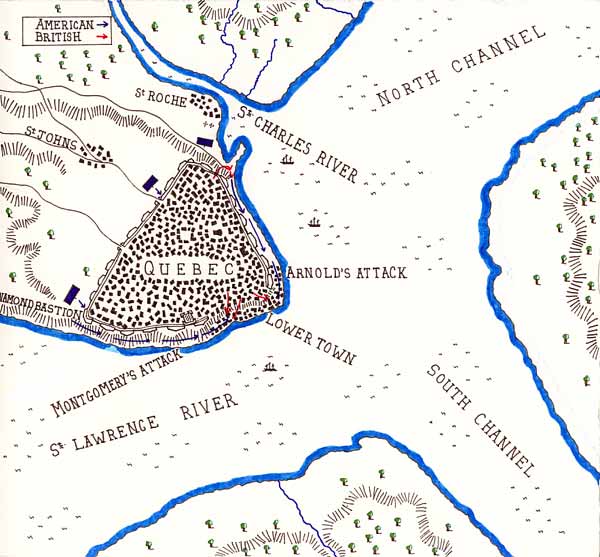
Montgomery’s column arrived on December 5, and the Americans commenced setting up his mortars and artillery outside of Quebec. The Americans finally attacked during a snowstorm in the early morning darkness of December 31, but their force numbered only 950 men. Arnold’s column came under fire as it moved toward the ramparts of Quebec, and a musket ball struck Arnold taking him out of action. Although Morgan was not the senior officer, the others insisted that he take command, having seen actual combat which they had not. Morgan later noted that this “reflected credit on their judgment.” At Morgan’s order, his riflemen rushed to the front, armed with both their Pennsylvania rifles and a spontoon for the assault while some carried ladders to storm the walls. They quickly drove a small force of British away and closed in on the walls.
Map of Battle of Quebec, 1775 (courtesy of British Battles)
Morgan ordered the men up the ladders and first one gingerly began the climb. Morgan sensed his hesitancy, pulled him down and scaled it himself, shouting, “Now boys, Follow me!” The men instantly complied, and Morgan reached the top of the wall where a volley of musketry exploded, knocking him back to the snow-covered ground. The burst burnt his hair and blackened his face; one ball grazed his cheek and another pierced his hat; but Morgan was otherwise unhurt. Stunned he laid motionless on the ground for a moment, and the attack stopped, his men thinking him dead. But he soon stirred and clambered up the ladder to the cheers of his men who followed suit. This time he stopped before reaching the top, and hurtled himself over the rampart into the midst of the enemy. He landed on a cannon and injured his back and found British bayonets levelled at him from all directions. While the British focused on Morgan, his riflemen poured over the wall and came to his rescue, driving off Morgan’s would-be impalers. Morgan kept up a close pursuit of the British who offered weak resistance to the attacking riflemen. Although Morgan had broken into Quebec, the main body of Arnold’s division failed to follow the riflemen over the wall and exploit the opportunity at hand. Morgan captured much of the lower portion of Quebec with only two companies of his riflemen. He later described the breakdown that occurred:
“Here, I was ordered to wait for General Montgomery, and a fatal order it was. It prevented me from taking the garrison, as I had already captured half of the town. The sally port through the (second) barrier was standing open; the guard had left it, and the people were running from the upper town in whole platoons, giving themselves up as prisoners to get out of the way of the confusion which might shortly ensue. I went up to the edge of the upper town with an interpreter to see what was going on, as the firing had ceased. Finding no person in arms at all, I returned and called a council of war of what few officers I had with me; for the greater part of our force had missed their way, and had not got into the town. Here I was overruled by sound judgment and good reasoning. It was said in the first place that if I went on I should break orders; in the next, that I had more prisoners than I had men; and that if I left them they might break out and retake the battery we had just captured and cut off our retreat. It was further urged that Gen. Montgomery was coming down along the shore of the St Lawrence, and would join us in a few minutes; and that we were sure of conquest if we acted with caution and prudence. To these good reasons I gave up my own original opinion, and lost the town.”
Montgomery never arrived; he had been killed in the first blast of musketry against his column, and his command broke. As time went on, the British regained their composure and pushed back against Morgan’s command. Morgan went back and brought up 200 New Englanders who joined the riflemen as they attempted to renew the attack. Now, the previously undefended point, was well manned, and daylight illuminated the paucity of Morgan’s numbers. Nevertheless, Morgan pressed them back further into the town to an interior fortification. A brave British officer led a counterattack, but Morgan personally shot him dead and disrupted the assault. Nevertheless, the time for action had passed. The British had become aware that Morgan’s was the only active American force in the city and closed in around him. In the meanwhile, additional British forces reoccupied the gates Morgan had initially taken and trapped him in the city. Morgan had no choice but to surrender his small command.
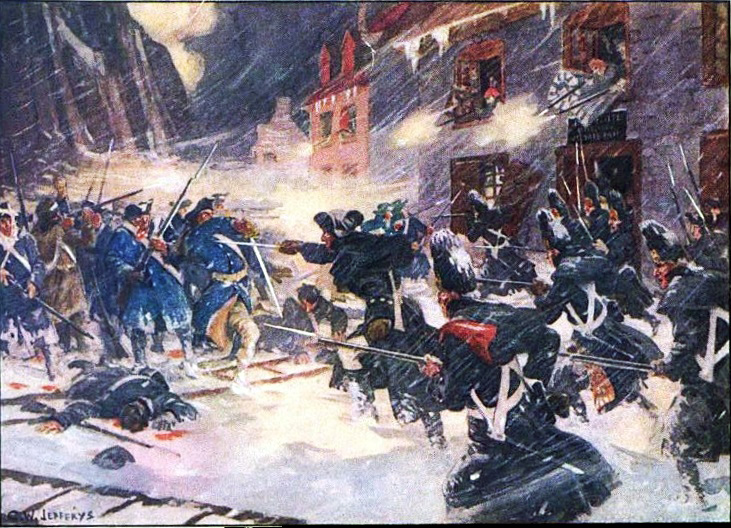
One artist’s depiction of the Battle of Quebec, 1775. Both forces are wearing blue overcoats. (courtesy of British Battles)
Morgan and the other officers enjoyed a liberal captivity with generous quarters in a seminary. The British officers visited them often and remained on friendly terms with the Americans. Morgan developed a dislike for some of his fellow officers whom he regarded as dishonest and scheming, and his fighting skills were brought to bear on at least one occasion when several men teamed up against big Dan Morgan. The imprisonment ended when the British returned the American officers on September 24, 1776, in New Jersey. Morgan returned to his wife and two daughters at his home outside of Battletown or Berryville, where he awaited his proper exchange. While there, he named his home “Soldier’s Rest,” as he recuperated from the trials of the taxing expedition to Quebec. The war was still young, and the Continental Army would soon be calling upon his services again. A special command of riflemen was being organized and Morgan would be its commander.
You can almost feel the cold weather from just looking at the painting. With the snow on the ground, and white specks of wintry mix falling in the distance, one almost wants to say “brrr.”
With rags wrapped around feet, heads bowed into the storm, and no two soldiers dressed a like the painting depicts winter 1777 for the American Continental Army. The title “The March to Valley Forge” also concocts images of the harshness of that winter during the American Revolution.
And in the middle of the picture, sits George Washington, astride his horse, staring at the marching soldiers in silent tribute. One of the soldiers is depicted doffing his cap at Washington. Respect, admiration, and solidarity of the joint struggle of the war, is present, by just examining the painting a little closer.
That is why this painting below, done by William Trego, a century and a few years after this march would have happened, is my favorite painting about the American Revolution.
This is part two in the series by guest historian Drew Gruber. For part one, click here.
On the morning of October 3, 1781, British Colonels Tarleton and Thomas Dundas led another expedition north towards Gloucester Courthouse and away from the protection of their fortifications at Gloucester Point. Their command that day included some of the most renowned fighting men then in service. Cavalry and mounted infantry from Tarleton’s own British Legion, combined with a detachment of Colonel Simcoe’s Queen’s Rangers, elements of the 17th Dragoons, men from the 23rd Regiment (Royal Welch Fusiliers), German Jaegers and part of the 80th Regiment of Foot provided an impressive host for their American and French adversaries. Captain Johann Ewald, commander of the Jaegers commented after the war that he was sent out with “one hundred horse of Simcoe’s and the remainder of the jagers and rangers, which amounted to only sixty man in order to take a position between Seawell’s planatation and Seawall’s Ordinary. I was to form a chain there to protect a foraging of Indian corn.”[1]
Emerging Revolutionary War and Revolutionary War Wednesday is pleased to welcome back guest historian Drew Gruber.
Part 1
When we think about American militia during the Revolutionary War, the image of an untrained rifle-toting citizen turned soldier comes to mind. This stereotype of the American soldier, popularized by movies like The Patriot is not completely false but such generalizations should give us pause and inspire us to investigate the roll of American militia, independent companies, and ‘irregular’ troops a bit closer. For example, how was it that on October 3, 1781 a group of Virginia militiamen defeated an elite British force? The story of Lieutenant Colonel John Mercer’s Grenadier Militia during the battle at Seawell’s Ordinary has been told and retold since 1781, however the formation of this illustrious group is often ignored and deserves a closer look. Continue reading “Mercer’s Grenadier Militia”→
Revolutionary War Wednesday and Emerging Revolutionary War is pleased to welcome guest historian Mark Maloy this week.
African-Americans fought for the Americans during the Revolutionary War, right? Many of us remember learning about Crispus Attucks dying during the Boston Massacre or have heard the oft-repeated saying that the Continental Army was the last integrated American army until the Korean War.
In this lithograph published in 1855, Crispus Attucks is portrayed front and center. Crispus Attucks was lauded as the first martyr in the War for Independence much from the insistence of abolitionists like William C. Nell. A Crispus Attucks Day was created in Boston in 1858 and a memorial placed for him and the other victims on Boston Common after the Civil War. Despite all this, according to John Adams (who defended the British soldiers in court), Attucks was a rabble-rouser who actually helped precipitate the massacre.
Rev War Wednesday and Emerging Revolutionary War is pleased to welcome guest historian Kate Gruber.
Let me guess– you are a Rev War Nerd who is the best friend of/dating/married to a Civil War Nut.
I recognize the symptoms. You have often thought that the third person in your relationship might just be Shelby Foote. Hardtack is just not something you can get voluntarily excited about. The idea of blue and grey is not nearly as appealing as red and blue. You have been dragged to Gettysburg when you really wanted to check out Valley Forge.
Friends, you are not alone. I myself am a Nerd married to a Nut, and I am here to tell you that your problems might just be solved by spending some quality time in historic Yorktown, Virginia. Continue reading “ERW Weekender – Yorktown”→
It will be hard to describe in modern terms the celebrity of Marie-Joseph Paul Yves Roch Gilbert du Motier de Lafayette, Marquis de Lafayette (aka LaFayette) in 18th century America.
The young Marquis was fascinated with the American ideal of revolution and against the wishes of the French monarchy, in 1776 he cast his lot with the American patriots. His relationship with George Washington and other American leaders played a major role in the American-French alliance that brought about American independence. Continue reading “The Return of L’Hermoine”→
As the British under Lt. Col. Francis Smith marched out of Lexington on the morning of April 19th, they left behind them 18 American casualties. One of these men who suffered wounds that morning was Prince Estabrook. Estabrook was unlike the others who lined up that morning on the Lexington Green, Estabrook was an enslaved African American.
Prince Estabrook Service Record for June 1775
Born in the 1740’s and owned by Benjamin Estabrook there is little information on Prince’s life and family. Benjamin Estabrook operated a grist mill near Lexington and maintained a decent sized farm. Benjamin served in various positions in Lexington including coroner, justice of the peace and Selectman. He inherited Prince from his father and both men were near the same age. Prince enlisted in the Lexington militia in 1773 and his owner had to grant him the ability to do so. Continue reading ““A Negro Man”: Prince Estabrook of Lexington”→
Lord Hugh Percy, the 2nd Duke of Northumberland and holding the rank of brigadier general commanded the relief brigade that was ordered out from Boston by Sir Thomas Gage after Lieutenant Colonel Francis Smith had sent back a messenger asking for reinforcements.
Little did Lord Percy realize at the time that by the late afternoon of April 19th, one quick decision saved the lives of countless British Redcoats and hundreds of American militia and minutemen.Continue reading “The Most Fateful Decision of April 19, 1775”→






 Revolutionary War Wednesday and Emerging Revolutionary War is pleased to welcome guest historian Mark Maloy this week.

 Emerging Revolutionary War Era