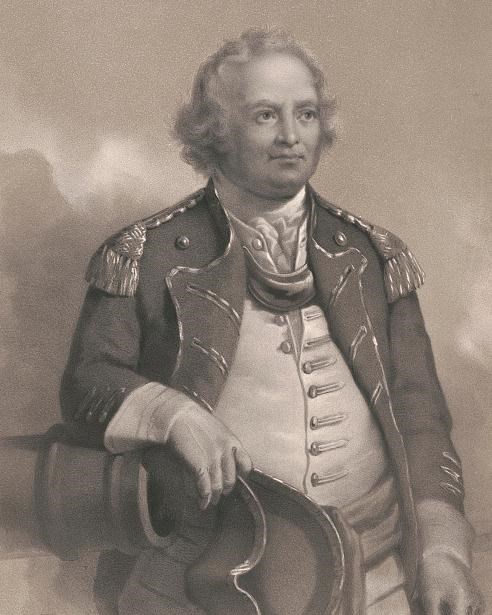
On July 3, 1775 George Washington formally took command of the Continental Army in Cambridge, Massachusetts. Appointed Commander-in-Chief by the Second Continental Congress on June 15, 1775, Washington arrived in Cambridge on July 3, 1775 and assumed command of a disorganized and poorly supplied force besieging British troops in Boston. His leadership would begin the transformation of colonial militias into a unified fighting force capable of challenging British military power.
Washington’s assumption of command occurred at a time when the American colonies were transitioning from protest to open rebellion. The battles of Lexington and Concord in April 1775 had already ignited armed conflict, and the Battle of Bunker Hill in June had demonstrated that colonial forces could stand up to British regulars, though at great cost. Washington understood the gravity of his new role. In a letter to the President of Congress, he wrote humbly, “I am truly sensible of the high Honor done me in this Appointment… I do not think myself equal to the Command I am honored with.” This characteristic modesty was paired with a strong sense of duty and resolve.
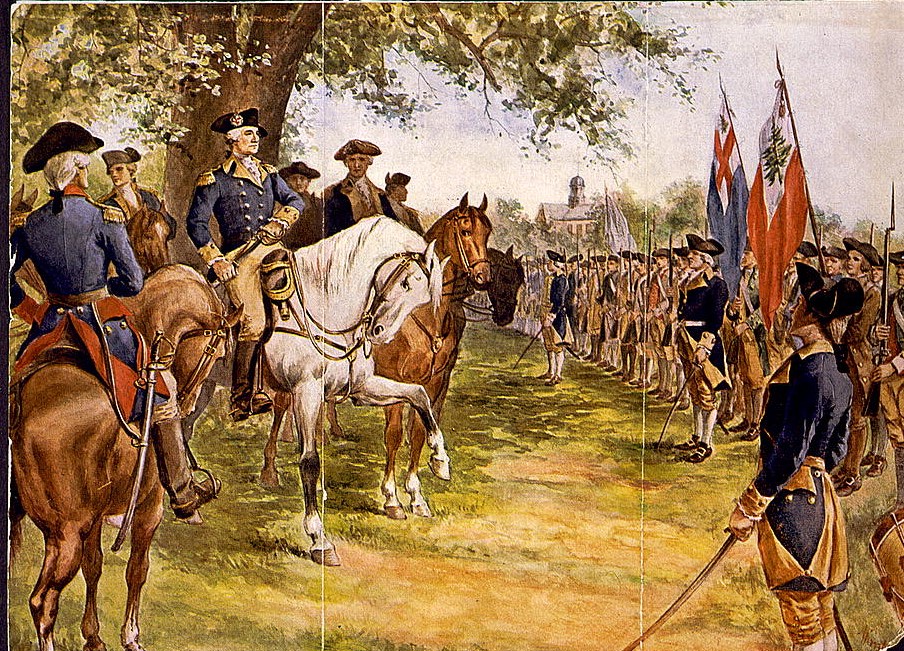
Washington assumes command at Cambridge, Courtesy Library of Congress
On July 3, Washington appeared before his troops on Cambridge Common, dressed in a blue coat with buff facings, signifying his Virginian roots. There is no official transcript of a speech he may have delivered that day, but contemporary accounts describe a solemn and determined atmosphere. One observer, Reverend William Emerson, noted in his diary, “General Washington… is a tall and noble-looking man, commanding the respect of all who see him.”
Washington immediately set to work imposing discipline, organizing supply chains, and creating a chain of command. Though former commander of the army, Major General Artemus Ward, worked hard on instilling discipline, he was not a man that instilled a lot of confidence. Washington was appalled by the state of the army, writing in frustration to Congress: “The Army… is in a very improper condition to carry on a vigorous War.” He introduced regular drills, uniform codes, and standardized procedures, striving to turn the disparate bands of militiamen into a functioning army. As historian David McCullough noted, “It was Washington’s presence alone that gave the army cohesion.”
Despite his military inexperience—Washington never commanded an army of this size—he brought a unifying vision and moral authority. His appointment was also politically astute, bridging the regional divide between New England and the southern colonies. A Virginian leading New England troops sent a clear message of unity in the face of British oppression.
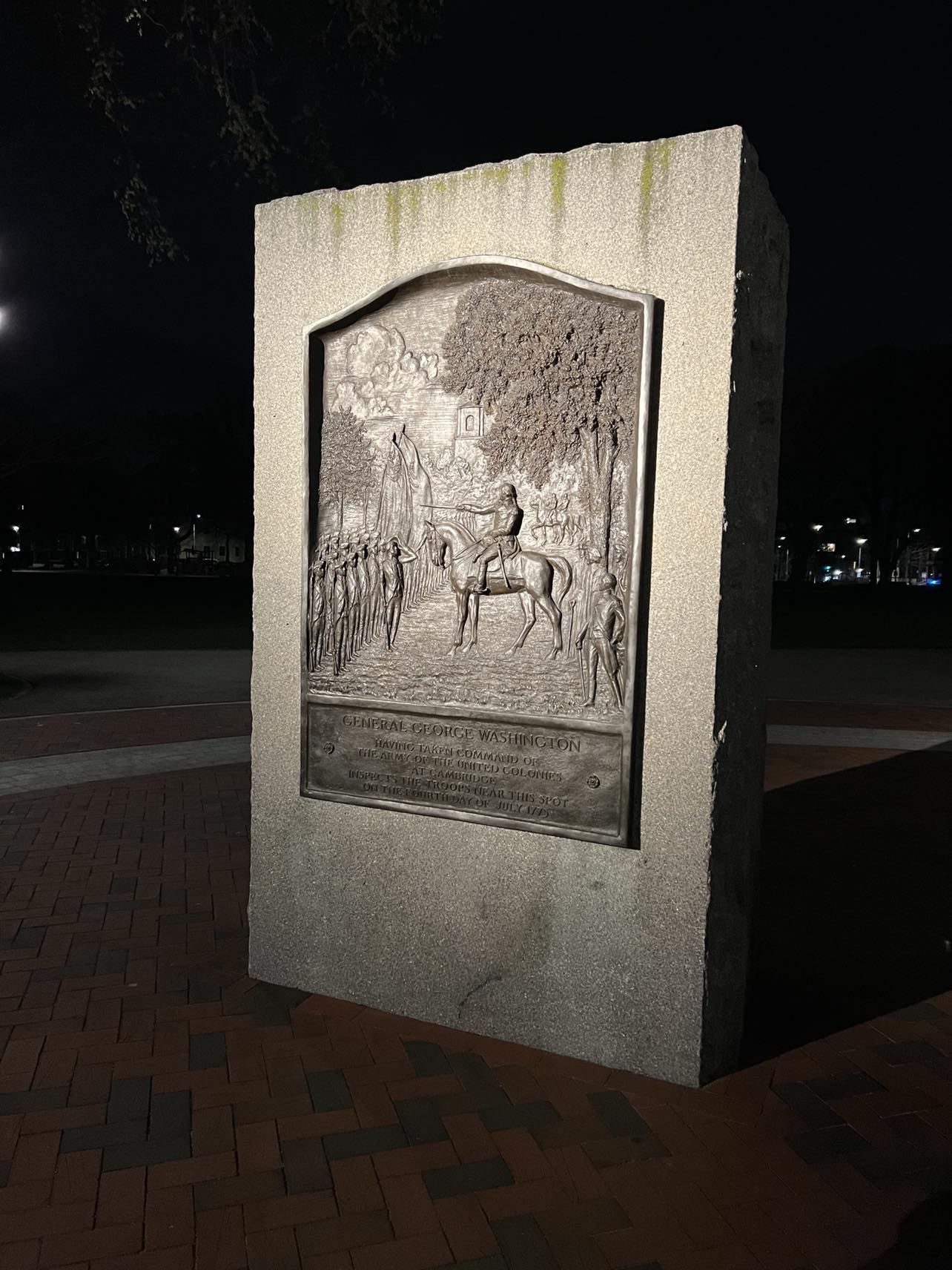
Marker commemorating Washington on the Cambridge Common, photo by William Griffith
The Cambridge encampment remained Washington’s headquarters until March 1776, when he successfully forced the British evacuation of Boston by fortifying Dorchester Heights with cannons brought from Fort Ticonderoga. This early strategic victory, achieved without major bloodshed, was a major morale boost and affirmed Congress’s faith in their commander.
In retrospect, July 3, 1775, was the beginning of an enduring legacy of leadership and a love of Washington by his men and officers. Through discipline, vision, and personal integrity, he began shaping a ragtag collection of volunteers into the Continental Army, laying the groundwork for American independence.
Following the initial skirmishes at Lexington and Concord on April 19, 1775, colonial militias from throughout New England converged around Boston, with the area of Cambridge and Roxbury serving as the epicenters of the camps. These New England militia effectively layed siege to the city where British General Thomas Gage concentrated after April 19th. The British, cut off from the countryside, relied heavily on supplies brought in by sea. At the same time, American forces were eager to secure resources and deny the British any additional supplies from nearby coastal areas.
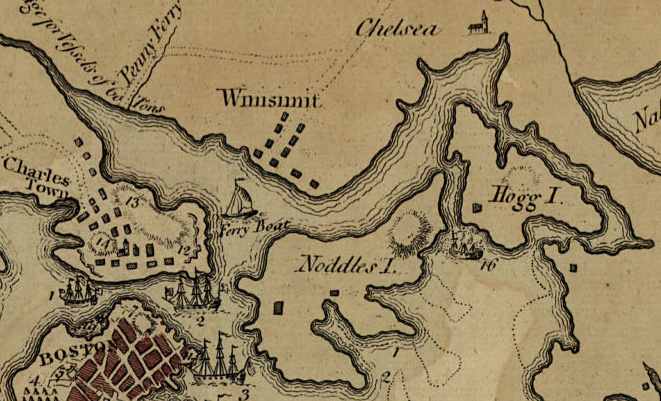
The location of the HMS Diana is marked with “16” on the map
One such resource-rich area was Noddle’s Island and Hog Island both located in Boston Harbor. These islands contained valuable livestock and hay, which the British had been attempting to secure to feed their troops and horses. American intelligence reported that the British were planning to remove these resources, prompting a proactive operation by the colonial forces to beat them to it.
In early May, Dr. Joseph Warren led a group inspecting the islands and recognized their imporance. As part of the Massachusetts Committee of Safety, Warren led the effort for a reslolution to be passed to either capture or destroy the supplies on the islands. On May 14th, the Committee stated “Resolved, as their opinion, that all the live stock be taken from Noddle’s Island and Hog Island, and from that part of Chelsea near the sea coast, and be driven back; and that the execution of this business be committed to the selectmen of the towns of Medford, Malden, Chelsea, and Lynn, and that they be supplied with such a number of men, as they shall need, from the regiments now at Medford.” Soon the commander of the New England army around Boston, General Artemas Ward, put a plan in motion to quickly strike both islands.
The American expedition was led by Colonel John Stark and Colonel Israel Putnam, both future generals in the Continental Army. The colonial forces, primarily composed of New Hampshire and Massachusetts militias, planned a nighttime amphibious raid to remove the livestock and destroy hay supplies that might benefit the British. On the night of May 27, colonial forces quietly moved onto Hog Island and began driving off livestock and burning haystacks. British forces, stationed in Boston and alerted to the colonial activity, responded by dispatching marines and the British schooner HMS Diana, a lightly armed but maneuverable vessel well-suited for operations in the shallow waters of the harbor.
As the colonists worked to transport livestock to the mainland, they encountered resistance from British marines who had landed on Noddle’s Island and began advancing toward their position. A sharp skirmish ensued, during which the American militia used the terrain to their advantage, fighting from behind trees, stone walls, and other natural cover. The colonial forces managed to repel the British marines, inflicting casualties and forcing a retreat.
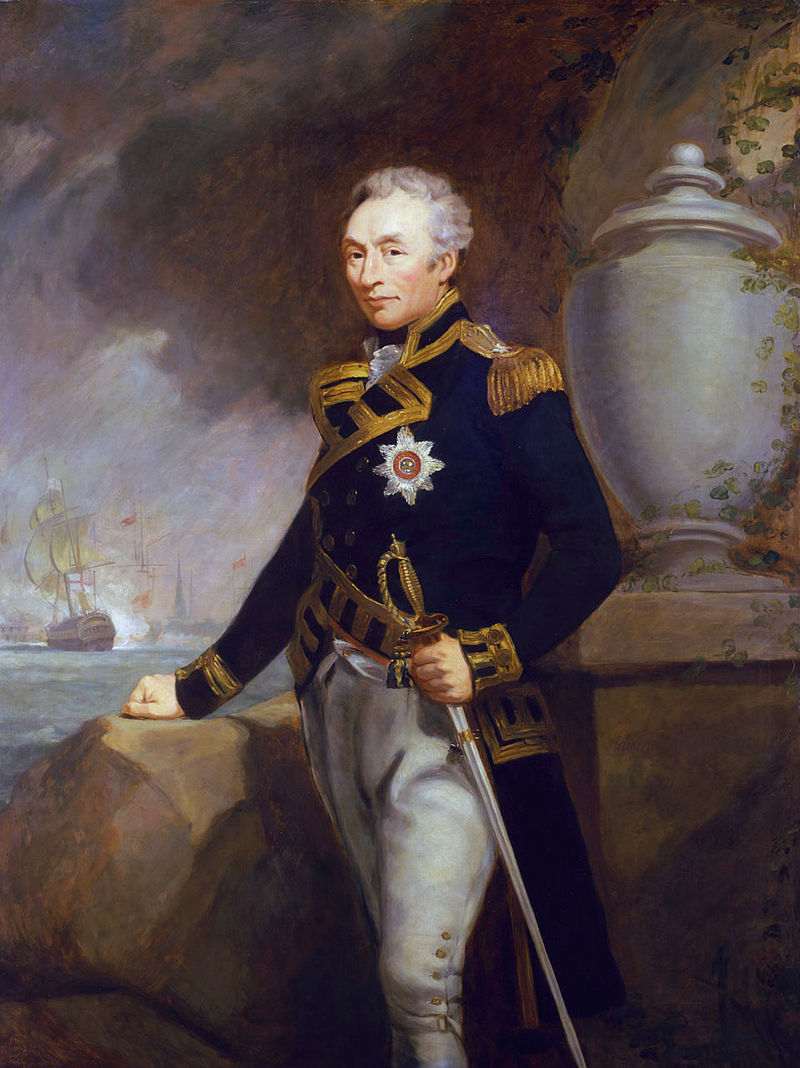
Lieutenant Thomas Graves (nephew of Vice Admiral Samuel Graves) commander of the HMS Diana. Shown in his rear admiral uniform in ca. 1801. Often confused with Lord Thomas Graves, British commander during the Battle of the Capes
The turning point of the engagement came with the involvement of the HMS Diana. The schooner attempted to support the marines by moving up the narrow Chelsea Creek to engage the colonial militia and cut off their withdrawal. However, as the tide receded and the ship ventured too far inland, it became grounded in the shallow, muddy waters.
Seeing an opportunity, the colonists brought up field artillery from shore and opened fire on the stranded vessel. Over the course of the battle, they subjected the Diana to intense musket and cannon fire. Unable to refloat the ship due to the falling tide and increasing colonial pressure, the British crew was forced to abandon it. American forces quickly boarded the vessel, stripped it of usable supplies, weaponry and its 76 foot mast, and then set it ablaze, destroying the schooner completely.
The Battle of Chelsea Creek resulted in a clear American victory, both strategically and psychologically. The destruction of the HMS Diana marked the first loss of a Royal Navy vessel in the Revolutionary War, dealing a symbolic blow to British morale. For the colonists, it was a tangible demonstration of their ability to challenge British authority not only on land but at sea.
Major General Israel Putnam said after the fight on Chelsea Creek “I wish we could have something of this kind to do every day,”
Tactically, the victory helped to solidify American control of the Boston-area islands and limited the British army’s ability to forage for supplies. This contributed to the worsening conditions inside besieged Boston and increased pressure on General Gage. The morale boost for the colonial militias was significant; it reinforced the notion that British troops and naval forces were not invincible and that well-coordinated militia operations could succeed.
In addition, the battle was notable for showcasing early instances of American military ingenuity and leadership. Figures like Israel Putnam and John Stark went on to distinguish themselves in later battles, and the ability of the militia to effectively coordinate a land-sea operation foreshadowed the more sophisticated tactics that would develop over the course of the war. A few months later on August 1st, the mast of the HMS Diana was raised on Prospect Hill as a liberty pole. A symbol that was seen by not just the Americans around Cambridge but also the British in Boston. This location was also where legend states that George Washington ordered the first American flag, the Grand Union, to be raised on January 1, 1776.
While over shadowed by Lexington, Concord, or Bunker Hill, the Battle of Chelsea Creek played a crucial role in the early war. It helped secure the outer perimeter of the Siege of Boston, denied the British critical supplies, and emboldened the colonial cause at a time when confidence was still fragile. The success of the operation, including the destruction of the Diana, offered a dramatic image of colonial resistance and ingenuity that resonated beyond New England.
Today, the location of Noddle’s and Hog Island are gone. Nineteenth century and modern infill has completely reshaped the area from mudflats and tidal marshes to buildable land. Modern day East Boston, Winthrop and Logan Airport cover the area. The community of Somerville contines to commemorate the raising of the Grand Union flag on January 1 Diana‘s mast with a flag raising ceremony. Though mostly forgotten, the fighting along Chelsea Creek continued to embolden men like Joseph Warren and Israel Putnam and encourage their agressiveness a few weeks later on the Charlestown peninsula.
The Battle of Bunker Hill is routinely mentioned in the pantheon of memorable American military victories. Although myths of the engagement have obscured some of the history, much like the smoke of battle, the patriot victory on June 17, 1775, was another pivotal moment in the early stages of what became the American Revolutionary War.
To discuss the engagement, ramifications, and interpretation of the battle, Emerging Revolutionary War welcomes historian Dr. Paul Douglas Lockhart, Professor of History at Wright State and author of “The Whites of Their Eyes, Bunker Hill, the First American Army, and the Emergence of George Washington.” A full biography of Dr. Lockhart, including his other works, is at the bottom of this post.
As a teaser, this may be the first time in “Rev War Revelry” history that we mention Artemas Ward, who according to Dr. Lockhart is the “unsung hero of the battle (and indeed of 1775).” Come hear why! And full disclosure, I agree.
We hope you can join us on Sunday, January 21 at 7 p.m. EDT on Emerging Revolutionary War’s Facebook page for the next installment of the popular “Rev War Revelry.” Be ready to ask questions as you sip your favorite beverage during this historian happy hour.
Biography of Dr. Lockhart
“Paul Douglas Lockhart is Professor of History at Wright State University in Dayton, Ohio, where he has taught since earning his PhD in 1989. A native of Poughkeepsie, New York, Lockhart completed the PhD at Purdue University, where he studied military history with the late Gunther Rothenberg, the renowned Napoleonic scholar, and early modern European history with Charles Ingrao. He has seven single-author books to his credit. Four of them deal with the history of Scandinavia during the “Age of Greatness,” including Denmark, 1513-1660: The Rise and Decline of a Renaissance Monarchy, published by Oxford University Press in 2007. He is probably better known for his books on military history: The Drillmaster of Valley Forge: The Baron de Steuben and the Making of the American Army (2008), The Whites of Their Eyes: Bunker Hill, The First American Army, and the Emergence of George Washington (2011), and most recently his study of the parallel evolution of warfare and firearms: Firepower: How Weapons Shaped Warfare (2021). Wright State has awarded him the Brage Golding Distinguished Professorship and the Trustees’ Award for Faculty Excellence, the University’s highest academic honor. The Ohio Academy of History named him Distinguished Historian for 2020-21, and in 2021 he was elected to membership in The Royal Society for Danish History for his contributions to the history of Denmark, an honor rarely accorded to foreigners. He lives in Centerville, Ohio, with his family.”