

The American Revolution is often remembered through the familiar lens of successful campaigns and their contributing commanders: General George Washington at Yorktown, Virginia, and General Horatio Gates at Saratoga, New York, to name two of the most significant. Yet the Revolution was an international conflict fought across a much wider geographic area than just along the eastern seaboard of North America. In An Underappreciated Victory, Stephen L. Kling, Jr. and Kristine L. Sjostrom seek to restore one of these overlooked campaigns to its proper place in the history of the war. Their study of Bernardo de Gálvez’s 1779 Mississippi River campaign demonstrates how Spain, despite pursuing its own strategic interests, contributed materially to the defeat of Britain and how Gálvez’s leadership produced significant results with remarkably limited resources.
The authors begin by establishing the strategic importance of Spanish Louisiana and the Mississippi River Valley. Following Spain’s entry into the war against Britain in 1779, Louisiana became both a potential target for British operations and a valuable base from which Spain could threaten British possessions. New Orleans was particularly vulnerable. British control of posts along the Mississippi posed a danger to Spanish interests while also threatening communications and commerce throughout the region. Rather than remain on the defensive, Gálvez recognized an opportunity to seize the initiative.
It is in this decision that the authors make one of their strongest arguments about Gálvez’s leadership. His forces were hardly overwhelming, and the campaign presented formidable logistical challenges. Distance, weather, disease, difficult terrain, transportation problems, and uncertain intelligence, all complicated operations. Gálvez nevertheless chose an offensive strategy. His willingness to act before the British could concentrate their forces became one of the campaign’s defining characteristics. The resulting operations against British positions, culminating in the capture of Baton Rouge and other posts, demonstrated the effectiveness of surprise, mobility, intelligence, and decisive leadership.
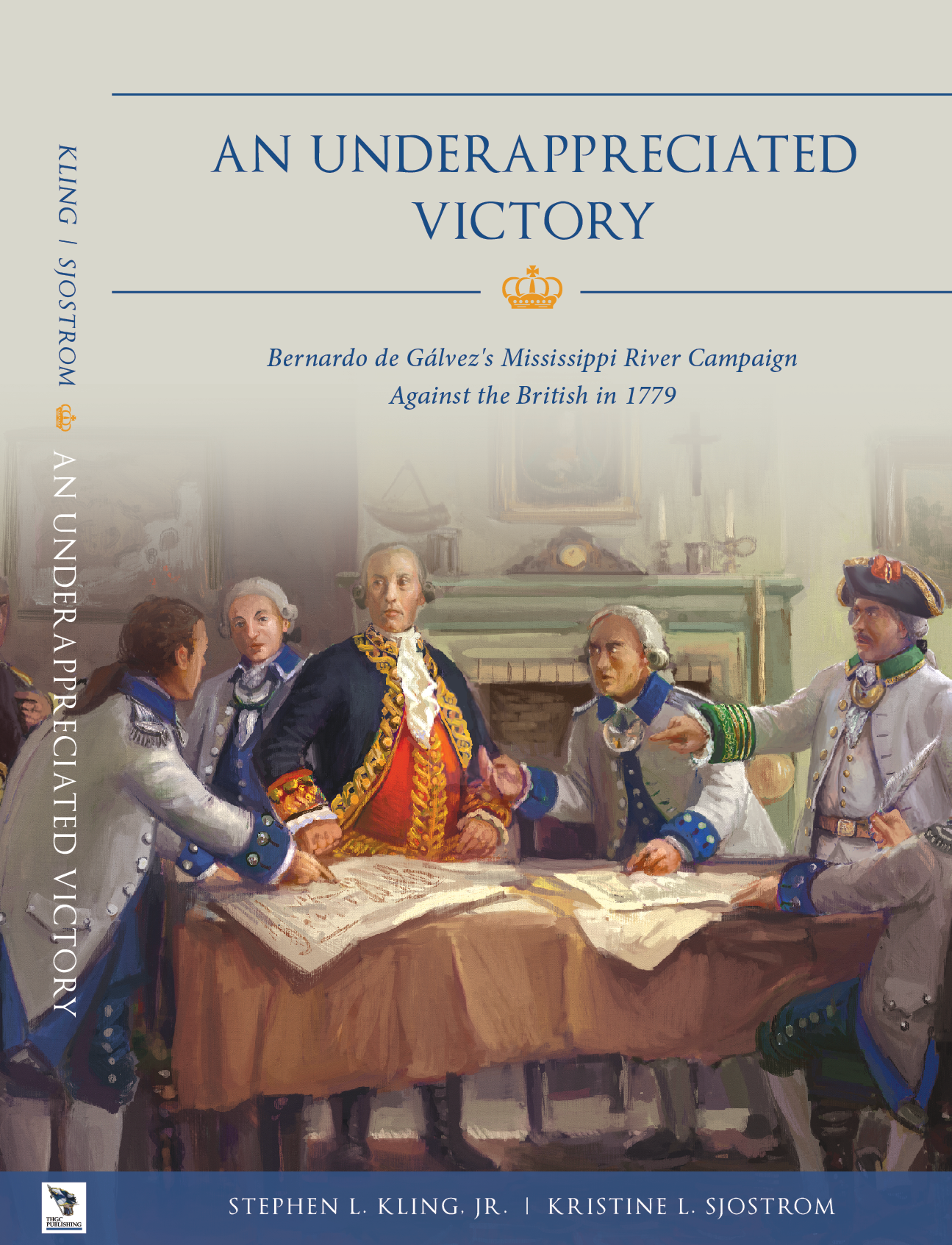
Kling and Sjostrom are very effective in showing that the campaign cannot be understood solely through its engagements. Logistics and geography receive significant attention, revealing the extent to which environmental conditions shaped military possibilities along the Mississippi River. The campaign’s success therefore becomes more impressive when measured against the obstacles continuing to confront Gálvez. His achievement was not simply that he defeated British forces; it was that he managed to organize and sustain an offensive in an environment that severely restricted the movement and supply of armies.
Another of the book’s greatest strengths is its use of multinational sources. By incorporating Spanish, British, and German accounts, the authors move beyond the predominantly Anglo-American perspective that has traditionally dominated Revolutionary War narratives. These sources allow them to reconstruct events from competing viewpoints and provide greater insight into the decisions made by both sides. Their documentary approach also strengthens the case for reconsidering Gálvez’s campaign as a serious military operation rather than an isolated episode on the margins of the Revolution.
The book’s greatest historiographical contribution, however, lies in its reassessment of Spain’s role in the American Revolution. Spain did not enter the war solely to assist the American colonies; it had territorial, commercial, and geopolitical objectives of its own. Nevertheless, those objectives frequently aligned with the interests of the American revolutionaries. Gálvez’s campaign illustrates how Spanish military operations diverted British attention and resources while weakening British control of the Gulf Coast and Mississippi Valley. The authors therefore broaden the traditional interpretation of the Revolution from an Anglo-American struggle supported by France into a genuinely international conflict.
The study is not without potential limitations. This book is a deep and exhaustive study of a particular subsect of war, designed to be the volume on this aspect. Similarly, the authors’ admiration for Gálvez occasionally raises the question of whether they attribute his successes too heavily to exceptional leadership rather than to a combination of favorable circumstances, British weaknesses, and Spanish strategic interests. Nevertheless, the evidence presented makes a convincing case that Gálvez exercised considerable initiative and understood the advantages of striking quickly against dispersed British positions.
Ultimately, An Underappreciated Victory shows that the importance of a military campaign cannot always be measured by the size of participants or soldiers. Gálvez’s 1779 Mississippi campaign involved relatively modest forces compared with the armies that fought at Saratoga or Yorktown, yet its strategic consequences were considerably greater than its obscurity might suggest. Kling and Sjostrom provide a valuable reconstruction of the campaign while challenging readers to reconsider the geographic and international dimensions of the American Revolution. Their study establishes Gálvez not merely as a peripheral Spanish commander but as an important participant in the broader struggle against Britain. In doing so, An Underappreciated Victory makes a persuasive case that the campaign—and Gálvez himself—deserve a more prominent place in the history of the American Revolution.
THGC Publishing, St. Louis, MO
2026
634 pages, including images
$50.00


 Emerging Revolutionary War Era