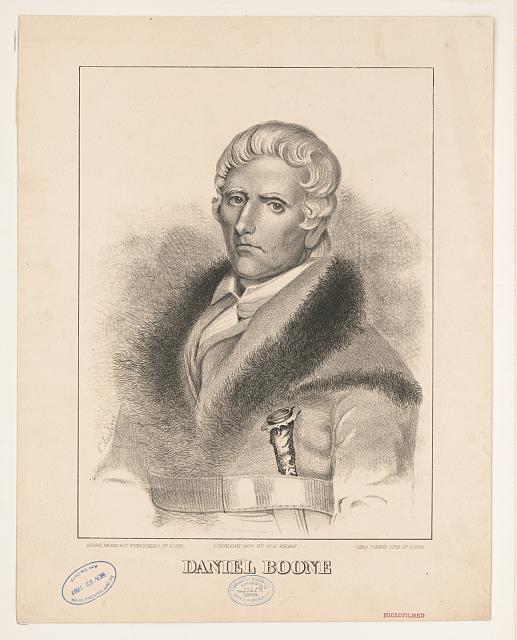
“Let’s All Sit Down Now and Have a Hearty Cry”

The summer of 1776 was tense on the Kentucky frontier. Since the spring, Shawnee raids from north of the Ohio had increased, with tribesmen raiding the white settlements with the intention of driving the settlers east, back across the mountains.

By the late spring, hardly more than 200 Americans remained in Kentucky, most forting up in the settlements south of the Kentucky River at Harrodsburg, Logan’s Station, and Boonesborough as war parties ranged nearby. Years later, an old settler remembered the rancid conditions of long confinements in “a row or two of smoky cabins, among dirty women and men with greasy hunting shirts.” By the summer, conditions in the forts were almost unbearable as supplies of salt and meat began to run low.

On the quiet Sunday afternoon of July 14, 1776, 13-year-old Jemima Boone, daughter of frontiersman Daniel Boone, slipped out of the log gates of Boonesborough with her friends Elizabeth (Betsy) and Frances (Fanny) Calloway. Tired of the confinement of the fort, the three girls untied the lone canoe of the settlement and pushed out into the Kentucky River for an old-style joy ride. Jemima would remember years later that her father had warned her to stay near the cabins and never cross to the other side of the river.

Betsy Calloway, 16, guided the canoe but it was soon caught up in the current and taken downstream toward the northern bank. A small mixed war party of Shawnees and Cherokees were watching the settlement from the woods across the river. They had been in the area for at least a week when they spotted the girls in the canoe. As the craft got close to the shore a warrior jumped into the river and grabbed the towline. Understanding immediately the danger they were in all three girls began to scream. The warriors brought the canoe to shore and quickly made signs to the girls of what would happen if they continued screaming. But the sounds had already alerted the settlers in the fort.

It was Sunday, the Sabbath and, as was his normal custom, Daniel Boone was lying down for his Sunday afternoon nap when he heard the commotion from out in the fort. Running out of his cabin in his bare feet, Boone joined with Richard Calloway, father of Betsy and Fanny, and several other men of the settlement as they eventually made their way to the opposite shore of the river and began tracking the war party as it made its way towards the crossing of the Licking River at the upper Blue Licks.

One of the Cherokee men in the party was named Scolacutta but known to the Americans as Hanging Maw. He knew Daniel Boone and his family and spoke a bit of English. He recognized Jemima as Boone’s daughter. Hanging Maw laughed at the joke they were playing on old Boone, Jemima remembered many years later, and confirmed they were headed for the Shawnee towns north of the Ohio. If the party managed to get across the big river, the rescue of the girls would most likely become impossible. As they were forced along the trail, the three girls dug their heels into the earth or dropped bits of material from their clothing; anything to give signs to anyone who may be following that they were on the right path.

By the morning of the second day, Boone and his party were roughly 10 miles behind the kidnappers. Now with a pretty good idea of where the war party was heading and understanding that, continuing to follow the tracks would slow them down considerably, Daniel Boone made the decision to break from the trail and speedily head for the Blue Licks. It was certainly a gamble but the men with Boone trusted his judgment. The Kentuckians moved out, setting a jogging pace.

As they got closer to the war party, the rescuers began finding the signs left for them by the kidnapped girls. They also came across muddled waters at a creek crossing, a dead snake along the trail and finally the carcass of a recently butchered buffalo calf. They knew they were getting close. Boone figured the warriors would stop to cook at the next water they came across. At a branch known today as Bald Eagle Creek, east of the current town of Sharpsburg, KY, the trail ended. Boone divided his party, with four men going up stream and four heading down.

After two days of hard travel with no sign of pursuit, the warriors began relax a bit. They would soon cross the Licking River and link up with other war parties so they began feeling confident. They made camp and began to roast the buffalo meat. The terrified girls were exhausted by being on the march. The camp was in a small, open glen. As the warriors lolled about the girls were sitting near the cook fire. Suddenly, Jemima Boone heard a noise in the brush. The sound caught the attention of one of the Shawnees who looked up but, seeing nothing, returned to his work. Glancing up along the nearby ridge, Jemima suddenly caught sight of her father. The girl remembered he was “creeping upon his breast like a snake.” Around 100 yards or so apart, the father and daughter locked eyes. Boone gave a quick signal for the girl to remain quiet.

The rest of Boone’s party were gathered up on the ridge when, in a fit of excitement, one of them fired his rifle down into the camp. Before she heard the shot, Fanny Calloway saw blood spurt from the chest of the warrior standing next to the campfire. He managed to hobble off into the brush. “That’s Daddy!” Jemima cried as she and the other girls hit the ground with shots filling the air from the rescue party above. Boone’s party rushed down into the camp among the startled warriors. Those tribesmen not hit by rifle fire managed to escape into the woods. All at once the terrible ordeal was over, for both father and daughter. “Thank Almighty Providence, boys,” Boone said, “for we have the girls safe. Let’s all sit down by them now and have a hearty cry.” Jemima Boone would long remember that “there was not a dry eye in the company.”

The story of the kidnapping and rescue would be retold in the Boone and Calloway families for generations. In the 19th century, historian Lyman Draper collected accounts of the story from at least forty people. This would become one of the most famous episodes in the life of Daniel Boone and provide the inspiration for author James Fenimore Cooper in his novel “The Last of the Mohicans”.

Along The Way

   It’s nearly 25 years ago now. I was driving through western North Carolina, on my way south to Cowpens National Battlefield located in Gaffney, SC, scene of the January 17, 1781, battle.

   These were the days before the internet or GPS. Travelers of the day, such as I, depended solely on our wits and a good old-fashioned state map. I had recently finished reading a wonderful biography on the life of American frontiersman, Daniel Boone by John Mack Faragher. So, when I crossed a bridge over the Yadkin River, I knew I was in Boone country.

   The Boone family had migrated south from Exeter Township, in Berks County, PA in 1750. The father of Daniel, Squire Boone, Sr, had purchased land in the Yadkin Valley. It’s where young Daniel Boone took his bride, Rebecca Bryan, and where the couple would be domiciled longer than anywhere else they would live during their long marriage. This is where they would start a family of their own.

   After consulting my map and the copy of Faragher’s book, I knew I was near the small community of Mocksville, south of Winston-Salem, not far off I-40. There in the old Joppa Burial Ground, can still be found the graves of Squire and Sarah Morgan Boone; the parents of the famous frontiersman.

   It’s almost 25 years now since I first pulled up to this ancient cemetery; I parked in a small strip mall adjacent to it. Souvenir hunters had chipped off pieces of the grave stones over the years, so they were later encased in a small masonry wall for protection. I had almost forgotten this impromptu stop; that is until quite recently when I found myself heading south again, this time on my way to visit the Guildford Courthouse battlefield in Greensboro. Remembering the area, I decided to stop off again to pay my respects to the Boones.

Continue reading “Along The Way”

Stumbling Upon Daniel Boone

Recently I had the chance to travel through Lexington, Kentucky en route to western Kentucky and to see the sites associated with the Fort Donelson campaign in the American Civil War.

In Frankfurt, Kentucky, Simon Bolivar Buckner, the Confederate general who surrendered the Tennessee fort, is buried.

Little did I know that a stone’s throw away, literally, is the grave of Daniel Boone. A fascinating find, if I would have researched a little more, I probably would have realized who all was buried in that cemetery in the state capital of Kentucky.

There, on a bluff, above the Kentucky River, lies Daniel and his wife Rebecca. The great frontiersman and pioneer who took settlers through the Cumberland Gap. One of the first folk heroes of American history.

Never know what you may stumble upon, when on a history excursion!

Pictures are below.

“You are a fine fellow”: The April 24, 1777 Attack on Boonesborough

Emerging Revolutionary War welcomes historian Daniel T. Davis. 

1777.

Boone
An elder Daniel Boone (courtesy of the LoC)

The conflict ignited at Lexington and Concord finally reached beyond the Allegheny Mountains as the British stepped up their raids on American settlements in Kentucky. With so many troops dedicated to the colonies, Henry Hamilton, the Lieutenant Governor at Detroit, relied on Native tribes allied with the Crown to carry on the war effort. In March, Shawnees began to harass Harrodsburg, Logan’s Station and Boonesborough. Founded as part of the Col. Richard Henderson’s proprietary colony of Transylvania along the banks of the Kentucky River, Boonesborough derived its name from one of the most famous long hunters of the day and resident, Daniel Boone. Continue reading ““You are a fine fellow”: The April 24, 1777 Attack on Boonesborough”

Daniel Boone

Full disclosure: Mr. Brown is a fan of the reviewer’s blog and I received a copy of the DVD for review purposes.

Kent Masterson Brown is likely known to many readers as an author and historian of the War Between the States. But Mr. Brown’s knowledge, interest and expertise in the field of American history is much broader than just his study of the Civil War. This is evident in his recent film project, Daniel Boone and the Opening of the American West. I recently viewed the film for the purpose of this review.

daniel boone coverThe docudrama is an in-depth look at Boone’s life and his impact on the American frontier and the settlement of Kentucky. There is also detailed information regarding the geography and natural history of Kentucky which I found quite fascinating. The DVD comes packaged as a 2 disc, 112 minute DVD and was produced by Witnessing History, LLC – a company led by Brown. This is the first full-length film on the life of Daniel Boone ever produced for television broadcast. The film includes an original score by composer Clark D. Cranfill which provides a perfect backdrop for the narrative. Numerous Boone scholars consulted on the film. Included in the film are original Boone documents and works of art.

Let me begin by stating that I thought I knew a little bit about one of the American frontier’s best known icons until I viewed this documentary. Born in 1958, I had the privilege of being introduced to Daniel Boone by the popular 1960’s TV series, “Daniel Boone.” I watched the show so many times growing up (and still on occasion) that I can still sing the show’s theme song! Though the 1964-1970 television production took quite a bit of literary license the series was, nonetheless, responsible for instilling an interest in, and love of, American history in many a young boy during that time period. I rarely missed an episode growing up and have purchased the series for my own grandsons.

While watching this latest production, I couldn’t help but chuckle about some of the misconceptions many Americans have about Boone due, perhaps, to that old TV series. Brown explodes some of those misconceptions in this project: Boone was not the first white man to explore or settle Kentucky (then part of Virginia). He did not care for coonskin caps and never wore one. He was court-martialed, refused an attorney, defended himself, was acquitted and then promoted. He never used tobacco and though he did not totally abstain from alcohol, he was never known to abuse its use. He was red-headed and fair-skinned. He had a deep and abiding faith in God. His reading and writing skills were largely self-taught. And he was, as Brown notes, “one of America’s most authentic and remarkable men.”

This effort by Witnessing History is the first documentary film of its kind about the life of one of America’s best known historical figures. Brown describes some aspects of this project:

The filming of action scenes of Boone’s early explorations of Kentucky, his first attempt at settlement, the Treaty of Sycamore Shoals, the opening of the Wilderness Road, the Revolutionary War in Kentucky and the Ohio Valley (including the sieges of Boonesborough, Ruddle’s Station and Bryan’s Station and the disastrous Battle of Blue Licks), and Boone’s later life as a surveyor, tavern keeper and even a legislator in Virginia were planned.

More than 100 actors and actresses were specially contacted to appear. The production was designed to be studded with magnificent scenes filmed in Pennsylvania, Virginia, Tennessee, North Carolina, Kentucky and Missouri, as Boone would have seen them, the traces, caves, springs, rivers, creeks, hills, and even dwellings and cemeteries.
Born in Reading, Pennsylvania in 1734 and (like so many of America’s early pioneers), of Scots-Irish stock, the film traces Boone’s life through America’s founding era, with the American Revolution as the backdrop, to his death in 1820 in Missouri. The film reveals that Boone was an intensely religious man and grew up in a Quaker family.

In addition to being instrumental in the settlement of Kentucky, Boone also helped establish Kentucky as the dominant horse-breeding state by presenting a bill in May of 1775 to “encourage the breeding of fine horse flesh.” To this day, horse-breeding and Kentucky are synonymous.

The film reminded me of the many hardships endured by the men, women and families that settled the American frontier—something so easy for modern Americans to forget. Particularly heart-wrenching is the film’s recounting of the death of Boone’s oldest son, James. Just 16, James and some companions were ambushed by a party of Shawnee Indians. Most of the party was killed, but James and one other member of the group were both paralyzed by the attack. They were then tortured for hours by the Shawnee. Their screams and cries could be heard for miles. Daniel Boone soon discovered the sad carnage and buried his son where he had been killed. Boone’s efforts to settle Kentucky had cost him his first-born son. It would not be his last sorrow as his brother would suffer a similar fate.

Daniel Boone Escorting Settlers through the Cumberland Gap (1851–52) by George Caleb Bingham.

I found much of the scenery in the film breathtakingly beautiful, particularly the landscape of “the inner bluegrass” with its “sinks, sinkhole topography, sinking springs, sinking creeks and subterranean streams.” Much of that particular scenery, with its limestone formations, reminded me of my native Shenandoah Valley to which, interestingly enough, Boone also has a connection.

Brown’s knowledge of and love for his native Kentucky comes through in his narration of the film. This, in my mind, only makes the film more compelling and I found myself feeling as though I was actually standing in the landscape Brown so expertly and passionately describes.

Explorer, pioneer, folk hero, woodsman, frontiersman, militia officer during the Revolutionary War and surveyor; Daniel Boone was most assuredly, as Brown describes him, “one of America’s most authentic and remarkable men.”

The documentary was written, narrated and directed by Kent Masterson Brown. Full of historical nuggets and surprises, the film is as entertaining as it is educational. And though the documentary is 112 minutes, it moves along at a quick pace and it kept me interested the whole time I was watching. The closing few minutes of the film are quite poignant as Brown summarizes Boone’s life in few, but profound words. This is the way that history films should be done. In June of 2015, Daniel Boone and the Opening of the American West, won the coveted Telly Award. 

If you are, as I am, a fan of Brown’s work or if you’re interested in learning something about Daniel Boone you didn’t know, I highly recommend this film and give it 5 out of 5 stars. It really is that good.

Note: If you are an Amazon Prime member, you can watch several of Witnessing History’s other projects for free, as part of your membership. Unfortunately, the Boone project is not one of them. 

Richard G. Williams Jr., is a writer and the author of four books and numerous articles and essays related to the Civil War. His latest, The Battle of Waynesboro, (The History Press, 2014), was part of The History Press’s Sesquicentennial Series. He’s also written three essays for The Essential Civil War Curriculum which is an online Sesquicentennial project at the Virginia Center for Civil War Studies at Virginia Tech. Williams serves on the Board of Trustees for the National Civil War Chaplains Museum in Lynchburg, VA and blogs at oldvirginiablog.blogspot.com. He writes from the Shenandoah Valley.