“Rev War Roundtable with ERW” Author Interview: William “Billy” Griffith

This Sunday, at 7 p.m. join Emerging Revolutionary War on our Facebook page as we interview William “Billy” Griffith, author of the latest volume in the Emerging Revolutionary War Series.

His book, A Handsome Flogging, The Battle of Monmouth, June 28, 1778 was just released by Savas Beatie, LLC this month. The book is so new that Amazon still has it listed for pre-sale, but don’t worry, you can purchase the book directly from Savas Beatie by clicking here.

Billy Griffith is a full-time contributor to ERW and is also the author of The Battle of Lake George: England’s First Triumph in the French and Indian War, which was released in 2016 by HistoryPress. A native of Branchburg, New Jersey, he has a family connection to the the Monmouth area; he graduated with a degree in history from Shepherd University and holds a graduate degree in military history from Norwich University. He currently works as a full-time Gettysburg Licensed Battlefield Guide. We would be remiss if we did not include his other passion, besides American military history, the New York Yankees. Feel free to join the Facebook Live to disparage his love of the Evil Empire!

ERW looks forward to seeing you, hearing your questions, comments, and what personalized message you want inscribed on your copy of Billy’s latest publication. Although this happy hour historian discussion centers on an author interview, it is still a “happy hour” so bring your favorite brew; we can guarantee the two historians on the program will be imbibing theirs!

Symposium Change – New Date, May 22, 2021

Due to concerns related to the COVID pandemic, Emerging Revolutionary War and Historic Alexandria/Gadsby’s Tavern have decided to delay the 2nd Annual Emerging Revolutionary War Symposium until May 22. 2021.

Yet, don’t fret! Everything else will remain the same, including the subject of the one-day conference and the full-slate of historians scheduled to speak. To refresh the memory, here is the slate of historians and their topics.

Michael Harris – Misconceptions of the Battle of Brandywine

Vanessa Smiley – Myths of the Southern Campaign

Travis Shaw – American Loyalists

John U. Rees – African-American Continental Soldiers

Mark Maloy – Myths of the Battle of Trenton

Stay tuned as we continue to highlight the speakers and topics in the upcoming months. Besides circling May 22, 2021, please remember August 1, 2020, as that is the date tickets will go on sale for Hindsight is 2020: Revisiting Misconceptions of the Revolution.

We hope you all stay safe and healthy and we look forward to seeing you in person next May!

“Rev War Roundtable with ERW” A Special Rev War Revelry: “HamiLive”

Unless you have been living under Plymouth Rock, the play Hamilton has come across your radar screen in one form or another. Late last month Disney+ announced they would begin hosting the play on their streaming channel. Over the Independence Day weekend many historic sites had programs, watch parties, etc about the production.

So, why is Emerging Revolutionary War doing something similar this Sunday, at 7p.m. on our Facebook page? We wanted to do our own take on it, by presenting a mix of historians and fans of the play for an hour long discussion. For those that have been our faithful followers and thank you for your commitment, you will know how excited one of our historians is for this particular Zoom history.

If you guessed, Mark Maloy, you are correct! In fact, he is the one that made sure our title followed the correct vernacular for a Hamilton-esque post.

Joining Mark on Sunday will be the triumvirate of great historians, two that have been a part of past “Rev War Revelry’s” and one making her inaugural appearance.

Felicia Abrams is the Manager for Onsite Education at the Jamestown-Yorktown Foundation and a member of the Virginia Association of Museums. She will be joined by another great historian and co-worker, Kate Gruber, the Curator of Special Exhibits for the Jamestown-Yorktown Foundation.

Liz Williams, Director of Gadsby’s Tavern in Historic Alexandria will also be returning to the revelry this Sunday evening.

ERW invites you to attend our historian happy hour on Hamilton this Sunday, on our Facebook page. If you have not seen it, now is the time to catch up do you can have your questions and comments ready for Sunday evening. Don’t forget your favorite brew too!

“Rev War Roundtable with ERW” All Things Independence Day

As this posting goes live today, July 2, there is a link to the American Revolutionary War era. This was the day that John Adams, future president of the United States, believed would be the date Americans would celebrate as their independence day.

Yet, the day reserved for that celebration would fall two days later, on July 4, the date that John Hancock affixed his signature as president of the Continental Congress.

However, join Emerging Revolutionary War historians and three guest historians this Sunday, July 5, at 7 pm EST, on our Facebook page, as another date to talk “All Things Independence Day” including John Adams and Independence Hall.

Joining ERW to discuss John Adams and Thomas Jefferson, which will be the volume in the Emerging Revolutionary War Series, is Emerging Civil War co-founder and Stevenson Ridge historian-in-residence, Dr. Chris Mackowski.

Savannah Rose, a National Park Service ranger at Independence National Historical Park and the new layout coordinator for the Emerging Revolutionary War Series. You can see her work with the upcoming A Handsome Flogging, on the engagement at Monmouth Course House, which just shipped from the printer this week.

Rounding out the triumvirate of guest historians will be Dan Welch, who you may remember from his dramatic reading of “A Midnight Ride” the poem about Paul Revere’s Ride. Dan is also a seasonal historian with the National Park Service at Gettysburg National Military Park.

As you round out your holiday weekend, we hope that you include “Rev War Revelry” as one of the events you attend to commemorate Independence Day weekend. We look forward to toasting you as we enjoy our favorite brews and discuss “All Things Independence.”

“Rev War Roundtable with ERW” Epic Moments of the American Revolution

This Sunday, at 7 pm, EST on our Facebook page, join Emerging Revolutionary War historians as they discuss “Epic Moments of the American Revolution.”

What is an epic moment? This umbrella term will be discussed by using examples from the eight-year conflict that spawned American independence. As ERW historian Mark Maloy relates, one such moment came in early 1777 at Princeton, New Jersey, as explained by a participant in that engagement:

“I saw [Washington] brave all the dangers of the field and his important life
hanging as if it were by a single hair with a thousand deaths flying around him.” –
Pennsylvania officer at Princeton”

Moments of bravery, of personal sacrifice, be it in a battle, skirmish, raid, siege, political moment or on a mission of importance, the American Revolution has a multitude of them. During the hour-ish long historian happy hour, the panel will describe the ones that they deem as important or noteworthy. Bring your own as well, as we encourage comments, opinions, and dialogue via the comments section of our Facebook live.

Looking forward to sharing a brew and an epic moment from the War of Independence with you, this Sunday, on Emerging Revolutionary War‘s “Rev War Revelry.”

ERW Statement

With the recent events facing our nation, American Revolutionary War monuments and memorials have an important role in demonstrating pride in our shared past and the highest ideals we value.  Statues and monuments to the leaders and participants of the struggle for American independence today stand on battlefields, in courthouse squares and on historic sites all across this nation.  While these statues depict very flawed and imperfect human beings, they memorialize the deeds and character that contributed to the creation of the nation we now live in. 

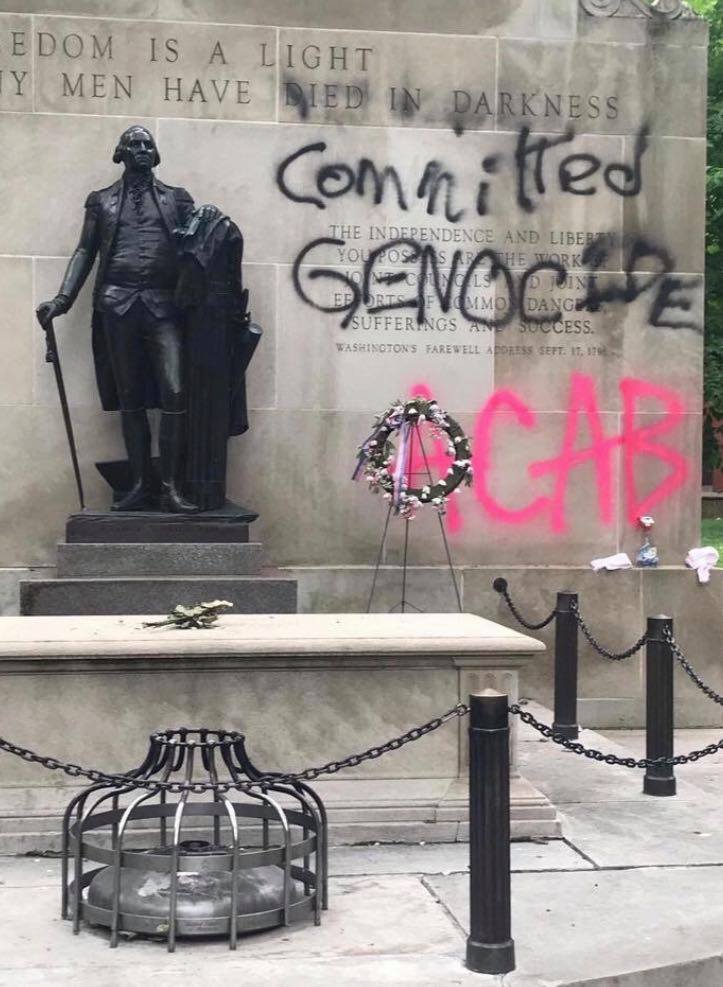
These statues and monuments not only tell an important part of the nation’s founding, they are also artifacts of the eras in which they were constructed and how we have remembered our Revolutionary struggle, and how the ideals of the Revolution continue to live to this very day. Part of what we do at Emerging Revolutionary War is connect the past to the places today. Over the past few weeks we have seen localities remove or plan to remove statues honoring Caesar Rodney in Delaware and Philip Schuyler in New York.  We have also seen statues of Marquis de Lafayette, Baron von Steuben, and Thaddeus Kosciusko vandalized in Washington, DC, a statue of George Washington vandalized in Boston, statues vandalized in Philadelphia of Washington and Benjamin Franklin, and the Tomb of the Unknown Revolutionary War in Philadelphia desecrated. 

We feel it is important that all of the United States’ Revolutionary War statues and monuments are protected so they can continue to demonstrate our highest values and ideals and the tell the story of the important figures who shaped our nation. Without these monuments, we lose vital resources to tell the important stories of our past and help unite us in moving forward as a country. As the 250th anniversary of the American Revolution draws near, rather than the removal of monuments, we hope more monuments and memorials will be erected, especially for overlooked populations that also played a role in the founding of our nation. With this more comprehensive view of history in mind, a broader and more accurate story can be told to the American public.  Emerging Revolutionary War will continue to trace the stories of the past and tie them to the places through these challenging times and we look forward to a better tomorrow.

“Rev War Roundtable with ERW” Father’s Day, Father of the Country

This Sunday, Father’s Day in the United States, join Emerging Revolutionary War for the next historian happy hour on the proverbial “Father of the Country” George Washington.

As our historians discuss, converse, and share their knowledge, the “Rev War Revelry” will not just be dedicated to one man, George Washington. But, also, to the “Fathers’ of the Father of the Country.” The generations prior to Washington who are buried in eastern Virginia, on the historic Northern Neck of Virginia, and within the boundary of George Washington Birthplace National Monument, a part of the National Park Service.

Joining the ERW crew this week will be guest historian Scott S. Hill, who is the Chief of Interpretation and Education at George Washington Birthplace National Monument and Thomas Stone National Historic Site.

So, if you are a father, we wish you a great Father’s Day. We also encourage you to share an hour and a brew, with your father, if able, and tune into our Facebook page at 7 p.m. EST to catch the discussion that ensues.

Burial Ground, George Washington Birthplace NM (courtesy of Project Gutenberg)

Review: American Rebels, How the Hancock, Adams, and Quincy Families Fanned the Flames of Revolution

Two of the above three last names are very familiar to even casual observers of American history. John Hancock, whose signature is readily apparent at the bottom of the Declaration of Independence, where it was joined by John Adams and Samuel Adams. Yet, that last name in the title, Quincy, may not be as obvious as should be at first glance.

What is remarkable about these last names? Besides, the simple fact that members with those three surnames played a major role in the road to revolution and surprisingly on both sides of the chasm of loyalties? All could trace their roots to a small town in Massachusetts; Braintree.

“The covenant of liberty that they shared would be sharpened by ambition and envy, polished through friendships and love, and fought for in a revolution fomented by these children of Braintree” (pg. 8).

In that town, from its first inhabiting European settlers, the spirit of questioning accepted decrees took root, matured, and blossomed. And until now, the intertwining vines of those family trees had not been put under the microscope of historic observation until the publication this year of American Rebels, How the Hancock, Adams,and Quincy Families Fanned the Flames of Revolution. Penned by Nina Sankovitch an Illinois native, author of several nonfiction works, and resident of New England, she effortlessly weaves the stories of these families into part biography, part family history, and part United States history. All parts equally important and very well written.

“Even as the fortunes of these children of Braintree diverged, their futures would bring them together again. A shared promise connected them, fostered by the history, the land, and the people of Braintree…” (pg. 8)

One of the highlights in the book is the emergence of the Quincy family into a popular history such as this. One of the unsung heroes of the road to revolution was Josiah Quincy Jr.

“As Reverend Hancock preached, the “solemn covenant….of their Liberty” was not obtained through faith alone but could only be realized through hard work performed by a community together. And this sacred covenant would be protected against any and all usurpers who attempted to take their liberty away.” (pg. 15).

Furthermore, Sankovitch brings to the forefront the role of women in the various families and their impact on the time. The best known is Abigail Adams who is the confidant and intellectual equal of her husband, John. Another is the aunt of John Hancock, Lydia, who constantly watches out for John’s place in society. She is the driving force that will bring to fruition the connection between the Quincy and Hancock families. Or Abigail Quincy, who had married Josiah Quincy, Jr., would never remarry but dedicated the rest of her days to raising their son and preserving his memory and contributions to the cause of America. The anguish of losing her beloved is quite evident:

“I have been told that time would wear out the greatest sorrow, but mine I find is still increasing. When it will have reached its summit, I know not.” (pg. 348).

Highlighted by the quote above, the author brings these historic personas and people to life, capturing the heartache, familial turmoil, ambition, and connections. Just as these families bred revolutionaries, there were sons that stayed loyal to the British crown, including a brother and brother-in-law of Josiah Quincy.

From weaving the families together, to connecting the threads of the evolution of political thought, and showing the personal strains of what the road to revolution looked like, Sankovitch has compiled an easily readable, insightful look into the 18th century world.

Enjoy!

*Book Information*

Publisher: St. Martin’s Press (March 2020)

Pages: 416

Following in Father’s Footsteps

On June 12, 1781, William Pitt, referred to as the “Younger” to differentiate from his father, Lord Chatham, William Pitt, and former prime minister of Great Britain during the Seven Years’ War, stood up in the House of Commons.

Like his late father, Pitt spoke on a war, this time not in favor of a conflict but in opposition. Also like his father, he spoke with a passion and eloquence that marked him for future roles of higher prominence. He also stood to correct his father’s legacy in regards to the Americans which that day was referred to by other members in Parliament. His view on the current war, the American Revolution, is quite evident.

“A Noble Lord who spoke earlier has in the warmth of his zeal called this a holy war. For my part, although the Right Honorouble gentleman who made the motion, and some other gentlemen, have been more than once in the course of the debate reprehended for calling it a wicked or accursed war, I am persuaded, and I will affirm, that it is a most accursed, wicked, barbarous, cruel, unnatural, unjust, and most diabolical

The expense of it has been enormous, far beyond any former experience, and yet what has the British nation received in return? Nothing but a series of ineffective victories or severe defeats–victories only celebrated with temporary triumph over our brethren whom we would trample down, or defeats which fill the land with mourning for the loss dear and valuable relations, slain in the impious cause of enforcing unconditional submission. Where is the Englishman who on reading the narrative of those bloody and well-fought contests can refrain from lamenting the loss of so much British blood shed in such a cause, or from weeping on whatever side Victory might be declared?”

Approximately a year and a half later, in December 1783, the 24-year old William Pitt became the prime minister of Great Britain. His tenure as prime minister, which lasted into the 19th century, would like his father’s, be marked with a war against France.

Yet, for a brief moment, in late spring, in London, William Pitt, the Younger, stood up, without preparing, as he did not intend to speak that day, and gave a passionate but reasonable response to the issue of the war with America. His closing words ring through the centuries.

Who (in Pitt’s case Englishmen but substitute whomever you’d like) “can refrain from lamenting the loss…or weeping on whatever side Victory might be declared.”

“Rev War Roundtable with ERW” War of 1812

The War of 1812 is considered by some historians as the end of the American Revolutionary Era. From the conflict, the United States will find a war hero and future president, Andrew Jackson and a poem by lawyer Francis Scott Key that turns into our national anthem.

But, the origins of the war, the military actions that spread around the United States, from Louisiana to the nation’s capital, to the invasion of Canada, and on the high seas are largely overlooked. There are numerous reasons for this.

That, in part, is why, this Sunday, at 7pm EST, on ERW’s Facebook page, the next historian happy hour “Rev War Revelry” will be focused on this important conflict. Join ERW historian Phillip S. Greenwalt along with the following guest historians for an hour-ish discussion of the three-year war.

Joining Phill will be;

Dan Davis, of the American Battlefield Trust, who has lectured on Andrew Jackson and the Battle of New Orleans. He is also a full-time historian with Emerging Civil War.

Also, formerly of Fort McHenry National Monument and Historic Shrine, and now working for the National Park Service in the Washington D.C. area, guest historian Jim Bailey will be the second of three guest historians.

Leaving the best for last, okay pun intended, as all three guest historians are great. But in all seriousness, the third guest historian joining for this revelry will be George Best. He is a park ranger for the National Park Service at Harper’s Ferry National Historical Park and volunteers as the Communications Coordinator for the Friends of Maryland’s War of 1812.

We look forward to you joining with your thoughts, comments, and questions this Sunday on our Facebook page (there will be an event post for you to use as a reminder) as we discuss this three-year conflict that had reverberations for many years afterwards.