This Sunday, April 26, at 7 p.m. EST, Emerging Revolutionary War invites you to click on and listen to the next installment of our “Rev War Revelry.” This week’s happy hour will focus on the most over-looked battle or engagement from the American Revolution. Each of the historians slated to participate will bring their pick for that category.
Feel free to chime in with yours in the comments here or on the Zoom call on Sunday. The feed will be live on ERW’s Facebook page. So, grab your favorite beverage and join us for a free-flowing conversation to toast off the weekend with.
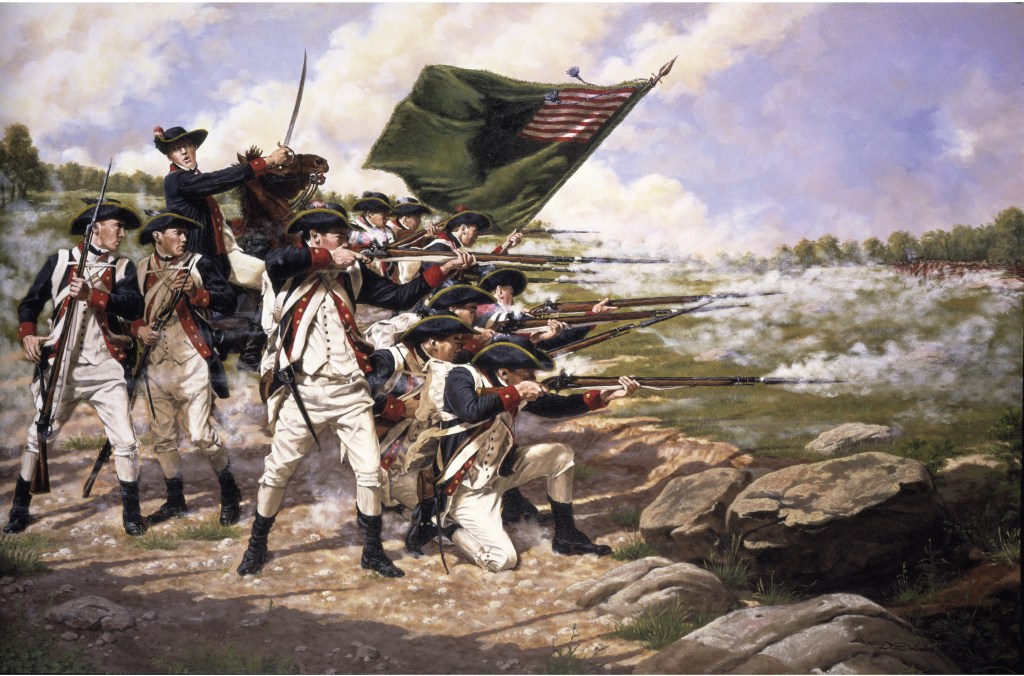
Delaware Regiment at the Battle of Long Island (Wikipedia)
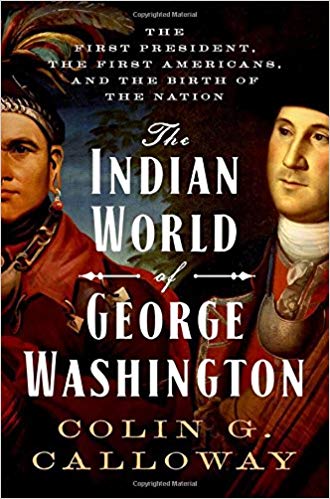
Multiple tomes grace bookshelves in libraries, book stores, and personal residences that depict various aspects of George Washington’s life and legacy. Historian Colin G. Calloway’s “The Indian World of George Washington” deserves a space on that bookshelf.
Long overdue, this volume about Washington fills a void, as “nothing was more central than the relationship between the first president and the first Americans” (pg. 4). From his first appearances in the greater colonial world in the early 1750s to the last years of his presidency, “a thick Indian strand runs through the life of George Washington as surely as it runs through the history of early America” (pg. 4).
At 3:00 in the afternoon on April 21, 1781 Virginia militia Colonel James Innes sat down to write a letter near Hickory Neck Church, just shy of the halfway point between Virginia’s old colonial capitol at Williamsburg and its new capitol at Richmond. Perhaps with a heavy heart and a weary hand, Innes picked up his pen to scrawl a letter to Governor Thomas Jefferson. The situation in Virginia was bleak. It had only been a year since, in apprehension of a British attack, the Virginia Assembly voted to move the seat of government from the Peninsula west to Richmond, and along with it the public stores for outfitting, equipping, and otherwise supporting Virginia’s patriot forces in the fifth and sixth years of the war with the British. The gamble hadn’t paid off. January 1781 saw Benedict Arnold’s forces sacking Richmond. Everywhere they went, it seems, a new combined force of British, Hessian, and Loyalist forces left destruction in its wake.
he approximate landing site of the the main body of British soldiers with Col. Simcoe’s detachment landing further downstream in an effort to catch the Virginians by surprise. “…On a signal given, they all, except the gun-boat turned and rowed rapidly towards the point where the landing was to take place…” (author collection)
Emerging Revolutionary War invites you to attend our “Rev War Revelry” tonight at 7 p.m. EST as we discuss the beginning of the American Revolution on April 19, 1775, 245 years ago today.
Yet, not only will Emerging Revolutionary War historians be on the call but we have a special guest historian joining us as well.
Stacey Fraser
Stacey Fraser is the Collections and Outreach Coordinator for the Lexington Historical Society. She has overseen new exhibits in the town and has assisted with the annual Patriots Day events. She will be on to share her expertise in this momentous day in American history and about what is happening, both virtually, and in the future with the Lexington Historical Society.
ERW looks forward to welcoming Stacey and all of you to our inaugural Zoom history call tonight!
On April 19, 1775, Massachusetts militia and minutemen responded to the call of British Regulars, “redcoats” marching from Boston to the town of Concord. What ensued was the “shot heard around the world” at the North Bridge in that town. What that shot signified was the changing course from words to war, that would define the relationship between 13 British North American colonies and Great Britain.
Now, 245 years later, Emerging Revolutionary War will turn that war back into words with its inaugural Rev War Revelry Zoom series. On Sunday, 7 p.m. EST, tune in to listen and watch historians from Emerging Revolutionary War discuss in an informal setting this momentous day in American history. Other topics are welcomed that pertain to the American Revolutionary War era as well.
As the title of the Zoom series relates, this will be similar to a tavern talk, much like the talks and information sharing rendezvous that went on in the 18th century, in places like Boston, where the road to revolution gained momentum as ales and spirits flowed. Thus, grab your favorite beverage, rest assured that ERW historians will be doing the same and join us, virtually, in our tavern Sunday evening.
So, you have a relative that fought in the American Revolution and you want to know more… now what? Joining an organization, such as the Daughters of the American Revolution (DAR), is a lengthy and detail-oriented process. It takes patience and perseverance. Before beginning the process, I attended a research seminar hosted by the local chapter to learn about the specific requirements for applying. If you have any experience with records, the one consistent theme is that records do not consistently capture the same information. Some death records do not list birth-dates, birth records do not always list both parents, and worst-case scenario, many records can be lost, stolen or severely damaged.
As I mentioned in part 1, my grandmother provided me with a box of documents detailing the Bitely heritage. The materials she gave me was helpful for pointing my path forward, but it lacked the necessary vital records for completing the application. Luckily, each chapter has a registrar that guides you through finding the right resources and completing the paperwork accurately. The registrar in my chapter was a seasoned member of DAR and walked me step by step through the process. Together, we reviewed the documents from my box, made a family tree and contacted the Michigan vital records department for appropriate birth, death and marriage certificates for each generation between John and me. Thankfully, both New York and Michigan had the records I needed, in good condition and had the required information on them to meet DAR standards. If you hit a snag in the process, there’s an entire community of DAR women who are trained to help you through this. Reach out, we will help!
Here is a sample of the documents passed down to me in the family history box. This helped start the journey for learning more about my heritage.
George Washington retired from public life at the end of his second presidential term on March 4, 1797. Twenty months and ten days later he died on December 14, 1799. In between Washington was also the first in the United States to be a former president, first to deal with securing his legacy as both a military hero and political figure, and having to see the country he sacrificed so much to create, lurch forward without him having an active part in it.
Until now, these years have been either excluded, glossed over, or an anti-climatic ending to a Washington biography. Until now. Joseph Horn, a former presidential speechwriter and the author of The Man Who Would Not Be Washington lends his talent to a new biography of Washington, examining those last few years in-depth.
The author has a valid point when he argues that, “for too long, the story of Washington’s last years has been squeezed into the margins of manuscripts, if included at all” (pg. 14). Channeling the method of famed Washington biographer Douglas Southall Freeman, Horn writes this biography in the “fog of war” style that affords the reader the opportunity to read the history “through the eyes of those who made it rather than through the hindsight of historians” (pg. 14).
Emerging Revolutionary War welcomes back guest historian Kate Bitely
Part 1
How much do you know about your great-great-great-great-great grandparents? Did your family pass on detailed stories of their past? Perhaps you took a DNA test like ‘23andMe,’ or maybe you know little if anything about your roots. Whatever the case may be, now is a great time to start the journey of learning about your familial past, as it might just lead you to an unexpected destination. For me, I grew up knowing my distant relative, John Biteley Sr., a New Yorker who come to the U.S. from Germany in the 1750’s. His American born son, John Biteley Jr., went on to serve as a patriot in the American Revolution. My grandfather, Ralph Bitely, always told us, “the Bitely’s were at Ticonderoga!” In 2010, my grandfather passed away. A few years after his death, my grandmother gave me a box filled with documents that detail the history of the Bitelys. This box would be the start of my journey back to the 18th century.
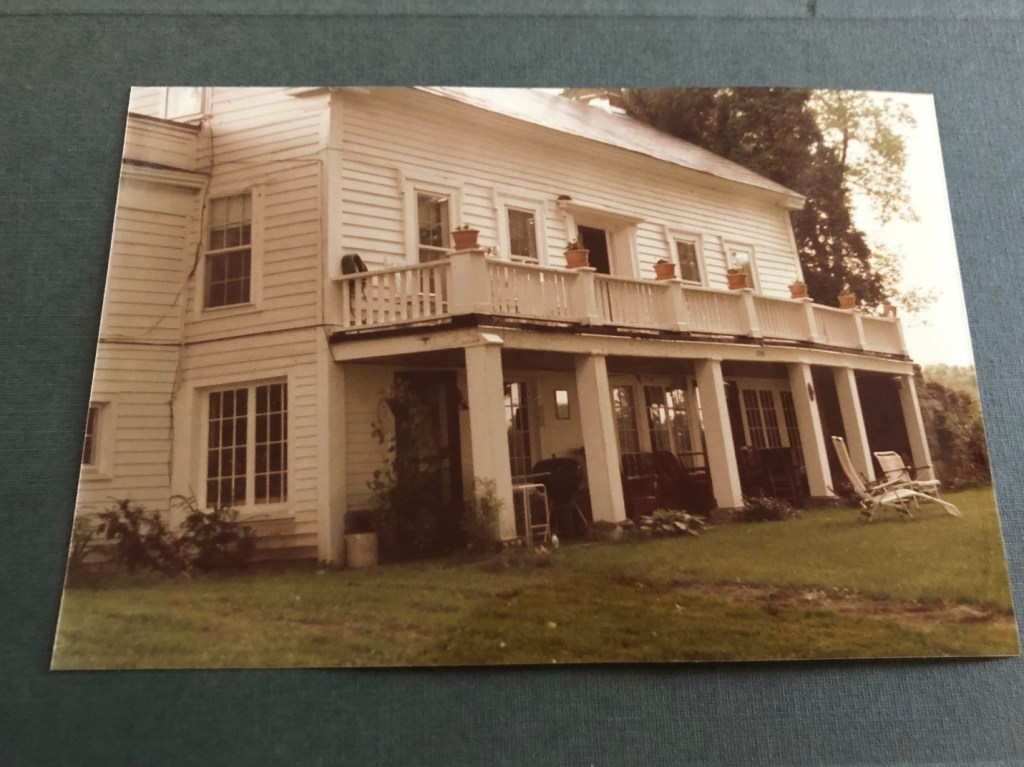
As I dug through the box a few years ago, I recall being filled with excitement as I learned about my family. They were farmers, predominately grape farmers to be exact. (My love for wine is clearly hereditary). As I dug deeper, I found a more modern picture of the “Bitely Homestead,” the home of John Biteley Sr., located in Saratoga County, NY. It was first built before the war around 1770, was burned down by Gen. John Burgoyne in 1777 and was rebuilt in 1779. Nearby remains a family cemetery where many of my relatives remain. While I have not been for a visit yet, I hope to make a trip soon when conditions are safe to do so.
Photo of the “Bitely Homestead” in Moreau, NY rebuilt in 1779 after the British burned down the original structure in 1777 found inside the box from my grandmother.Continue reading “Finding Your Patriot”→
Marquis de Lafayette was a French aristocrat serving in the French army, and recently married, when the Revolution broke out in America. He followed events with interst, and was motivated to come and fight with the Americans.
He arrived in March, 1777, nineteen years old and eager. He immediately formed a friendship with Washington, and was an aide on his staff. In the meantime British forces had invaded Pennsylvania, intent on capturing Philadelphia. Washington’s army took a position behind Brandywine Creek, and the British attacked on September 11, 1777. British troops had flanked the Americans, and reinforcements were rushed to the threatened sector, making a stand on Birmingham Hill.
Eager to get to the fighting, Lafayette and a group of French officers rode to the unfolding battle at Birmingham Hill, arriving as the action was at its hottest. Approaching from the south, they rode up the Birmingham Road, and turned to the left, coming in behind the brown-coated troops of General Thomas Conway’s Pennsylvania brigade.
Emerging Revolutionary War welcomes guest historian Darien Ashley.A short bio follows this post.
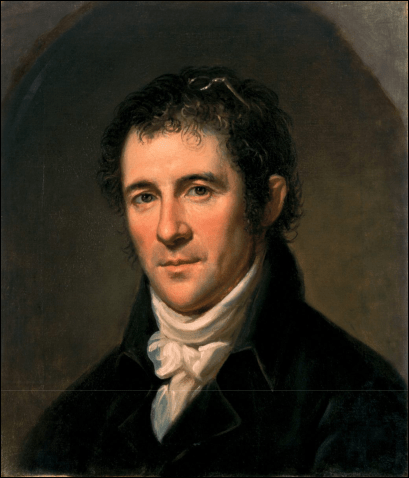
The best architecture is that which reflects clearly the ideals and activities of the people which inhabit it. This is true for both private dwellings and public buildings. The objects of architecture serve as a lasting testament to identity. These objects, once created, continue to shape minds long after the architect is gone. A nation’s capital city is a site where man can establish glorious structures which convey a sense of who the people are, where they came from, and where they intend to go. The United States Capitol building is a prime example of a structure that continues to inform American identity long after its architects have passed. This article serves as an investigation of the life of one of the most important architects of not only the Capitol, but of the nation itself, Benjamin Henry Latrobe.
Guests to the United States Capitol building often get a shock from the fact that one of its primary architects, Benjamin Henry Latrobe, was an Englishman. Indeed, the man who designed the hallowed, old halls of Congress hailed from a Moravian religious settlement located on the outskirts of Leeds, England. However, Latrobe himself would have objected to the label “Englishman”. Indeed, throughout his life, Latrobe referred to the United States as “his” country and was quick to point out that his mother, Anna Margaretta Antes, was born and raised in Pennsylvania. Latrobe’s father, Benjamin Henry Latrobe Sr., met Anna after she had been sent to London to finish her education. Both of Latrobe’s parents held prominent positions within the Moravian ministry and raised their children to follow in their example.






 Emerging Revolutionary War Era