Book Review: Steven P. Locke, War Along the Wabash: The Ohio Indian Confederacy’s Destruction of the U.S. Army, 1791 (Havertown, PA: Casemate Publishers, 2023).

The frontier is inextricably tied to the early development of the United States under its 1789 Constitution.  In The Treaty of Paris ending the Revolution, Britain legally ceded its territories north of the Ohio and east of the Mississippi Rivers up to the borders of Canada to the United States—the very same territory it had claimed from France at the end of the Seven Years War.  While European states might redraw borders, they did not consult the people actually living in the area.  Congress proclaimed the area the Northwest Territory and in the following years, native people, particularly the Native nations living in modern Ohio, Indiana, and Michigan fought a lengthy war with the new Unites States, inflicting one of its worst defeats on the United States Army and coming closer than any other Native American coalition to halting, or at least slowing, the spread of white society beyond the Appalachians.

            Steven P. Locke, in his new book, War Along the Wabash, chronicles the first major campaign of the United States Army in what has become known as the War of the Northwest Territory.  In 1791, frustrated by Indian attacks on frontier settlements that had not stopped after the American Revolution, Congress authorized the Washington Administration to raise an army and conduct a campaign against the Ohio Indians, the Miami, Seneca/Cayuga, Shawnee, Wyandot, Odawa, Ojibwe, Potawatomi, and Delaware.  Major General Arthur St. Clair, a veteran of the Revolutionary War, was Governor of the Northwest Territory and took personal command of the army created for the campaign.  His objective was simple enough, to launch his army from Fort Washington in modern Cincinnati to Kekionga, a cluster of Native American villages at the portage between the Maumee and Wabash Rivers in modern Fort Wayne.  Presumably, Americans ensconced in such a fort would be able to readily overawe the local tribes in their homes, force a Native American recognition of American “ownership” of the Ohio Country, and stop Indian raids along and across the Ohio River.  St. Clair received command on March 4, 1791 and was expected to march out of Fort Washington by July 10, hardly sufficient time to recruit, organize, train, and equip an army large enough for the task before him, particularly on the sparsely populated frontier.   Federal troops and supplies had to come all the way from the east coast by way of Pittsburgh and the Ohio River, while Kentucky provided militia and filled out some provisional levies. 

            Despite his intimate experience with the connection between military operations and logistical support, Secretary of War Henry Knox pressed St. Clair all summer to get his troops moving.  St. Clair, of course, could not.   The Americans had already launched mounted raids into Native American territory, which generally resulted in burned villages and despoiled crops.  According to Locke, the speed with which those raids proceeded highlights the cross-purposes under which St. Clair’s campaign would take place.  He could either move quickly with a largely mounted force over existing trails or take a more deliberate, plodding approach through the wilderness by building a road, which necessitated infantry and engineers.  St. Clair chose the latter, but the pressure from Knox and President Washington never ceased.  St. Clair responded by marching the army out of Fort Washington in September and slowly moving northward, building a road, camps, and forts as it moved a little over two miles a day, even before the army had fully assembled at Fort Washington. Indeed, in the first month, St. Clair was not usually with the army, consumed by logistical duties as he shuttled back and forth from Fort Washington or Kentucky gathering supplies and militia and then moving them forward over the newly built, yet still primitive, road. 

            By November 3, 1791, St. Clair had rejoined his army and reached the headwaters of the Wabash River with one regular infantry regiment, two levy regiments, and assorted militia, artillery, dragoons, teamsters, and camp followers.  Altogether, it was about 1,400 men.  Mistakenly believing he was closer to Kekionga than was the case and that the Indians would not attack, he did not build breastworks that night, but deployed his army in two lines with some militia thrown across a creek and various outposts scattered around his position.  He had detached his best federal regiment and sent it back down the trail to escort a supply train coming up to feed the army.  Thus, the United States Army was at its weakest point during the campaign when the Indians of the emerging Ohio Indian Confederacy struck early the next morning.  

            The Confederacy force of 1,100 warriors applied traditional tactics, quickly routing the forward militia and then moving along the flanks to the rear, essentially surrounding St. Clair and then pressing ever tighter.  Sniping from cover, the Indians seemed immune to American fire while inflicting heavy losses on the defenders.   St. Clair launched two bayonet charges to restore his lines.  As usual, the Native Americans gave way to the bayonet charges and then moved around the charging unit’s flanks as it separated from the main army, bringing each under a withering cross-fire.  In a sense, St. Clair carved up his own army and dished out pieces for the Confederacy to consume.  By the time St. Clair launched a third bayonet charge to clear his route of retreat, his army had collapsed.   He escaped with 500 men, leaving 900 dead, dying, or wounded on the battlefield, including dozens of women and children among his camp followers.  (Estimates of American losses vary widely among historians.)  The disaster was worse than General Braddock’s defeat on the Monongahela in 1755, or Custer’s in 1876.  War Along the Wabash is at its strongest when relating and analyzing the battle.  

            Locke tells the entire tale well, discusses the difficulties of raising an army from virtually nothing, includes small biographies of major “characters” as he introduces them, pays careful attention to logistics, which are often overlooked in campaign histories and were critical in the unfolding of St. Clair’s campaign, analyzes decisions and strategies, and discusses the fallout after St. Clair returned to Philadelphia to defend his decision-making.  While most of the story is from the American perspective, which is better documented, Locke makes a serious effort to address Native American perspectives and experiences as they assembled and fought the American army.  

All that said, he lapses into odd, avoidable errors from time to time.  In my Kindle edition, Locke writes on page 397 that there were approximately 400 commissioned officers in the army (nearly 1 in 3 of the total force) at the beginning of the battle, just 150 of whom remained at the end, meaning 250 commissioned officers were killed during the battle.  Yet, on page 429 he notes 69 out of 124 commissioned officers being killed or wounded during the three-hour battle.  Collectively—and there are more eyebrow-raising moments—such errors or inconsistencies distract from the book’s overall strengths, which are considerable.  

In 1793, during his campaign against the Ohio Indian Confederacy, Major General Anthony Wayne led his army up St. Clair’s trace and built a fort near the battlefield, identifiable by the large number of human remains and camp detritus, which he named Fort Recovery.  A town, still named Fort Recovery, grew up there, and the site of the battle largely lies under Wayne Street.   (Museums and parks around town commemorate both St. Clair’s defeat and Wayne’s subsequent campaign).  War Along the Wabash is an excellent starting point to understand St. Clair’s campaign and the defeat that often bears his name.  It will not be the last word, but it sets a high bar that future historians will have to work hard to surpass.  

Isaac Shelby State Historical Site

Entry to Traveler’s Rest. (Author Photo)

The American Revolution in the east has its share of founding fathers while war in the west has its share of legendary characters.  Few could claim to be both.  Isaac Shelby was born in western Maryland in 1750 and migrated with his family farther south and west in 1770, near Bristol Tennessee.  Shelby in Lord Dunmore’s War and became a surveyor for North Carolinian Richard Henderson’s Transylvania Company, created to secure land west of the Appalachians just before the American Revolution.  (Daniel Boone was the best known of Henderson’s surveyors).  

            When the Revolution broke out, Shelby served first with the Virginians and then accepted roles handling logistics for Virginians, Continentals, and North Carolinian units operating along the frontier. Organizational structures were fluid along the Appalachians, more often centered around communities and available manpower than formal state boundaries, and Shelby participated in a variety of actions against British and Loyalist forces in North and South Carolina.  The personal nature of the partisan conflict eventually led Shelby and others on the frontier, including John Sevier, to organize the so-called “Overmountain Men” in a pursuit of Loyalists led by British Major Patrick Ferguson.  The two sides eventually clashed in the Battle of King’s Mountain, a resounding victory for American forces in October 1780.

Continue reading “Isaac Shelby State Historical Site”

George Washington, Daniel Morgan, and Winchester, Virginia on Memorial Day

I’ve been intermittently visiting Winchester, VA for years, usually with an eye toward understanding its place in the Civil War.  Tradition has it that no town changed hands more frequently. But, the town also has a prominent, if sometimes overlooked, role in America’s colonial and Revolutionary War history.  In particular, it enjoyed a close relationship with George Washington and Daniel Morgan, helping shape both men.

W%oQ3yOcQbOrOlCK890IDQ
George Washington as a Teenage Surveyor, Winchester, VA

Winchester, or Frederick Town, as it was then known, was the largest village in the lower Shenandoah Valley when Lord Thomas Fairfax decided to relocate from England to his land grant in northern Virginia and became a way-station of sorts for people traveling along the Great Wagon road that ran from Pennsylvania to North Carolina in the 18thcentury.  So, when the Fairfax family hired a teenaged George Washington to help survey its grants in the Shenandoah, Winchester was a logical place for the surveying team to make its temporary home base.  (In truth, surveying teams were constantly moving to maximize their efficient use of time: the saddle might be considered home.)  While the teenager was less than impressed with most accommodations on the frontier, he was pleased with Fredericktown.  He recorded in his diary: Continue reading “George Washington, Daniel Morgan, and Winchester, Virginia on Memorial Day”

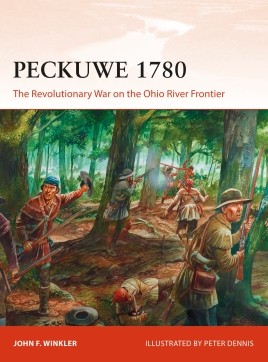
Book Review: Peckuwe 1780, by John F. Winkler

erw-book-reviews-11


9781472828859_6

John F. Winkler, Peckuwe 1780: The Revolutionary War on the Ohio River Frontier, (Oxford: Osprey Publishing, 2018).   $24.00

I once read a review comparing Osprey Publishing’s monographs on particular battles, weapons, uniforms, or campaigns to “flash cards,” which made me smile.  As a kid, I somehow acquired stacks of flashcards laying out the technical specs of various military aircraft or ships and thought they were the greatest things since sliced bread.  Those were the days before Amazon or Barnes & Noble, when a kid had to depend on the local library and Waldenbooks for books about history, which they didn’t have in large numbers.  The Osprey monographs were a windfall of sorts when the local library started carrying them.  They’re not intended for an academic audience by any stretch, but can play a useful role in interesting popular audiences in places, people, and events that might otherwise prove too obscure or too intimidating for a young or casual reader.  So, when I came across John F. Winkler’s new monograph for Osprey, Peckuwe 1780, I snapped it up as much for sentimental reasons as for my interest in the American Revolution on the western frontier.

Continue reading “Book Review: Peckuwe 1780, by John F. Winkler”

George Rogers Clark Recaptures Fort Sackville, Part II

Vincenes (Army Center of Military History)
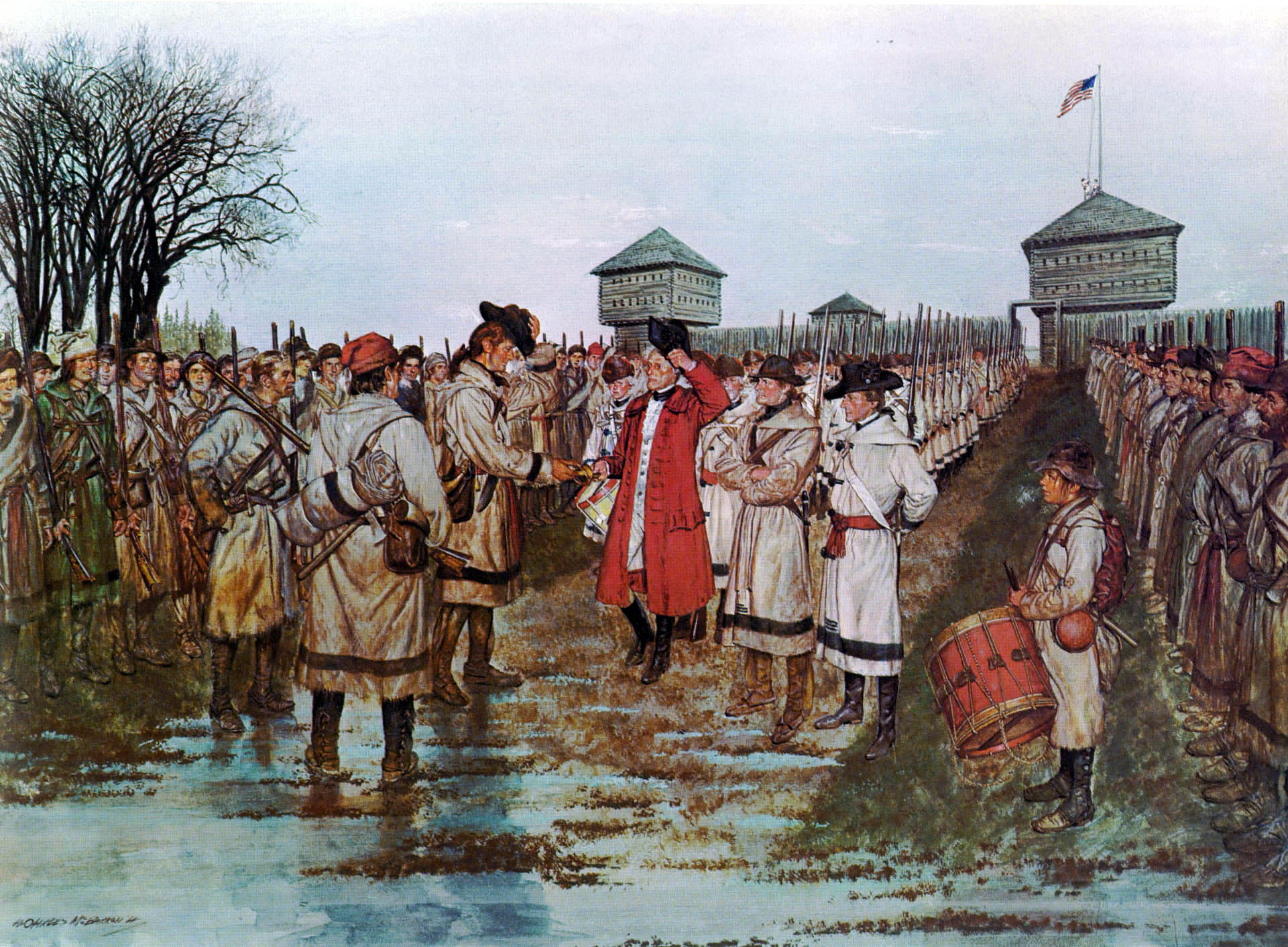
Hamilton Surrenders Fort Sackville (U.S. Army Center for Military History)

By February 23, 1779–two hundred and forty years ago—Virginia Lieutenant Colonel George Rogers Clark had marched his little army from the Mississippi across the flooded plains of what would become southern Illinois to the French town of Vincennes on the Wabash River, in modern Indiana.  His men were tired, hungry, and waterlogged, but they had made it safely across the Wabash and delivered themselves to the same shore as the town and Fort Sackville, then defended by the much-hated British Lieutenant Governor Henry Hamilton.  His river scouts had managed to find a small, dry hillock covered by a grove of trees and within sight of the town and Clark’s force, about 170 strong, lay in the grove drying their clothes by the sun, occasionally taking a wandering citizen from the town prisoner.   Clark later reported:

Continue reading “George Rogers Clark Recaptures Fort Sackville, Part II”

Norman MacLeod’s Campaign Journal, November 27, 1778

(An occasional series highlighting British Lieutenant Governor Henry Hamilton’s march south from Detroit to recapture Vincennes (Indiana) on its 240th anniversary.)

As fall progressed, cold set in and the weather began to catch up with Hamilton’s advancing army.  By November, it regularly dealt with freezing rain, snow, mud, and ice on the river and nearby trails.  MacLeod’s November 27th entry alludes to a few of those logistical challenges and the rather low opinion that the captain had of American soldiers, which began to place higher in MacLeod’s thinking as the army neared the territory so recently conquered by George Rogers Clark.

“Embarked at eight as usual, met with Great fields of ice this day But pretty good water.  So that we made us of our Oars only in two Rapids where most of the men was obliged to drag especially those in Boats because they draw more water than the Perogues, besides this the channels in the River are as if cut Purposely for no other Craft than Perogues.  We arrived at K [one or two words illegible] at 4 oClock called [sic; camped?] 10 miles from Weatono.  Us as our tents were Pitched five Savages from that Plase Arrived in camp, who acquainted us that there was no less than 200 of their nation ready to Join us the moment we arrived at the above Place.  They further told us that the Rebels had abandoned Au Post.  How true this is alittle more time we discover.  But it agrees with my own opinion for I never once thorough they would make a Stand either there or at the Illinois with So numbers especially on hearing that the Lieut. Govr. was coming who they know had all the Indians read at [hi]s call.”

William A. Evans and Elizabeth S. Sklar, eds., Detroit to Fort Sackville, 1778-1779: The Journal of Norman MacLeod, (Detroit: Friends of the Detroit Public Library/Wayne State University Press, 1978), 87.  The spelling and grammar errors are all from the original as transcribed by Evans and Sklar.  Evans and Sklar suspect “Weatono” is MacLeod’s reference to “Ouiatenon.”

Norman MacLeod’s Campaign Journal, November 7-14, 1778

(An occasional series highlighting British Lieutenant Governor Henry Hamilton’s march south from Detroit to recapture Vincennes (Indiana) on its 240th anniversary through the entries in Captain Norman MacLeod’s diary.)

Lieutenant Governor Hamilton’s army continued its progress towards Vincennes, but it was slow and backbreaking work.  Building dams to raise river levels did not work everywhere and his army often had to resort to the simple and monotonous task of unloading its vessels, dragging them through the shallows, carrying supplies forward, and then reloading boats to continue making progress the next day.  MacLeod’s diary entries for November 7th and 14th highlight the sheer fatigue involved in moving supplies on the frontier.

Continue reading “Norman MacLeod’s Campaign Journal, November 7-14, 1778”

Norman MacLeod’s Campaign Journal, October 13, 1778

Sketch of Wabash River, 1778
Sketch of the Wabash River Made During Hamilton’s 1778 Campaign (Wikimedia Commons)

In the summer of 1778, Lieutenant Colonel George Rogers Clark of the Virginia militia launched one of the most daring American military operations of the Revolutionary War when he invaded the “Illinois country” and captured Cahokia and Kaskaskia in modern-day Illinois and Vincennes in southern Indiana, effectively neutralizing British power on the Illinois, Wabash, and Mississippi Rivers.  Henry Hamilton, Lieutenant Governor of Quebec and Britain’s Superintendent for Indian Affairs in Detroit, could not allow such audacity to succeed, lest Britain’s influence with the western Indian nations wane.  Learning of Fort Sackville’s fall at Vincennes on the Wabash River, he set out to recapture it.

Continue reading “Norman MacLeod’s Campaign Journal, October 13, 1778”

Missionary Extraordinaire: David Zeisberger

Over the summer, I took a family excursion to several Revolutionary War sites in Ohio, some of which I recently wrote about.  In particular, I wanted to trace the experience of several Moravian missionaries and their congregations in the no-man’s land of the frontier.  Traveling a back road along the Tuscarawas River between the villages of Gnadenhutten and New Schoenbrunn, we stumbled across the graves of David Zeisberger (1721-1808) and several notable missionaries at the crossroads of Goshen.

IMG_2559
Moravian Cemetery at Goshen, Ohio.  (Author Photo)

Continue reading “Missionary Extraordinaire: David Zeisberger”

The Crawford Campaign, 1782: Captivity, Torture, and Execution

IMG_2443
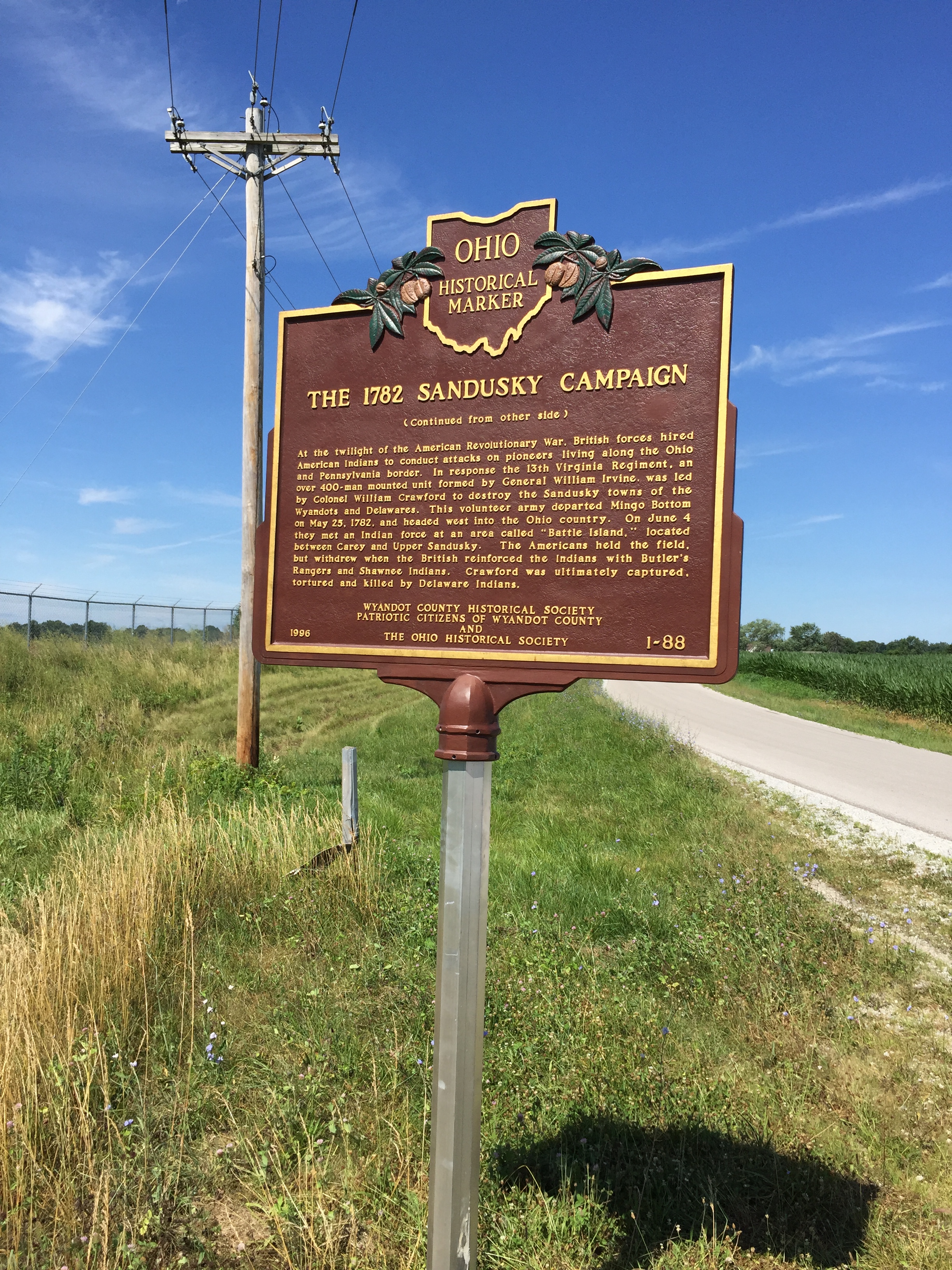
One of the few historical markers denoting the campaign.  The other side of the security fence at the left is home to the county landfill.  Tymochtee Creek is to the right.  (Author Photo)

(part five of five)

For those men separated from the retreating main body in the pell-mell retreat, Crawford’s expedition had become a nightmare, beginning with the panic on the night of June 5.  James Paul remembered being shaken awake with word that the men were leaving and attempting to retrieve his horse in the dark before finding it had already slipped its bridle and wandered away.

“I groped about in the dark and discovered two other horses tied to the same sapling and my horse standing at their tails.  This revived my drooping spirits.  On finding my horse standing quiet, I bridled him and mounted, and about the same time a number of other horses were mounted by their owners, and all put out from the camp ground together, amounting in all to nine in number, and we made as much haste to get away as we could, considering the darkness of the road, and no roads but open woods to ride through, and no one to guide us.”  Paul and his fellows realized Colonel Williamson, now leading the main body, was retreating on a longer route home, “leaving us nine and many other stragglers behind to take care of themselves as best they could, and to steer their own course homeward, and, as it turned out afterward, but few of these stragglers ever got home.”[1]

Paul and his group eventually became mired in a swamp and had to abandon their horses, making their way on foot, pursed by Native American warriors who forced them to scatter.  After sleeping in hollow logs and under rocks, going without food other than a blackbird and occasional handful of berries, Paul eventually made his way back across the Ohio alone near Wheeling, arriving at a small fort where settlers had taken refuge against renewed Indian raids.[2]

Continue reading “The Crawford Campaign, 1782: Captivity, Torture, and Execution”