

Winter, 1777

Part One, of a series on the importance of Valley Forge in the American Revolution

On December 19, 1777, the Continental Army, under the command of General George Washington, marched into Valley Forge, Pennsylvania. Located approximately 20 miles from Philadelphia, which had fallen to the British that autumn, Washington’s army would spend the next five-plus months in this soon-to-be iconic place in the quest for American independence.

Yet, the accounts of how desperate the condition of the American forces were emanates throughout the centuries and strikes awe and amazement at the level of perseverance that the soldiers committed to. The winter of Valley Forge was just one of many cold, bleak, and destitute winters that the Continental Army faced during the seven-year conflict.

Artist depiction of the encampment at Valley Forge. George Washington and the Marquis de Lafayette are the two horsemen
Artist depiction of the encampment at Valley Forge. George Washington and the Marquis de Lafayette are the two horsemen depicted prominently

However, that does not take away from the conditions of that winter. Especially when written from the ink and quill or pencil of the common soldier. Especially with what that winter cantonment did in the transformation of that Continental Army.

One of the best remembrances of that cold winter comes from Joseph Plumb Martin, whose Memoir of a Revolutionary Soldier, is still in print today.

Upon arrival at Valley Forge, Martin would write:

“We were now in a truly forlorn condition,–no clothing, no provisions, and as disheartened as need be. We arrived, however, at our destination a few days before christmas. Our prospect was indeed dreary.”

Just a short time after his arrival, Martin continued the plight of himself (and most likely many a soldier in that encampment) when he wrote;

“I lay here two nights and one day, and had not a morsel of any thing to eat all the time, save half a pumpkin, which I cooked by placing it upon a rock, the skin side uppermost, and making a fire upon it; by the time it was heat through I devoured it with as keen an appetite as I should a pie made of it at some other time.”

Martin’s account is supported by General James Varnum, who reported on December 20, 1777, “that his division had eaten no meat during 48 hours and had been three days without bread.”
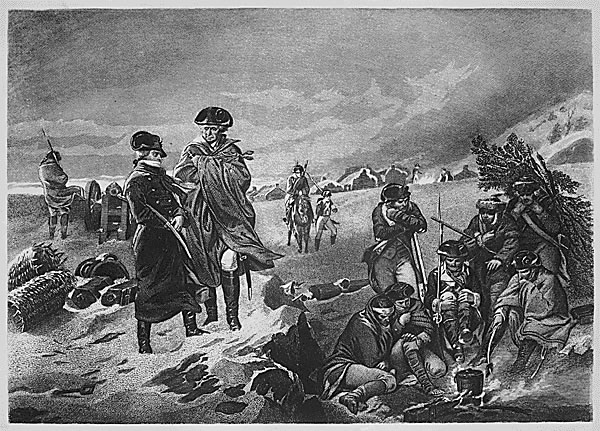
Suffering at Valley Forge

Yet, during that winter, the experience of Valley Forge, according to another veteran of that harsh winter, “added iron to their souls.”

More than “iron souls” would be needed to defeat the British in the American Revolution. Winter, 1777, would see to that as well.

ERW Weekender: The Brandywine Battlefield: A History & Visiting the Field

RevWarWednesdays-header


Emerging Revolutionary War and Revolutionary War Wednesday is pleased to welcome guest historian and author Michael C. Harris this week. 

The Battle of Brandywine was fought on September 11, 1777.  Visiting the battlefield to commemorate what took place there began just three years later.  On his way to Virginia in 1780, the Marquis de Lafayette made a point of stopping for day at the battlefield where he was wounded and giving a tour to the officers that were travelling with him.  An older Lafayette returned in 1825 during his celebrated 15-month tour of America.

However, it would not be until after the American Civil War during the golden age of preservation that any kind of markers or monuments began to appear around the ten-square-mile landscape.  During the 1877 centennial, artillery pieces were placed to mark the fighting near Sandy Hollow.  Eighteen years later, a monument was dedicated along Birmingham Road supposedly marking the spot where Lafayette was wounded.  Had Lafayette been alive, he would have been able to put out the error in location.

Continue reading “ERW Weekender: The Brandywine Battlefield: A History & Visiting the Field”

Mercer’s Grenadier Militia

RevWarWednesdays-header


Emerging Revolutionary War and Revolutionary War Wednesday is pleased to welcome back guest historian Drew Gruber.

Part 1

When we think about American militia during the Revolutionary War, the image of an untrained rifle-toting citizen turned soldier comes to mind. This stereotype of the American soldier, popularized by movies like The Patriot is not completely false but such generalizations should give us pause and inspire us to investigate the roll of American militia, independent companies, and ‘irregular’ troops a bit closer. For example, how was it that on October 3, 1781 a group of Virginia militiamen defeated an elite British force? The story of Lieutenant Colonel John Mercer’s Grenadier Militia during the battle at Seawell’s Ordinary has been told and retold since 1781, however the formation of this illustrious group is often ignored and deserves a closer look. Continue reading “Mercer’s Grenadier Militia”

“Our clocks are slow” L’Hermione, Lafayette and the Franco-American Alliance

RevWarWednesdays-header

unnamed
Marquis de Lafayette

With the visit of the L’Hermione to the east coast of the United States this summer, there has been a heightened interest in the Franco-American alliance that won the American Revolution.  The French rebuilt the L’Hermione not only for its beauty but also its historical significance.  Most importantly, its mission and the passenger it contained when it arrived in Boston in the fall of 1780.

The spring of 1780 was a low point in the American cause of independence.  Stagnation in the north between Washington and British commander General Sir Henry Clinton combined with devastating defeats in the Southern Theater caused low morale among the patriots.  Cornwallis had complete control over the Southern colonies and no standing American force seemed to be able to stop his movements.  Continue reading ““Our clocks are slow” L’Hermione, Lafayette and the Franco-American Alliance”

The Return of L’Hermoine

RevWarWednesdays-header

It will be hard to describe in modern terms the celebrity of Marie-Joseph Paul Yves Roch Gilbert du Motier de Lafayette, Marquis de Lafayette (aka LaFayette) in 18th century America.

The young Marquis was fascinated with the American ideal of revolution and against the wishes of the French monarchy, in 1776 he cast his lot with the American patriots.  His relationship with George Washington and other American leaders played a major role in the American-French alliance that brought about American independence. Continue reading “The Return of L’Hermoine”

Battle of Blandford

RevWarWednesdays-header

On April 25,  approximately 2,500 smartly dressed but campaign worn uniformed invaders  attacked Virginians defending their homes and hearths around Petersburg, Virginia.

One would suspect that the next few sentences would talk about the latest Union excursion against their Southern counterparts in the nine month siege that broke the back of the Confederacy.

However, one would be wrong. Continue reading “Battle of Blandford”