On February 1, 2017 at 7:00 p.m. join Emerging Revolutionary War’s Derek Maxfield for the launch of the “Historical Horizons Lecture Series” sponsored by the Genesee Community College History Club.
Two of the most important men in American History are John Adams and Thomas Jefferson. From the time they met in Philadelphia in 1775 until their deaths in 1826, these two men had a most fascinating relationship; much of the time it was one of admiration and love, but it was interrupted by a period of intense partisan strife that nearly ended the friendship. Come hear the intriguing story of how the friendship was restored.
The lecture is part of the Historical Horizons Lecture Series sponsored by the GCC History Club. Get the complete spring semester line-up here: https://gcchistoricalhorizons.wordpress.com/
All events are FREE and open to the public at the Genesee Community College Batavia campus, room T102 of the Conable Technology Building.
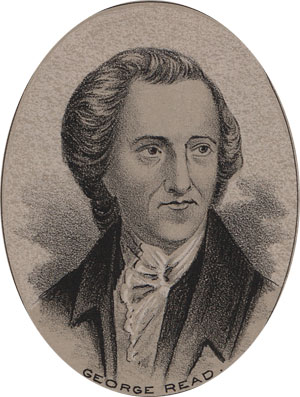
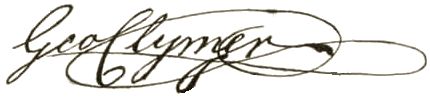
His name might not be too familiar, but he has the distinction of signing three of the most important documents of the American Revolutionary period; the petition to King George III of 1774, the Declaration of Independence, and the United States Constitution. His name?
George Read.
Born in the colony of Maryland on September 18, 1733 in the county of Cecil, the young Read was shortly thereafter on the move. His family, while George was an infant, resettled in New Castle, Delaware. When of school age, he attended Reverend Francis Allison’s Academy in New London, Pennsylvania, and one of his classmates was Thomas McKean, a future Signer of the Declaration of Independence as well. George moved on to study law in Philadelphia under the tutelage of John Moland. In 1753, George was admitted to the bar and the next year had settled back in New Castle, Delaware to practice. Continue reading “Six Signers Signing”→
The financier. Those two words explain the importance of Robert Morris, the Liverpool, England born Pennsylvanian transplant. As George Washington engineered the pivotal campaign that culminated in the actions at Trenton on Christmas Day 1776 and Princeton in early January, Robert Morris was the man who made it happen.
Born on January 20, 1734, Morris was a 13-year old lad when he sailed for the British North American colonies. He was headed to Oxford, Maryland where his father had emigrated prior to. While living on his father’s tobacco-growing plantation, Morris was afforded the opportunity to have a tutor and showed his mental prowess, advancing rapidly in his studies.
Outgrowing his tutor, Morris was sent to a family friend in Philadelphia where it was arranged the young man would become an apprentice in the shipping and banking of future Philadelphia mayor Charles Willing. When Willing died in 1754, Morris was made partner. He was only 24 years old at the time.
After the establishment of Willing, Morris, and Company on May 1, 1757, Morris was set about establishing himself firmly in the upper society of Philadelphia, the largest city in the 13 British colonies. Yet, it was not until he was 35 years old in 1759 when he wed Mary White, who hailed from a prominent Maryland family. In time, the family grew to include five sons and two daughters. That same year, Morris and his partner Thomas Willing organized the first non-importation agreement in which the slave trade was ended for good in the Philadelphia region.
Robert Morris (courtesy of our friends at The Society of the Descendants of the Signers of the Declaration of Independence, http://www.dsdi1776.com)
Even before his marriage, Morris was active in politics. In 1765 he had served on a committee comprised of local merchants. Formed in protest to the Stamp Act, Morris was chosen to mediate a mass town meeting of protesters. Even though he personally felt the new acts were unconstitutional, Morris was remained steadfastly loyal to Great Britain. Continue reading “Six Signing Signers”→
On August 2, 1776, in Philadelphia, Pennsylvania, the majority of the 56 men who would forever be known as the “Signers of the Declaration of Independence” placed quill to ink and affixed their signature.
On September 17, 1787, the men who persevered, haggled, and agreed on the United States Constitution, dipped a quill into ink and placed their signatures on that famous document.
If one looks closely and reads the names of the signers, six gentlemen’s names would appear on both documents. If one hazarded a quick guess, Thomas Jefferson, John Hancock, John or Samuel Adams, George Washington, and Benjamin Franklin would most likely be the first names to spill off the tongue.
Only one of those names would be correct; Benjamin Franklin. This post, the first in the series, will shed light on whose these men were, who had the great fortune–or luck?–to sign both famous political documents. The first of the “Six Signing Signers” is…..
Whether you are about to enjoy a firework display, finishing up a family barbecue, or enjoying this holiday in some other form, the historians here at Emerging Revolutionary War wish all our readers and fellow historians a “Happy Independence Day.”
For those protecting our country on this day, around the world, a big “thank you” to go along with this July 4th, to you as well.
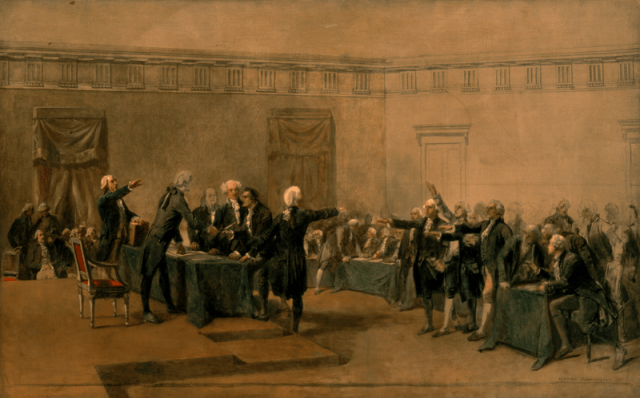
But, let’s not forget the true meaning of this day. When, in 1776, in Philadelphia, Mr. John Hancock, as president of the Second Continental Congress, affixed his signature to the document below, which declared to the world the break from Great Britain.
Declaration of Independence
From the words of Richard Henry Lee, “Resolved, That These United Colonies are, and of right ought to be, free and independent states,” to the quill of Thomas Jefferson, “When in the course of human events it becomes necessary for one people to dissolve the political bands which have connected them,” let us truly remember the history behind this day and the build-up to that fateful decision in Philadelphia.
This year, July 4th, which falls on a Monday, and will be celebrated as America’s Independence Day around the country. Americans remember that date, in 1776, as the day that John Hancock, as president of the Second Continental Congress, put quill to ink and then parchment, to affix his signature in a bold stroke at the bottom of the Declaration of Independence. Interestingly, only one other person signed their name to the document that day, secretary to the Second Continental Congress, Charles Thompson.
However, the important date to remember, is today, July 2. On this date in 1776, the Second Continental Congress will adopt Virginia delegate Richard Henry Lee’s resolution to declare independence from Great Britain. This document, crafted by another Virginia, Thomas Jefferson, was originally brought up for debate in June. By June 28th, Jefferson, chosen by a sub-committee to write the declaration, had presented it to Congress assembled in Philadelphia for review.
Artist Charles E. A. Dumaresq’s rendition of the Second Continental Congress signing the Declaration of Independence
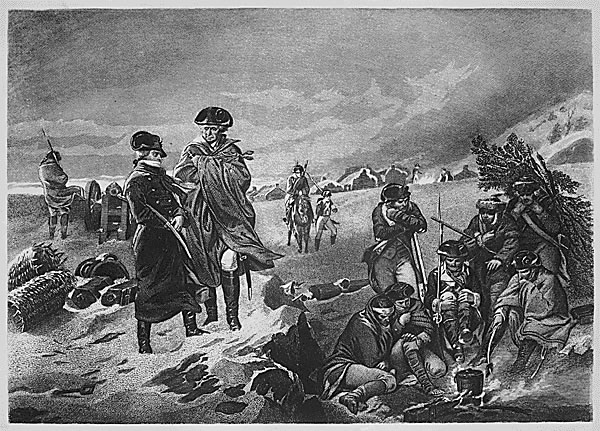
Part One, of a series on the importance of Valley Forge in the American Revolution
On December 19, 1777, the Continental Army, under the command of General George Washington, marched into Valley Forge, Pennsylvania. Located approximately 20 miles from Philadelphia, which had fallen to the British that autumn, Washington’s army would spend the next five-plus months in this soon-to-be iconic place in the quest for American independence.
Yet, the accounts of how desperate the condition of the American forces were emanates throughout the centuries and strikes awe and amazement at the level of perseverance that the soldiers committed to. The winter of Valley Forge was just one of many cold, bleak, and destitute winters that the Continental Army faced during the seven-year conflict.
Artist depiction of the encampment at Valley Forge. George Washington and the Marquis de Lafayette are the two horsemen depicted prominently
However, that does not take away from the conditions of that winter. Especially when written from the ink and quill or pencil of the common soldier. Especially with what that winter cantonment did in the transformation of that Continental Army.
One of the best remembrances of that cold winter comes from Joseph Plumb Martin, whose Memoir of a Revolutionary Soldier, is still in print today.
Upon arrival at Valley Forge, Martin would write:
“We were now in a truly forlorn condition,–no clothing, no provisions, and as disheartened as need be. We arrived, however, at our destination a few days before christmas. Our prospect was indeed dreary.”
Just a short time after his arrival, Martin continued the plight of himself (and most likely many a soldier in that encampment) when he wrote;
“I lay here two nights and one day, and had not a morsel of any thing to eat all the time, save half a pumpkin, which I cooked by placing it upon a rock, the skin side uppermost, and making a fire upon it; by the time it was heat through I devoured it with as keen an appetite as I should a pie made of it at some other time.”
Martin’s account is supported by General James Varnum, who reported on December 20, 1777, “that his division had eaten no meat during 48 hours and had been three days without bread.”
Suffering at Valley Forge
Yet, during that winter, the experience of Valley Forge, according to another veteran of that harsh winter, “added iron to their souls.”
More than “iron souls” would be needed to defeat the British in the American Revolution. Winter, 1777, would see to that as well.
Down the street from the Governor’s Palace in Colonial Williamsburg sits a two-story brick structure. Living historians, in first-person, debate the road to the American Revolution.