

“Rev War Revelry” A Discussion with Revolutionary Maryland historian Drew Palmer

When you think of Maryland in the American Revolutionary War, what are the first connections that come to mind? Taking a stab at it, probably the Maryland 400 during the Battle of Brooklyn in 1776? Or possibly the 1st Maryland at the Battle of Guilford Court House in 1781? If you are a national park junkie, potentially Thomas Stone National Historic Site, home of one of Maryland’s four Signers of the Declaration of Independence, may come to mind. If you are not familiar with that NPS unit, click here.

To fill in those gaps, Emerging Revolutionary War welcomes historian Drew Palmer. He is the creator of Revolutionary Maryland, which is an online public history blog that is “dedicated to uncovering and sharing all things related to the state’s experience during this transformative period.”

Palmer is a Revolutionary War historian, a U.S. high school history teacher, and the creator of Revolutionary Maryland. Palmer has worked as a public historian at numerous historic sites over the years, including Appomattox Courthouse, Fort Ticonderoga, Adams National Historical Park, and Fort McHenry National Monument and Shrine. Palmer’s research primarily focuses on the Revolutionary War in Maryland and the South. Most recently, he published his research on Fort Whetstone and the Maryland Matrosses during the Revolutionary War. He also worked with Fort McHenry to direct a short documentary on Fort McHenry’s 250 years of history. Palmer earned his B.A. in history from DeSales University in 2023 and his M.A. in applied history from Shippensburg University in 2024. He currently lives outside of Baltimore and is working on multiple research topics involving the Revolutionary War.

Emerging Revolutionary War is proud to welcome a great emerging historian of the Revolutionary War Era to the “Revelry.” We hope you can join us, live, on Sunday, April 19, at 7 p.m. EDT on our Facebook page.
The Defense of the Upper Chesapeake: Maryland’s First Trial in the Revolutionary War

Emerging Revolutionary War welcomes back guest historian Drew Palmer. He is the founder of Revolutionary Maryland; click here to learn more about that blog.

(Vallejo Image Galleries)

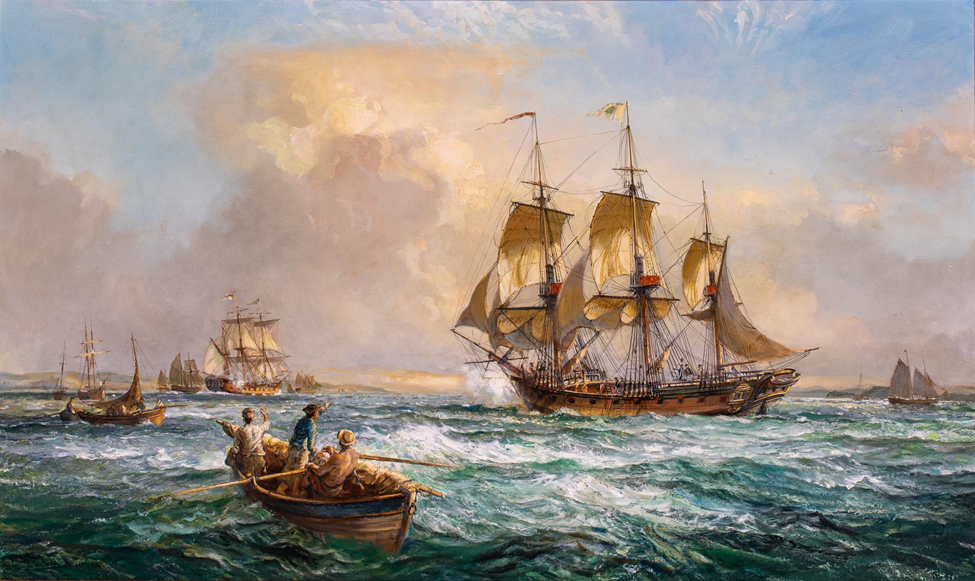
In the early evening of March 5, 1776, two armed boats left Annapolis to patrol the Chesapeake Bay. Captain John Pitt and Joseph Middleton were patrolling to prevent any British ships nearby from entering Maryland’s waters.  As they patrolled, they discovered an alarming sight: three British warships heading directly towards Annapolis. Middleton and Pitt rushed off to the Maryland Council of Safety’s chambers in Annapolis to report the startling news.1 In the coming days, Maryland was tested for the first time in the growing Revolutionary conflict.

The American rebellion had become a full-scale war by the spring of 1776. In early March, the siege of British-held Boston was about to end. Hundreds of miles south in Philadelphia, the Declaration of Independence was only four months away. In Maryland, politicians worked hard to maintain Maryland’s isolation from the worst of the conflict. In Virginia, a raiding war had already begun. Only two months before, the town of Norfolk, Virginia, was bombarded, leading to the destruction of the town. Along with Norfolk’s destruction, British attacks and raids were carried out throughout the lower Chesapeake Bay, along with a blockade. 2

Participating in British operations in the lower Chesapeake was Captain Mathew Squire of the British Royal Navy. For several months, Squire’s vessel, the  Otter, served as the headquarters of the exiled Virginia Governor, Lord Dunmore. From the Otter, British attacks and raids were launched on Patriot strongholds in the lower Chesapeake. By March, Squire had gained a reputation as a competent officer and ruthless raider of American shipping.3 Squire was heavily involved in the bombardment of Norfolk and an attempted attack on Hampton, Virginia. Though Squire’s area of operation had been centered on the lower Chesapeake, new intelligence pulled him northward into Maryland.

Continue reading “The Defense of the Upper Chesapeake: Maryland’s First Trial in the Revolutionary War”