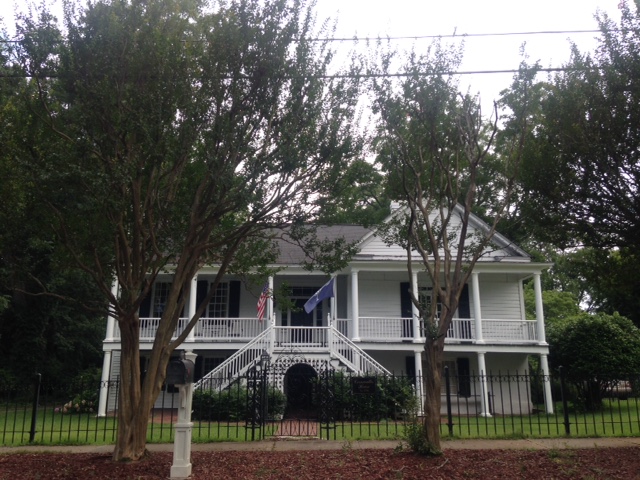
In the quaint South Carolina town of Winnsboro, a few miles off of current Interstate-77 sites a two-story stands one of the oldest dwellings in a town founded by Richard Winn of Virginia a few years before the start of the American Revolution.
Yet, it was during those hostilities that one of the more famous military leaders came to “Winnsborough” as it was sometimes listed on maps of the time. His name, Lord Charles Cornwallis, the overall commander of British forces in the Southern Colonies. He would use the house during the winter of 1780-1781.
The house itself is an enigma. The structure dates to pre-1776 obviously, but the builder and owner of the house is still not known. Yet, it is well document that the house did serve during the labeled “winter of discontent” for the British and Cornwallis.
Across the street resides the Mount Zion Institute which became quarters for British soldiers during that winter of 1780-1781.
After the conflict the property and house was deeded to Captain John Buchanan, a veteran of the American Revolution. Buchanan was part of the welcoming party for the Marquis de Lafayette when the Frenchman landed at Georgetown, South Carolina.
Although not open to the public, special requests will be entertained. Click here for the link below for more information on the house and also who to contact for those special arrangements.
Emerging Revolutionary War is pleased to welcome back historian Bert Dunkerly, who is the co-author (with Irene B. Boland) of the upcoming book; “Eutaw Springs; The Final Battle of the American Revolution’s Southern Campaign” slated to be released this month.
Part One
The weather was warm and the men had been marching for days, but their morale was high. They had been through a lot recently: caught off guard and defeated at Hobkirk’s Hill, a month of grueling siege work – and for naught, at Ninety Six. Not to mention the engagements that many of them had fought in previously: Kings Mountain, Cowpens, Guilford Courthouse, and dozens of smaller battles.
Yet the army that General Nathanael Greene led forward on the morning of September 8, 1781, was confident and ready to come to grips with its adversary. Everyone from the private in the ranks on up to the commanding general knew that ahead lay an opportunity.
Battles in the Revolution were, in fact, rare opportunities for commanders. Engagements were the short, pulse-pounding events that broke up the monotony of marching and maneuvering. An army spent most of its time in garrison, in camp, or on the road. In battle the infrequent opportunity came to crush an opponent and influence the outcome of a campaign, or the war. These chances were few and far between.
“Eutaw Springs” by Benson Lossing
Both commanders at Eutaw Springs appreciated this fact. General Nathanael Greene’s forces had experienced a series of close calls at Guilford Courthouse, Ninety Six, and Hobkirk’s Hill. The American army fought well in all of these engagements, save Hobkirk’s Hill, yet they met defeat in every one. Greene hoped Eutaw Springs would put the finishing touches on his South Carolina campaign, and end it with a clear cut victory.[i]
Eutaw Springs was a rare chance for Greene to pick the time and place of engagement, array his forces to his choosing, and initiate the battle, and control its \tempo. It was the only set engagement of the campaign, other than Guilford Courthouse, in which Greene chose the ground and initiated the battle. Commanders do not often have this luxury, and Greene earnestly hoped to make the most of it. Continue reading “Eutaw Springs”→
In Charleston’s Marion Square, an odd chunk of limestone, sand, and oyster shells sits inside a wrought-iron fence just beyond the normal boundaries of the weekend market. While shoppers buy their weekly produce or shop for gifts, the food court along King Street tempts them with just about anything you can image. Someone usually plays live music on the park-side of the market—and there, nearby, sits the hunk of rock. Continue reading “Charleston’s Horn Work Offers Glimpse Into the Walled City’s Colonial Fortifications”→
Emerging Revolutionary War welcomes back historian Bert Dunkerly. The accounts below come from Mr. Dunkerly’s book on the battle.
“The Battle of Kings Mountain, Eyewitness Accounts” by Bert Dunkerly (Acadia Publishing)
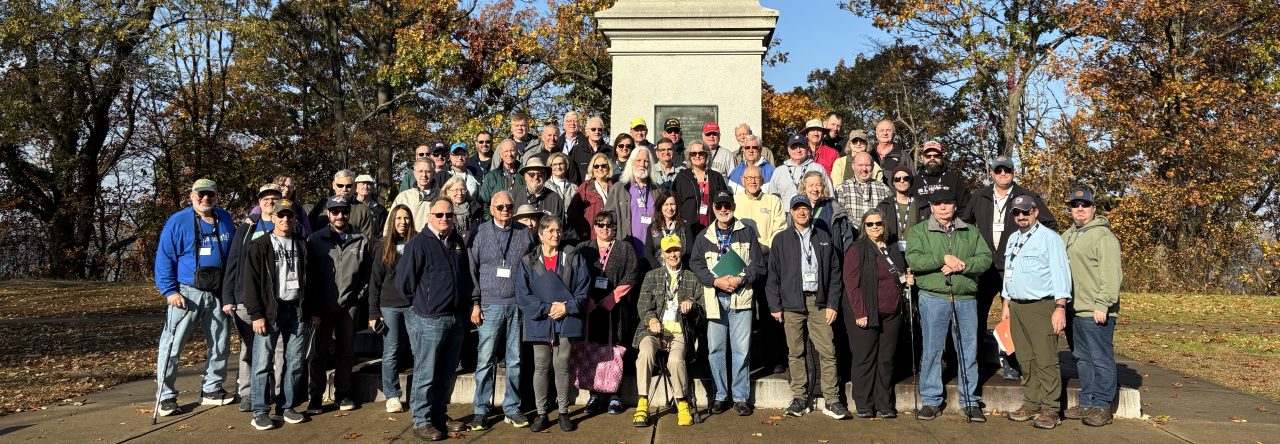
The battle of Kings Mountain was an intense, one-hour battle fought just below the North Carolina-South Carolina border. The October 1780 engagement pitted about 900 American militia from five states (Virginia, the two Carolinas, Georgia, and modern-day Tennessee) against 1,100 Loyalists under Maj. Patrick Ferguson. With Ferguson’s wounding late in the action, command fell to his subordinate, Captain Abraham DePeyster. As the Americans closed in, the Loyalists surrendered.
Eyewitness accounts provide details of the battle, especially its lesser known aspects like the conclusion of the battle and subsequent Loyalist surrender. Here are a few detailed accounts, presented with original spelling and grammar.
Virginia militiaman Leonard Hice had quite an experience in the battle, being wounded four times. He would spend two years recovering:
“I was commanded by Captain James Dysart where I was dreadfully wounded, I received two bullets in my left arm and it was broken. We were fighting in the woods and with the assistance of my commander who would push my bullets down, I shot 3 rounds before I was shot down. I then received a bullet through my left leg. The fourth bullet I received in my right knee which shattered the bone by my right thigh and brought me to the ground. When on the ground I received a bullet in my breast and was bourne off the ground to a doctor.”
Andrew Cresswell was a militiaman from Virginia who found himself too far in front during the final phase of the battle. He also was fortunate to witness the surrender and provided one of the only accounts of Captain Abraham DePeyster surrendering to Colonel William Campbell. His account also speaks to the brutal nature of the fighting between Loyalist and Whig.
“I saw the smoke of their guns and as I saw but one man further round than myself I spoke to him and told him we had better take care least we might make a mistake. I retreated about ten paces where I discharged my gun. About that moment they began to run. I waited for nobody. I ran without a halt till I came to the center of their encampment at which moment the flag was raised for quarters. I saw Capt. DePeyster start from amongst his dirty crew on my right seeing him coming a direct course towards me. I looked round to my left I saw Col. Campbell of Virginia on my left DePeyster came forward with his swoard hilt foremost. Campbell accosted him in these words “I am happy to see you Sir. DePeyster, in answer swore by his maker he was not happy to see him under the present circumstances at the same time delivered up his sword – Campbell received the sword, turned it round in his hand and handed it back telling him to return to his post which he received. Rejoining these words, God eternally damn the Tories to Hell’s Flames and so the scene ended as to the surrender.”
Lt Anthony Alliare was a New York Loyalist in Ferguson’s command. He recounts the experience of the New York detachment, which launched a series of unsuccessful bayonet charges early in the battle. His reference to the “North Carolina regiment” refers to local Loyalist troops fighting alongside his men.
“The action continued an hour and five minutes, but their numbers enabled them to surround us. The North Carolina regiment seeing this, and numbers being out of ammunition, gave way, which naturally threw the rest of the militia into confusion. Our poor little detachment, which consisted of only seventy men when we marched to the field of action, were all killed and wounded by twenty, and those brave fellows were soon crowded as close as possible by the militia.’
Ensign Robert Campbell of Virginia also witnessed the close of the battle, and recounts a white flag being raised.
“It was about this time that Colonel Campbell advanced in front of his men, and climbed over a steep rock close by the enemy’s lines to get a view of their situation and saw they were retreating from behind the rocks that were near to him. As soon as Captain Dupoister observed that Colonel Ferguson was killed, he raised flag and called for quarters. It was soon taken out of his hand by one of the officers on horseback, and raised so high that it could be seen by our line, and the firing immediately ceased. The Loyalists, at the time of their surrender, were driven into a crowd, and being closely surrounded, they could not have made any further resistance.”
Isaac Shelby, from the Carolina frontier (modern Tennessee) was a militia commander in the battle. He also provides insights in the battle’s final moments.
“They were ordered to throw down their arms; which they did, and surrendered themselves prisoners at discretion. It was some time before a complete cessation of the firing, on our part, could be effected. Our men, who had been scattered in the battle, were continually coming up, and continued to fire, without comprehending in the heat of the moment, what had happened; and some, who had heard that at Buford’s defeat the British had refused quarters to many who asked it, were willing to follow that bad example. Owing to these causes, the ignorance of some, and the disposition of other to retaliate, it required some time, and some exertion on the art of the offices, to put an entire stop to the firing. After the surrender of the enemy, our men gave spontaneously three loud and long shouts.”
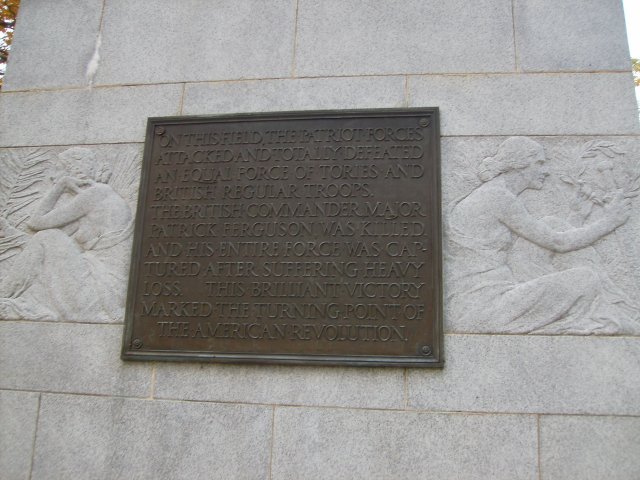
In one hour, the entire Loyalist force of 1,100 was killed, wounded, or captured. October 7 marks the anniversary of this battle which, in the words of Thomas Jefferson, was the “turn of the tide of success.”
Plaque at Kings Mountain National Military Park
Robert M. Dunkerly (Bert) is a historian, award-winning author, and speaker who is actively involved in historic preservation and research. He holds a degree in History from St. Vincent College and a Masters in Historic Preservation from Middle Tennessee State University. He has worked at nine historic sites, written eleven books and over twenty articles. His research includes archaeology, colonial life, military history, and historic commemoration. Dunkerly is currently a Park Ranger at Richmond National Battlefield Park. He has visited over 400 battlefields and over 700 historic sites worldwide. When not reading or writing, he enjoys hiking, camping, and photography.
Baron Frederich Wilhelm August Heinrich Ferdinand Steuben or Frederich Wilhelm Ludolf Gerhard Augustin von Steuben or more simply Baron von Steuben, may be the most recognizable German to serve with the American army during the American Revolution.*
Portrait of Baron Johann de Kalb (by Charles W. Peale)
His merits, pedigree, and how he came to America has been questioned and studied by many scholars and historians.
Another German has not fared so well in terms of recognition of his invaluable services to the American cause.
This post is about that other German-speaking military officer. He did something von Steuben did not.
Baron Johann von Robais de Kalb not only offered his services to the fledgling American Continental Army, he also gallantly gave his life for his adopted-cause.
Born June 19, 1721 in Huttendorf, near Erlangen in Bavaria, de Kalb led a life of privilege, learning multiple languages before earning a commission in the French army in the Loewendal Regiment. He served admirably in the War of Austrian Succession and the Seven Years War, in the later, he won the Order of Military Merit and gained his baronetcy.


 In Charleston’s Marion Square, an odd chunk of limestone, sand, and oyster shells sits inside a wrought-iron fence just beyond the normal boundaries of the weekend market. While shoppers buy their weekly produce or shop for gifts, the food court along King Street tempts them with just about anything you can image. Someone usually plays live music on the park-side of the market—and there, nearby, sits the hunk of rock.