Emerging Revolutionary War welcomes back guest historian Michael Aubrecht
As someone who enjoys the occasional cocktail I am admittedly curious as to the rumored excessive-drinking habits of our Founding Fathers.
After conducting a casual examination, I think it would be fair to say that their wealth, power, and the period in which they lived in made alcohol a mainstay in their daily lives. Most of these gentlemen were the political playboys of their day and we already know that many of them had a penchant for wine, women and song. Today most people assume that the common table wine was the preferred beverage of colonial times and that most folks simply enjoyed it as a compliment to meals.
According to research conducted by Stanton Peele, the Founders had a much broader palette when it came to engaging in the Spirit of ‘76. Simply put, these boys liked to party:
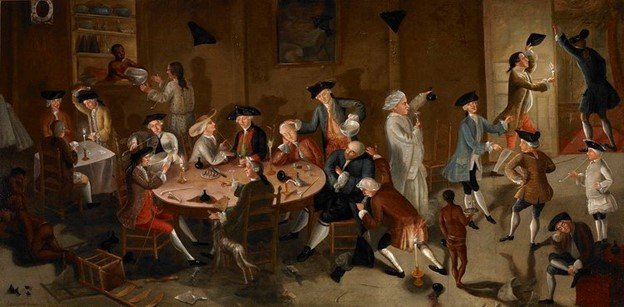
How do we know the Founding Fathers as a group drank a lot? Well, for one thing, we have records of their imbibing. In 1787, two days before they signed off on the Constitution, the 55 delegates to the Constitutional Convention partied at a tavern.
According to the bill preserved from the evening, they drank 54 bottles of Madeira, 60 bottles of claret, eight of whiskey, 22 of porter, eight of hard cider, 12 of beer and seven bowls of alcoholic punch. That’s more than two bottles of fruit of the vine, plus a few shots and a lot of punch and beer, for every delegate. Clearly, that’s humanly impossible.
Emerging Revolutionary War welcomes guest historian and reviewer Al Dickenson
No president has an easy job. But imagine holding the position of president immediately after undoubtedly the best president the United States has ever had.
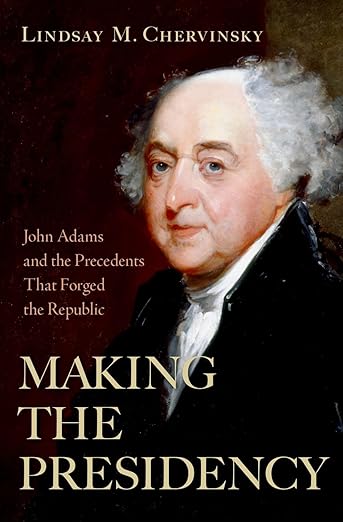
That was John Adams’ conundrum. Additionally, it is the subject of renowned historian Lindsey Chervinsky’s new book, Making the Presidency: John Adams and the Precedents That Forged the Republic. Initially released last year, in the midst of a politically fraught election season, Chervinsky places the modern world into a context we should all understand better: the history of the 1790s.
After a brief introduction regarding the Revolutionary War, the early republic, and George Washington’s presidency, readers are thrown into John Adams’ presidency. Federalists opposing Democratic-Republicans (commonly referred to as simply “Republicans” in Chervinsky’s text, as they referred to themselves), the Americans opposing the French, the North opposing the South, Federalists opposing Federalists: it seemed there could be no peace in the nation so split apart. Yet the nation stood for another 220 years. Why is that?
Chervinsky argues that the reason we are a nation today relies on how John Adams served his presidency, specifically the power sharing he enacted in his cabinet amongst Republicans (like Vice President Thomas Jefferson), Federalists (like Secretary of State Timothy Pickering), and Archfederalists (like Secretary of War James McHenry), the successful navigation of foreign affairs (see the ongoing French Revolution, specifically the XYZ Affair), and the peaceful transfer of power.
The final focus of Chervinsky’s book, Adams’ loss in the 1800 election, perhaps offers the most original outlook on Adams’ presidency. Being the loser of the election, and being the first incumbent president to lose an election, historians have often treated Jefferson a little kindlier than Adams. Where Chervinsky’s work shines, however, is in showing how these great, powerful men, the leaders of their respective parties, differed in how they saw power, and in how they wielded it.
Little scholarship focuses on Jefferson’s machinations to gain the presidency. Rarely researched are his Virginia and Kentucky Resolutions, which called for nullifying federal law, even though these ideas were eventually adapted into various Confederate causes and mentalities in the following decades. Nor are the essentially political and emotional blackmail Jefferson laid on Federalist members of Congress who refused to vote for him over Aaron Burr. Jefferson threatened the members of Congress with, in essence, secession of Republican states if they did not pick a president soon, given that this was the only election in American history where the House of Representatives made the presidential selection. The dirty tricks of politics manifested themselves in this election, including smear campaigns against Adams and unfounded warnings that the Federalist Party would forego the will of the people and simply appoint a new, Federalist president.
Compare this to John Adams, who, while certainly desirous of a second term, largely laid low during the turmoil occurring on the other side of the Capitol. When presented with suggestions to keep himself as president, he refused. When asked to annul the election, Adams refused. When asked to stand for himself and campaign in the final months of the election season, and during the contingent election in the House between Jefferson and Burr, Adams refused and stayed silent. He did not cling to power, nor did he view his opinion better than that of the American people who voted for a Republican and the House members who would choose the next presidency. Though he was a lame duck president in every sense of the word, he held true to his convictions of propriety in politics, though privately he fumed.
In this way, though history often sheds more light on the winner, makes historians wonder what other ways “losers” of an election may have impacted our politics and history. An interesting study question for any intrigued historian, but one that Chervinsky shows is vital to understanding American history and modern politics alike.
Emerging Revolutionary War welcomes back guest historian Michael Aubrecht.
Thomas Jefferson rejected the “divinity” of Jesus, but he believed that Christ was a deeply interesting and profoundly important moral or ethical teacher. He also subscribed to the belief that it was in Christ’s moral and ethical teachings that a civilized society should be conducted. Cynical of the miracle accounts in the New Testament, Jefferson was convinced that the authentic words of Jesus had been contaminated.
His theory was that the earliest Christians, eager to make their religion appealing to the pagans, had obscured the words of Jesus with the philosophy of the ancient Greeks and the teachings of Plato. These so-called Platonists had thoroughly muddled Jesus’s original message. Firmly believing that reason could be added in place of what he considered to be “supernatural” embellishments, Jefferson worked tirelessly to compose a shortened version of the Gospels titled The Philosophy of Jesus of Nazareth. The subtitle stated that the work was “extracted from the account of his life and the doctrines as given by Matthew, Mark, Luke and John.”
In 1820, Jefferson returned to his controversial New Testament research. This time, he completed a much more ambitious work titled The Life and Morals of Jesus of Nazareth Extracted Textually from the Gospels in Greek, Latin, French and English. The text of the New Testament appears in four parallel columns in four languages. Jefferson omitted the words he thought were inauthentic and retained those he believed were original. The resulting work is commonly known as the Jefferson Bible.
Using a razor and gum, Jefferson committed blasphemy. He cut and pasted his arrangement of selected verses from a 1794 bilingual Latin/Greek Bible using the text of the Plantin Polyglot, a French Geneva Bible and the King James Version. He selected excerpts from the gospels of Matthew, Mark, Luke and John in chronological order and combined the narrative with those of another to create a single chronicle.
No supernatural acts of Christ are included, as Jefferson viewed Jesus as strictly human. He also believed that Jesus himself recognized a more deistic belief system. In a letter to Benjamin Rush, Jefferson wrote, “I should proceed to a view of the life, character, and doctrines of Jesus, who sensible of incorrectness of their ideas of the Deity, and of morality, endeavored to bring them to the principles of a pure deism.” Jefferson also completely denied the resurrection. The book ends with the words: “Now, in the place where He was crucified, there was a garden; and in the garden a new sepulchre, wherein was never man yet laid. There laid they Jesus. And rolled a great stone to the door of the sepulchre, and departed.”
Jefferson engraving from 1867. Library of Congress.
Jefferson described the work in a letter to John Adams, dated October 12, 1813:
In extracting the pure principles which he taught, we should have to strip off the artificial vestments in which they have been muffled by priests, who have travestied them into various forms, as instruments of riches and power to them.…We must reduce our volume to the simple evangelists, select, even from them, the very words only of Jesus, paring off the Amphibologisms into which they have been led, by forgetting often, or not understanding, what had fallen from him, by giving their own misconceptions as his dicta, and expressing unintelligibly for others what they had not understood themselves. There will be found remaining the most sublime and benevolent code of morals which has ever been offered to man. I have performed this operation for my own use, by cutting verse by verse out of the printed book, and arranging the matter which is evidently his, and which is as easily distinguishable as diamonds in a dunghill. The result is an 8vo of 46 pages of pure and unsophisticated doctrines.
In a letter to Reverend Charles Clay, Jefferson described his results: “Probably you have heard me say I had taken the four Evangelists, had cut out from them every text they had recorded of the moral precepts of Jesus, and arranged them in a certain order; and although they appeared but as fragments, yet fragments of the most sublime edifice of morality which had ever been exhibited to man.” Most historians feel that Jefferson composed the book for his own satisfaction, supporting the Christian faith as he saw it. He did not produce it to shock or offend the religious community; he composed it for himself, for his devotion and for his own personal assurance.
After completion of the Life and Morals, Jefferson shared it with a number of friends, but he never allowed it to be published during his lifetime. The most complete form Jefferson produced was inherited by his grandson Thomas Jefferson Randolph.
The Life and Morals of Jesus of Nazareth.Monticello.org.
Among America’s Founding Fathers, Thomas Jefferson is among the most well-known. Author of the Declaration of Independence, Governor of Virginia, Minister to France, and the third President of the United States, Jefferson’s public career is familiar to many Americans. Of his many accomplishments, his authorship of the Statute of Virginia for Religious Freedom is perhaps less well-known among the public, but was one of which he was supremely proud. In Thomas Jefferson and the Virginia Statute for Religious Freedom: Faith & Liberty in Fredericksburg, Michael Aubrecht expertly delivers the story of the creation of this remarkable document and its relationship to the city in which it was written.
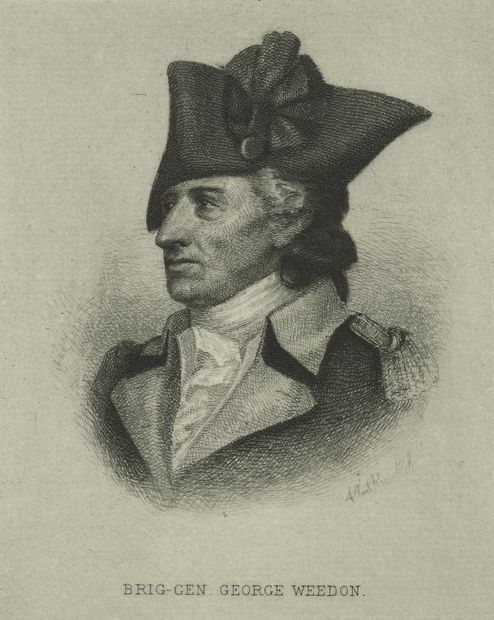
The Virginia Statute for Religious Freedom was written in Fredericksburg, Virginia in January 1777. Jefferson and four other men had been appointed to a Committee of Revisors tasked to examine Virginia’s existing laws and redraft them as necessary for the newly independent Commonwealth. Jefferson’s Statute, originally known simply as Bill 82, was only one of more than a hundred bills cataloged by the committee, but its significance has certainly been profound. Aubrecht’s narrative goes beyond telling how Jefferson wrote the document, however. Indeed, historians are not sure as to when exactly that occurred during the week that the committee met at Weedon’s Tavern in Fredericksburg. Instead, Aubrecht expertly places the story of the document’s creation within the context of the time and place it was written.
Each of the book’s thirteen chapters is essentially a vignette, concisely covering the man who wrote the statute, his and the nascent country’s views towards religion and religious practice, and the city and tavern in which it was written. The author also covers topics related to statute’s legacy, including its commemoration, and civic organizations, such as the Jefferson Institute, that perpetuate that legacy. Thus, while the story of the writing of the Virginia Statute for Religious Freedom can be and, indeed has been, quickly and effectively described on interpretive signs and monuments, Aubrecht effectively focuses on the sentiments and character of the man and locations that shaped the document.
Thomas Jefferson was not a one dimensional figure and Aubrecht does not whitewash his chief character. Jefferson was a man with many virtues and talents, but also possessed his share of faults. Aubrecht, like many other historians of the Colonial and Early Republican eras, observes and notes the contradiction between Jefferson’s views on liberty and the fact that his way of life was entirely dependent on slavery. Such objectivity only serves to strengthen the credibility of Aubrecht’s work.
Aubrecht’s work is masterfully researched. As is the case with any effective work of history, the work is truly based on extensive primary source research, chiefly the papers and correspondence of Jefferson. Scholars examining topics relating to religion in Colonial and Early America will find value in mining Aubrecht’s bibliography. Michael Aubrecht’s Thomas Jefferson and the Virginia Statute for Religious Freedom: Faith & Liberty in Fredericksburg will be of interest to anyone interested in Early American history and is a must read for scholars researching religious attitudes during this fascinating and complex period.
Emerging Revolutionary War welcomes back guest historian Michael Aubrecht
In 1777 Thomas Jefferson and a committee of revisors came to the City of Fredericksburg for the purpose of revising several Virginia statutes. This led to Jefferson drafting the Virginia Statute for Religious Freedom.
When Jefferson and his comrades arrived in Fredericksburg they were met with a town bristling with military activity. Troops were drilling in the public square and filled the crowded streets, buildings and shops. Awaiting travel orders were the men of the Second Virginia and the Seventh Virginia, ordered here on January 9 for a rendezvous just prior to marching to join General Washington at the front. By the time Jefferson arrived in Fredericksburg, sixty of the more than two hundred battles and skirmishes of the war had already taken place.
Emerging Revolutionary War welcomes a guest post from historian Keith J. Muchowski. Keith is a librarian and professor at New York City College of Technology (CUNY) in Brooklyn. He blogs at thestrawfoot.com.
The plaque dedicated King Juan Carlos I in June 1976 today tucked in a corner of the visitor center. Courtesy Author
King Juan Carlos I arrived in Brooklyn’s Fort Greene Park on Saturday June 5, 1976 to great fanfare. The thirty-eight-year-old monarch had ascended to the Spanish throne just seven months previously, two days after the death of Francisco Franco. The new leader was determined to reform his nation after three and a half decades of strongman rule. Juan Carlos I’s ancestor, King Carlos III, had helped the colonists achieved their independence nearly two centuries previously with his supply of money, matériel, and men. Many of those Spaniards made the ultimate sacrifice; well over one hundred of them alone perished in British prison ships moored off Brooklyn Wallabout Bay during the war.[i] Now King Juan Carlos I was in the outer borough to recognize them, dedicate a tablet to his fallen countrymen, and help his American hosts celebrate the bicentennial of their independence. The entombed Spaniards were among the over 11,500 men commemorated by the Prison Ship Martyrs Monument. The king’s visit in the mid-1970s was the latest in a series of public commemorations of the prison ship dead dating back over a century and a half. Some of the institutions that did so much to recognize the martyrs, such as the Society of St. Tammany, are today long gone. Others however very much remain. The Society of Old Brooklynites, a civic organization founded in 1880 when Brooklyn was still an independent municipality, has been holding events since the late nineteenth century.
George Washington’s first presidential cabinet included many luminaries of the American Revolutionary era; Thomas Jefferson as Secretary of State and Alexander Hamilton as Secretary of the Treasury to just name two. When studying the formation of the present United States government and the creation of cabinets that serve the president, we tend to gloss over it, as a sort of bygone conclusion, that this was a natural product out of this creation.
A closer reading of the United States Constitution, however, does not include the executive branch having a cabinet of secretaries to assist the president. George Washington, as first president, was entirely on his own in creating one, and the first cabinet meeting was not called into session until two and a half years into his first term.
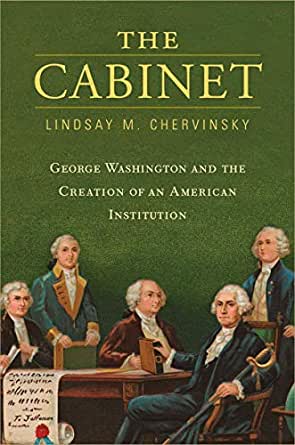
The creation of this American institution is the basis of this week’s “Rev War Revelry” as Emerging Revolutionary War welcomes historian and author Dr. Lindsay Chervinsky as she discusses the history in and surrounding her publication, The Cabinet, George Washington and the Creation of an American Institution.
When discussing the importance of the cabinet, Chervinsky said:
“The best way to better understand the creation of the presidency, presidential leadership, or Washington’s legacy is through the cabinet.”
But this story isn’t just one about the early Founding Era. As Chervinsky writes in her work, “we can’t evaluate the cabinet without examining Washington’s use of councils of war from the Revolution. He developed critical management strategies in the councils that he replicated as president. The war shaped Washington as president.”
Chervinsky is an early American historian and is currently the Scholar-in-Residence at the Institute for Thomas Paine Studies at Iona College and a Senior Fellow at the International Center for Jefferson Studies. In addition, she is teaches courses on the presidency at George Washington University’s School of Media and Public Affairs.
For a sneak peak into the book and its history, click here to access Chervinsky’s talk at the Virginia Historical Society.
Tim McGrath has written two award-winning winning books about the early history of the United States Navy: Give Me a Fast Ship and John Barry. For his third book, he switched gears to tackle an oft-overlooked soldier, lawyer, politician, and president: James Monroe. In what will likely be the definitive Monroe biography, McGrath tackles the entirety of our fifth president’s life. Born in 1758, Monroe joined the American army in the Revolution’s early days until he was sidelined with a serious wound at Trenton.
As McGrath tells it, the story of Monroe’s early life was a constant search for a mentor and sponsor, which eventually landed him on William “Lord Stirling” Alexander’s staff. It was enough to bring him the attention and lukewarm friendship or support of many of the army’s leading lights and the country’s future leaders, but not enough to really launch his career. Eventually, he landed a legal apprenticeship with Virginia’s Governor Thomas Jefferson. It changed Monroe’s life, giving him a path forward professionally, politically, and intellectually.
As this posting goes live today, July 2, there is a link to the American Revolutionary War era. This was the day that John Adams, future president of the United States, believed would be the date Americans would celebrate as their independence day.
Yet, the day reserved for that celebration would fall two days later, on July 4, the date that John Hancock affixed his signature as president of the Continental Congress.
However, join Emerging Revolutionary War historians and three guest historians this Sunday, July 5, at 7 pm EST, on our Facebook page, as another date to talk “All Things Independence Day” including John Adams and Independence Hall.
Joining ERW to discuss John Adams and Thomas Jefferson, which will be the volume in the Emerging Revolutionary War Series, is Emerging Civil War co-founder and Stevenson Ridge historian-in-residence, Dr. Chris Mackowski.
Savannah Rose, a National Park Service ranger at Independence National Historical Park and the new layout coordinator for the Emerging Revolutionary War Series. You can see her work with the upcoming A Handsome Flogging, on the engagement at Monmouth Course House, which just shipped from the printer this week.
Rounding out the triumvirate of guest historians will be Dan Welch, who you may remember from his dramatic reading of “A Midnight Ride” the poem about Paul Revere’s Ride. Dan is also a seasonal historian with the National Park Service at Gettysburg National Military Park.
As you round out your holiday weekend, we hope that you include “Rev War Revelry” as one of the events you attend to commemorate Independence Day weekend. We look forward to toasting you as we enjoy our favorite brews and discuss “All Things Independence.”
At 3:00 in the afternoon on April 21, 1781 Virginia militia Colonel James Innes sat down to write a letter near Hickory Neck Church, just shy of the halfway point between Virginia’s old colonial capitol at Williamsburg and its new capitol at Richmond. Perhaps with a heavy heart and a weary hand, Innes picked up his pen to scrawl a letter to Governor Thomas Jefferson. The situation in Virginia was bleak. It had only been a year since, in apprehension of a British attack, the Virginia Assembly voted to move the seat of government from the Peninsula west to Richmond, and along with it the public stores for outfitting, equipping, and otherwise supporting Virginia’s patriot forces in the fifth and sixth years of the war with the British. The gamble hadn’t paid off. January 1781 saw Benedict Arnold’s forces sacking Richmond. Everywhere they went, it seems, a new combined force of British, Hessian, and Loyalist forces left destruction in its wake.
he approximate landing site of the the main body of British soldiers with Col. Simcoe’s detachment landing further downstream in an effort to catch the Virginians by surprise. “…On a signal given, they all, except the gun-boat turned and rowed rapidly towards the point where the landing was to take place…” (author collection)





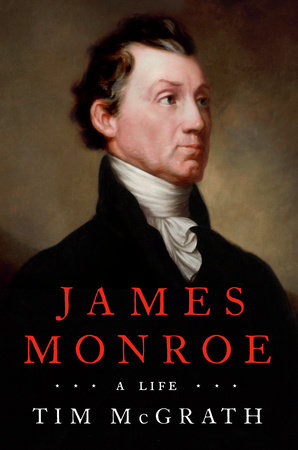 Tim McGrath has written two award-winning winning books about the early history of the United States Navy: Give Me a Fast Ship and John Barry. For his third book, he switched gears to tackle an oft-overlooked soldier, lawyer, politician, and president: James Monroe. In what will likely be the definitive Monroe biography, McGrath tackles the entirety of our fifth president’s life. Born in 1758, Monroe joined the American army in the Revolution’s early days until he was sidelined with a serious wound at

 Emerging Revolutionary War Era