

Two Patriots: One Slave and One Free; James Armistead Lafayette and James Forten

Emerging Revolutionary War welcomes back guest historian Malanna Henderson

Part One

 “It is not for their own land they fought, not even for a land which had adopted them, but for a land which had enslaved them, and whose laws, even in freedom, oftener oppressed than protected. Bravery, under such circumstances, has a peculiar beauty and merit.” – Harriet Beecher Stowe.

The words spoken by “the little woman who wrote the book that started this Great War,” so said Abraham Lincoln, according to legend, upon meeting Mrs. Stowe sometime in 1862, rang true for black patriots in the Civil War as well as those in the Revolutionary War.

The Smithsonian tome, The American Revolutionary War: A Visual History quotes a Hessian officer in 1777, as saying, “No regiment is to be seen in which there are not Negroes in abundance and among them are able-bodied and strong fellows.”

In every battle of the Revolutionary War from Lexington to Yorktown; black men, slave and free, picked up the musket and defended America; and yet, many historians as well as visual artists have omitted their contributions in the history books and their images on canvases depicting historic battles. The need for white historians to “overlook,” “underestimate,” and or “erase,” these sacrifices is a gross negligence that distorts and misrepresents American history; and furthermore, it continues to disenfranchise the patriotic heroes of the past and malign the self-image of millions of Americans today simply because of the color of their skin.

Black soldiers have always fought two wars simultaneously; wars declared by their government and the unspoken wars at home for liberty, equality and before the Civil War, for citizenship.

What kind of men fight for the liberty of others when their own liberty isn’t guaranteed?

True patriots: James Armistead Lafayette was one such person.

malanna-henderson-image-1
James Armistead Lafayette (1760-1832) Blackpast.org

Slaves serving in the rebel military was a question that manifested itself early amongst the colonial government agencies. Their presence rankled many, while others welcomed them and praised their bravery. Some men of color had fought gallantly and with distinction as they stood alongside their white compatriots, defenders of liberty on the Lexington Green in April of 1775.

For instance, in the Battle of Bunker Hill, Peter Salem, a slave, served with courage under fire, as varying accounts reported. Salem was introduced to George Washington as “the man who shot Pitcairn,” the British Royal Marine Major who shouted to his men before Salem shot him down, “The day is ours.” Despite the competence and bravery of such men on the battlefield their exploits didn’t convert the wide-spread reluctance of most colonists to accept black men as soldiers.

General George Washington, Commander-in-Chief of the Continental Army, harbored the same common prejudices of the southern-planter ruling class of which he was a member. In July, he instructed recruiters “not to enlist any stroller, negro, or vagabond, or person suspected of being an enemy to the liberty of America.” Commanders in each colony and regiment made up their own minds. Some ignored his command. Their decision was based on need and experience. Those who had already served successfully with black militia and minutemen may have seen no cause to alter their regiments.

By December of 1776, Washington back-pedaled on his decision, allowing for black veterans of Lexington, Concord and Bunker Hill to serve; but of the slave, he maintained his objection. However, some junior officers appreciated the contributions of blacks. Col. John Thomas wrote John Adams on October 24, 1775, “We have negroes, but I look upon them as equally serviceable with other men, for fatigue (labor); and, in action many of them have proven themselves brave.”

As the war raged on, the necessity for able-bodied men settled the question. White soldiers, who usually served for only a few months to a year, mustered out, died or were wounded; while others deserted. Black soldiers who expected to receive their freedom if they served were in the war for the duration. This was a positive factor for the commanding officers who had to re-train all new recruits. Around five-thousand blacks served in the Revolutionary War as soldiers. However, a vast unknown number provided a myriad of support services.

Another reason the colonials reconsidered enlisting blacks was the bold military tactic that occurred in November of 1775. Lord Dunmore, the last royal governor of Virginia, ratified a proclamation freeing all indentured servants and slaves of rebels if they would fight for the British. Thousands of people fled the plantations to gain their freedom. This single act struck a devastating blow on two fronts, it threaten their economic stability and increased the tension between master and slave, with the master fearing slave revolts and the permanent loss of their property. Moreover, it upset the social order. Enslaved men serving alongside whites put them on an equal footing in the battlefield, which violated the white supremacy dogma that governed current thought and practice.

Born into slavery on December 10, 1748, in New Kent, Virginia to owner William Armistead, James enlisted in the Revolutionary War under General Marquis de Lafayette in 1781. His owner was a patriot and most likely received the bonus James would have gotten for enlisting had he been free or white. Enlistment bonuses comprised of money, land or slaves.

By the time Armistead entered the war, the efforts of Benjamin Franklin and other colonial agents had secured a military and economic alliance with the French. A long-time imperial rival of British expansion, the French provided naval ships, money and personnel.

malanna-henderson-image-2


Marquis de Lafayette (born Marie Joseph Paul Yves Roch Gilbert du Motier) was a descendant of ancient French nobility. His father, a colonel in the French Grenadiers had died in the Seven Year’s War (known as the French and Indian War in America) when the young nobleman was only two years old. The political ideals of liberty and equality espoused by the colonials matched his beliefs and fired his military ambitions. Perchance, his yearning to play a role in America’s fight for independence from British rule may have been spawned by a desire to avenge his father’s death.

Since Lord Dunmore’s Proclamation, it was easy for Armistead to gain access in the enemy camps as a runaway slave seeking his freedom. While providing varied services to the British, he gained the confidence of Brigadier General Benedict Arnold, who by now had defected to the British. He charged Armistead with scouting, foraging and spying. Armistead was able to comfortably go between both camps, in essence becoming a double spy. He carried false and misleading information to the British but provided accurate intelligence on the movement of British forces and details of their military strategies to General Lafayette.

When Arnold left Virginia, Armistead was able to deceive General Charles Cornwallis as well, who rampaged through parts of Virginia and burned Richmond, the capital. He sent Colonel Banastre Tarleton to capture the entire legislative assembly, which included Daniel Boone, Patrick Henry and the governor. The plan was thwarted by an astute young man named Jack Jouett. Although, a few were apprehended, among them Daniel Boone; Jouett’s actions prevented the British from arresting the biggest prize: Governor Thomas Jefferson.

By early August, Cornwallis had made plans to establish fortifications in Yorktown, expecting reinforcements to increase his troops of approximately nine-thousand.

General Washington, in the meantime, had joined forces with Comte de Rochambeau to recapture New York. With intelligence supplied by James Armistead, they learned that Cornwallis was in Yorktown waiting for military support. French Admiral de Grasse, with a fleet of about twenty-eight naval ships, was on his way to the Chesapeake from St. Dominick (present-day Haiti). A plan to surround Cornwallis by land and sea appeared possible. The French naval fleet, along with the Washington’s Continental and Rochambeau’s French forces, headed to the enemy’s headquarters. Once Washington reached Yorktown, General Lafayette’s regiment joined him. Thus, Armistead’s accurate and meticulous reports were vital to the American victory that culminated in Yorktown on October 19, 1781.
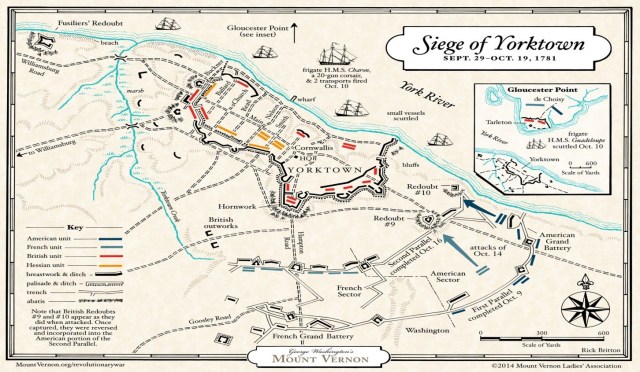
 

malanna-henderson-image-3jpg
(http://www.mountvernon.org/preservation/maps/map-the-siege-of-yorktown/)
malanna-henderson-image-4
The surrender of the British forces at Yorktown, Painting by John Trumbull (US Capitol) (http://www.mountvernon.org/preservation/maps/map-the-siege-of-yorktown/)


Later Cornwallis met the Marquis at his headquarters and was flabbergasted to find his spy James Armistead present.

The Treaty of Paris in 1783 severed ties from Britain, the mother country, and established America as an independent nation. That same year, the Act of 1783 was passed freeing slaves who had fought in the Revolutionary War on their masters’ behalf. However, it excluded slave-spies. Ergo, James Armistead, who risked his life by providing information to help win the freedom of many, was himself denied freedom. Was his life in less danger operating under subterfuge as a spy amongst the British than it would have been, had he served as a soldier on the battlefield? I think not. Had his espionage been discovered, he surely would have had to forfeit his life.

After the war, Armistead was returned to slavery. Even his own master didn’t have the legal right to free him because of the Act of 1783, omitting slave-spies from emancipation.

When learning of his compatriot’s status, the Marquis penned a certificate to the Virginia legislator in October of 1784 imploring them to grant Armistead his freedom, declaring:

“This is to Certify that the Bearer By the Name of James Armistead Has done Essential Services to me While I had the Honour to Command in this State. His Intelligences from the Ennemy’s Camp were Industriously Collected and More faithfully deliver’d. He properly Acquitted Himself with Some Important Commissions I Gave Him and Appears to me Entitled to Every Reward his Situation Can Admit of. Done Under my Hand,” Richmond, November 21st 1784.

The legislator didn’t act upon the request straightaway. However, again in 1786, James Armistead applied for his freedom and it was duly granted on January 9, 1787, with a fair compensation to his master, William.

In honor of his benefactor, James Armistead added Lafayette to his surname. After emancipation, he moved a short distance south of New Kent, near Richmond, Virginia and acquired forty acres of less than suitable farmland. He married and had a family. He even owned slaves. History doesn’t tell us if he bought enslaved relatives to free them or if they were bought to farm his land as field hands.

It wasn’t until 1819 that he applied to the state legislature for financial assistance to ease his poverty. This time, the response was immediate; he received $60 and an annual pension of $40 for his service during the Revolutionary War.

Unlike James Armistead Lafayette, many blacks who worked as laborers, guides, messengers and spies were not as fortunate. Whether they were pressed into service or willingly answered the call, most neither received their freedom nor wages for their behind-the-scene contributions to the war.

In 1824, the Marquis de Lafayette visited the United States and was lauded as a hero of the American Revolutionary War in Richmond with festivities and a parade. Spying Armistead in the crowd, it is said he halted the procession, dismounted from his horse and embraced his old comrade.


_____________________________________________________________

End Notes

References:

  • Kareem Abdul-Jabbar and Alan Steinberg Black Profiles in Courage: A Legacy of African-American Achievement. (New York: William Morrow and Company, Inc.1996) pages 32-34.


  • Col. Michael Lee Lanning (Ret.) Defenders of Liberty: African Americans in the Revolutionary War. (New York: Kensington Publishing Corp. 2000) pages 45-46; 130


  • Smithsonian The American Revolution, A Pictorial History. (New York: DK Publishing, First Edition 2016)


  • Harry M. Ward, For Virginia and For Independence: Twenty-Eight Revolutionary War Soldiers from the Old Dominion, Chapter 26 “Spy”, pages 155-159.


Defending the New Nation: The Fredericksburg Gun Manufacturing Plant

Part Two by historian Malanna Henderson 

The financial direction of the gunnery was put into the hands of Fielding Lewis. Born into a wealthy family at Warner Hall in Gloucester County, Virginia in 1725, Fielding was the third son of John and Frances Lewis. Following his father’s footsteps, Fielding was a prosperous industrialist, running a fleet of ships to England and English ports, exporting tobacco and grain. In addition, he operated a store and served on numerous committees and local government associations that laid the groundwork for governing what would eventually become the United States of America. Fielding was addressed as Colonel Lewis, more often than not, reflecting his participation as a provider of provisions and raising the local Spotsylvania militia during the French and Indian War. Feats he was to repeat and go beyond during the Revolutionary War.

colonel-fielding-lewis
Colonel Fielding Lewis (Courtesy of The George Washington Foundation)

Often using his vast personal wealth, Lewis purchased schooners and sloops, outfitting them with artillery to patrol the Rappahannock River in an effort to protect civilian lives and property, and to stop British troops from seizing colonial weaponry.

In February 1776, Lewis purchased the schooner, Liberty, outfitting it with armory. Later, renamed Hornet, it sailed under the command of Richard Taylor of Caroline County. It carried a crew of twenty-one men. Lewis, then purchased a sloop named Defiance and placed it under the command of Captain Eliezer Callender. In April, Lewis purchased the pilot boat, Adventure, appointing Captain William Saunders at the helm.

Lewis commissioned ships to be built as well. The row galley was the most popular vessel used for defense of the river and harbor at the time. Although equipped with sails, the primary source of power was the oar. Larger row galleys measuring seventy feet long could carry a crew of fifty men. These galleys often-times carried two large eighteen pound cannons. Lewis commissioned another ship named Dragon and launched it in 1777; it was used primarily to patrol the Chesapeake Bay.

Free and enslaved blacks were often members of the crew. Around one-hundred and forty black men served with the Virginia fleet; one to ten on each of the seventy vessels. About ten served on the Dragon. Some of these men may well have been slaves belonging to Lewis or Dick. Only ten percent of black men who served in the navy were free, most were escaped slaves posing as free men, like Crispus Attucks, the first casualty of the Revolutionary War. To fulfill enlistment quotas, slaves served as substitutes for their masters. Unlike white men who served for a specific time, blacks were in it for the long haul; for only then could their service earn them the promise of freedom.

The first ship to engage in warfare was the Hornet, capturing four enemy merchantmen in the Rappahannock. Their ship, Speedwell, was taken into custody by the Virginia Navy and sent to the West Indies to bring back gunpowder. Fielding imported guns and ammunition for use in the colonies by the Rappahannock and the Patsey.

Lewis’s commitment to freeing the colonies from British rule was unrelenting. A wealthy man, he sacrificed nearly everything he possessed to see his dream of American independence from Britain rule become a reality. He sat on one local government committee after another. He bought ships and turned them into naval ships. He managed the financial direction of the gunnery, as well as procuring military materials. Col. Lewis appointed ship captains and he raised regiments, adding manpower to the Continental Army. During this time, Lewis didn’t neglect the on-going responsibilities he administered before the war. He presided over legal cases as the Justice of the Peace, provided religious leadership, administrative duties and support for the poor as a vestry member of St. George’s Anglican Church, and ran his plantation and mercantile business.

The Fifth Convention met in May of 1776 and authorized the Virginia Committee to reimburse Lewis 1,059 pounds to pay privateers who imported provisions. He was also reimbursed an additional 1,800 pounds in July. However by the end of the war Lewis was virtually bankrupt. He was owed a considerable amount of money but he never recouped all of the money he invested. By 1780, Lewis’ health had deteriorated to the extent that he was no longer able to manage the gunnery and the full responsibility fell on the shoulders of Charles Dick, who had used his personal credit to finance various tasks related to the success of the gunnery. The Convention was delinquent in its payments to Lewis, Dick and the sixty employees at the gunnery. Dick closed the factory for a time due to his inability to meet payroll. He wrote to Governor Thomas Jefferson his frustrations about the lack of funds:

I will do all in my Power to carry on the Work; but impossibiltys I cannot do … There must be proper stores laid in, Provisions, Walnut Plank for Gun-stocks, Iron, Steel are the principal articles, and these require even a good deal of Real money – And without which little or nothing can be done; I cannot speak plainer.”

The gunnery closed in 1783, the same year that the Treaty of Paris was signed establishing the independence of the United States of America. The manufacturing plant continued to operate, repairing muskets badly damaged after the war. Subsequently, once the gunnery ceased operations, the property and land was sold to trustees of the Fredericksburg Academy, whose president was James Mercer. The academy opened in 1786.

The last major battle of the Revolutionary War occurred at Yorktown. Major General Charles Cornwallis surrendered to General George Washington in October of 1781. By December, Fielding Lewis, at the age of fifty-six, had succumbed to his battle with (consumption) tuberculosis.  Charles Dick died a few years later in 1783. True patriots, Fielding Lewis and Charles Dick sacrificed their fortunes and health to free colonial America from British rule and were eye-witnesses to the birth of a new nation.

Today, at Historic Kenmore, in Fredericksburg, Virginia, stands the 18th-century plantation home built by Fielding Lewis and Betty Washington Lewis. The home, the pre-Revolutionary colonial kitchen and the Crownsinshield Gallery are open to the public for tours. Besides the antique collection of furniture and decorative arts, a musket produced by the Fredericksburg Gun Manufactory hangs in a display case in the gallery.

In the pages of American history, Col. Lewis and Charles Dick stand out as men whose faithful and persistent dedication to the cause of liberty lives on as an example of true patriotism.

“Fielding Lewis and Charles Dick may not have served on the battlefield during the Revolution, but they fought their own battles on the homefront, sacrificing all they had to keep the Gunnery running, naval ships operating and the militia supplied.  Their sacrifices should remind us all to ask ourselves if we would be willing to do the same if ever called upon.” – Meghan Budinger, Aldrich Director of Curatorial Operations, The George Washington Foundation.

memorial-stone-dedicated-to-col-fielding-lewis-from
(Courtesy of The George Washington Foundation)


*Endnotes “Protecting the New Nation: The Fredericksburg Gun Manufactory


Photo Credit Information


Meghan Budinger, curator, sent me a list of questions that I had to answer in order to get permission to use the photographs from their collection.


  1. State Marker: N-7,Fredericksburg Gun Manufactory
  2. Courtesy of the George Washington Foundation (The Papers of George Washington Revolutionary War Series, Fielding’s letter to George Washington)
  3. Courtesy of the George Washington Foundation (The Papers of George Washington Revolutionary War Series, Military Manual)
  4. Courtesy of the George Washington Foundation (Musket: Fredericksburg Gunnery, Gift of Thomas Mellon II, 1936.)
  5. Courtesy of the George Washington Foundation (Colonel Fielding Lewis, portrait by John Wollaston, Courtesy of the George Washington Foundation, circa 1755-1757.)
  6. Courtesy of the George Washington Foundation  Memorial stone from The Sons of the American Revolution

Bibliography:

Fielding Lewis and the Washington Family; A Chronicle of 18th Century Fredericksburg  by Paula S. Felder, © 1998.

Kenmore Training Manual, Fielding Lewis of Ships and Slaves, courtesy of the George Washington Foundation.

Prelude to a Revolution: Dunmore’s Raid on the Williamsburg Magazine, by Norman Fuss, www.allthingsliberty.com

Free-Lance Star “The Way It Was,” by Ruth Coder Fitzgerald, February 15, 1997.


Surrender at Yorktown

On this date, in 1781, the British army marched out of their entrenchments at Yorktown and surrendered to General George Washington and the combined Continental and French armies.

img_5983
Modern view of the “Surrender at Yorktown” site (P. Greenwalt)

Although the victory did not conclusively end the war, the victory prompted British Prime Minister, Lord Frederick North, to exclaim,

“Oh, God, it is all over!”

Approximately two years later, with the signing of the Treaty of Paris on September 3, 1783, the American Revolutionary War was truly over.

What is not truly over is the efforts to preserve, interpret, and educate the current and future generations about the importance of Yorktown and the American Revolution. In the spring, the new American Revolution Museum of Yorktown will open its doors, updating the Victory Center at Yorktown Museum.

From the Jamestown-Yorktown Foundation website, the museum’s goals are to;

“Through comprehensive, immersive indoor exhibits and outdoor living history, the American Revolution Museum at Yorktown offers a truly national perspective, conveying a sense of the transformational nature and epic scale of the Revolution and the richness and complexity of the country’s Revolutionary heritage.”

For more information about the museum, what it entails, and the opening date, click here.


Six Signing Signers

Part Two of Six
(for part one, click here)

The financier. Those two words explain the importance of Robert Morris, the Liverpool, England born Pennsylvanian transplant. As George Washington engineered the pivotal campaign that culminated in the actions at Trenton on Christmas Day 1776 and Princeton in early January, Robert Morris was the man who made it happen.

Born on January 20, 1734, Morris was a 13-year old lad when he sailed for the British North American colonies. He was headed to Oxford, Maryland where his father had emigrated prior to. While living on his father’s tobacco-growing plantation, Morris was afforded the opportunity to have a tutor and showed his mental prowess, advancing rapidly in his studies.

Outgrowing his tutor, Morris was sent to a family friend in Philadelphia where it was arranged the young man would become an apprentice in the shipping and banking of future Philadelphia mayor Charles Willing. When Willing died in 1754, Morris was made partner. He was only 24 years old at the time.

After the establishment of Willing, Morris, and Company on May 1, 1757, Morris was set about establishing himself firmly in the upper society of Philadelphia, the largest city in the 13 British colonies. Yet, it was not until he was 35 years old in 1759 when he wed Mary White, who hailed from a prominent Maryland family. In time, the family grew to include five sons and two daughters. That same year, Morris and his partner Thomas Willing organized the first non-importation agreement in which the slave trade was ended for good in the Philadelphia region.

Robert-Morris-213x300
Robert Morris (courtesy of our friends at The Society of the Descendants of the Signers of the Declaration of Independence, http://www.dsdi1776.com)

Even before his marriage, Morris was active in politics. In 1765 he had served on a committee comprised of local merchants. Formed in protest to the Stamp Act, Morris was chosen to mediate a mass town meeting of protesters. Even though he personally felt the new acts were unconstitutional, Morris was remained steadfastly loyal to Great Britain. Continue reading “Six Signing Signers”

The Virginia Capes, Jutland, and American Destiny

At the end of last month and the beginning of this, I was in Britain marking the centennial of the Battle of Jutland, World War I’s largest naval battle. My great-grandfather was there as part of the Royal Navy, and it was meaningful in the extreme for me to be present at the commemorations.800px-BattleOfVirginiaCapes

The National Museum of the Royal Navy interpreted Jutland as “The Battle that Won the War,” and based its argument on the fact that the battle’s outcome led directly to German resumption of unrestricted submarine warfare, which in turn brought the United States into the war, with all the resulting titanic effects. In other words, a naval battle which didn’t feature a single American had a profound impact on U.S. history.

If that sounds familiar to Revolutionary War scholars, that’s because the same description applies to the 1781 Battle of the Virginia Capes. Let me explain.

Continue reading “The Virginia Capes, Jutland, and American Destiny”

Mercer’s Grenadier Militia

RevWarWednesdays-header


Emerging Revolutionary War and Revolutionary War Wednesday is pleased to welcome back guest historian Drew Gruber.

Part 1

When we think about American militia during the Revolutionary War, the image of an untrained rifle-toting citizen turned soldier comes to mind. This stereotype of the American soldier, popularized by movies like The Patriot is not completely false but such generalizations should give us pause and inspire us to investigate the roll of American militia, independent companies, and ‘irregular’ troops a bit closer. For example, how was it that on October 3, 1781 a group of Virginia militiamen defeated an elite British force? The story of Lieutenant Colonel John Mercer’s Grenadier Militia during the battle at Seawell’s Ordinary has been told and retold since 1781, however the formation of this illustrious group is often ignored and deserves a closer look. Continue reading “Mercer’s Grenadier Militia”

ERW Weekender – Yorktown

RevWarWednesdays-header


Rev War Wednesday and Emerging Revolutionary War is pleased to welcome guest historian Kate Gruber. 

Let me guess– you are a Rev War Nerd who is the best friend of/dating/married to a Civil War Nut.

I recognize the symptoms. You have often thought that the third person in your relationship might just be Shelby Foote.  Hardtack is just not something you can get voluntarily excited about. The idea of blue and grey is not nearly as appealing as red and blue. You have been dragged to Gettysburg when you really wanted to check out Valley Forge.

Friends, you are not alone. I myself am a Nerd married to a Nut, and I am here to tell you that your problems might just be solved by spending some quality time in historic Yorktown, Virginia. Continue reading “ERW Weekender – Yorktown”

“Our clocks are slow” L’Hermione, Lafayette and the Franco-American Alliance

RevWarWednesdays-header

unnamed
Marquis de Lafayette

With the visit of the L’Hermione to the east coast of the United States this summer, there has been a heightened interest in the Franco-American alliance that won the American Revolution.  The French rebuilt the L’Hermione not only for its beauty but also its historical significance.  Most importantly, its mission and the passenger it contained when it arrived in Boston in the fall of 1780.

The spring of 1780 was a low point in the American cause of independence.  Stagnation in the north between Washington and British commander General Sir Henry Clinton combined with devastating defeats in the Southern Theater caused low morale among the patriots.  Cornwallis had complete control over the Southern colonies and no standing American force seemed to be able to stop his movements.  Continue reading ““Our clocks are slow” L’Hermione, Lafayette and the Franco-American Alliance”

Fashion in the Historic Triangle

RevWarWednesdays-headerWhen one heads to the Historic Triangle of Jamestown-Williamsburg-Yorktown, Virginia becoming immersed in early American History is almost a given.

At the same time, when one is looking for fashion in the area, the Premium Outlets in Williamsburg would usually be the direction one would head.

However, thanks to Jamestown Settlement and Yorktown Victory Center, fashion and American history come together. But, the clothing styles does not end with just Colonial American history, as fashion from British military uniforms to Native American and West African cultures will also be on display. Continue reading “Fashion in the Historic Triangle”

George Washington Remembers

RevWarWednesdays-header

Today, we are pleased to welcome guest author Bert Dunkerly.

WashingtonGeneral George Washington looks back at us from marble statues or stiff paintings with a grim-faced and determined look. Known for his dignity, resolve, and sound leadership, he seems cold and reserved. Yet he was also quite sentimental. In the midst of a campaign, with a massive British invasion force set to descend on him at New York City in July, 1776, Washington paused to pen these words: “I did not let the Anniversary of the 3rd or 9th of this Inst pas[s] of[f] without a grateful remembrance of the escape we had at the Meadows and on the Banks of the Monogahela. [T]he same Providence that protected us upon those occasions will, I hope, continue his Mercies, and make us happy instruments in restoring Peace & liberty to this once favour’d, but now distressed Country”.

Continue reading “George Washington Remembers”