

Emerging Revolutionary War welcomes guest historians Lori Amos Doss & Jarred A. Marlowe, bios follow part one.
Part 1: From Charlotte County to Washington’s Guard
James Johnston was born in Charlotte County, Virginia, around 1756, though no exact record of his birth has survived. Like many Revolutionary War soldiers, much of his early life remains in shadow. Even the identities of his parents are uncertain, despite Johnston referring to them in later accounts. What we do know begins in November 1776, when he made the decision to leave home and enlist in the Continental Army for a three-year term.
He joined the 14th Virginia Regiment under Colonel Charles Lewis and soon marched north to join George Washington’s army at Morristown, New Jersey. At that stage of the war, the Continental Army was still finding its footing. Enlistments were short, supplies were inconsistent, and discipline varied widely from unit to unit. Yet within a matter of months, Johnston distinguished himself.
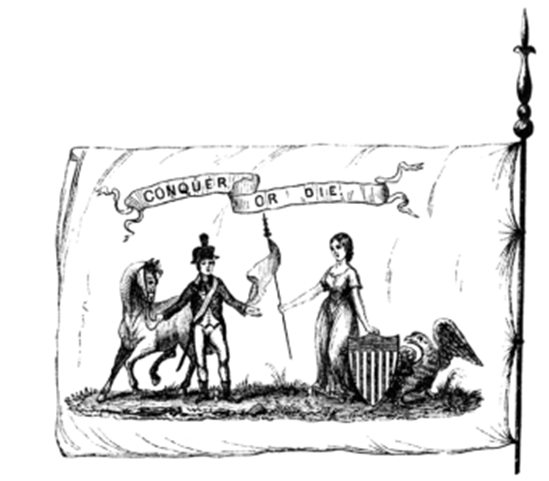
On May 1, 1777, he was selected for the Commander in Chief’s Guard, an elite corps formed to protect Washington personally, as well as the army’s funds and official documents. This was one of the most trusted assignments in the army. Officers were instructed to select men known for their honesty, sobriety, and reliability. Washington also had a preference for appearance, requesting soldiers who were well built, neat, and presentable. Johnston’s selection tells us a great deal about how he was viewed by those who knew him. He was not simply capable. He was dependable.
That summer, Johnston was stationed with the army at Middlebrook in the Watchung Mountains of New Jersey. It was there that he encountered the Marquis de Lafayette, the young French volunteer who had recently joined the American cause. Lafayette’s energy and enthusiasm made an impression on many, and Johnston was no exception. Over time, he developed a strong admiration for the Frenchman and would serve alongside him repeatedly during the war.
Although members of the Guard were not required to fight, they were hardly removed from danger. When the army was under pressure, many volunteered for active duty. Johnston was among them. On September 11, 1777, he joined Lafayette during the Battle of Brandywine. The fighting was severe, and the Americans were eventually forced to retreat. Still, the army remained intact. Lafayette distinguished himself in the action but was wounded in the leg. Johnston was chosen to accompany him to Bethlehem, Pennsylvania, where he remained for roughly two months while Lafayette recovered.
While Johnston was away from the main army, the British captured Philadelphia, the American capital. When Lafayette returned to duty, he quickly resumed active operations, and Johnston appears to have remained close to him, possibly taking part in reconnaissance efforts against British positions.
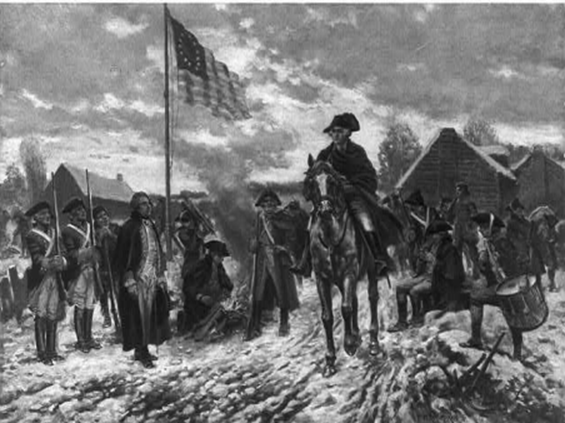
As winter approached, Washington moved his army into camp at Valley Forge. Johnston, like thousands of others, endured the harsh conditions there. The shortages of food, clothing, and medicine are well known. Disease spread quickly, and nearly two thousand soldiers died during the encampment. Yet Valley Forge was also a turning point. Through steady training and improved discipline, the army emerged in the spring of 1778 stronger and more capable than it had been before.
In May of that year, Johnston once again volunteered to serve with Lafayette, this time on a reconnaissance mission near Barren Hill. The operation nearly ended in disaster when British forces moved to trap the Americans. Lafayette managed a skillful withdrawal, slipping away with minimal losses. Johnston later described it as one of the finest retreats he had ever witnessed.
The tempo of the war increased soon after. In June 1778, as the British evacuated Philadelphia and moved across New Jersey, Washington sought to harass their retreat. Colonel Daniel Morgan and his riflemen were sent to pressure the British flank, and Johnston joined them along with other members of the Guard. It was a period of constant movement and readiness. Johnston later recalled that his cartridge box was never off his neck, a reflection of the relentless pace of operations.
That same month, he fought at the Battle of Monmouth. The engagement took place under intense heat and tested both armies. This time, the Continental Army stood firm against British regulars. The fighting was hard and often chaotic, but the Americans held their ground. By the end of the day, the British withdrew during the night. Washington praised his troops for their discipline and composure, clear signs of the army’s growing maturity.
Johnston continued to serve with the Commander in Chief’s Guard until his discharge on November 16, 1779, at West Point. For many soldiers, that would have marked the end of their service. For Johnston, it was only a pause. Encouraged to reenlist with the promise of rank, pay, and land, he chose to continue. His decision would soon carry him into a very different theater of war, where his experience would prove especially valuable.
Endnotes:
Avery, Elroy Mrs. ed. “Copy of a Letter From James Johnston, A Revolutionary Soldier, to General William H. Harrison”. The American Monthly Magazine 37 (1910), 235-237.
Babits, Lawrence Edward and Joshua B. Howard. Long, obstinate, and bloody: the Battle of Guilford Courthouse.
Eichner, L.G., M.D. “The Military Practice of Medicine During the Revolutionary War.” Tredyffrin Easttown History Club Quarterly 41.1 (2004), 25-32. 15 May 2011 .
Farmer, Lydia Hoyt. The Life of La Fayette, The Knight of Liberty in Two Worlds and Two Centuries. New York: Thomas Y. Cromwell & Co., 1888.
Godfrey, Carlos. The Commander-in-Chief’s Guard. Washington, DC: Stevenson-Smith Company, 1904.
Golway, Terry. Washington’s General, Nathanael Greene and the Triumph of the American Revolution. New York: Henry Holt and Company, LLC, 2005.
Hannah, George. Letter to Virginia Legislature. Aug 3, 1826. Richmond: Library of Virginia. Microfilm Reel No. 89.
Johnston, James. Letter to Virginia Legislature. Dec. 14, 1835. Richmond: Library of Virginia. Microfilm Reel No. 89.
Johnston, James. Letter to Virginia Legislature. Oct 23, 1826. Richmond: Library of Virginia. Microfilm Reel No. 89.
Pension file W7935, Johnston, Joice, Revolutionary War, HeritageQuest.com, File W7935, May 15, 2011.
Southern, Ed, ed. Voices of the American Revolution in the Carolinas. Winston-Salem: John F. Blair Publisher, 2009.
The Papers of George Washington Digital Edition, ed. Theodore J. Crackel, et al, Charlotte: University of Virginia Press, Rotunda, 2007-.
Wright, Robert K., Jr. The Continental Army. Washington, DC: Center of Military History, United States Army, 1983.
Will of Joice Johnston recorded in the Clerk’s Office of the Circuit Court of Henry County, Virginia in Will Book 5, page 611.
Bios:
Lori Amos Doss is a homeschool mother and homemaker living in Callands, Virginia. She enjoys history as a hobby and has completed several biographical research projects on her ancestors. Her original research and narrative on her ancestor, James Johnston, serves as the foundation for these articles.
Jarred Marlowe is a local historian who grew up outside of Danville but now lives in Collinsville with his wife and two daughters. He is a past president of the Colonel George Waller, SAR Chapter, a former board member of the Martinsville-Henry County Historical Society, and is a social media coordinator for the Blue & Gray Education Society. He co-operates the “History in Sight” YouTube page with Andy Doss. Jarred holds degrees from the Virginia Military Institute and Johnson University and currently works in the credit department for Carter Bank.
 Emerging Revolutionary War Era
Pingback: “In the Ranks of the Revolution: James Johnston’s War” Part II – Emerging Revolutionary War Era