

Emerging Revolutionary War welcomes guest historian Marc Lee.
At first glance, it is an unremarkable accounting ledger filled with columns of figures and financial calculations. Yet hidden among its entries is the story of a Revolutionary War soldier whose compensation claim continued to circulate through Connecticut’s bureaucracy years after the fighting had ended. The surviving manuscript, together with wartime muster rolls and treasury records, allows us to follow Edmund Fowler’s claim from military service to a replacement for a lost note, revealing how the Revolution’s paperwork could outlive the war itself.[i]
The document at the center of this story is an Invoice of Officers’ and Soldiers’ Notes, Payable June 1783, a manuscript created as Connecticut settled the financial obligations left by the Revolutionary War. Rather than recording the service of a single soldier, the ledger summarizes military notes issued to officers and enlisted men, listing an aggregate amount exceeding £10,700 and bearing a notation that the account was “charged July 9, 1784.” At first glance, it appears to be little more than a routine accounting record.[ii]
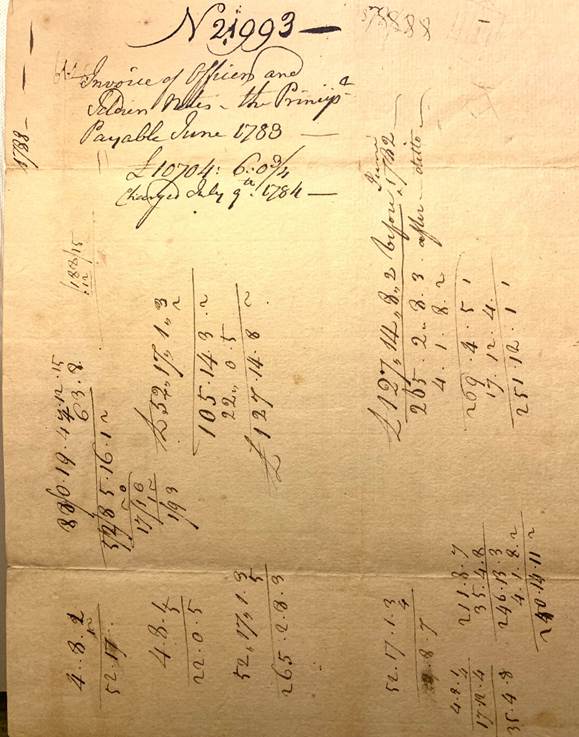
A closer examination tells a different story. The manuscript remained in active use long after it was first prepared. While the principal heading and endorsements were written in one hand, later calculations were added in a different ink and by a different hand, indicating that officials returned to the account years after the notes first became payable.[iii]
Those physical clues reveal an important reality about the Revolution’s aftermath. Paying veterans was not accomplished through a single transaction. Military service had to be verified, financial obligations reconciled, and documentary evidence maintained as claims moved through the state’s accounting system. What appears to be an ordinary ledger therefore preserves part of the administrative machinery that transformed wartime service into recognized financial compensation.
Among the many entries associated with Connecticut’s officers’ and soldiers’ notes is one that allows this broader process to be examined on a human scale. Through a series of surviving military and treasury records, the documentary trail of Revolutionary War veteran Edmund Fowler can be followed from his wartime muster rolls to the postwar administration of his compensation claim, offering a rare glimpse into how one soldier’s service continued to generate paperwork long after the fighting had ended.[iv]
The ledger identifies many officers and enlisted soldiers, but one name stands out because his surviving records extend well beyond this single document. Edmund Fowler appears in a series of Connecticut military records that preserve different stages of his wartime service, allowing his postwar compensation to be traced across several distinct record groups.[v]
Like many Connecticut soldiers, Fowler did not serve under a single commander throughout the Revolution. His name appears in multiple muster rolls created under different officers as enlistments expired, companies reorganized, and military assignments changed during the course of the war.[vi] Viewed individually, these records offer only brief snapshots of his service. Taken together, however, they establish the military service upon which his later financial claim depended.
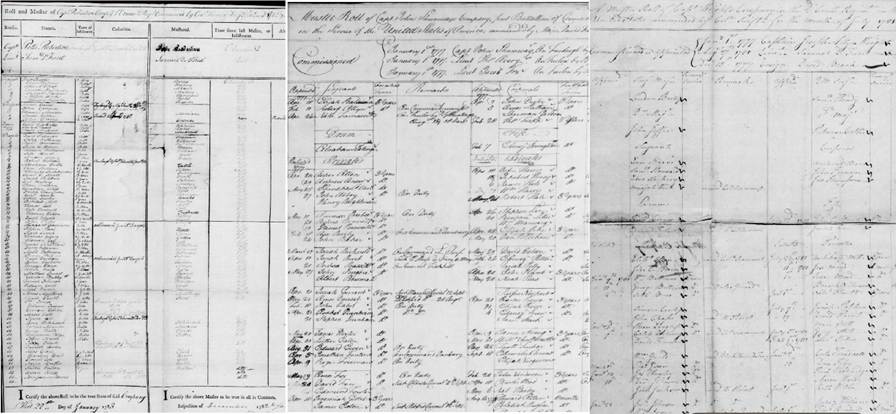
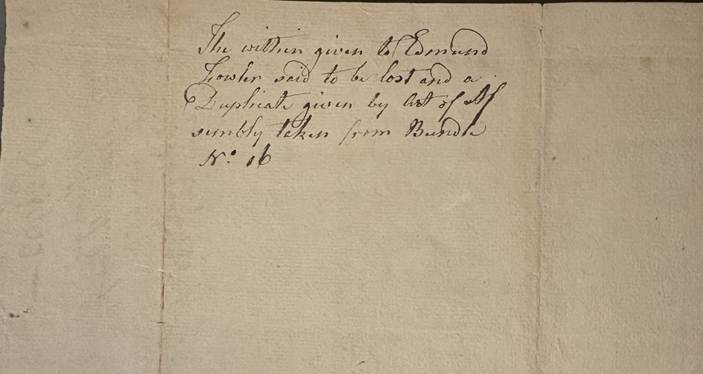
The invoice provides the next surviving chapter in Fowler’s documentary trail. By the time it was compiled, his wartime service had been converted into one of Connecticut’s officers’ and soldiers’ notes. The endorsement on the reverse further indicates that his original note had reportedly been lost and that a duplicate was issued under an Act of Assembly.[vii]
The final surviving piece of that record appears on the reverse of the invoice itself. There, an endorsement records that Fowler’s original note had reportedly been lost and that a replacement was apparently authorized under an Act of Assembly. Although the circumstances surrounding the loss remain unknown, the notation provides an unusually tangible reminder that the state’s responsibility extended beyond issuing compensation. It also had to preserve the legal documents that allowed veterans to claim it.[viii]
The endorsement documenting the replacement of Fowler’s lost note is more than a clerical notation. It reveals the practical challenges Connecticut faced as it settled the financial obligations left by the Revolution. Connecticut’s treasury records show that this was not an isolated procedure. The General Assembly established a process through which veterans who had lost their notes could petition for duplicates after meeting prescribed legal requirements.[ix] The notation on Fowler’s invoice reflects that broader system in action, preserving a rare example of how those policies were applied to an individual claim.
Viewed alongside the wartime muster rolls and treasury records, the endorsement completes an unusually well-documented paper trail. Few surviving records allow historians to follow a veteran’s path from military service through the administration of his compensation and, finally, to the replacement of the document that embodied his claim. In Fowler’s case, an ordinary accounting ledger became the final link in a paper trail spanning nearly a decade.
Today, the manuscript reminds us that the Revolution produced more than battles and political change. It also generated an immense administrative effort carried out by clerks, treasurers, and legislators whose work ensured that promises made during the war could be honored after peace was won. Though easily overlooked, records such as this invoice preserve that quieter history—one written not on the battlefield, but in the ledgers and files of Connecticut’s postwar government.
Edmund Fowler’s compensation claim survived because an unusual combination of records remained intact. Muster rolls documented his wartime service, treasury records traced the financial administration of his claim, and a working invoice preserved evidence of its continued use years after the war. Together, these documents reveal how Connecticut translated military service into a legally recognized financial obligation and maintained that obligation through successive stages of civil administration.
Although Fowler represents only one veteran, his surviving paper trail offers a window into a much larger process. Thousands of soldiers depended upon similar records as state governments struggled to settle wartime accounts in the uncertain years following independence. Most of those administrative transactions have long since disappeared into scattered archives, but this manuscript preserves a rare glimpse of the system in operation.
For historians, the significance of the invoice lies not simply in the financial figures recorded across its pages, but in the documentary connections it preserves. When examined alongside military and treasury records, an otherwise ordinary accounting ledger becomes evidence of the enduring relationship between military service, public finance, and governmental recordkeeping during the early years of the American republic. It reminds us that the Revolution’s legacy was shaped not only by soldiers in the field, but also by the clerks and officials whose careful recordkeeping ensured that their service could be recognized long after the fighting had ended.[x]
Bibliography
Invoice of Officers’ and Soldiers’ Notes, Payable June 1783. Manuscript. Private collection.
Connecticut State Library. Connecticut Archives: Revolutionary War, 1763–1789. Series I, Volume III (Pensions and relief for disabled; Soldiers’ notes; Private claims and petitions). General Assembly Papers. History and Genealogy Unit, Hartford, CT
United States. National Archives and Records Administration. Revolutionary War Rolls, 1775–1783. Microfilm Publication M246, Record Group 93. Washington, DC: National Archives and Records Administration. Accessed via Fold3.
Ferguson, E. James. The Power of the Purse: A History of American Public Finance, 1776–1790. Chapel Hill: University of North Carolina Press, 1961.
Hoadly, Charles J., ed. The Public Records of the State of Connecticut. Vol. 2. Hartford: Case, Lockwood & Brainard Company, 1895.
[i] Invoice of Officers’ and Soldiers’ Notes, Payable June 1783, charged July 9, 1784, manuscript, private collection; United States, National Archives and Records Administration, Revolutionary War Rolls, 1775–1783, Microfilm Publication M246, Record Group 93: Capt. Peter Robertson’s Company, p. 19; Capt. John Shumway’s Company, p. 30; Capt. Joseph Wyer’s Company, p. 45, accessed via Fold3.
[ii] Invoice of Officers’ and Soldiers’ Notes, heading and accounting calculations.
[iii] Invoice of Officers’ and Soldiers’ Notes, heading and accounting calculations.
[iv] Invoice of Officers’ and Soldiers’ Notes, heading and accounting calculations.
[v] Revolutionary War Rolls, 1775–1783, M246, RG 93, pp. 19, 30, 45.
[vi] Revolutionary War Rolls, 1775–1783, M246, RG 93, pp. 19, 30, 45.
[vii] Connecticut General Assembly, “Petitions for Duplicate Soldiers’ Notes,” Connecticut Archives: Revolutionary War, 1763–1789, Series I, Vol. III, Connecticut State Library, Hartford, CT.
[viii] Invoice of Officers’ and Soldiers’ Notes, reverse endorsement.
[ix] Charles J. Hoadly, ed., The Public Records of the State of Connecticut, vol. 2 (Hartford: Case, Lockwood & Brainard Company, 1895), 142–145.
[x] E. James Ferguson, The Power of the Purse: A History of American Public Finance, 1776–1790 (Chapel Hill: University of North Carolina Press, 1961), 25–28.
Bio:
Marc Lee holds a B.A. in History and an M.S.Ed. in Language Teaching. He is an independent researcher with an interest in Revolutionary War history.

