
Emerging Revolutionary War welcomes back guest historian Drew Palmer of Revolutionary Maryland
Part I
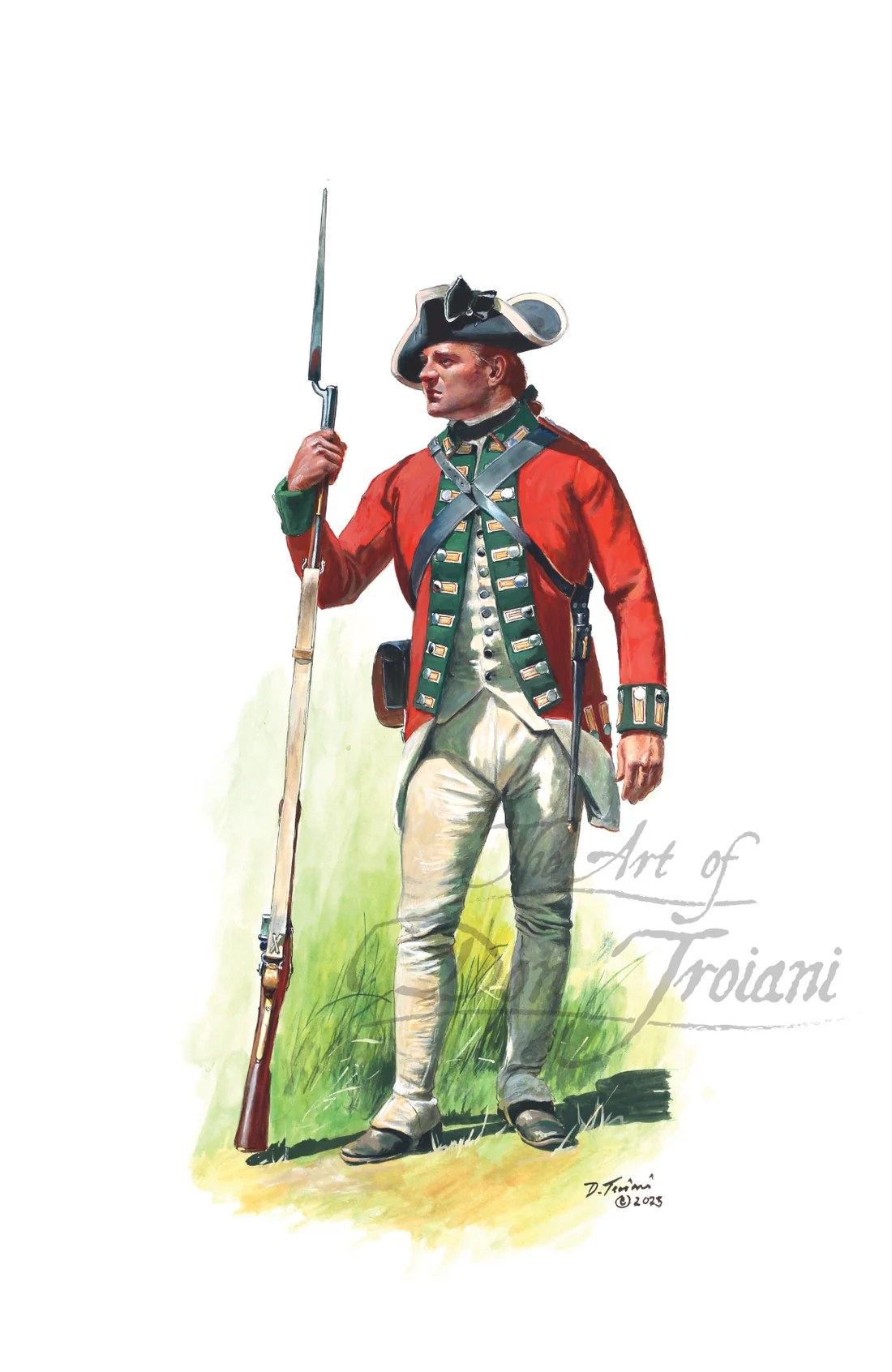
The historical memory of the Revolutionary War in Maryland generally focuses on the state’s Patriots. Men such as Otho Holland Williams and John Eager Howard are remembered fondly for their committed, heroic military service to the American cause. Politically, men such as Charles Carroll and William Paca—both signers of the Declaration of Independence and Maryland Patriots—are remembered for their commitment to the cause. Studying and remembering these men is vital to understanding Maryland’s role in the conflict. However, the Revolutionary War was a civil war. A civil war that made men from the same states sworn enemies. Though Maryland is rightly known as a state that contributed immensely to the Patriot cause, both ideologically and materially, it had a sizable and vocal minority of Loyalists who took it upon themselves to fight against the Patriot cause. Just like Maryland Patriots, Maryland’s Loyalists supported their cause both politically and militarily.
Geography and Religion
The strength of Loyalist sentiment depended on where you were in Maryland. Baltimore, Annapolis, and the surrounding area mostly favored the Patriots. After the Patriot Committees of Correspondence in Baltimore and Annapolis developed their own networks of communication and governance, they strictly enforced conduct among people living within their areas of control. Anyone deemed an enemy “to the cause of liberty” faced strict legal and extralegal proceedings, along with harsh punishments. Though the Patriot cause already preached ideals of liberty, free speech, and self-governance, Patriot governments ironically cracked down hardest on political dissent early in the conflict. The accused dissenters were expected to beg for forgiveness before a Patriot tribunal.
Many such instances occurred in Baltimore in 1775, when James Dalgleish, a merchant, was accused of saying, “that as soon as the English troops shall land here, he will join them against the Americans, it being a folly for him to longer deny his principles.” The Baltimore Committee of Correspondence deemed Dalgleish dangerous to the cause and an “incurable enmity to this country.” Dalgleish was summoned before a tribunal where he had to beg for forgiveness and blamed his Loyalist speech on his drinking. The Continental Congress declared Dalgleish an “enemy to the liberty of Americans.” Out of fear of violent retribution, Dalgleish fled Baltimore and was never seen again.1
James Christie, another merchant from Baltimore, faced ridicule and ousting from the Baltimore Committee of Observation for saying in a letter that, “we are in such terrible confusion here with our politics, there is no depending on anything, and that makes me wish myself out of this province. We have some fanatical spirits among us, who do everything in their power to run things to the utmost extremity, and they are gone so far, that we moderate people are under a necessity of uniting for our own defense, after being threatened with expulsion and loss of life.”2 Christie was arrested, deemed an enemy to liberty and the people of America, and, “banished from the province forever.”3 Early in the conflict, it was not realistic to be an outspoken Loyalist in most of the Baltimore and Annapolis region due to organized systems of punishment for speaking against the Patriot cause. Outspoken Loyalism was minimal in the greater Baltimore and Annapolis regions. Maryland’s Eastern Shore, on the other side of the Chesapeake Bay, was a different story.
Maryland’s largest contingent of Loyalists was on the Eastern Shore. Loyalists came from every social class on the Eastern Shore, whether they were plantation owners, fishermen, small farmers, or tradesmen. The large numbers of Eastern Shore Loyalists stemmed from the influence of the local Church of England, commonly called Anglicans, whose ministers preached loyalty to the King. This loyalty should not be considered surprising since Anglican clergy took oaths of loyalty to the King of England at their ordinations. Deeply intertwined with English history, culture, and government, Anglican ministers often refused to abandon the King’s name and, in many cases, urged their congregations to resist the popular rebel movement
sweeping across Maryland.4
What scared Maryland’s revolutionaries most was popular and influential religious leaders using their platforms to discourage people from the Patriot cause. This was exactly what was occurring in the Chester parish in Chestertown, Maryland, where the Reverend John Paterson’s candid views made him a target for silencing by the Kent County Patriot Committee. Paterson was called in front of the committee and used the opportunity to declare that the Continental Congress and the Kent County Committee were illegitimate, that the current proceeding was a sham, and concluded his impassioned criticism by writing that, “there was more liberty in Turkey than in this Province.”5
At Queen Anne’s parish, Reverend Jonathan Boucher delivered a sermon entitled, “On Civil Liberty, Passive Obedience, and Nonresistance,” to his followers in the parish. The sermon mostly focused on how religion relates to obedience and respect for authority. Boucher stated to his followers that “obedience to government is every man’s duty because it is every man’s interest. Boucher further believed that obedience to government was essential for Christians because it is “enjoined by the positive commands of God.” Boucher also preached against the idea of equality and felt that it was human nature that people were naturally inferior and subject to another authority. Boucher thought that Patriots, “openly teach and inculcate principles subversive of all good government. Realizing he could not stay in Maryland for much longer, Boucher left for London.6
As Patriot authorities saw the growing influence of Loyalist preachers on the Eastern Shore, crackdowns intensified. Reverend John Bowie in Worcester County refused to take an oath of fidelity to the Patriot cause and was imprisoned in Annapolis. The Reverend John Scott, also of Worcester, was investigated for having Tory sympathies. Authorities arrested him and forced him to pay a large fine. When Scott was freed, authorities did not allow him to preach on public affairs.7 In Cecil County, Reverend William Edmondston circulated pamphlets urging people to stay loyal to the king after hearing of Patriot calls for arms and ammunition.8 Eastern Shore loyalism evolved from preachers’ pulpits into hundreds of men willing to fight against the
rebel cause. Due to heavy crackdowns by the Patriot governments on the Eastern Shore, the Loyalist movement had been passionate and popular but largely ineffective because it lacked organized leadership.9 However, this changed by late March 1776.
James Chalmers: A “Worthy Character”
In 1760, James Chalmers arrived in Maryland and settled in the Chestertown region of Kent County. He was born in Scotland in 1727 and left for the British West Indies at thirteen. What Chalmers did in the West Indies remains unclear. It is clear, though, that he made a fortune while there. When Chalmers arrived in Maryland, he had several enslaved people with him and
thousands of British pounds. The amount of money Chalmers had made it relatively easy for him to become a landowner of great standing; his wealth gave him popularity, influence, and confidence. Chalmers was described as “a sound disciplinarian, resolute, strict, and humane. He was “well bred and well-informed,” and had “strong peculiarities of his temper, manner, address, and diction.” 10 In 1775, suspicions first arose about Chalmers’ loyalty when he declined requests to serve on Patriot committees. He was offered command of a Patriot militia regiment sometime in 1775, which he declined. Written by Thomas Paine on January 10, 1776, Common Sense argued that Great Britain had no right to govern America. It stated that Britain’s system of
government was corrupt and that it made more sense for Americans to govern themselves. Though Common Sense was incredibly popular, many Loyalists viewed Paine’s pamphlet as dangerous and successful propaganda. Chalmers was one of these Loyalists.
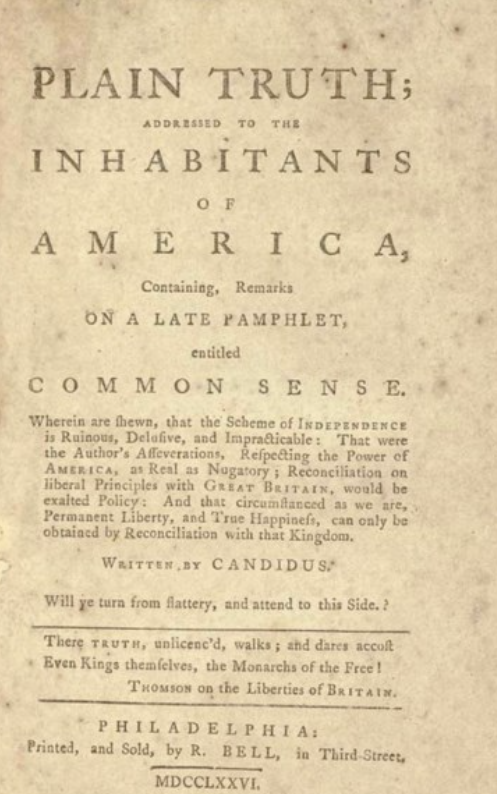
Chalmers, articulate and confident as ever, challenged Paine’s Common Sense with his own literary rebuttal, Plain Truth. In seventy pages, Chalmers ripped apart Common Sense. Chalmers called Paine “a political quack,” and wrote that, “even with its imperfections, [the English Constitution] is, and ever will be, the pride and envy of mankind.”11 Chalmers also attacked Paine’s love of Democracy, calling it unreliable. Chalmers asserted that, “The Demogogues to seduce the people into their criminal designs ever hold up democracy to them…. If we examine the republics of Greece and Rome, we ever fine them in a state of war domestic or foreign…. Apian’s history of the civil war of Rome, contains the most frightful picture of massacres…. That ever were presented to the world.”12
Chalmers also reminded his readers of the great debt of loyalty the colonists owe to Great Britain for the colonies’ success, writing that English settlers brought to the colonies “toleration, industry, and permanent credit.” He further states, “The people of England, encouraged by the extension of their laws and commerce to those colonies, powerfully assisted our merchants and planters, insomuch, that our settlements increased rapidly…. It may be affirmed, that from this period, until the present unhappy hour; no part of human kind, ever experienced more perfect felicity. Voltaire indeed says, that if ever the Golden Age existed, it was in Pennsylvania.”13
Chalmers noted that the colonies could not win a war against Great Britain. From his perspective, the colonies’ weaknesses made it laughable to support the Patriot cause against arguably the greatest army and navy in the world, especially given their lack of industry and coordination to produce arms and ammunition. In short, Chalmers did not think the colonies stood a chance. Chalmers further asserted that much of Great Britain’s authority and “political existence” depended on the colonies’ obedience, and that Great Britain would stop at nothing to save itself “from ruins” and the prospect of France.14 After publishing Plain Truth, Chalmers was just as angry and published a further writing called Additions to Plain Truth. After mostly reiterating arguments from the original Plain Truth, Chalmers made one last plea to colonists, saying, “Let us remember that reconciliation on generous principles with Great Britain, is our true and only road to permanent happiness. Above all, let us seriously consider, that this when
the commissioners arrive to treat with the Congress, is the juncture, this the moment, when we may receive everything we can reasonably desire. I conclude these remarks, by observing, that if they are founded in truth, they will instruct you to keep a good lookout, that ye may not be surprised into American independency without a thorough examination of it and its
consequences.”15
Plain Truth failed to capture the American mind the way Thomas Paine’s Common Sense did. Chalmers’ writing was overshadowed by recent Patriot victories. The British had just evacuated Boston, and Patriot morale was sky-high. Though Plain Truth did not change the tide of the rebellion, it was widely circulated and was even read in England. Plain Truth certainly raised Chalmers’ status as an influential and respected Loyalist. The notoriety Plain Truth generated for Chalmers in Loyalist circles led to his sitting across a table from General Sir William Howe, commander of British forces in America, a year after Plain Truth’s publication. Perhaps Chalmers thought that his career was about to take off.
The endnotes for the three-part series will be included at the end of Part III*

