Offering engaging perspectives on the Revolutionary War Era
Author: Eric Sterner
Eric Sterner is the author of three books on the American Revolution: Anatomy of a Massacre (Westholme, 2020), The Battle of Upper Sandusky, 1782 (Westholme, 2023), and Till the Extinction of This Rebellion (Westholme, 2024). He spent most of his career in the national security and aerospace communities and earned a Bachelor's in Russian/USSR Area Studies and separate Master's Degrees in Security Policy Studies and Political Science.
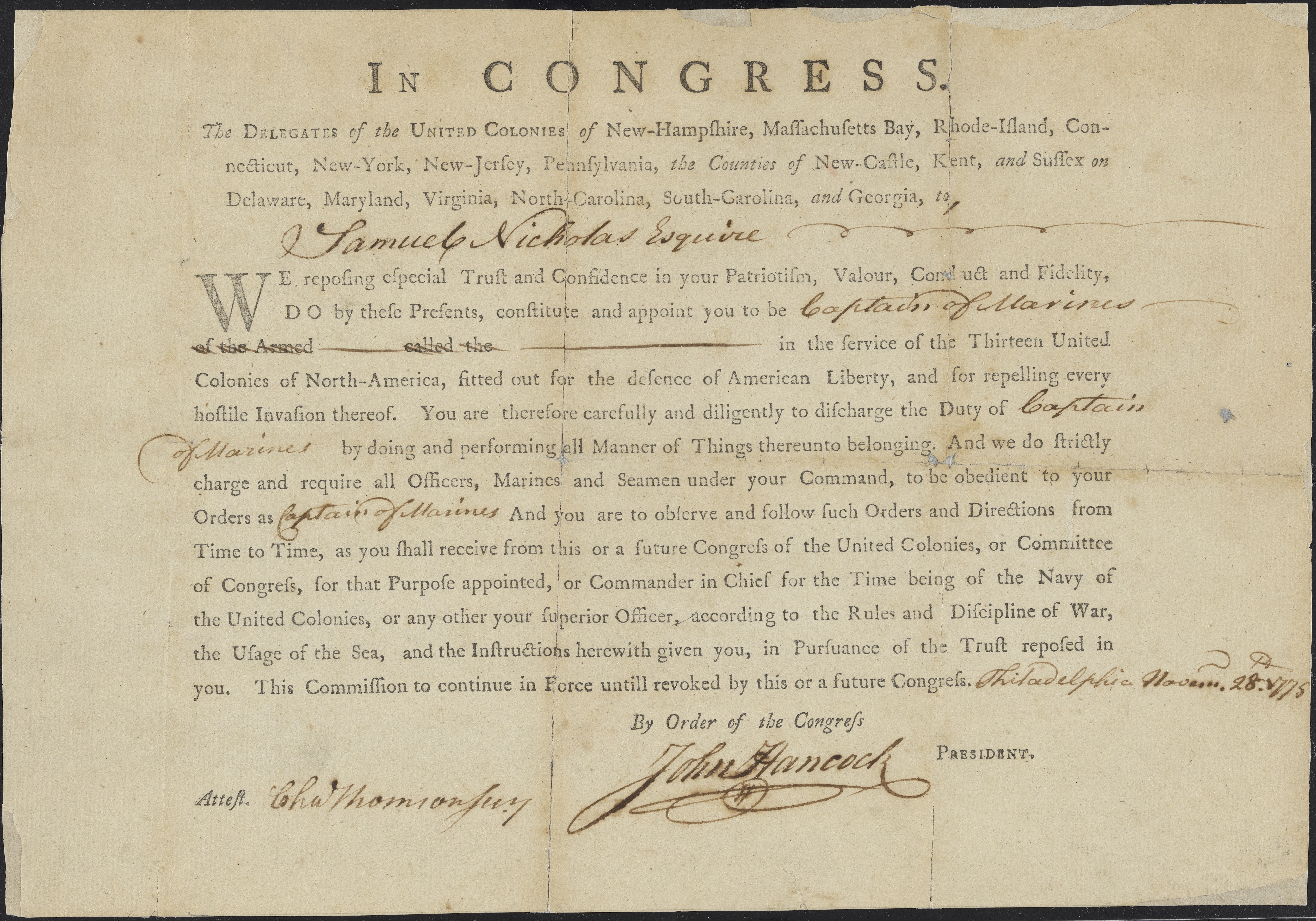
The Commission of Captain Samuel Nicholas, the first American Marine. (USMC)
Today marks the 250th birthday of the Marine Corps. November 10, 1775 was a milestone in the creation of American naval power, but the birthday story is a little more complicated.
The Continental Congress resolved to create a navy under its auspices on October 13, 1775, but much work remained to build American naval power to a point where it might serve a strategic purpose. Individual colonies had already begun creating naval forces and George Washington had leased ships under the army’s authority. Thus, the resolution served as more of milestone on a long road, rather than a fresh beginning.
On October 30, the Continental Congress considered the reports of its naval committee and confirmed recommendations for two vessels of 14 and 10 guns. Moreover, it resolved to add two more ships to its burgeoning navy, one of 20 guns and one carrying up to 36 guns. It also added four new members to the naval committee, bringing it to a total of seven. Stephen Hopkins (RI), Joseph Hewes (NC), Richard Henry Lee (VA), and John Adams (MA) joined John Langdon (NH), Silas Deane (CT), and Christopher Gadsden (SC).[1] On November 2, Congress gave the naval committee authority to call on the treasury for up to $100,000 to acquire a navy and delegated to the committee the authority to recruit officers and seamen, offering them prize money in the amount of one-half the value of all warships and one-third the value of transports made prizes.[2] It also took up a petition from a Committee of Safety in Passamaquoddy, Nova Scotia to join the association represented by the Continental Congress. Naturally, Congress appointed a committee—Silas Deane, John Jay, Stephen Hopkins, John Langdon, and John Adams to consider the matter. The naval expansion and Passamaquoddy petition sparked a new round of thinking about American naval power.
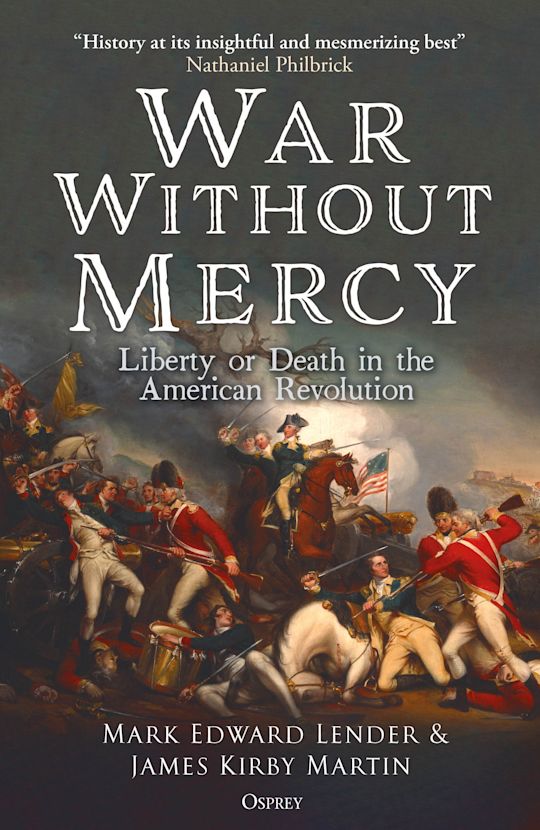
War Without Mercy: Liberty or Death in the American Revolution by Mark Edward Lender and the late James Kirby Martin is an enlightening and innovative look at violence and norms during the American Revolution. The authors waste no time getting to the point: they want to know why the war reached a point in which seemingly boundless levels of violence were embraced by all sides without regard to emerging standards of international law nominally intended to govern the use of force in warfare, collectively referred to as jus in bello, a Latin phrase essentially referring to the legal conduct of a war or justice in war. (Jus ad bellum refers to the legality of initiating a war. Collectively, they are key components of just war theory. Lender and Martin focus on jus in bello, particularly as it refers to legal or moral constraints on violence.)
War Without Mercy lays out the basic concepts of jus in bello as it was understood in the late 18thcentury. While historians often attribute the origins of modern international law to Hugo Grotius, Lender and Martin take Emer de Vattel’s landmark 1758 work “The Law of Nations” as the baseline text relevant to the American Revolution. Vattel offered limits on the conduct of military operations, clearly delineating concepts such as combatants, non-combatants, and proportionality. In general, he tried to narrow the scope of war so that it remained the domain of organized governments and outside the domain of broader society. Elites on both sides of the Atlantic had often read Vattel’s work, or were at least familiar with the ideas it contained, and War Without Mercy demonstrates that many of them sought to honor its principles, for moral, professional, and practical reasons.
That said, Lender and Martin argue that violence committed outside of the purview of elite-led revolutionary governments and the Continental Army (usually) characterized the war. The vast majority of fighting during the American Revolution occurred in small battles, skirmishes, and raids that resembled mob and gang violence directed at people out of uniform more than organized martial conduct. In that context, it routinely violated concepts of jus in bello. In addition to outlining earlier studies making that case, War Without Mercy examines the war in New Jersey, the western theater, the New York frontier, and the south. While those regions saw significant battles or campaigns, the day-to-day war was fought between small units of militia or irregulars with an occasional admixture of regulars or Continentals. In each case, Lender and Martin examine the escalation of events over the course of the war and the reasons each side tended toward “existential warfare,” essentially, war to the death in which the alternative to victory was total destruction. Given such high stakes, any constraints on means were self-defeating. No combatants could run the risk of losing the war by being charitable towards their enemies. Outrage sparked outrage. Thus, violence escalated like a ratchet as each side retaliated for perceived wrongs. It was a possibility several prominent patriots recognized before the fighting began. Indeed, James Lovell predicted it in his 1771 speech commemorating the Boston Massacre. War Without Mercy attributes the beginning of the cycle to the rebels, who quickly turned to intimidation, the threat of violence, and outright violence to silence loyalists and establish local political control as British colonial government collapsed.
One chapter examines Benedict Arnold’s raid on New London, CT. Lender and Martin consider the offensive and the Battle of Groton Heights, as the assault on Fort Griswold defending the River Thames was known, in the context of jus in bello. In general, despite the destruction of New London and the bloody results at Fort Griswold, they find the raid consistent with Vattel’s law of war. As a major privateering base, New London made itself a legitimate target of war and Arnold strove to limit damage to private property that did not contribute to the American war effort. The bloodletting at Fort Griswold was more the result of the fog of war, weak command and control, and the natural challenges of suddenly attempting to restrain men in the midst of intense combat. The New London raid, however, does demonstrate the blurring of lines between combatant and non-combatant, legitimate and non-legitimate objects of military operations, under the doctrine of jus in bello, as the war progressed and intensified. Lender and Martin liken it to the difficult decisions facing RAF Bomber Command during World War II, when it shifted from ineffective attempts to bomb specific targets to area bombing.
War Without Mercy is a must read. Revolutionary War library shelves are rife with biographies, battle studies, and political narratives. Fewer books place the American Revolution in the wider study of warfare and its evolution. By considering the war in the context of emerging principles of jus in bello and the rapid escalation to existential warfare, Lender and Martin are bringing a new analytical perspective to the study of the American Revolution. It’s a vital interpretation of the war’s nature.
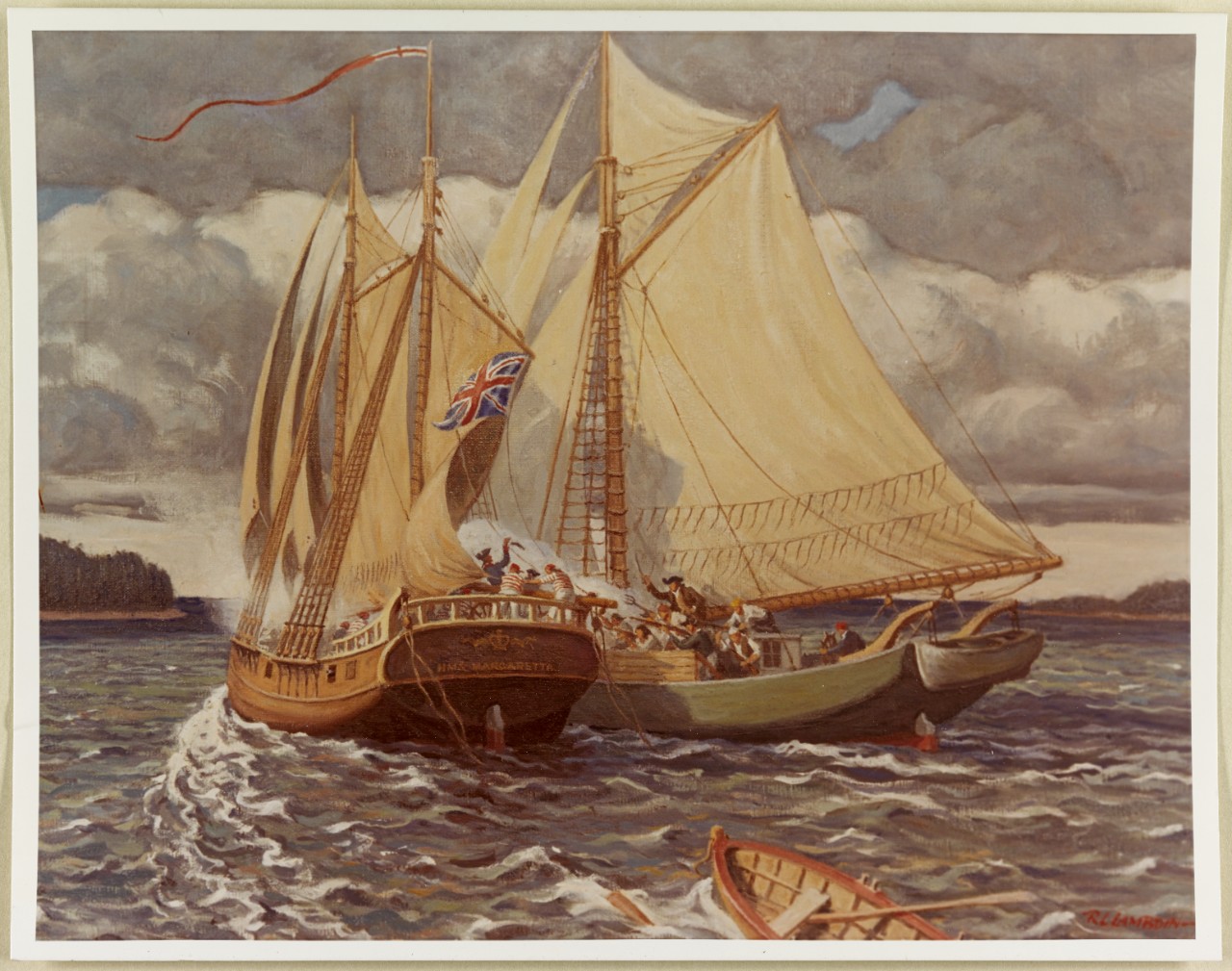
Unity vs. Margaretta, 12 June 1775 by Robert Lambdin (Naval History and Heritage Command). Margaretta was a Royal Navy vessel captured off Machias, then part of Massachusetts but now in Maine. The image illustrates the relatively small sizes of vessels involved in creating the early American navy.
During the first six months of the American rebellion, the colonies inched toward some means of dealing with Britain’s naval superiority. Over the summer the Americans had already waged a sort of whaleboat war among the estuaries and islands around Boston, mainly to deprive the British army couped up there of forage and fodder. Efforts escalated as the war continued. A confrontation between small Royal Navy vessels and the Massachusetts town of Machias over the summer serendipitously resulted in a small Massachusetts Navy created by capture in June 1775.[1] In June, Rhode Island’s General Assembly voted to charter two ships and outfit them for naval operations to protect the colony’s trade, essentially by contesting the Royal Navy’s control of Narragansett Bay.[2] In September, Colonel John Glover in the Continental Army offered his fishing schooner, Hannah, as a charter to wage war on the sea. George Washington naturally accepted, limiting its operations to capturing unarmed supply ships serving the British army.[3] The army had essentially created its own navy out of necessity.
The American Revolution on the frontier produced its share of stories and legends. In many ways, the heroes in those tales were more relatable than the men who led the war east of the Appalachians. They were not land-owning generals like George Washington, political organizers like Sam Adams, world-renowned scientists like Benjamin Franklin, inspiring speakers like Patrick Henry, or political philosophers like Thomas Jefferson. Instead, they were farmers turned amateur soldiers, trappers and hunters turned scouts, family men turned avenging marauders. In at least one case, even a quasi-fugitive from the law could become a symbol of protection and security.
By the 19th century, names like Daniel Boone, Simon Kenton, Ebenezer Zane, Lewis Wetzel, Issac Shelby, and Samuel Brady were known to every schoolboy west of the Appalachians. Some of their reputations faded with time as the frontier moved west onto the Great Plains and into the Rocky Mountains. Still, the stories remained, mostly to sit in in aging volumes on a library bookshelf, but occasionally to be dusted off for works of historical fiction. Like most stories, they occasionally morphed and evolved over time in the retelling. Sometimes they hold up quite well on close examination and can be verified.
Sometimes a little more skepticism may be in order. Samuel Brady’s leap over a river is one such story. There are two versions of the story. In one he leaped to the opposite side of a rocky Cuyahoga River chasm. In the other, he leaped entirely across a deep ravine through which Slippery Rock Creek ran.
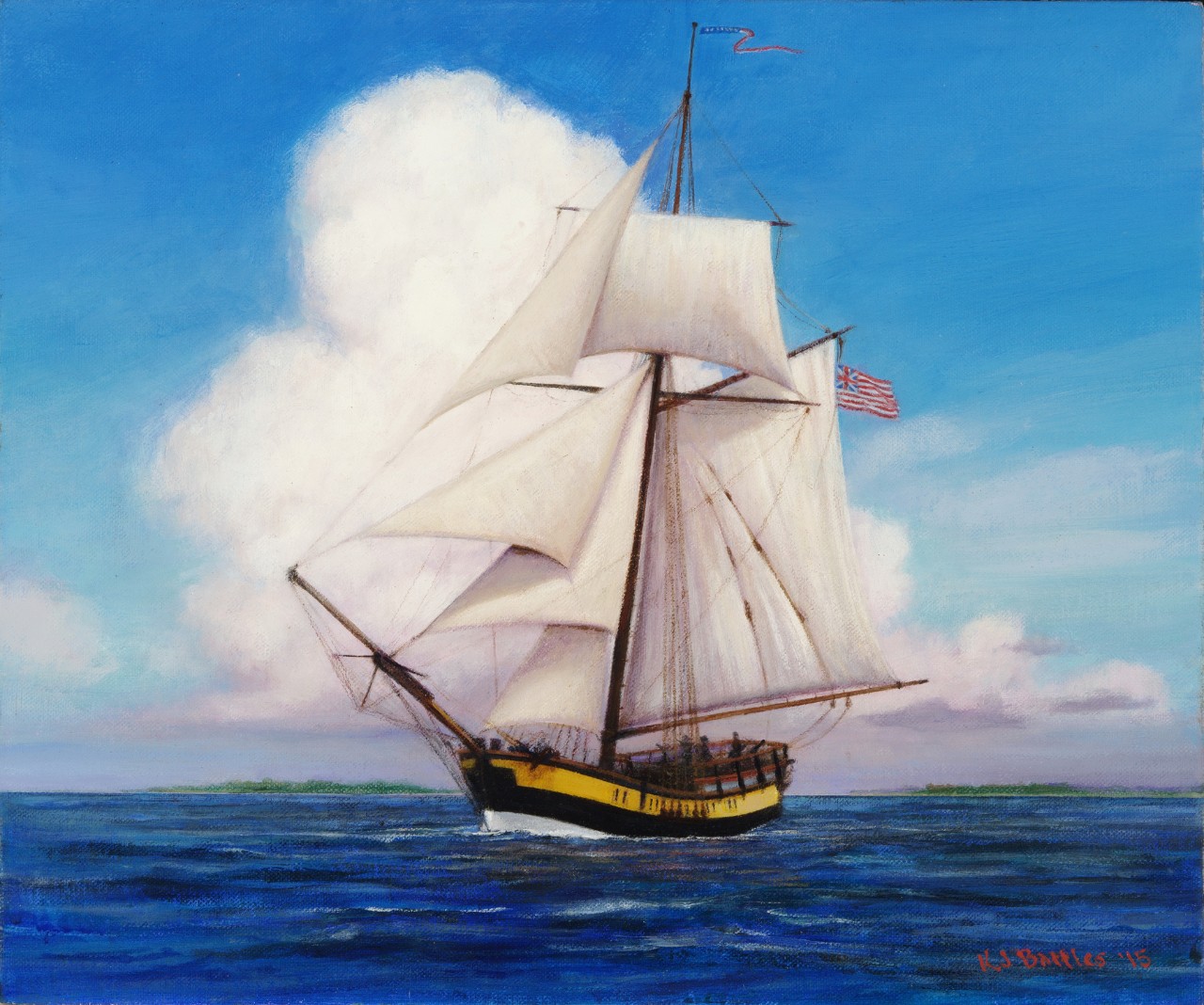
Katy in her later service as the Continental Navy ship Providence. “Sloop Providence under Sail by Kristopher Battles” (Naval History and Heritage Command)
Since his brief visit in November 1774 and his longer term stay commencing in December, Captain James Wallace of the British ship Rose (20 guns), had patrolled Narragansett Bay to enforce the Coercive Acts and prevent Britain’s rebellious colonies from importing gunpowder and armaments. Loyalists had taken heart and rebels had been frustrated with his presence. Not only were his patrols interfering with local commerce by seizing ships and their cargos—his main mission—but he created a more visible symbol of Britain’s ability and willingness to force its colonists to comply with Parliament’s laws.
One of the loyalists encouraged by the Royal Navy presence in Narragansett Bay was a Newport merchant named George Rome. Wallace had visited Rome and was dining with him when a breathless messenger warned the captain that a mob was out to tar and feather him back in December, 1774. In the moment, nothing came of it, but Governor Joseph Wanton warned Wallace that the town was not safe for British officers, sailors, or loyal subjects. Things remained at a low simmer that winter and spring, including the initial weeks after the Lexington and Concord. Tensions, however, could not help but rise. Diarist Ezra Stiles, recorded on May 23 that some 90 Rhode Island soldiers under the command of Captains [John] Topham and [Thomas] Tew marched from the Newport courthouse and through town beating up volunteers to join the nascent American Army. Wallace was dining in town that day and no doubt heard the racket.[1] Stiles wrote, “The Tories were greatly mortified to see the daring Boldness of the Rebels as they called them. The Tories had said that the Men o’War would fire the To[wn] if any Soldiers were raised in it. But there was no Molestation.” From Stiles’ version of events, the march appears as nothing less than a provocation to determine whether the rumored threat of Wallace and his ships to Newport proper was a bluff. The lack of an immediate response may have demonstrated that it was. In truth, a significant portion of Newport’s population opposed the rebels and voluntarily supplied Wallace and contracted for grain to provide to the British army.
James Wallace of the Royal Navy commanded the twenty-gun Rose and arrived in Narragansett Bay on November 5, 1774. Over the next six months, it served as a base to maintain his ship and operate in the waters off Connecticut and Rhode Island to enforce the Coercive Acts passed earlier that year and prevent the colonies from importing guns, gunpowder, or other armaments. The Rhode Island Assembly took advantage of Wallace’s brief absence in December to remove most of the armaments from Fort George, which protected Newport, and take them to Providence, ostensibly to defend the colony from Canadians and Native Americans. Of course, they were also farther from British reach. The governor was explicit with Captain Wallace about the motivation: “they had done it to prevent their falling into the hands of the King, or any of his servants; and that they meant to make use of them, to defend themselves against any power that shall offer to molest them.”[i] Wallace sensed rebellion in the air and promptly asked the governor, Joseph Wanton, whether he [Wallace] might expect assistance in carrying out the king’s policies in Rhode Island. The answer was a swift “no.”
Nevertheless, Wallace remained ashore, as officers and seamen did when a ship was in port. As if to confirm local sensibilities, Wallace heard that a mob threatened to seize, tar, and feather him while he dined ashore. He quickly ordered his pinnace and cutter—boats from the Rose—to be manned and summoned men to his temporary quarters. He waited six hours, but no mob appeared. Not wanting to over-react to rumors, he again wrote the governor to ask about the rumored mob and determine whether Wanton would use his powers in Wallace’s defense. Wanton declined to respond in writing, but assured Wallace’s messenger that “they,” meaning the men assembled on the streets, did not intend to insult Wallace. Instead, Wanton himself feared local rebels might assault him and the town. He gave the messenger, and by extension Wallace, the impression that Newport was not safe for the King’s subjects, including the ships, officers, and crew of the Royal Navy.[ii] It was unwelcome news for the naval officer, as Vice Admiral Samuel Graves, commanding the North American Station, expected Wallace and Rose to winter over in the bay.
Students of the American Revolution face a wealth of opportunities at the end of May with two conferences in Virginia and New York. Although they overlap, they’re far enough apart geographically to cater to people from New England through the Mid-Atlantic down to the South.
National Museum of the United States Army Symposium
Events marking the 250th anniversary of the American Revolution are well underway and ERW is along for the ride to bring them to a wider audience. With that in mind, we’re pleased to draw attention to The National Museum of the United States Army, which is opening a new exhibit titled “Call to Arms: The Soldier and the Revolutionary War” and kicking off events with a Symposium on the war’s early years. (https://www.thenmusa.org/symposium2025/)
The Symposium starts virtually in the evening of May 29 with a panel discussion on commemoration before moving to both virtual and in-person talks on Friday, May 30. Panelists include:
David Preston: “The Roots of Conflict.”
Holly Mayer: “The Formation of the Continental Army.”
Michael Cecere: “The Early was in the South.”
Panel: “Revolutionary War Leadership,” with Christian McBurney, Joyce Lee Malcolm, and Ricardo Herrera.
Mark Lender: “Washington’s Campaigns, 1776-1777.”
Those attending in-person will have a sneak peak at the “Call to Arms” exhibit. On May 31, John Maass will lead a group on a walking tour of George Washington’s Alexandria, Virginia.
The conference and walking tour are free, but do require registration as space is limited.
Fort Plain Museum and Historical Park Conference
The same weekend, Fort Plain Museum and Historical Park is holding its annual Revolutionary War Conference in Johnstown, NY with an equally auspicious lineup of speakers and presentations. Events begin with a bus tour of Lexington and Concord on May 29 and then recommence with a full series of speakers in the afternoon of May 30, all day on May 31, and a series of presentations on the morning of June 1.
Some of the featured speakers include Pulitzer Prize winning author Rick Atkinson, previewing his forthcoming book “The Fate of the Day: The War for America, Fort Ticonderoga to Charleston, 1777-1780,” Don Hagist discussing his groundbreaking work on British soldiers in the war, and Major General Jason Bohm, USMC (ret) on his book about the founding of the Marine Corps during the Revolution and its earliest operations.
Kentuckians knew 1777 as the “Bloody Sevens” due to the severity and frequency of Native American attacks. Those raids were difficult in the spring, but only intensified after June, when Henry Hamilton, a Detroit-based lieutenant governor of Quebec, executed his orders to actively promote and support Native American offensives across the Ohio River. In particular, war parties from the Ohio and Great Lakes Indian nations allied with Britain crossed the Ohio and struck the region’s three largest towns: Harrodsburg, Boonesborough, and St. Asaph’s/Logan’s Fort. Of the three, the last was the smallest by far, and yet it was the scene of some of the year’s most dramatic moments.
In the spring of 1775, Benjamin Logan led a surveying party into Kentucky and established a “town” of sorts—mostly surveyor’s huts—that they dubbed St. Asaph’s. For his part, Logan built a log cabin and planted a corn crop that later established his land claim. Logan’s group did not remain long as Kentucky was already under attack, but he and several others, including his family, eventually returned in March 1776.[1] A raid on Boonesborough that summer prompted the St. Asaph’s residents to begin fortifying their town. Logan’s family left for the additional safety of Boonesborough, but he remained behind with several enslaved people to continue working on the fort.
Fortified towns were typically established by building two lines of cabins in parallel lines with their fronts face one another. Windows were limited to the front and perhaps the sides, but the rear wall was solid with narrow firing slits. Gaps in between cabins were then closed by digging a trench and standing cut posts in them upright, then filling in the trench and creating a wall. It was a fast means of quickly building a fort. More robust defenses would include blockhouses at the corners with overhanging rooms on a second story enabling defenders to fire down and along walls. There would be a substantial gate on one side and then perhaps a sally port or two along the walls or in a corner blockhouse. The common area between the rows of cabins would often have common buildings and facilities, such as a smithy, herb gardens, a powder magazine, etc. Several buildings, ranging from cabins to storehouses and horse stalls, might remain outside the walls. Residents of the community would then retreat into town when concerned about attack. Logan moved his family back to the fortifying town in February.[2] Logan took the additional step of digging a trench to a nearby spring to create a secure water supply. He then covered it and it was sometimes referred to as a tunnel, even though it was not completely underground.[3] The fort at St. Asaph’s, now more widely known as Logan’s Fort, was completed just in time.
Reverend John Gano served as a pastor of a Baptist Church in New York City before the Revolution. When the British occupied the city, his congregation split and dispersed. Although he resisted attempts to recruit him as a chaplain, the minister accepted an invitation to preach to a Continental regiment on Sundays until the Royal Navy cut him off from Manhattan. Recalled Gano, “I was obliged therefore, to retire, precipitately, to our camp.”[1] The preacher would become a chaplain after all. Gano joined Colonel Charles Webb’s Connecticut Regiment and followed it.
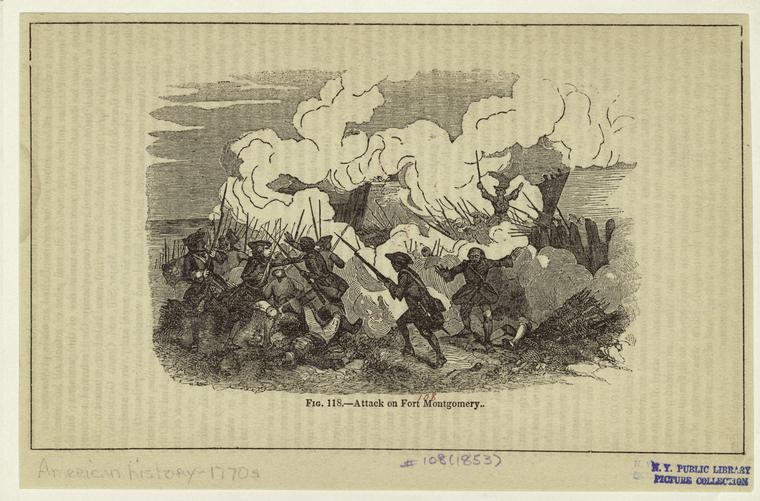
Gano stayed with the army, was there during the battles in New York and mistakenly found himself in front of his regiment at White Plains. He remained with the unit until enlistments expired at the beginning of 1777. The minister pledged to rejoin if Webb and his officers raised a new regiment, but instead found himself at Fort Montgomery on the Hudson, eventually succumbing to arguments from General James Clinton and Colonel “Dubosque” to join the men stationed there as a chaplain. (This was probably Colonel Lewis Dubois of the 5th New York.) He remained there until Sir Henry Clinton launched his autumn attack into the Hudson Highlands to support General Burgoyne’s campaign to Albany. Allowing for the uncertainties and errors of first-hand experiences and perspectives, the happenstance-chaplain provided an excellent first-hand account of the battles for Fort Montgomery and Fort Clinton on October 6, 1777.
“We had, both in Fort Montgomery, and Fort Clinton, but about seven hundred men. We had been taught to believe, that we should be reinforced, in time of danger, from the neighbouring militia; but they were, at this time, very inactive. We head of the approach of the enemy, and that they were about a mile and a half from Fort Clinton. That fort sent out a small detachment, which was immediately driven back. The British army surrounded both our forts, and commenced universal firing. I was walking on the breastwork, viewing their approach, but was obliged to quit this station, as the musquet balls frequently passed me. I observed the enemy, marching up a little hollow, that the might be secured from our firing, till they came within eighty yards of us. Our breast-work, immediately before them, was not more than waist-band high, and we had but a few men. The enemy, kept up a heavy firing, till our men gave them a well directed fire, which affected them very sensibly. Just at this time, we had a reinforcement from a redoubt, next to us, which obliged the enemy to withdraw. I walked to an eminence, where I had a good prospect, and saw the enemy advancing toward our gate. This gate, faced Fort Clinton, and Captain Moody, who commanded a piece of artillery at that fort, seeing our desperate situation, gave the enemy a charge of grape-shot, which threw them into great confusion. Moody repeated his charge, which entirely dispersed them for that time.
About sun-set, the enemy sent a couple of flags, into each of our forts, demanding an immediate surrender, or we should all be put to the sword. General George Clinton, who commanded Fort Montgomery, returned for answer, that the latter was preferable to the former, and that he should not surrender the fort. General Hames Clinton, who commanded in Fort Clinton, answered the demand in the same manner. A few minutes after the flags had returned, the enemy commenced a very heavy firing, which was answered by our army. The dusk of the evening, together with the smoke, and the rushing in of the enemy, made it impossible for us to distinguish friend, from foe. This confusion, have us an opportunity of escaping, through the enemy, over the breastwork. Many escaped to the water’s side and got on board a scow, and pushed off.”[2]
In his recent history of the Saratoga Campaign, Kevin Weddle cites General Clinton’s estimate of 350 American casualties: 70 killed, 40 wounded, and 240 captured, roughly half of the combined garrison of both forts. (Weddle estimates the American garrison at 700, not the 800 Gano believed). British losses amounted to forty killed and 150 wounded out of 2,150 in the assaulting forces.[3]
Gano spent the remainder of his service in the northeast, accompanying the men during General Sullivan’s campaign against the Iroquois, but otherwise spending the time in encampents. He finally returned to New York and reoccupied his house after war: “My house needed some repairs, and wanted some new furniture; for the enemy plundered a great many articles.”[4] After the war, the minister rebuilt his congregation in New York before relocating to Kentucky, where he died in 1804.
[1]Biographical Memoirs of the Late Rev. John Gano (New York: Printed by Southwick and Hardcastle for John Tiebout, 1806), 93.
In March, 1776 Commodore Esek Hopkins led the bulk of the Continental Navy on a raid to the Bahamas, where it occupied the town of New Providence on Nassau Island for two weeks. Hopkins and his captains were drawn by a report of gunpowder stored in the town, which the patriot cause desperately needed.[1] Unfortunately for Hopkins, the colony’s governor had spirited away some 150 barrels the night before the American flotilla’s arrival. Not all was lost as the Marines quickly demanded and received the surrender of two small forts defending the town and its harbor. With those in hand, Hopkins and his men quickly got to work removing artillery, military stores, and other useful supplies.
While the American Marines and sailors managed to recover just 24 casks of powder, their haul in sizeable artillery pieces and mortars was impressive: 88 cannon ranging from 9- to 36-pounders; 15 mortars from 4-11 inches; 5,458 shells; 11,071 roundshot; 165 chain & double shot, plus fuses, rams, sponges, carriage trucks, mortar beds, copper hoops, and various stores not required for artillery.[2] It was a boon to be sure. The curious part of Hopkins’ inventory of captured war material, however, is that he sent it to Connecticut Governor Jonathan Trumbull, not a representative of the Naval Committee that had issued his orders. To John Hancock, president of the Continental Congress, he sent a report of his mission, but only mentioned “I have taken all the Stores onboard the fleet.”[3] Indeed, his report of the armaments aboard the British schooner Hawke, which the fleet captured on its return to American waters, was more complete. It took another day, until April 9, for Hopkins to forward the inventory of seized cannon. Congress merely resolved that an extract of his letter should be published for delegates to peruse.[4] Perhaps inadvertently, Hopkins exacerbated regional political conflicts and undermined his own command.