The Journal of Nicholas Cresswell, Part 1


1BF5561D-F286-4DDD-BCEC-272C39979E49_1_201_a
Nicholas Cresswell from the Frontispiece of his Memoir (Library of Congress)

For some Englishman, the political conflict between the United Kingdom and its American colonies was an afterthought that should not interfere with their plans to build a future based on American wealth.  Nicholas Cresswell was one such person.  He traveled to the colonies on the eve of the American Revolution and returned home in 1777, having kept an extensive diary of his travels, experiences, thoughts, and conditions in America during the war’s first years.  Along the way, he met some of the most colorful and interesting people who played prominent roles in the war: George Rogers Clark, Delaware Indian leaders White Eyes and Killbuck, Thomas Jefferson, Patrick Henry, William Howe, Robert Rogers, and Charles Lee to name a few.  Since its publication, Cresswell’s journal has become a touchstone for historians looking for insight into those people, how a loyal Englishman like Cresswell saw the world and the Americans around him interpreted events.  In particular, he recounts the feelings and treatment of loyalists trapped in America during the war.  With that in mind, reviewing Cresswell’s diary might help spread the word about a worthwhile primary resource.

Continue reading “The Journal of Nicholas Cresswell, Part 1”

Groundhog Day and the Legend of Ponks Uteney

Before Americans began relying on a local groundhog to predict the weather, Punxsutawney, Pennsylvania had a legend attached to it.

In 1772, Native Americans converted to Christianity under the tutelage of missionaries from the Church of the United Brethren (known as Moravians for their European roots) began migrating from the Susquehanna River and Wyoming Valleys in Pennsylvania to the Muskingum River Valley in modern Ohio.  The exodus, which lasted much of the year, passed through many places, including a small, abandoned Indian village on Mahoning Creek northeast of Pittsburgh known as “Ponks Uteney,” which the missionaries understood to mean “habitation of the sand fly.”  One missionary recalled, “not a moment’s rest was to be expected at this place, otherwise than by kindling fires throughout the camp, and sitting in the smoke.”[1]  The refugees from the east hurried through the area, despite a wealth of game.

Sand flies, or gnats, were legion on the frontier, but Ponks Uteney’s insect inhabitants had become legendary by 1772, which of course required an explanation.  The missionaries were told that in the 1740s an old Indian hermit and shaman lived there on a rock.  Being a magician, from time to time he would magically appear to travelers and hunters passing by and scare or murder them.  Fed up with the harassment and danger, a local Indian chief surprised the shaman and killed him.  From there, oral history turns to mythmaking.  Some storytellers had it that the chief then burned the shaman’s body to ash, which he threw into the air to dispel the shaman’s magical powers.  Caught by the breeze, the ashes turned into “Ponksak” (sand flies) so they could continue the shaman’s habit of pestering anyone passing through.

The migrants survived the Ponksak and eventually arrived at their new homes on the eastern branch of the Muskingum River, known today as the Tuscarawas.  While their new communities flourished, the American Revolution plunged the frontier into war, which many of the people who had braved the plague of sand flies would not survive.

[1]                John Heckewelder, A Narrative of the Mission of the United Brethren among the Delaware and Mohegan Indians, (Philadelphia: McCarty & Davis, 1820), 121.


Historians from the Past: Lyman Draper

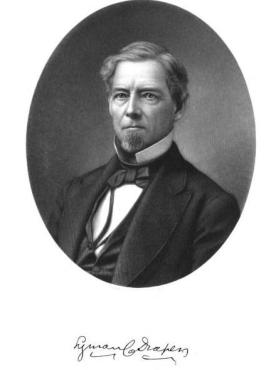
Lyman Copeland Draper (Wikimedia Commons)
Lyman Copeland Draper from the Fronts-pieceof his book, King’s Mountain and its Heroes, 1881 (Wikimedia Commons)

For the last century, everyone studying the frontier in the American Revolution has owed a debt to Lyman C. Draper.   Not many people are familiar with him, but he compiled one of the deepest and most extensive collections of original material related to the Trans-Appalachian Frontier, particularly during the American Revolution.  His hard work and extensive efforts represent a life dedicated to history that enabled his successors to continue his remarkable work .

Born in western New York in 1815, Draper’s grandfathers were both veterans of war with the British, either during the American Revolution or the War of 1812.  Given the number of veterans moving west to start farms after the war, a young and impressionable Draper heard their stories.  Draper’s family eventually settled in Lockport, NY on the Erie Canal and that is where he attended Continue reading “Historians from the Past: Lyman Draper”

Thanksgiving with George Washington

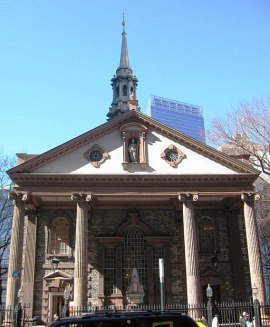
St Paul's Chapel New York (Wikimedia Commons)
St. Paul’s Chapel, New York (Wikimedia Commons)

Setting aside one day to give national thanks to God for the blessings of the prior year and beseech him for future blessings had been frequently practiced in England, but it merged with several Puritan traditions in New England during the 17th century.  By the time of the American Revolution, Thanksgiving was a well-established custom.   The Second Continental Congress turned a regional tradition into a national one when offered its first Thanksgiving Proclamation on November 1, 1777, recommending that the individual states of the new United States set apart December 18th as a day of Thanksgiving and praise.  During the Revolution, Congress continued the practice, issuing its last proclamation in 1784.

Continue reading “Thanksgiving with George Washington”

“I Have not Yet Begun to Fight!” or Words to that Effect (September 23, 1779)

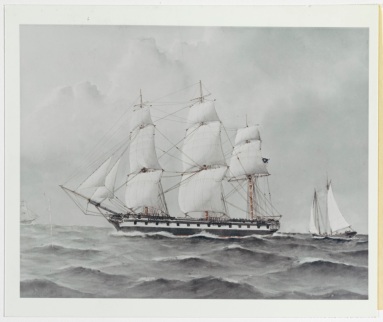
Bonhomme Richard (Naval History and Heritage Command)

During the night of September 23/24, 1779, Captain John Paul Jones led his frigate, Bonhomme Richard, into its legendary fight with Serapis. In the midst of a battle that was not going well for the Americans, British Captain Richard Pearson asked if Jones was ready to strike his colors and surrender. Jones offered one of the most famous replies in American naval history: “I have not yet begun to fight!” Or did he? Continue reading ““I Have not Yet Begun to Fight!” or Words to that Effect (September 23, 1779)”

The Gerrymander: A Gift from the Founding Fathers

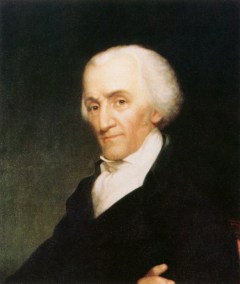
Elbridge-gerry-painting
Massachusetts Governor and U.S. Vice President Elbridge Gerry

Lately, the term “gerrymandering” is getting thrown around as some sort of new illness that afflicts the republic.  The process essentially involves drawing electoral district boundaries in ways that benefit one political party or the other and dates back to 1812 Massachusetts, when Governor Elbridge Gerry, a member in good standing of the founding generation, signed legislation radically redrawing electoral districts in the state to favor the Democratic-Republican Party.

Born in 1744, Gerry was a Massachusetts merchant and vocal opponent of British policy in the colonies who served in the Second Continental Congress, signed the Declaration of Independence, the Articles of Confederation, and attended the Constitutional Convention.   Like a few of his contemporaries, notably George Mason and Patrick Henry of Virginia, he refused to sign the Constitution due to its lack of an explicit Bill of Rights. Nonetheless, he went on to serve as an envoy to France in the Adams administration, then was elected to the U.S. House of Representatives, as Governor of Massachusetts, and then was Vice President under James Madison.  Only a few men had a better claim on the term “founding father.”

Continue reading “The Gerrymander: A Gift from the Founding Fathers”

George Washington, Daniel Morgan, and Winchester, Virginia on Memorial Day

I’ve been intermittently visiting Winchester, VA for years, usually with an eye toward understanding its place in the Civil War.  Tradition has it that no town changed hands more frequently. But, the town also has a prominent, if sometimes overlooked, role in America’s colonial and Revolutionary War history.  In particular, it enjoyed a close relationship with George Washington and Daniel Morgan, helping shape both men.

W%oQ3yOcQbOrOlCK890IDQ
George Washington as a Teenage Surveyor, Winchester, VA

Winchester, or Frederick Town, as it was then known, was the largest village in the lower Shenandoah Valley when Lord Thomas Fairfax decided to relocate from England to his land grant in northern Virginia and became a way-station of sorts for people traveling along the Great Wagon road that ran from Pennsylvania to North Carolina in the 18thcentury.  So, when the Fairfax family hired a teenaged George Washington to help survey its grants in the Shenandoah, Winchester was a logical place for the surveying team to make its temporary home base.  (In truth, surveying teams were constantly moving to maximize their efficient use of time: the saddle might be considered home.)  While the teenager was less than impressed with most accommodations on the frontier, he was pleased with Fredericktown.  He recorded in his diary: Continue reading “George Washington, Daniel Morgan, and Winchester, Virginia on Memorial Day”

Book Review: Revolutionary: George Washington at War by Robert L. O’Connell

erw-book-reviews-11

Robert L. O’Connell, Revolutionary: Washington at War, e-book, (New York: Random House, 2019), $32 in hardback.

O'Connell's Washington

Robert L. O’Connell is best known for asking “big” questions.  Armed with a PhD in history and a lengthy career in the intelligence community, his books Of Arms & Men: A History of War, Weapons, and Aggression (1989) and Ride of the Second Horseman: The Birth and Death of War (1995) tackled the origins, nature, and future of warfare. In the last decade, however, he has turned his sights on more specific targets: Hannibal at Cannae, William Tecumseh Sherman, and, most recently, George Washington.  Released earlier this year, O’Connell’s Revolutionary: George Washington at War is just the latest work to tackle the martial aspects of George Washington’s life and career.

Continue reading “Book Review: Revolutionary: George Washington at War by Robert L. O’Connell”

John Wayne, Colonel James Smith, and the Black Boys Rebellion

AlleghenyUprisingposterAllegheny Uprising, starring John Wayne and Claire Trevor, is an overlooked Revolutionary War movie.  I first watched the 1939 film as a kid on a local UHF station, but never quite realized how closely it tracked with the memoir of a colonial and Revolutionary War soldier, Colonel James Smith.  So, I decided to take a look.

For a significant portion of the last century, no actor signified “the American Century,” more than John Wayne. But, in the 1930s, he was a former-stuntman-turned-B-grade-actor churning out movies as a contract player for RKO Pictures.  Born in Iowa as Marion Morrison, Wayne’s family made its way to California during World War I and he eventually attended the University of Southern California as a pre-law student.  When an injury sidelined his football career, he did odd jobs in Hollywood for a friend-of-a-friend, eventually taking on bit parts and extra work before getting his first starring break in The Big Trail, a 1930 epic that flopped horrendously.  Morrison needed a more impressive name for the movie—Marion Morrison apparently not being heroic enough for the character he would portray. So, Morrison, still in his 20s, suggested Anthony Wayne after the Revolutionary War general himself.  The studio passed on “Anthony,” but settled on John Wayne.  Newly named, Morrison went back to work, settling for the lead in a bunch of forgettable westerns.

Continue reading “John Wayne, Colonel James Smith, and the Black Boys Rebellion”

Book Review: Peckuwe 1780, by John F. Winkler

erw-book-reviews-11


9781472828859_6

John F. Winkler, Peckuwe 1780: The Revolutionary War on the Ohio River Frontier, (Oxford: Osprey Publishing, 2018).   $24.00

I once read a review comparing Osprey Publishing’s monographs on particular battles, weapons, uniforms, or campaigns to “flash cards,” which made me smile.  As a kid, I somehow acquired stacks of flashcards laying out the technical specs of various military aircraft or ships and thought they were the greatest things since sliced bread.  Those were the days before Amazon or Barnes & Noble, when a kid had to depend on the local library and Waldenbooks for books about history, which they didn’t have in large numbers.  The Osprey monographs were a windfall of sorts when the local library started carrying them.  They’re not intended for an academic audience by any stretch, but can play a useful role in interesting popular audiences in places, people, and events that might otherwise prove too obscure or too intimidating for a young or casual reader.  So, when I came across John F. Winkler’s new monograph for Osprey, Peckuwe 1780, I snapped it up as much for sentimental reasons as for my interest in the American Revolution on the western frontier.

Continue reading “Book Review: Peckuwe 1780, by John F. Winkler”