Emerging Revolutionary War welcomes back guest historian Michael Aubrecht
John Trumbull
John Trumbull’s paintings represent some of the most familiar depictions from the time of the American Revolution. Trumbull was a graduate of Harvard University and the gifted son of the Governor of Connecticut. As a child, Trumbull showed a remarkable talent for an attention to detail. This aptitude set his drawings apart from his contemporaries. Trumbull traveled to London in 1784 to study painting under the master Benjamin West. It was then that he started painting some of his most notable pieces. There he honed his expertise for realistic painting. A year later later Trumbull traveled to the City of Paris to do commissioned artworks. He later did portraits of George Washington, John Adams, Alexander Hamilton and Thomas Jefferson. In 1816, he was selected as the president of the American Academy of the Fine Arts where he would serve for 20 years. Emphasizing classic traditions Trumbull attempted to teach the skills he had acquired while overseas. Following his death in 1843 at the age of 87, Trumbull was buried beneath the Art Gallery at Yale University which he had designed. In 1867, his collection of artworks were displayed at the Street Hall building on the same grounds. He and his wife’s remains were later re-interred and buried on the grounds of that building. Trumbull’s approach to painting has been studied by art students around the world. Today Trumbull’s paintings remain some of the most cherished ever to be painted by an American artist. Continue reading “The Brush of John Trumbull”→
Emerging Revolutionary War welcomes guest historian Eric Sterner.
In February 1778, Brigadier General Edward Hand, commanding Continental forces at Fort Pitt on the American frontier, launched what may be one of the oddest campaigns of the American Revolution, more famous for its fecklessness than any benefit to the American war effort. Born in Ireland, Hand arrived in the colonies with the 18th Royal Irish Regiment as a surgeon’s mate. He eventually left service in 1774 and set up a medical practice in Philadelphia. The siege of Boston found him among the besiegers as Lieutenant Colonel of a Pennsylvania Rifle Battalion. He fought under Washington on Long Island, at White Plains, and then Princeton, after which Washington successfully pursued the rank of Brigadier for him before sending him to Pittsburgh.[1] Hand arrived in June, 1777, finding just two companies of the 13th Virginia.[2] As was often the case on the frontier, Fort Pitt was under-garrisoned and Continental officers would have to scrounge constantly for troops, largely relying on local militia forces to defend the frontier.
General Edward Hand (courtesy of Ohio History Central)
Hand hoped to conduct a campaign to the west, driving toward British power at Detroit, but was unable to raise sufficient forces that fall. Instead, he settled for a trip down the Ohio to ensure local garrisons were in proper order.[3] Around Christmas, Hand received information that the British had established a small magazine on the Cuyahoga River, likely somewhere close to where it empties into Lake Erie in the current city limits of Cleveland.[4] As December gave way to January and February, Hand resolved to do something about it. At the beginning of the month, he wrote Colonel William Crawford, formerly of the 13th Virginia, currently of the Pennsylvania militia and a well-respected local leader, entreating the colonel to undertake an expedition: “As I am credibly informed that the English have lodged a quantity of arms, ammunition, provision, and clothing at a small indian Town, about one hundred miles from Fort Pitt to support the savages in their excursions against the inhabitants of this and the adjacent counties, I ardently wish to collect as many brave, active lads as are willing to turn out, to destroy this magazine. Every man must be provided with a horse, and every article necessary to equip them for the expedition, except ammunition, which, with some arms, I can furnish.”Continue reading “General Edward Hand: The Squaw Campaign”→
Emerging Revolutionary War welcomes guest historian Bill Backus to the blog.
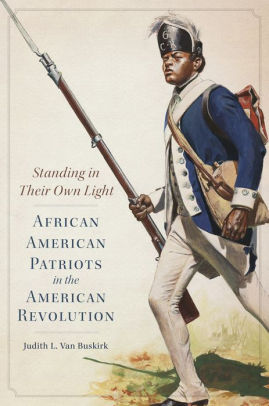
Fighting for Independence, Patriots commonly argued they were combating an attempt by the English Crown to reduce the American colonies to slavery. The irony that most leaders crowing against “English slavery” owned enslaved African-Americans is one of the greatest contradictions of American history. In a struggle about slavery, enslaved people played an important role. In her new book, Standing in Their Own Light: African-American Patriots in the American Revolution, Professor Judith L. Van Buskirk explores African-American participation in the Patriot cause.
“Standing in Their Own Light” by Judith L. Van Buskirk
The foundation for Van Buskirk’s study is the pension claims for nearly 500 soldiers made decades after the war. To obtain a pension, veterans had to prove in a county court that they had served in the military during the war. In addition to their recollection of when they enlisted, with whom they fought with, and where they campaigned, aspiring pensioners routinely recruited serving comrades and officers to offer testimony on their behalf. While the pension records are an important source for historians, these documents were intended to prove wartime service and thus offered only a cursory examination of their military career. The limitations of using these sources become apparent throughout the study
The book is divided into six chapters. Van Buskirk first examines slavery prior to the American Revolution with South Carolina standing in for the Deep South, Virginia for the Upper South, Pennsylvania for the Middle Atlantic, and Massachusetts for New England. In the second chapter, Van Buskirk utilizes the pensions to explore the life of an African-American patriot soldier, from enlistment, to camp life, and battle. The subsequent two chapters explore two case studies of attempts to recruit, African-American soldiers: the segregated 1st Rhode Island Infantry and the story of the Laurens family connection of the recruit of African-Americans in South Carolina. The final two chapters explore the pensions after the war.
The study on the 1st Rhode Island is outstanding. On May 14,1781, a detachment of the regiment on picket duty was ambushed outside of Peekskill, New York, by a local loyalist unit. In the space of a few minutes, the Continentals lost eight killed, including both its colonel and major killed or mortally wounded, four wounded and twenty-four captured. The majority of the killed were black while those captured tended to be white. Stories of the field officers either bayonetted or shot while in their beds added a salacious detail to this American disaster. While its unknown if race played a crucial factor, the Battle of Pines Bridge foreshadowed the bloody battles involving African-American soldiers 80 years later in the Civil War.
While inconclusive, enough evidence survives in various pension claims that some of the first soldiers who entered the British fortifications at the Battle of Stoney Point weren’t officers, but black enlisted men. Finally how subsequent generations of Americans used black soldiers involved in the Revolutionary War is another important contribution to the literature.
The limitation of the source material becomes evident in several places throughout the study. For example in exploring the Battle of Stoney Point, Van Buskirk prefaces many observations with “probably” and “likely”. At other sections, Van Buskirk generalizes the service of the men, an example being Jacob Francis and his military career. Van Buskirk fleshes out Francis’ pension claim with an overly generalized overview of a battle experience in a Revolutionary Era army. Sources for 18th century battles can be somewhat sparse compared with other events, but the qualifying terms that Van Buskirk uses diminishes some of the conclusions that she reaches
These quibbles aside, Standing in Their Own Light: African-American Patriots in the American Revolution is a tremendous addition to the historiography of the American Revolution, such as the sections about the 1st Rhode Island and black patriots after the war. Anyone interested in African-American history or the Continental Army should pick up this book.
*Bio*
A native of Connecticut, Bill Backus graduated from the University of Mary Washington with a bachelor’s degree in Historic Preservation. Currently working as a historian for multiple Civil War sites in Northern Virginia, Bill has worked for the National Park Service at Vicksburg National Military Park and Petersburg National Battlefield. Bill currently resides in historic Brentsville, Virginia, with his wife, Paige, and their dog, Barley.
Emerging Revolutionary War welcomes guest historian Michael Aubrecht. A biography of Mr. Aubrecht is attached below.
In 2011 an exhibit titled “Slavery at Jefferson’s Monticello: Paradox of Liberty” started running at the Smithsonian’s American History Museum from January 27, 2012 – October 14, 2012. This somewhat controversial exhibition explored slavery and enslaved people in America through the lens of Jefferson’s plantation and was a collaborative effort between the Thomas Jefferson Foundation at Monticello and the African American History and Culture Museum in Washington DC. It helped to instigate public discussion about the dichotomy between the Founders and freedom. The paradox of course is that Thomas Jefferson drafted the Declaration of Independence and called slavery an “abominable crime,” yet he was a lifelong slaveholder. The exhibition provides a glimpse into the lives of 6 slave families living at Monticello and reveals how the paradox of slavery in Jefferson’s world is relevant for generations beyond Jefferson’s lifetime.
Reviewed by guest historian Robert “Bert” Dunkerly.
Lord Dunmore’s War remains one of the murkier events of the Colonial era. Historian Glenn F. Williams has produced a book that will set the standard for the study of this conflict.
Dunmore’s War, the Last Conflict of America’s Colonial Era by Glenn F. Williams
Dunmore’s War, The Last Conflict of America’s Colonial Era by Williams, explains the complexity of the conflict and goes into detail analyzing the intertwined diplomatic and military events. The late 1760s and early 1770s were a fascinating and complex time on the frontier. Violence from the French and Indian War and Pontiac’s War had subsided, tribes were shifting alliances, settlers were moving into the region, and the colonies were still adjusting to the new realities following the Treaty of Paris. The British regulations that would trigger colonial resistance were already coming, and tensions were slowly building. Yet the issues which dominated the attention of most colonists were inter colonial rivalries, such as that between Virginia and Pennsylvania.
Emerging Revolutionary War welcomes back guest historian Katie Turner Getty.
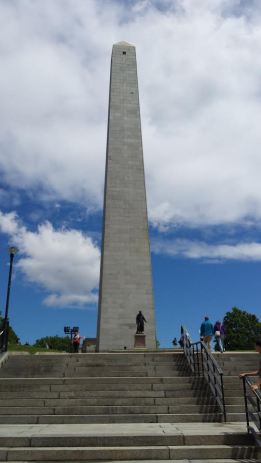
Towering over Charlestown, Massachusetts, its foundation set in sacred battleground soil, the Bunker Hill Monument is a 221 foot obelisk commemorating the Battle of Bunker Hill. The cornerstone of the monument was laid by the Marquis De Lafayette in 1825, fifty years after the battle was fought on June 17, 1775.
Bunker Hill Monument (author collection)
Although the land surrounding the monument has been greatly developed since the battle, visitors today can get still get a sense of the 18th-century landscape just by walking through Charlestown and climbing the hill to reach Monument Square. Approaching visitors are greeted by the statue of Colonel William Prescott, the gray granite of the monument serving as an impressive backdrop behind him. Continue reading “ERW Weekender: Bunker Hill Monument & Museum”→
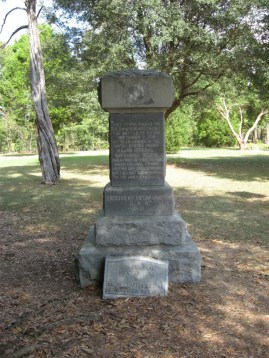
Daughter’s of the American Revolution (D.A.R.) Monument, Eutaw Springs Battlefield (author collection)
In many ways, the battle of Eutaw Springs was a disappointment for both commanders. Greene’s troops at one point broke through the British lines, but they recovered, and the Americans failed to drive them off the field. Stewart, in a letter to Cornwallis, wrote that there were two things he would regret the rest of his life: the loss of an early morning supply gathering party and his lack of cavalry. Having them, he felt, would have enabled him to decisively defeat Greene. Probably both commanders, and many of their officers, reflected upon these events and second guessed themselves for the rest of their days. Although both armies fought well at Eutaw Springs, a clear cut victory eluded both of them. Continue reading “After Eutaw Springs”→
Emerging Revolutionary War is honored to welcome back historian Katie Turner Getty. Biography of Ms. Getty is below the post.
On April 19, 1775, the placid farm of fifty-eight-year-old Jason Russell of Menotomy erupted into carnage when he, along with eleven other Americans, were shot and bayonetted by British soldiers in his home and yard.
Jason Russell House (author collection)
As American militia and minutemen poured in from surrounding towns, the British—fatigued yet furious—found themselves under increasingly heavy musket fire. As they pulled back from Concord and retreated to Boston, the main column passed near Russell’s house which stood near the battle road. Russell had just returned home after secreting his family at a nearby farm. Unbeknownst to him, American minutemen and British soldiers would soon converge upon his property and a desperate battle would occur within the walls of his own house.
Earlier that day, twenty-six-year-old Gideon Foster had set off from Danvers with a company of minutemen. The men had set a scorching pace and made the sixteen mile journey to Menotomy in four hours, running half the way.[1] Upon arriving, Foster’s men joined others from Lynn, Beverly, Salem, Dedham, and Needham.[2] Some took cover behind trees and others in Russell’s yard, where a breastwork was constructed out of shingles.
The Fight at the Jason Russell House, bicentennial painting by Ruth Linnell Berry (1974). Appearing with permission from the Arlington Historical Society.
The men focused their attention on the approaching main column of British troops and fired upon them. Capt. Israel Hutchinson, a seasoned French and Indian War veteran, warned that flank-guards would likely be traversing the fields alongside the road[3], helping the main column to pass unmolested. But before the men could reconsider their position or move to a more defensible location, the flank-guard was upon them, trapping the men against the main column.
In a frantic search for cover, many of the men bolted into Russell’s house. Jason Russell, too, attempted to dash inside but was slowed by his lame leg.[4] He was shot twice and fell on his doorstep. The soldiers tore inside the house in hot pursuit of the men, bayonetting Jason Russell’s body eleven times as they passed.
Once inside the house, the Americans had no choice but to fight for their lives in rooms with no egress, in very close quarters, against raging, bayonet-wielding soldiers. It was a bloodbath. With two rooms on the bottom floor, a narrow stairwell, and two rooms on the top floor, Jason Russell’s house offered very little refuge. Soldiers outside the house hailed musket fire into the windows.
Sign depicting what happened at the Jason Russell House on April 19, 1775
With nowhere else to go, several men rushed into the cellar. What at first would seem to be an ill-advised hiding spot turned out to be the only sanctuary that Russell’s home could offer. Taking position near the bottom of the stairs, the men raised their muskets and shot dead the first soldier who descended.[5] Any other soldiers who attempted to follow were met with blazing musket fire. Holes left by musket balls are still visible in the stairwell, attesting to the firestorm.
Soon, the house grew quiet. All of the men who had sought safety in the house had been killed, with the exception of the men who took refuge in the cellar. The British ransacked the house then left.[6]
In 1835, sixty years after the bloodbath at Russell’s house, a memorial was erected in Danvers to commemorate the townsmen who lost their lives in Menotomy that day. Danvers lost the second highest number of men, after Lexington[7], and all of them at Jason Russell’s house. Foster, the commander of the company of minutemen who had ran halfway to Menotomy, was by then the last surviving Danvers veteran of the war. Aged eighty-six, he addressed the crowd assembled for the dedication of the monument and recounted the events of April 19th:
On that morning, more than one hundred of my townsmen hastened to the field of battle…ready to offer their lives on the altar of their liberties. Seven of those who thus started in the prime of life and vigor of manhood, ere that day’s sun descended in the west, were numbered with the dead.[8]
Foster called the dedication of the memorial “One of the happiest days and most pleasing events of my life.”[9]
In total, twelve Americans were killed at Jason Russell’s house. Jason’s wife, Elizabeth, returned home to find her husband dead. He and the other fallen Americans, their bodies riddled with musket balls and slashed by bayonets, had been laid out on the floor in the kitchen, the blood from their wounds pooling around them. Elizabeth later said that “the blood in the room was almost ankle deep”.[10]
Musket ball damage to the staircase of the Russell House
*Biography: Katie Turner Getty is a lawyer, history enthusiast, and lifelong resident of Boston. She holds an A.A. from Bunker Hill Community College in Charlestown, Massachusetts, a B.A. in History from Wellesley College, and a J.D. from New England Law Boston. She can often be found exploring historic sites both on and off the Freedom Trail.
Emerging Revolutionary War is pleased to welcome back historian Bert Dunkerly, who is the co-author (with Irene B. Boland) of the upcoming book; “Eutaw Springs; The Final Battle of the American Revolution’s Southern Campaign” slated to be released this month.
Part One
The weather was warm and the men had been marching for days, but their morale was high. They had been through a lot recently: caught off guard and defeated at Hobkirk’s Hill, a month of grueling siege work – and for naught, at Ninety Six. Not to mention the engagements that many of them had fought in previously: Kings Mountain, Cowpens, Guilford Courthouse, and dozens of smaller battles.
Yet the army that General Nathanael Greene led forward on the morning of September 8, 1781, was confident and ready to come to grips with its adversary. Everyone from the private in the ranks on up to the commanding general knew that ahead lay an opportunity.
Battles in the Revolution were, in fact, rare opportunities for commanders. Engagements were the short, pulse-pounding events that broke up the monotony of marching and maneuvering. An army spent most of its time in garrison, in camp, or on the road. In battle the infrequent opportunity came to crush an opponent and influence the outcome of a campaign, or the war. These chances were few and far between.
“Eutaw Springs” by Benson Lossing
Both commanders at Eutaw Springs appreciated this fact. General Nathanael Greene’s forces had experienced a series of close calls at Guilford Courthouse, Ninety Six, and Hobkirk’s Hill. The American army fought well in all of these engagements, save Hobkirk’s Hill, yet they met defeat in every one. Greene hoped Eutaw Springs would put the finishing touches on his South Carolina campaign, and end it with a clear cut victory.[i]
Eutaw Springs was a rare chance for Greene to pick the time and place of engagement, array his forces to his choosing, and initiate the battle, and control its \tempo. It was the only set engagement of the campaign, other than Guilford Courthouse, in which Greene chose the ground and initiated the battle. Commanders do not often have this luxury, and Greene earnestly hoped to make the most of it. Continue reading “Eutaw Springs”→
Leading up to the anniversary of April 19, 1775, we will be sharing some short remembrances from a few people who are from Lexington and Concord.This installment is by Rich Gillespie, a native of Lexington, Massachusetts.
If you live in Lexington, Massachusetts, the beginning of the American Revolution is an essential piece of life. The Minuteman statue dominates the center of town, the village green where the Alarm List stood to face the Regulars is much as it once was, the Town Seal seen on your friendly snowplow quotes Sam Adams’ comment to John Hancock upon hearing the firing—“Oh, What a glorious morning for America!”, and the high school’s team is predictably the Minutemen. The British marched to and from Concord within 150 yards of my 4th grade classroom, and the spring field trip was to the key sites of Lexington and Concord. My first job (as was my sister’s) was guiding visitors on Lexington Green.
Hip-hip Huzzah-Haughty British troops leave Lexington (author collection)








 Emerging Revolutionary War Era