Emerging Revolutionary War welcomes guest author Michael Aubrecht
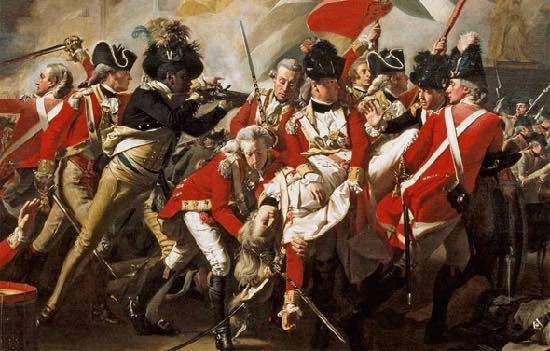
At the time of the Revolutionary War it is estimated that there were over a half million African-Americans living in the thirteen colonies. As the rebellion’s patriotic call to fight for liberty grew, the British government sought to undermine the expanding Continental Army by soliciting slaves who ran away from their masters. By promising to grant them their freedom and security, the Redcoat ranks were able to boost their manpower on the battlefield instead of constantly relying on the importation of additional troops who took months to travel to the Americas from England. Some of these all-black units even flourished as in the example of the Royal Ethiopian Regiment and later, the Black Pioneers.
According to the Atlantic Canada Virtual Archives Website Black Loyalists in New Brunswick: “In November 1775, Virginia Governor Lord Dunmore, hoping to bolster the British war effort, encouraged slaves and indentured servants of the Patriots to join His Majesty’s army. Many did so. When the British evacuated their army from Boston to Halifax in 1776, a “Company of Negroes” was part of the entourage. British Commander-in-Chief Sir Henry Clinton extended the policy of appealing to African Americans in his Phillipsburg Proclamation of 1779 in which he offered security behind British lines to ‘every negro who shall desert the Rebel Standard.'”
Following the British Army’s surrender, it is estimated that nearly 35,000 loyalists fled the United States to settle north in the provinces of Canada including the maritime regions of New Brunswick and Nova Scotia. Nearly 3,500 free black loyalists were among them including many who had fought alongside the Redcoats on behalf of the English crown. New Brunswick saw thousands of African-Americans settle in as new citizens and many went on to fight again for Britain in the War of 1812. Despite their service to the king, many black loyalists and their families still faced racial discrimination, although it paled in comparison to the institution of slavery that continued to thrive in the southern United States.
Michael Aubrecht is the author of Thomas Jefferson and the Virginia Statute for Religious Freedom: Faith & Liberty in Fredericksburg.
Emerging Revolutionary War welcomes guest historian Eric Wiser to the blog.
This is a brief story of my first and memorable visit to the Camden Battlefield in South Carolina this September past. I am a husband and father living in the suburbs of Chicago. I make my living as an accountant. As rewarding as my career has been, it’s my strong interest in early American history that stirs my imagination. My pilgrimage to Camden was part of a visit to my friend Phil Kondos who moved to eastern Georgia with his family over a decade ago. Phil is a gifted musician and wonderful father and happens to share a mutual love of history. This narrative of our visit will hopefully inspire others to place Camden Battlefield on their bucket list.
My interest in the Battle of Camden mostly derives from having a Patriot ancestor who fought there. Pvt. Michael Wiser, a 23-year-old grist miller from Frederick County, Maryland, was with the First Maryland Brigade and captured by the British at Camden.[i]
Emerging Revolutionary War welcomes guest historian Al Dickenson
Within the first few pages of his book, Brooklyn College professor Benjamin Carp illustrates all the key points about the 1776 burning of New York City. The points include how vital the city was to the war effort to both the rebels and Loyalists, a discussion on how the fire started (questioning if it was accidental or intentional, and if the latter, whose intention was it?), and furthermore, why has there never been a full investigation into the fire and its causes (Carp’s book is the first full-length work on the topic). In quick succession, readers understand what they will gain by reading this book, why the event in question is important for understanding the American Revolution, and Carp’s own thoughts on the matter.
Carp’s argument in The Great New York Fire of 1776 is that the rebels started the fire, and that the cause of the blaze was indeed arson, which previously had been in question (254). What Carp does not speak to, at least not without some speculation, is who precisely started the fire. While not totally disregarding George Washington’s potential involvement, Carp suggests the more likely culprits would be soldiers in Washington’s army. These men, and in many cases, boys, had yet to receive the disciple so desperately needed from Baron von Stueben’s efforts at Valley Forge, so it seems plausible they could start the inferno, which scorched up to a fifth of the city (244-245). As such, Carp puts his research skills to good use in this volume, sharing his thoughts on the possible origins of the fire and providing readers with a map of more than ten ignition points, illustrating how expansive the blaze was (104). Carp’s thesis is well supported by the primary material, which included letters, sermons, diaries, and other sources from the time.
Emerging Revolutionary War welcomes a guest post from historian Keith J. Muchowski. Keith is a librarian and professor at New York City College of Technology (CUNY) in Brooklyn. He blogs at thestrawfoot.com.
The plaque dedicated King Juan Carlos I in June 1976 today tucked in a corner of the visitor center. Courtesy Author
King Juan Carlos I arrived in Brooklyn’s Fort Greene Park on Saturday June 5, 1976 to great fanfare. The thirty-eight-year-old monarch had ascended to the Spanish throne just seven months previously, two days after the death of Francisco Franco. The new leader was determined to reform his nation after three and a half decades of strongman rule. Juan Carlos I’s ancestor, King Carlos III, had helped the colonists achieved their independence nearly two centuries previously with his supply of money, matériel, and men. Many of those Spaniards made the ultimate sacrifice; well over one hundred of them alone perished in British prison ships moored off Brooklyn Wallabout Bay during the war.[i] Now King Juan Carlos I was in the outer borough to recognize them, dedicate a tablet to his fallen countrymen, and help his American hosts celebrate the bicentennial of their independence. The entombed Spaniards were among the over 11,500 men commemorated by the Prison Ship Martyrs Monument. The king’s visit in the mid-1970s was the latest in a series of public commemorations of the prison ship dead dating back over a century and a half. Some of the institutions that did so much to recognize the martyrs, such as the Society of St. Tammany, are today long gone. Others however very much remain. The Society of Old Brooklynites, a civic organization founded in 1880 when Brooklyn was still an independent municipality, has been holding events since the late nineteenth century.
Emerging Revolutionary War welcomes back guest historian Kate Bitely.
In the heart of Fredericksburg, Virginia, you will find a well-preserved, Georgian-style home that once belonged to Betty Washington Lewis, the sister of George Washington. Historic Kenmore, as the home is known today, was constructed in the 1770s and originally sat on 861 acres near downtown Fredericksburg. Today, the historic house museum is open for daily tours where guests can explore the gardens, the main living floor of the home, several historic structures on the priority, and a visitor center filled with riveting artifacts and information.
Nearly 290 years ago, Betty Washington was born at Pope’s Creek in Westmoreland County, Virginia. As a young child, she lived in a few properties owned by the Washington family before relocating to Ferry Farm, located in Stafford County, Virginia, where Betty, George and their siblings grew up. On February 22, 1750, Betty married Fielding Lewis, a widowed distant cousin, and a father of two young children. In 1752, the family purchased 1300 acres in the Fredericksburg area and allocated a portion of the land as the future site for their home Millbrook, which was eventually renamed to Kenmore in the 1800’s. In total, Betty and Fielding welcomed eleven children, but only six survived to adulthood.
Fielding Lewis was a well-known member of his community. He built his wealth initially as a merchant, but was later elected as a member of the House of Burgesses and served as a colonel in the Revolutionary War. During the war, however, Lewis used his finances to personally pay for munitions and supplies for Patriot troops which ultimately drained much of the family’s resources.
The Lewis family were staunch Patriots. In 1775, when the Lewis’s were moving into their home, the spirit of independence was strong throughout the colonies. Given the Washington’s status, heritage and devotion to service, Betty and her family would become one of the biggest supporters for the Patriot cause, willing to risk their home, finances, reputation, and their safety in favor of breaking away from England. The impressive residence served as a visual representation of their wealth, which became significantly more important during the Revolutionary War.
Emerging Revolutionary War welcomes the contribution of Eric Olsen, Park Ranger/Historian at Morristown National Historical Park
Military history tends to be a lot of “so and so’s” brigade advanced on the left wing, while “what’s his face’s” division withdrew.” Lots of movements of large faceless masses of soldiers. Personally, I prefer the little personal stories of individuals in the face of battle. Here is one such story from the battle of Monmouth in June 1778.
Sir Henry Clinton
I recently ran across this little tidbit in a July 7, 1778, letter written by the Adjutant General of the Hessian forces in America, Major Carl Leopold Baumeister. He described an incident during the battle of Monmouth involving the British commander in chief, Sir Henry Clinton. “General Clinton in the thickest fire, was saved by one of his adjutants, Captain Sutherland, when a rebel colonel aimed at him, but missed. Captain Sutherland’s horse was wounded. Another adjutant, Lloyd, stabbed the colonel.”
The story sounded vaguely familiar. Then I recalled something I’d read written by a British officer named Thomas Anbury. He was a prisoner of war, part of Burgoyne’s captured “Convention Army.” Anbury and the other prisoners were being held near Charlottesville, Virginia. At a place called Jones’s Plantation, Anbury related the following story on May 12, 1779,
“A very singular circumstance took place in that battle [Monmouth], which fully marks the coolness and deliberation, though in the heat of action, of Sir Henry Clinton: As he was reconnoitering, with two of his Aide de Camps, at the short turning of two roads, they met with an American officer, exceedingly well mounted upon a black horse, who, upon discerning them, made a stop, and looked as if he wished to advance to speak to them, when one of Sir Henry Clinton’s Aid de Camps fired a pistol at him, and he instantly rode off. Sir Henry was much displeased at his Aide de Camp, and censured him for being so hasty, adding, he was confident that the man wished to speak to him, and perhaps, might have given intelligence that would have been very essential, remarking, that when he was in Germany last war, and reconnoitering with Prince Ferdinand, a man rode up in a familiar manner, and gave such intelligence as decided the fate of the day.”
To read more about the Battle of Monmouth, check out “A Handsome Flogging, the Battle of Monmouth, June 28, 1778 by William Griffith, part of the Emerging Revolutionary War Series.
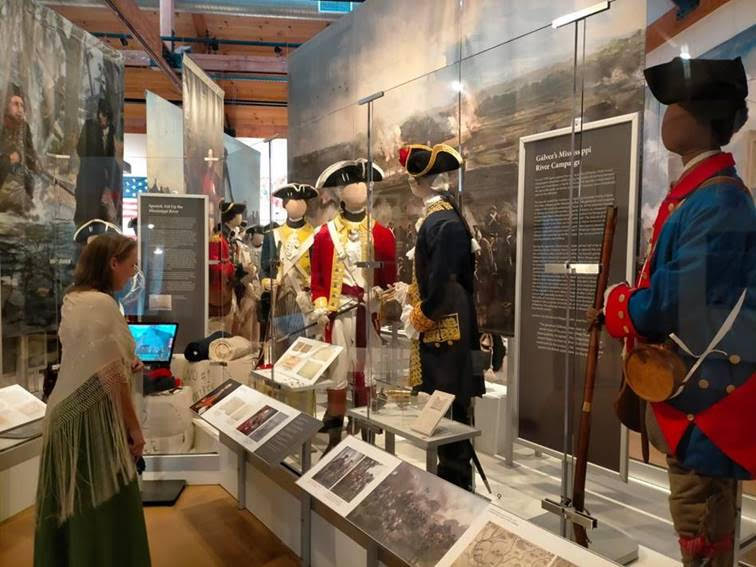
This conference will focus on the military, political, social and material culture history of the western theater of the American Revolutionary war, featuring scholars from across the U.S. and from Spain.
Location: The Sheraton Westport Plaza Hotel, St. Louis County, Missouri
Speakers and Topics:
Larry L. Nelson—”George Rogers Clark, the Illinois Campaign, and American Ambitions in the West”
Robert M. Owens – “Jean Baptiste Ducoigne, the Kaskaskias, and Pragmatic Patriotism in the Revolutionary Era”
José Manuel Guerro Acosta – “Spain and the Support for the American Revolution”
Friederike Baer – “’O, how the Mississippi is costing us many a good man!’: German Soldiers in West Florida, 1779-1781”
Frances Kolb Turnbell – “Indian Politics and the American Politics in the Lower Mississippi Valley”
Stephen L. Kling, Jr. – “An Opportunity to be Seized: The British Grand Plan to Conquer the Entire Mississippi River Valley”
Alexander S. Burns – “The Worst Looking Soldiers and the Drunkest Men to Ever Carry a Musket?: The 8th Regiment and the War in the West”
Kristine L. Sjostrom – “Valentía y Visión: Lt. Governor Fernando de Leyba and the Defense of St. Louis”
Kimberly Alexander – “O What Can These Things Tell Us: Material Culture at Revolutionary War St. Louis”
Jim Piecuch – “Fighting from Horseback: A Comparison of Revolutionary War Cavalry in the Eastern and Western Theaters”
Paul Douglas Lockhart – “For Want of a Good Musket and a Sharp Knife: Weaponry and Wilderness Warfare”
Evening Events: A cocktail reception will be held on Friday evening at 6:00pm at the Sheraton Westport Plaza Ballroom. A private party on Saturday evening at 6:30pm at the St. Charles County Heritage Museum will include a private tour of The American Revolutionary War in the West museum exhibit.
Registration: Conference registration cost including evening events: $75.00. Registration can be made through the St. Charles County Historical Society by 1) mailing a check to The St. Charles County Historical Society, 101 S. Main St., St. Charles, MO 63301, Attn: Joan Koechig; 2) credit card or PayPal by calling at (636) 946-9828 MWF, 10am-3pm; or 3) online at scchs.org. Registrations are limited and will be filled on a first come, first served basis. Questions, call Melissa at: (314)-561-5077. NOTE, online registration will be available starting April 19, 2023.
Emerging Revolutionary War welcomes guest historian Christopher of The British-American Historian blog.
Almost two years after debating a joint French-American assailment of Lord Cornwallis’ precarious position in Yorktown, Virginia over Washington’s grand plan to recapture New York long after being swept from the city and its environs as independence was officially declared in 1776, the implacable Washington prepared to reenter New York in triumph.
Eight years after making New York the center of the British war effort in the American Revolution, the massive garrison was greatly reduced and preparing for its final retirement from the new nation. The new commander in chief of North America, Sir Guy Carleton, arrived in New York on May 5, 1782[1] to relieve Sir Henry Clinton. Carleton won accolades for holding Quebec City when the Continental Army struck during a late night blizzard, an accomplishment that was all the more vaunted now that the British were losing territory that did not include Canada. Carleton lost no time in notifying Washington of his arrival in an affable letter sent on May 7th, 1782 in which Carleton wrote “if the like pacific disposition should prevail in this country, both my inclination and duty will lead me to meet it with the most zealous concurrence”[2].
A notable disruption in the growing amity was the unresolved Asgill Affair. Exasperated with wanton assailments of loyalists in New Jersey, a prominent rebel militia commander named Joshua Huddy was plucked from the provost in New York by an American member of the Associated Loyalists[3]. The Associated Loyalists were presided over by William Franklin, the loyalist son of Benjamin who had endured arduous captivity before being exchanged[4]. In response to the wanton execution of Joshua Huddy, Washington ordered a British officer to await reprise. Charles Asgill was selected, but pleas from the French along with Washington’s honorable disposition prevailed and the captain was spared[5].
The city and Long Island were swarming with thousands of loyal “Refugees” who had fled from every rebellious colony to seek the king’s protection. Ranging from itinerant tenant farmers to some of the largest landlords in America such as Beverly Robinson and Frederick Philipse, Carleton’s task of evacuating the troops could not be fulfilled until such persons were safely resettled in the empire. While many of the men joined provincial regiments that saw combat in the south (playing a pivotal role defending Savannah and being routed at Kings Mountain) and performed prodigious woodcutting on Lloyd Neck for the insatiable demand for firewood[6], flocks of women and children crowded the city. A subset of the refugees were former slaves who had flocked to the British cause for the promise of freedom under Dunmore’s Proclamation and the Philipsburg Proclamation, a promise Washington would vigorously contest in negotiations.
Emerging Revolutionary War welcomes guest historian Werther Young.
I’m Too Sexy for My…Bavarian Fly
By Werther Young
Of all of the unique things that have managed to make it to the internet, a concise history of colonial men’s pants flies is surprisingly not one of them.
Our story begins in the Renaissance in, where else, France. King Henry III of France eschewed the old-fashioned dress and hose and embraced a new fashion, culottes, now known as “knee breeches.”
Henry III in his dress and hose
Henry III in his tony new culottes.
The fly of Henry’s pants was a simple affair, a rectangular panel sewn to the left side with buttonholes that buttoned over the right. This simple and practical design became known as the “French fly” and became almost universal in Western Europe over the next 60 years.
Ann Bonny the pirate, in French fly trousers, ca. 1721.
Over time, Ann Bonny’s “long” French fly was perfected into the “short” French fly. Anne’s fly extends from the inseam to the waistband. By merely sewing a few inches of the front seam together, the fly can be made shorter, removing a buttonhole and button or two.
These fly designs apparently did not reach into Eastern Europe, where presumably leather pants were as expensive as wool ones but lasted much longer, because they were never washed. Translating the French Fly into leather posed some problems, and so these leather pants had a different fly, essentially a hole in the center front with a panel buttoned over it that flipped or dropped up and down as necessary. This design caught on in the Alpine areas of central Europe, and especially in Bavaria under the label of “Lederhosen,” which is German for “leather pants.”
“Short” French Fly Breeches, ca. 1750.
The Bavarian fly migrated further north, as in the Deutsches Museum in Berlin can be found a pair of enlisted trousers from the mid-1700s, with a half drop front fly; that is, it opens only the right side. This is essentially a cheaper fly, because it needs only one button to close, and does the same thing.
By the middle 1700s, the French fly had been around for over 150 years, and someone in France started a different fashion (and outdoing the Huns) by putting the two -opening Bavarian fly on culottes, thus making the culottes “a la Bavarois,” French for “like the Bavarians.” This was runway level high fashion for the time, and quickly spread among the well to do as the latest thing, with a new name, the “drop front” or “fall front” fly. Unfortunately, translating the design from leather, which does not unravel, to fabric, which does, made the Bavarian fly extremely complicated and therefore expensive. This of course added to its cachet, so much so that by 1775, it had reached the aristocracy even in the backwater of Colonial America.
Lederhosen
Colonial Williamsburg has a fabulous collection of high-status men’s pants from the 18th century. A survey thereof shows the number of French flies waning into the 1770s, and the number of Bavarian drop front flies waxing beginning in 1775, reaching a height about 1800. Unfortunately, these are all very high-status garments, such as a pair of “button front breeches of cream-colored silk velvet, with repeat of small pink and green flowers self-covered buttons, those at knee embroidered with metallic silver thread. Silver galloon strap at knee.” But did the states and Continent really issue enlisted soldiers what amounts to hand made Givenchy trousers? Of course not.
The false idea that they did partially comes from a series of paintings done by Charles M. Lefferts in the early 1900s, later published as Uniforms of the Armies in the War of the American Revolution, 1775–1783. in 1926.
A Lefferts rendering of trousers a la Bavarois, 2d Maryland 1777.
Measuring this man’s height against the known length of his musket makes him about 6’4 inches tall, the height of actors Clint Walker, Chuck Connors, Clint Eastwood, and the average NBA basketball player. If you look below the point of his vest, he is wearing drop front pants over his massive thighs. Curiously, he is also wearing a 1760s style skirted vest and long regimental coat. Are we to believe that Maryland issued its men old fashioned vests and coats, but high fashion breeches? Since Lefferts was born in 1873, he had no first-hand knowledge of his subject, we must look to period images.
Alas, these are of little help. It is difficult to discern whether any of the men in period paintings are wearing French Fly pants, Bavarian drop front pants, or anything else. The most informative images, the von German drawings, are unfortunately from the side, and of no help.
Von German “American Soldier” New York Hist Soc.
Amerikanische Scharfschutz, Brown University
Since information is so scarce, we must turn to the other reason we believe that rev war soldiers wore drop front pants. Klinger’s Sketchbook ’76. Page 9 shows a pair of Bavarian drop front breeches, based on George Washington’s uniform in the Smithsonian, and Lt. Col. Tench Tilghman’s uniform from the Maryland Historical Society. This is odd, because Washington’s uniform is from the 1794, 15 years after the war and at the height of the drop front craze. Tilghman was the scion of a blue blood family, owned half of Baltimore, was an aide to Washington, and hobnobbed with Lafayette. Even if his uniform can be dated to the war years, it is not only a high-status uniform, but one of the highest status possible in America at the time; his not wearing Bavarian trousers would be of greater note. Neither are evidence that any of the 13 colonies nor the Continent paid to make their enlisted men such high fashion trousers.
On Sketchbook page11, Klinger bases his Bavarian drop front overalls on unspecified plates in “Bernard’s History of England” and the images above. While these may establish Bavarian drop front flies supplied by the King George, it certainly does not necessarily mean that the colonies were doing so.
Surprisingly, two pairs of enlisted overalls are known to exist, mistakenly labelled as “Pantaloons,” and residing in the Metropolitan Museum of Art’s Costume Department. These are exquisitely made, and probably military examples, but unfortunately European, and from 1793 and later.
No credible evidence exists that any of the 13 colonies nor the Continent issued its troops Bavarian drop front pants. This makes sense, as that design is difficult to make, does the exact same thing as the simple French fly, and fashionable pants do not really contribute much extra to Liberty. Additionally, with all but the highest status clothiers making French fly pants, retraining them to cut out and make the new design would seriously impede production, even assuming that patterns and training could be somehow provided from Georgia to Vermont at a time when the men could barely be supplied a musket or shirt. In the War of the Revolution, the colonists were by all indications wearing French fly breeches and overalls, not drop front ones a la Bavarois.
Today, Emerging Revolutionary War is pleased to welcome guest writer, Arthur Ceconi.
There are a few figures from the French and Indian War that are recognizable to Americans today. They the European generals Jeffery Amherst, James Wolfe, and Louis-Joseph de Montcalm – Grozon, Marquis de Montcalm de Saint-Veran, and two North Americans, George Washington and Robert Rogers. In some ways Robert Rogers is the person that many Americans growing up in the 20th century associate with the French and Indian War.
In part, Rogers’ recognizability can be traced to the historical novel Northwest Passage by Kenneth Roberts, which was published in 1937. It was the second best-selling novel published that year behind Gone with the Wind. The book is split into two parts – the first part is about the 1759 raid on the Abenaki village of St. Francis by Robert Rogers and his Rangers, and the second part is about Rogers’ post French and Indian War life.
In 1940 MGM released the movie Northwest Passage (covering the raid on St. Francis) starring Spencer Tracy, Robert Young, and Walter Brennan. The movie was nominated for an Academy Award for best cinematography. MGM later produced a Northwest Passage TV series, and its 26 episodes aired in 1958 and 1959.
Rogers’ Early Life and the Beginning of the French and Indian War.
Robert Rogers was born in Massachusetts in 1731 and raised on the New Hampshire frontier. Little is known about Rogers’ life prior to 1754.
In 1754 he was arrested for counterfeiting and was standing for trial in 1755 when New Hampshire began enlisting men for an expedition to take Fort St. Frederic at Crown Point on Lake Champlain. Rogers raised a fifty-man company and obtained a captain’s commission. Rogers’ company was part of a regiment commanded by Joseph Blanchard, a justice who presided over the counterfeiting case. With that, the case ended. Rogers’ first lieutenant was a man, who a few months earlier had provided incriminating testimony against him in the counterfeiting case, named John Stark.
The expedition against Fort St. Frederic, led by William Johnson, was underway when Rogers and his company arrived at the south end of Lake George a few days after Johnson’s colonial and native force defeated the French and allied native army led by Baron de Dieskau in September 1755.
After the Battle of Lake George Johnson’s force did not advance and began construction of Fort William Henry. With Johnson’s native allies gone, he called upon Rogers and his New Hampshire men for scouting/reconnaissance and harassing/spoiling missions. The missions were directed at Fort St. Frederic and Fort Carillon at Ticonderoga and brought back critical intelligence on the French movements and manpower, and they raised Rogers’ profile and stature. The missions continued through the winter of 1755 – 1756 and kept the French on edge. Rogers and the rangers were providing the Anglo-American military on the New York frontier with a scouting capability they sorely lacked. In my view these small detachment scouting and harassing missions were where Rogers and the rangers excelled. Because of their success, Rogers was charged in 1756 with raising an independent company of rangers.
Rogers and Larger Scale Missions He Commanded
Due to their audacious and successful spoiling raids, Rogers and the rangers were marked men. From this point forward I am of the opinion that Rogers’ and the rangers’ significant engagements were largely unsuccessful and some were disastrous.
The First Battle on Snowshoes occurred in January 1757. Rogers and his command left Fort Edward and, after stopping at Fort William Henry, traveled down a frozen Lake George and bypassed Fort Carillon at its northern end. Several miles north of Fort Carillon they saw a French sled heading for Fort St. Frederic. John Stark and a group of rangers took the sled and seven prisoners. However, a larger trailing group of French sleds observed the ambush and escaped to Fort Carillon. Knowing they were now discovered, Rogers called a council of war to decide on their return route to Fort William Henry. The officers recommended making a return by Wood Creek, east of Lake George, but Rogers overruled the council and ordered a march to their last campsite. This tactic violated Rogers’ Rule 5 of ranging he had authored: “[I]n your return take a different route from that in which you went out, that you may the better discover any party in your rear, and have an opportunity, if their strength be superior to yours, to alter your course, or disperse, as circumstances may require.”
After gathering themselves at the prior campsite they dried their muskets and began their 40-mile journey to Fort William Henry. Late in the afternoon a combined French and native force of about 180 men ambushed Rogers and his party. After the initial shock from the ambush the rangers killed the seven French captives and formed a defensive perimeter holding out until nightfall, when they were able to retreat to Lake George. The rangers eventually arrived at Fort William Henry two days later. The battle toll on the rangers was substantial – of the 74 rangers in the battle 14 were killed, six were wounded, and six missing. The French reported 18 dead (11 from the battle plus the seven captives killed at the outset of the ambush) and 27 wounded (casualty figures from French and Indian War frontier engagements should be taken with a grain of salt).
For the remainder of 1757 Rogers did not participate in the Northern New York theatre as he was sick with smallpox and later assigned to a failed campaign to take Louisburg. However, the rangers were involved in both battles at Fort William Henry, the one in March and the siege in August.
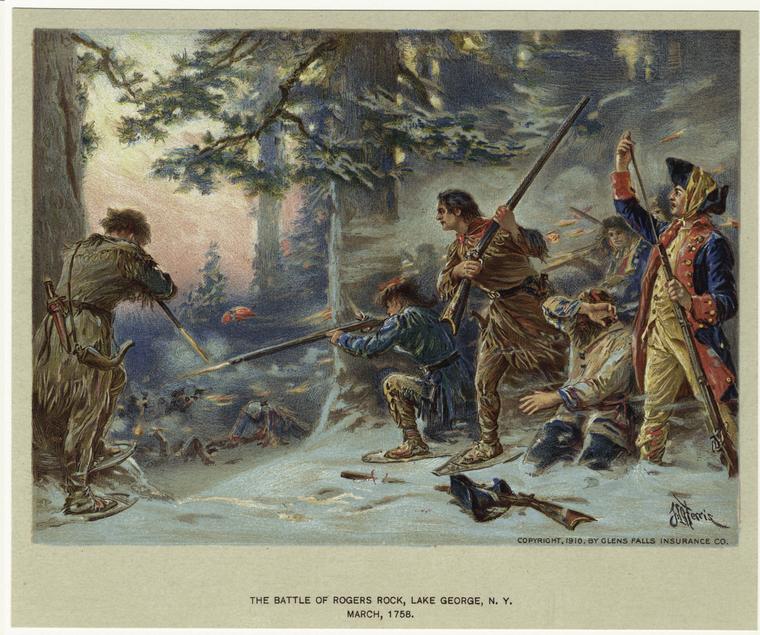
In March 1758 Rogers led a force of about 180 out of Fort Edward toward Fort Carillon. It was bitter cold and they proceeded down a frozen Lake George. Before leaving, Rogers feared the secrecy of the mission may have been compromised in the days leading up to their departure by colonials captured outside Fort Edward. During their journey the rangers found signs they were being observed, and in fact the French had discovered Rogers was approaching and watched his progress down Lake George. Rogers decided to approach Fort Carillon by leaving Lake George and traveling overland from the southwest down Trout Brook, a small stream. The snow was four feet deep and the rangers donned large racquet like snowshoes. Rogers expected a French patrol would follow the brook and the rangers set-up an ambush.
Rogers’ instincts were correct and as a 95-man patrol consisting mainly of natives entered the kill zone an ambush was triggered. The rangers initial volley killed and wounded many (Rogers reported 40 killed), with the survivors fleeing. Some of the rangers descended on the dead and wounded and began killing the wounded and scalping the dead. A large group of rangers chased the fleeing French and native survivors along Trout Brook and they ran head long into the main French and native force of about 200 led by the Canadian partisan fighter Ensign Jean-Baptiste Langy. Langy’s main party unleashed a devastating volley on the rangers killing outright upwards of 50 rangers. Within minutes the rangers were overwhelmed by the counterattack and faced annihilation. Rogers rallied his remaining force and began a close-range fighting retreat toward Lake George. The situation was growing desperate—Rogers had lost maybe half his force within a short time and men were continuing to drop under the relentless assault of the French and natives. As darkness fell, Rogers and what was left of his command scattered and made their way to a rendezvous on Lake George. Rogers’ escape is a mystery, but the legend is he slid down what is now known as Rogers Rock to the shore of the frozen lake. A couple days after the battle Rogers and what remained of his command made their way to Fort Edward. The rangers were decimated – only about 50 survived.
In the summer of 1758 a British and American force of 17,000, the largest ever assembled in North America, gathered at the south end of Lake George. Their first objective was Fort Carillon, approximately 35 miles north. The army embarked by water with Rogers and the rangers leading the way. Upon landing a few miles from Fort Carillon Rogers was sent ahead to secure an advance position and, finding no French, they were followed by a mixed advance guard of British regulars and colonials led by Brigadier General Lord George Augustus Howe, who was effectively the leader of the British expedition. The advance Anglo-American guard encountered difficulty negotiating the terrain and collided surprisingly with a French party. In the ensuing engagement the French were routed, but significantly, Lord Howe was killed. With his death, General James Abercromby lost the heart of the command structure. A couple days later Abercromby ordered the army to assault the French entrenched defensive line with the disastrous consequences of approximately 1,000 dead and 1,500 wounded between the two sides.
Following the Battle of Carillon, Abercromby’s army retreated and encamped at the south end of Lake George. Fort Edward, situated on the Hudson River about 15 miles south, supplied Abercromby’s army by a military road. The British supply trains were regularly attacked by French and native raiders who inflicted serious casualties and ransacked the supplies. Following a couple major attacks Abercromby ordered a mixed force of rangers, colonials and regulars commanded by Rogers and Israel Putnam to intercept and destroy the raiders. A force of about 700 men set out for South Bay and Wood Creek, an area a few miles east of Lake George.
After more than a week in the field Rogers’ and Putnam’s command could not locate the enemy, and the sick and injured were sent to Fort Edward reducing its size to 600. The British force camped near the ruins of the long-abandoned Fort Anne. Feeling secure, camp security was dropped, including Rogers and a British officer competing in a marksmanship contest. Lurking nearby was a Canadian and native force of about 350 – 450 men led by Captain Joseph Marin de La Malgue, an experienced and skilled partisan fighter. Marin set-up an ambush which the British force stumbled into. The ambush was sprung and Putnam was seized at its onset. Rogers rallied the command and beat back the French, inflicting serious casualties. Reported British losses were 37 dead, 40 wounded and 26 missing. Rogers returned to Fort Edward with 50 plus scalps and it had been estimated Marin may have lost as many as 70 to 100 men.
In 1759 Major General Jeffery Amherst led a campaign to take Forts Carillon and St. Frederic and drive north up the Richelieu River into Canada. As the army of 11,000 approached Forts Carillon and St. Frederic the French blew up the forts and withdrew north into Canada. The campaign stalled as the British began construction of a massive fort at Crown Point, next to the ruins of Fort St. Frederic. Rogers and his rangers were attached to Amherst’s army.
Rogers had long wanted to attack an Abenaki settlement at St. Francis, which is located south of the St. Lawrence River about midway between Montreal and Quebec. The Abenaki originally lived in Massachusetts and Maine, but as the English encroached, a group settled in St. Francis. Around 1700 the Jesuits established a mission at St. Francis converting many Abenakis to Catholicism, and the St. Francis people became closely allied with the French. For decades Abenaki war parties from St. Francis terrorized the New England frontier, developing a notorious reputation among English frontier settlers such as Rogers.
In September 1759 Amherst approved a raid on St. Francis. Rogers with a force of approximately 200 men – rangers, Stockbridge natives, provincials and British regulars – left Crown Point by whaleboat heading 80 miles north down Lake Champlain. After beaching their craft, they set out on foot across Southern Canada; St. Francis was 75 miles away. Soon after leaving Lake Champlain their boats were discovered by the French and Rogers was warned by Stockbridge allies of the French discovery. Rogers considered his options and decided to push on to St. Francis. He sent back to Crown Point 58 sick and injured, proceeding with 142 men. The trip was daunting as the expedition crossed spruce bogs and unforgiving wilderness reaching St. Francis on October 4, three weeks after leaving Crown Point.
At daybreak Rogers’ force struck St. Francis and overwhelmed the village. Most of the Abenaki warriors were away. After pillaging the village the English torched it and departed knowing full well they were being pursued. The English battle casualties were one killed and seven wounded and the estimates of Abenaki killed range from 30 to 200.
After traveling through Southern Canada Rogers’ force was out of food and still being pursued. After nine days the party split up, with most heading to a rendezvous on the Connecticut River. At the rendezvous the expected relief was absent so Rogers traveled to Fort No. 4 and brought food and supplies to his starving survivors on November 4. The objective was achieved, St. Francis was destroyed, but of the 142-man English force that raided the village only 80 men made it to Fort No. 4 and Crown Point.
What to make of Rogers
Rogers is an iconic French and Indian War personality. He is the key figure in many books, a landmark movie, and a TV show. Historians have studied him for centuries. But how should he be viewed as a military figure?
The French and Indian War’s frontier was violent and brutal. The terrain was rugged and engagements often occurred in remote areas during the winter. The weapons were lethal and wounds very often fatal.
My opinion is that Rogers was a highly capable woodsman and scout at a time when the English sorely lacked such capability. The raids he conducted in 1755 and 1756 kept the French on constant alert and provided British forces with much needed intelligence. He was brave, physically strong, indefatigable, and a leader of men. I would not call him a uniquely capable woodsman because Canada had many experienced and battle-hardened Canadian officers of Compagnies franches de la Marinein the field such as Langy, Marin, and Langlade, as well as a large contingent of coureur des bois, and one can plausibly argue these Canadians were superior bush fighters to Rogers. His Rules for Ranging Service have withstood the test time. Some of Rogers’ best personal qualities (bravery, leadership, clear thinking, resourcefulness) showed when he faced possible disaster as he and the rangers were able to inflict significant casualties on their foes and Rogers every time led his surviving command to safety.
When I push my self back and examine Rogers as a military tactician and his contributions to the British triumph in North America I have a very different opinion from many historians. Why was he ambushed so often? Why did he fail to adhere to the Rules for Ranging Service at key times? Why were his men put at risk in battles and campaigns of no strategic consequence? In the crucial British victories of the French and Indian War Rogers did not play a role.
The purpose of this essay is not to tarnish Rogers’ military legacy, but to rather bring to light the blemishes of his service in the French and Indian War so there can be a balanced view of “the brave Major Rogers.”
Bibliography
White Devil by Steven Brumwell
A True Ranger by Gary Stephen Zaboly
The History of Rogers Rangers, Volume 1, by Burt Garfield Loescher
War on the Run by John F. Ross
Betrayals by Ian K. Steele
The Annotated and Illustrated Journals of Major Robert Rogers by Timothy Todish
Ticonderoga 1758 by Rene Chartand
Empires in the Mountains by Russell P. Bellico
Stark by Richard Polhemus and John Polhemus
Rogers Rangers and the French and Indian War by Bradford Smith
Wilderness Empire by Allan W. Eckert
Robert Rogers’ Rules For Ranging Service
Northwest Passage by Kenneth Roberts
Sites Visited
Crown Point State Historic Site
Fort Ticonderoga
Fort William Henry Museum
Lake George Battlefield Park
Rogers Island Visitors Center and Museum
Art Ceconi was raised in North Tarrytown, New York (now Sleepy Hollow) and is a longtime resident of Montville, New Jersey where he currently lives with his wife Eileen. A retired tax attorney, he earned degrees from Fordham University (BS), Rutgers Business School (MBA), Rutgers School of Law (JD), and New York University School of Law (LLM).
Art’s passion for North American colonial history took root with a family vacation to Lake George as a 7th grader. His reading and research centers on the French and Indian War and Revolutionary War. As his five daughters can attest, no family vacation was complete without visiting at least one historical site.






 Emerging Revolutionary War Era