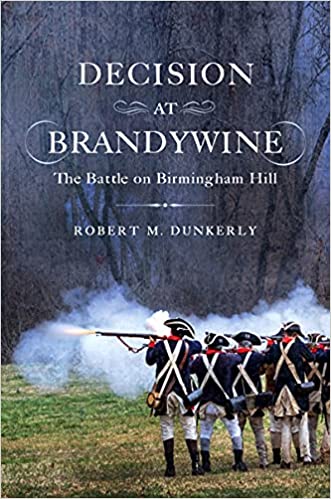
This Sunday on the Emerging Revolutionary War’s Facebook page, Robert Dunkerly will join the “Rev War Revelry” to discuss his newest publication, Decision at Brandywine: The Battle of Birmingham Hill.
The Battle of Brandywine, fought on September 11, 1777, saw the defeat of the American forces in southeastern Pennsylvania. The victory by the British opened the road to Philadelphia, which fell to Sir William Howe’s forces on September 26, fifteen days after the battle.
Dunkerly, a park ranger with Richmond National Battlefield Park and a contributing historian for Emerging Revolutionary War will discuss the pivotal action that happened around Birmingham Hill on that Thursday in 1777. The engagement at Brandywine was the largest and longest battle in the entire American Revolution and the third bloodiest. This new publication examines the action near Birmingham Hill and Meeting House where the action that day turned against George Washington’s forces.
Thus, this Sunday, at 7 p.m. EDT, tune into ERW’s Facebook page for the next historian happy hour as the popular “Rev War Revelry” series continues with this author spotlight.
On October 17, 1777, British General John Burgoyne surrendered his joint British, Canadian, and Hessian and Brunswicker forces to patriot General Horatio Gates near Saratoga, New York. Over 6,000 soldiers, the number placed by one historian is 6,222, became captives of war. Under the terms of the convention agreed upon by Burgoyne and Gates, the vanquished army was to march to Boston, Massachusetts, board British ships, and sail to England, to await formal exchange and to not participate in the war in America further.
When news reached the Continental Congress of this concession, that political body demanded a complete list of the troops surrendered to ensure the terms of the convention was to be upheld. When this was not forthcoming by the British, Congress reacted by vowing to not adhere to the stipulations of the convention. Burgoyne’s forces would not head back to Great Britain to await an exchange that year. Instead, these men were to be confined in camps both in New England and Virginia for the duration of the war. This force came to be called the Convention Army.
This Sunday, March 6, at 7 p.m. EDT, join Emerging Revolutionary War on our Facebook page for the next historian happy hour, as Dan Welch and Phillip S. Greenwalt discuss the Convention Army and what happened after the pivotal battle of Saratoga in October 1777.
On Sunday, January 23, Emerging Revolutionary War will journey, virtually, into the heart of the Mohawk Valley of New York in a discussion with Brian Mack of the Fort Plain Museum and Historical Park.
Established in 1961 the museum and park now encompasses over 75 acres and includes the site of Fort Plain/Fort Rensselaer, the foundation of a Revolutionary era bridge, the Fort Rensselaer Redoubt and works constructed by British forces, along with sites of colonial farmsteads, industry, and settlement. The museum also covers a wide era of the history of the area.
Mack lives out his passion for his family & for history in everything he does. A family vacation always includes a stop to a historic site or two. He is involved with the Fort Plain Museum & Historical Park as a member of their Board of Trustees, a Board member with The Stone Arabia Preservation & Battlefield, and a Board Member with The Mohawk Country Association. Most recently, he joined the Board with the Dr. Joseph Warren Foundation.
We look forward to a great discussion about the American Revolution in the Mohawk Valley of New York with Brian this Sunday, at 7 p.m. on Emerging Revolutionary War’s Facebook page.
On January 17, 1781, General Daniel Morgan and his mixed force of Continental soldiers and militia defeated the British under the command of Lieutenant Colonel Banastre Tarleton. This victory for the patriots in northwestern South Carolina had major implications on the southern theater and the main British force under General Lord Charles Cornwallis. The battle, named after the use of the fields in which it was fought, Cowpens, also included one of the only instances in American history of a successful double envelopment.
On Sunday, at 7 p.m. EDT, Emerging Revolutionary War will be joined by American Battlefield Trust’s Kristopher White, Deputy Director of Education and Daniel Davis, Education Manager, in a discussion about the history and preservation of the Battle of Cowpens.
Round out your January weekend by joining us on our Facebook page for this live historian happy hour.
244 years ago this week is when the Continental army, under the command of George Washington, marched into what would become their winter encampment as the year turned from 1777-1778. Recently, Phillip S. Greenwalt, one of the Emerging Revolutionary War historians was a “talking head” on a documentary about the Valley Forge encampment and what the soldiers and civilians faced during the ensuing six-month cantonment.
The documentary which features historians and park rangers is airing on Fox News Nation, the streaming service that is part of the Fox News network. Below is a screen shot of Phillip, who is also the author of Winter that Won the War, the Winter Encampment at Valley Forge, 1777-1778, which is part of the Emerging Revolutionary War Series published by Savas Beatie LLC.
So, if you need a break from the holiday specials that are airing, tune in for your history fix and learn more about the history at Valley Forge. If you want to dive even deeper into this period of the American Revolution, check out the link above labeled “2022 Bus Tour” and secure your tickets to join ERW at our second annual bus tour next November, which will include Valley Forge.
Our monthly recap of what our good friend and fellow historian Tom Hand has written on his blog, AmericanaCorner.
The Legacy of Paul Revere November 2, 2021
Paul Revere began his famous ride from Boston to Concord, around 11:00pm on April 18, 1775, informing the residents and militiamen that the British were on the march. He arrived in Lexington, a town about 10 miles from Boston, around midnight. Read more here.
Lexington and Concord: Minutemen in Arms November 9, 2021
The Battles of Lexington and Concord, fought on April 19, 1775, marked the start of America’s war for independence from England. The story of that fight is an inspiring account of how everyday Americans came together to resist the power of Great Britain. Read more here.
Lexington and Concord: The Shot Heard Round the World November 16, 2021
The fight between our Minutemen and the British regulars at Lexington was over in a matter of minutes, and the British began the seven-mile march to Concord. By now, reports of the shooting had reached the minutemen in the surrounding area, and they began to assemble. A bad day for the British was about to begin. Read more here.
The Battle of Bunker Hill November 23, 2021
The Battle of Bunker Hill, fought on June 17, 1775, is one of the most iconic and familiar events in American history. It was our first pitched battle against the British army and, although technically a defeat, the efforts of the American militiamen were inspirational. Read more here.
Emerging Revolutionary War wishes everyone a “Happy Thanksgiving!”
On October 3, 1789, George Washington, as president of the United States of America, issued a “thanksgiving proclamation” designating November 26 as a day of “public thanksgiving.” The statement found its way into newspapers, as depicted in the image below. The text of Washington’s proclamation is typed out below as well.
(courtesy of Mount Vernon)
“By the President of the United States of America, a Proclamation.
Whereas it is the duty of all Nations to acknowledge the providence of Almighty God, to obey his will, to be grateful for his benefits, and humbly to implore his protection and favor– and whereas both Houses of Congress have by their joint Committee requested me to recommend to the People of the United States a day of public thanksgiving and prayer to be observed by acknowledging with grateful hearts the many signal favors of Almighty God especially by affording them an opportunity peaceably to establish a form of government for their safety and happiness.
Now therefore I do recommend and assign Thursday the 26th day of November next to be devoted by the People of these States to the service of that great and glorious Being, who is the beneficent Author of all the good that was, that is, or that will be– That we may then all unite in rendering unto him our sincere and humble thanks–for his kind care and protection of the People of this Country previous to their becoming a Nation–for the signal and manifold mercies, and the favorable interpositions of his Providence which we experienced in the course and conclusion of the late war–for the great degree of tranquility, union, and plenty, which we have since enjoyed–for the peaceable and rational manner, in which we have been enabled to establish constitutions of government for our safety and happiness, and particularly the national One now lately instituted–for the civil and religious liberty with which we are blessed; and the means we have of acquiring and diffusing useful knowledge; and in general for all the great and various favors which he hath been pleased to confer upon us.
and also that we may then unite in most humbly offering our prayers and supplications to the great Lord and Ruler of Nations and beseech him to pardon our national and other transgressions– to enable us all, whether in public or private stations, to perform our several and relative duties properly and punctually–to render our national government a blessing to all the people, by constantly being a Government of wise, just, and constitutional laws, discreetly and faithfully executed and obeyed–to protect and guide all Sovereigns and Nations (especially such as have shewn kindness unto us) and to bless them with good government, peace, and concord–To promote the knowledge and practice of true religion and virtue, and the encrease of science among them and us–and generally to grant unto all Mankind such a degree of temporal prosperity as he alone knows to be best.
Given under my hand at the City of New York the third day of October in the year of our Lord 1789.
With the turkey eaten, Black Friday shopping completed, and a slate of American football watched, and prior to cyber Monday beginning, Emerging Revolutionary War invites you to tune in for a historian happy hour. This week “Rev War Revelry” returns to the French and Indian War and welcomes as guests Lake George Battlefield Park Alliance President John DiNuzzi and the Board of Trustee Member Lyn Hohmann.
The discussion will entail their organizations effort to preserve and interpret one of the America’s most historical places and hallowed ground.
“The Lake George Battlefield Park was the scene of major battles during the French and Indian War and American Revolutionary War, and the home of Fort George, a key anchor of first British and then American military strategies in those world-changing conflicts. Enveloped by the natural beauty of the Adirondack Mountains in the town of Lake George, the site’s history reflects its prominence as part of the crucial Hudson River-Lake George-Lake Champlain corridor in the mid-to-late 18th Century.”
The Lake George Battlefield Park Alliance’s effort to commemorate the ground is so invaluable to telling the overall story. Joining the two guest historians and preservationists will be ERW historian Billy Griffith who is an author on a book with the HistoryPress on the actions around Lake George.
Grab that last remaining beer, tune in to our Facebook page this Sunday, at 7 p.m. EDT, and hear the amazing work being done in New York. How else would you want to round out the holiday weekend?
Our monthly recap of what our good friend and fellow historian Tom Hand has written on his blog, AmericanaCorner.
The Midnight Ride of Paul Revere October 26th
The story of Paul Revere and his Midnight Ride is one of the many fascinating subjects of the grand American past. Taking place in conjunction with the Battles of Lexington and Concord, on April 19, 1775, the tale has passed down from generation to generation. Read more here.
Forefathers Gather at Historic First Continental Congress October 19th
The First Continental Congress was a key link in the chain of events that led to our nation’s gaining its independence from England. The brief convention brought together most of the influential leaders from colonial America to determine an answer to Parliament’s recently enacted Coercive Acts. Read more here.
The Boston Tea Party Takes Colonists Past the Point of No Return October 12th
The Boston Tea Party is one of the most iconic moments in American history. In some ways, it sealed our fate to separate from England and become our own nation. The road that led to this watershed event began several years earlier with the Townshend Acts. Read more here.
Aftermath of the Boston Massacre October 5th
The violence on the evening of March 5, 1770, in Boston is known to us today as the Boston Massacre. It was an unfortunate incident that left five people dead and growing anger between American colonists and leaders in England. Read more here.
After you give out the last piece of candy or consume the last piece of candy or just need a break from the doorbell ringing and handing out candy, join Emerging Revolutionary War for our latest “Rev War Revelry” this Sunday, at 7 p.m. EDT, on our Facebook page. This next installment of the historian happy hour will discuss Headless Hessians and other German tales from the American Revolution.
Joining Emerging Revolutionary War historians Kevin Pawlak and Mark Wilcox will be guest historian Ross Schwalm who specializes in the history of Hessians and their role in the American Revolutionary era. Besides diving into this tale on Halloween night, the history behind Washington Irving’s fictional tale will also be discussed.
Questions such as; Was the Headless Horsemen really a Headless Hessian? What is fact and what is fiction? The answers to these questions and more (and we encourage questions from the viewers) will be answered this Sunday. Grab your favorite pumpkin beverage and/or Halloween treat and tune in to this exciting “Rev War Revelry.”




 Emerging Revolutionary War Era