“Remember, it is the fifth of March, a day ever to be forgotten; avenge the death of your brethren,”

In March 1776, a quiet hill overlooking Boston Harbor became one of the first turning points of the American Revolutionary War. Dorchester Heights, rising above the southern approaches to Boston in what is now South Boston, played a decisive role in forcing the British Army to evacuate the city. The dramatic occupation and fortification of the Heights by American forces under General George Washington transformed a long, grinding siege into a strategic victory that reshaped the war’s momentum.

After the battles of Lexington and Concord in April 1775 and the bloody clash at Bunker Hill in June, British forces under General Thomas Gage and then William Howe found themselves effectively trapped in Boston. Surrounding militia units from Massachusetts and neighboring colonies formed a loose ring around the city, beginning what became known as the Siege of Boston. When George Washington arrived in July 1775 to take command of the newly formed Continental Army, he inherited a force that was determined but poorly supplied and short on artillery.

Throughout the fall and winter of 1775–1776, Washington searched for a way to break the stalemate. A direct assault on Boston would have been costly and risky. Instead, he looked to geography. Dorchester Heights, commanding sweeping views of the harbor and the city, offered a strategic advantage. If American forces could fortify the Heights with cannon, they would threaten both the British fleet and the troops stationed in Boston. Control of this high ground would make the British position untenable. The British Navy had encouraged British General Howe (now commanding the British forces in Boston) to take the position due to the Navy’s vulnerability if the Americans were able to command the heights with artillery. Howe underestimated the importance of the heights and also believed the Americans lacked the proper artillery and strength to hold it.
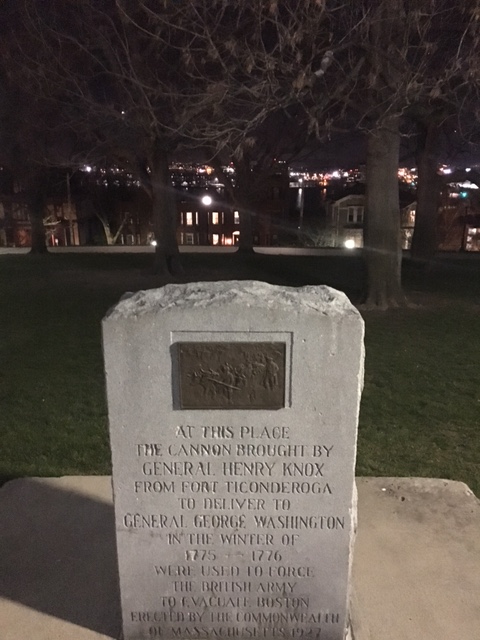
Knox marker on Dorchester Heights

The key to Washington’s plan lay in artillery. In late 1775, Colonel Henry Knox undertook an audacious mission to transport heavy cannons captured from the British at Fort Ticonderoga in upstate New York. Over the winter, Knox and his men hauled approximately 60 tons of artillery—an operation later dubbed the “Noble Train of Artillery”—over 300 miles of frozen rivers and snow-covered terrain to Cambridge, Massachusetts.

These cannons provided Washington with the firepower necessary to implement his strategy. By early March 1776, conditions were ripe. The ground was still frozen, making it easier to move heavy equipment and but would challenge their skills at building fortifications.

On the night of March 4, American troops moved silently toward Dorchester Heights. Under the cover of darkness and diversionary bombardments from other positions, they began constructing fortifications with remarkable speed. Using pre-prepared materials—fascines (bundles of sticks), chandeliers (wooden frames filled with earth), and hay bales—they built defensive works capable of withstanding British cannon fire.

By dawn on March 5, the anniversary of the Boston Massacre, British sentries were stunned to see formidable American fortifications atop the Heights, bristling with cannon aimed at the city and harbor. General Howe reportedly exclaimed that the rebels had accomplished more in one night than his army could have done in months. The strategic implications were clear. From Dorchester Heights, American artillery could rain fire down on British ships and troop positions. The Royal Navy, essential to British supply and mobility, was now vulnerable. Remaining in Boston was a risk that Admiral Molyneux Shuldham was not willing to take and pushed Howe to respond quickly.

General Howe initially planned a counterattack to dislodge the Americans. However, a fierce storm on March 6 disrupted preparations and made an amphibious assault difficult. Also, Washington got word of the planned British assault and increased his manpower on Dorchester Heights to nearly 6,000. The memory of heavy British casualties at Bunker Hill also weighed heavily. Dorchester Heights were even stronger and more defensible than Breed’s Hill had been the previous year.
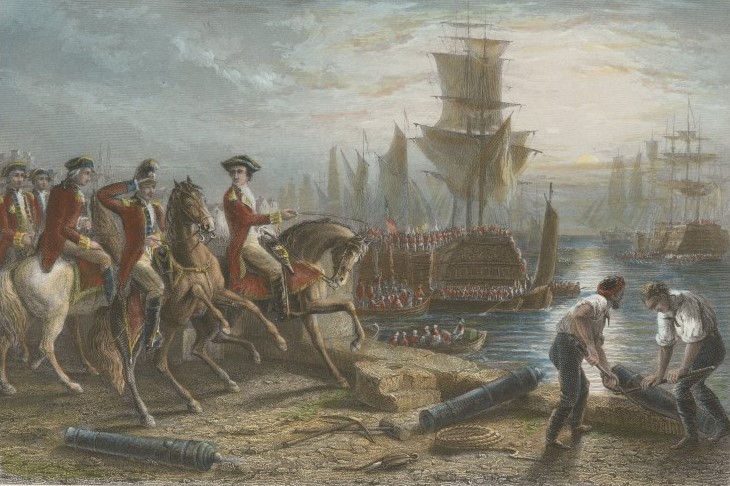
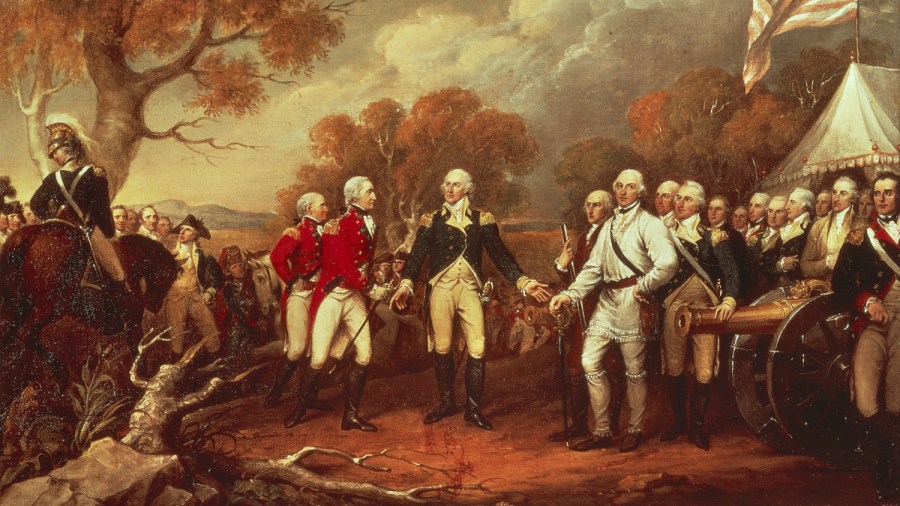
Howe evacuating Boston, courtesy New York Public Library

Facing the prospect of severe losses and an increasingly precarious situation, Howe reconsidered. Negotiations—informal and indirect—suggested that if the British evacuated Boston without destroying the town, American forces would not attack during the withdrawal.

On March 17, 1776, British troops and Loyalists began evacuating the city. More than 11,000 soldiers and nearly 1,000 Loyalists boarded ships and sailed to Halifax, Nova Scotia. The Siege of Boston was over, and the city was firmly in American hands for the remainder of the war.

The occupation of Dorchester Heights marked the first major strategic victory for the Continental Army under Washington’s leadership. It demonstrated the effectiveness of coordinated planning, logistical ingenuity, and the intelligent use of terrain. Rather than launching a costly frontal assault, Washington had leveraged geography and artillery to compel the enemy’s withdrawal.

This victory also boosted American morale at a critical time. The war was far from won—indeed, it would intensify dramatically later in 1776 with British campaigns in New York—but the successful eviction of British forces from Boston showed that the Continental Army could achieve meaningful results.

Moreover, Dorchester Heights solidified Washington’s reputation as a capable commander. His cautious but decisive approach, combined with Knox’s logistical triumph, set a pattern for future operations. The event underscored the importance of high ground in military strategy, a lesson that had already been evident at Bunker Hill but was applied with even greater effect in March 1776.
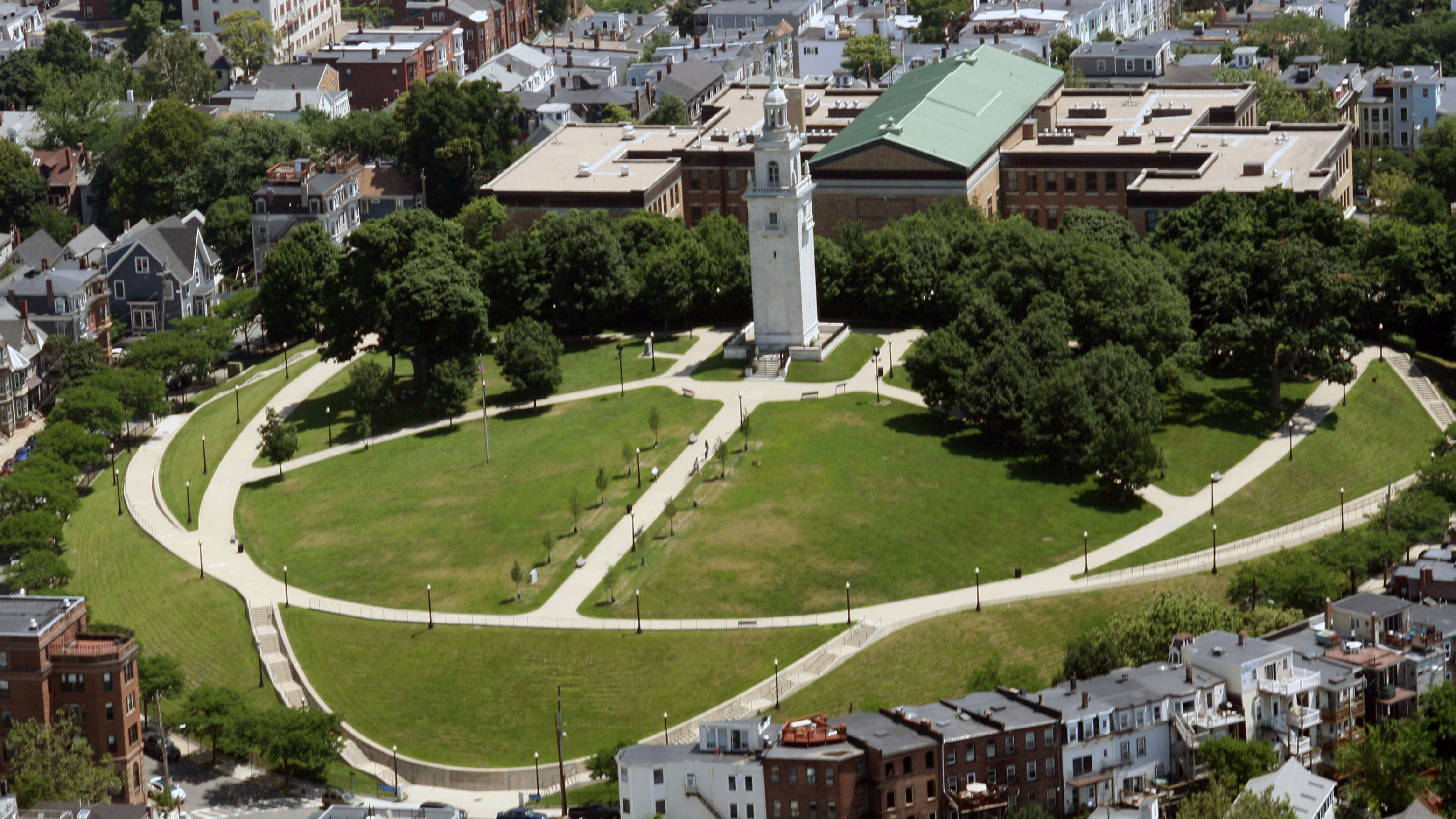
Dorchester Heights and the 1902 monument today, part of the Boston National Historical Park, courtesy of NPS

Rev War Revelry: The Atlas of Independence: John Adams and the American Revolution with Dr. Chris Mackowski

Join us this Sunday at 7pm LIVE on our Facebook page as we focus on ERW’s first 2026 book release, The Atlas of Independence: John Adams and the American Revolution by Dr. Chris Mackowski. Mackowski will discuss why Adams led him to write his first “Rev War book” and the much over looked impact Adams had during the war years. We will discuss some of the more “unique” relationships Adams developed through the war time years and of course his friendship with Thomas Jefferson and his close relationship with his wife Abigail.

To order a copy of “Atlas of Independence” visit Savas Beatie’s website at: https://www.savasbeatie.com/ . Again, this will be a LIVE broadcast on our Facebook page, so grab a drink and join in on the chat!

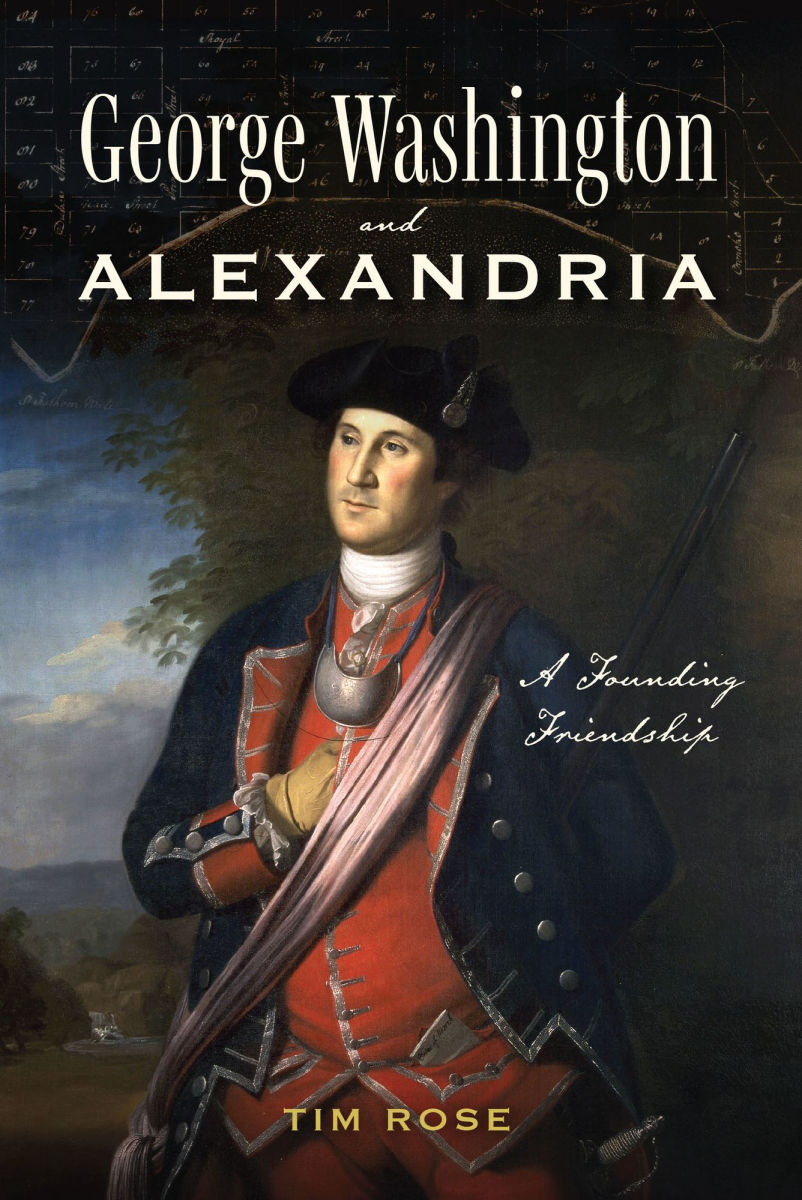
Rev War Revelry: George Washington and Alexandria; A Founding Friendship with Tim Rose

Join us this Sunday night at 7pm as we return LIVE for our next installment of Rev War Revelry. We welcome author and historian Tim Rose to discuss his new book on George Washington and his relationship with his hometown of Alexandria, VA (George Washington and Alexandria: A Founding Friendship – History Press). Tim is a local tour guide and will highlight the people and places that shaped Washington’s life. Grab a drink (or hot chocolate if you are on the eastern part of the country) and submit comments and questions via the live chat as we live stream on our Facebook page.

Rev War Revelry This Sunday: After Great Bridge: Dunmore and the Burning of an American City

Join us this Sunday, January 11th at 7pm as we welcome back historian Patrick Hannum as we discuss the events in Virginia after the Battle of Great Bridge. The results of the British loss at Great Bridge had profound impacts on Dunmore’s plans in Virginia which led to the destruction of Virginia’s largest city. Was Norfolk burned by Dunmore as has been popularly understood or is the story more complicated? What became of the former slaves that joined Dunmore’s army? Tune in and learn about the events in Virginia in the winter 1775 – spring 1776. This Revelry is pre-recorded and will be posted to our Facebook page on Jan. 11 at 7pm and also to our You Tube and Spotify channels.

ERW’s 2026 Tour Release – WAIT LIST!

This year will mark our SIXTH Annual ERW Bus Tour. In past years we walked in the footsteps of history at Trenton/Princeton, Monmouth/Valley Forge, Charleston/Eutaw Springs, Lexington/Concord, Brandywine/Paoli. Each year our tour has grown, our first tour coming out of COVID had a hearty 45 souls, but in recent years our tours have sold out. Our 2026 tour we will cover the battles and surrender of Saratoga (Freeman’s Farm, Bemis Heights) on October 9-11, 2026.

As in years past, we do an early release of our next bus tour to those who have been on past bus tours. Then on January 1st, we open the tour to everyone. Well this year, our past customers have been so satisfied that we have SOLD OUT our 2026 bus tour already to just our early bird customers! We could not be more honored by this and it shows the excitement around America’s 250th.

Though the tour is sold out, we want to create a wait list in case people who have already registered have to withdraw. To get your name on the waitlist, please email us at: emergingrevolutionarywar@gmail.com. The tour details are below.

Once again, thank you to all of you have gone on our tours in the past and made the decision to join us in 2026. If you have not been on one of our tours before, please email us to get on our waitlist!

This Army Will Not Retreat: The Battles of Saratoga Bus Tour

October 9-11, 2026

Join Emerging Revolutionary War historians on a bus tour of the 1777 battles in Saratoga, that turned the tide of the war. Program includes Friday night lecture, tour all day Saturday and half day Sunday. Lunch included on Saturday. Tour fee is $250 per person, does NOT include hotel accommodations. Host hotel is the Gideon-Putnam in Saratoga Springs, NY.

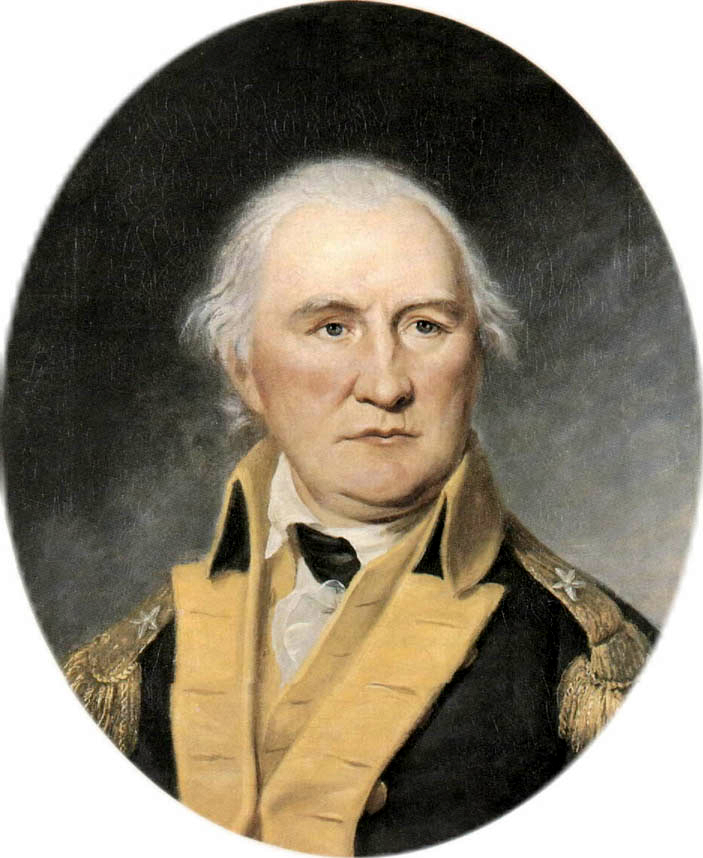
“The Old Wagoner” and the Beginning of the American Revolution

In honor of the 250th anniversary of the Battle of Quebec, we reshare guest historian Scott Patchan’s post on Daniel Morgan during the Canadian Campaign of 1775. This post originally posted in December 2015. 

When the situation deteriorated to outright rebellion against the crown, Morgan raised a regiment of crack riflemen from Frederick County, and marched them to Boston in twenty-one days to take part in the siege of Boston. There, he served under his former commander from the French and Indian War, General George Washington. Morgan learned the hard way that orders must be followed. He once allowed his riflemen to exceed orders in firing upon British positions at Boston. Washington called Morgan on the disobedience, and Daniel thought that he would be cashiered from the army. Washington, however, relented the next day, but Morgan had learned a valuable lesson about following orders.

Daniel Morgan in the American Revolution

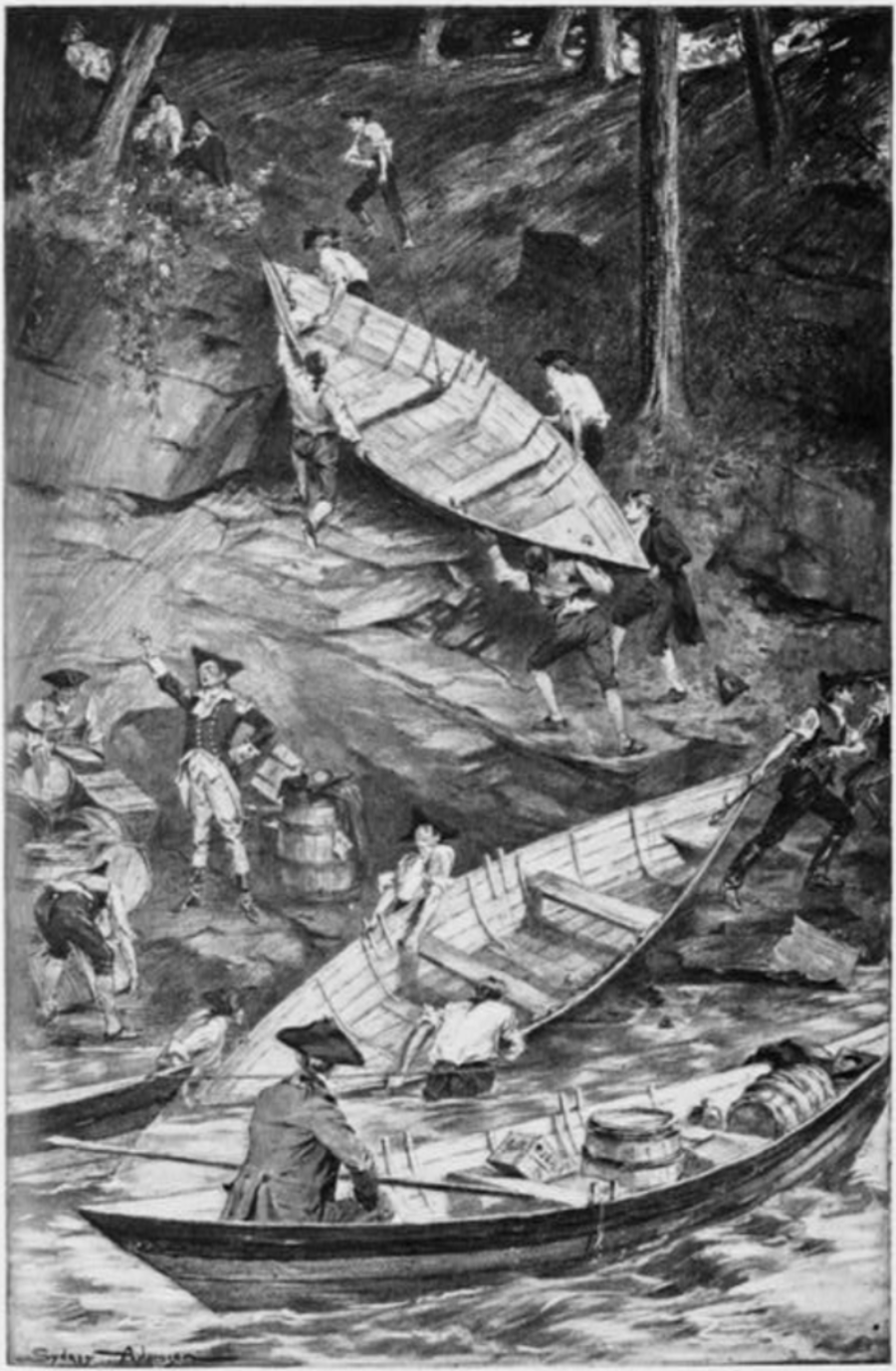
In the fall of 1775, Washington sent Morgan as commander of three companies of Continental riflemen on a mission to capture Quebec from the British. Morgan’s command marched with the column of Colonel Benedict Arnold. They traversed the Maine wilderness, rowing up stream to the “Great Carrying Place,” where carried their canoes and bateaux for great distances overland to another series of streams and lakes that took them to Quebec. As the cold weather set in, sickness and hunger overtook the column and Arnold sent those unfit for duty back to the rear. After covering 350 miles, the American arrived in front of Quebec in early November, surprising the British.

Although Morgan wanted to attack immediately and utilize the element of surprise, he was overruled and the small American force besieged Quebec, waiting for another column under General Richard Montgomery to arrive from the Hudson Valley. When a British party sallied forth and captured one of Morgan’s riflemen on November 18, Arnold believed the British would come out and fight in the open. As such, Arnold drew up his army in front of the fortifications to meet them. They declined his offer and instead looked down on the ragamuffin Americans from the ramparts and exchanged taunts and catcalls. The overall situation frustrated the irascible Morgan, and when his men complained that Arnold was not giving the riflemen their fair share of rations, the “Old Wagoner” violently argued with Arnold, and nearly came to blows with the future traitor. Morgan departed Arnold, leaving him with angry warning about poor treatment of the riflemen. From that time forward, Morgan’s command always received their fair share of the army’s rations.

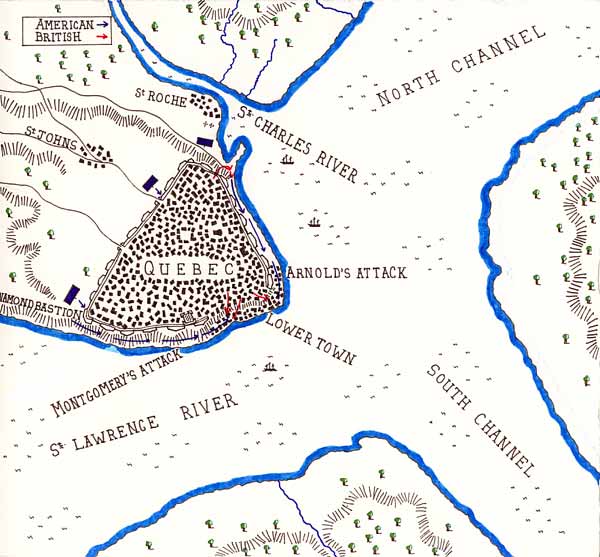
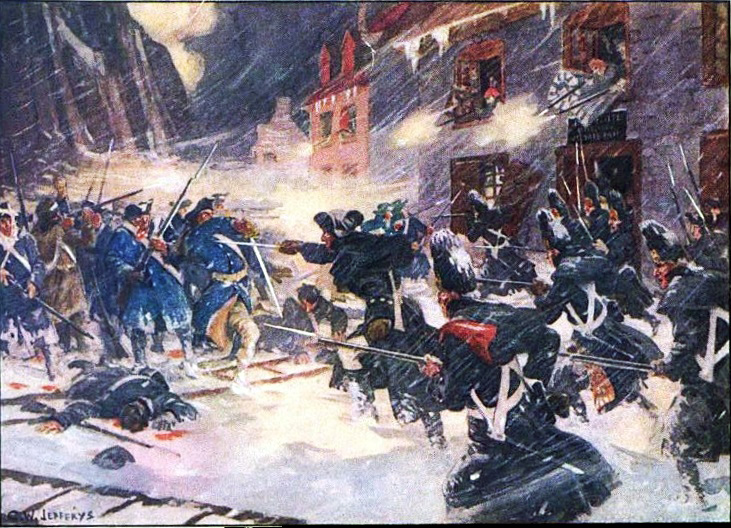
Montgomery’s column arrived on December 5, and the Americans commenced setting up his mortars and artillery outside of Quebec. The Americans finally attacked during a snowstorm in the early morning darkness of December 31, but their force numbered only 950 men. Arnold’s column came under fire as it moved toward the ramparts of Quebec, and a musket ball struck Arnold taking him out of action. Although Morgan was not the senior officer, the others insisted that he take command, having seen actual combat which they had not. Morgan later noted that this “reflected credit on their judgment.” At Morgan’s order, his riflemen rushed to the front, armed with both their Pennsylvania rifles and a spontoon for the assault while some carried ladders to storm the walls. They quickly drove a small force of British away and closed in on the walls.

Map of Battle of Quebec, 1775 (courtesy of British Battles)
Map of Battle of Quebec, 1775
(courtesy of British Battles)

Morgan ordered the men up the ladders and first one gingerly began the climb. Morgan sensed his hesitancy, pulled him down and scaled it himself, shouting, “Now boys, Follow me!” The men instantly complied, and Morgan reached the top of the wall where a volley of musketry exploded, knocking him back to the snow-covered ground. The burst burnt his hair and blackened his face; one ball grazed his cheek and another pierced his hat; but Morgan was otherwise unhurt. Stunned he laid motionless on the ground for a moment, and the attack stopped, his men thinking him dead. But he soon stirred and clambered up the ladder to the cheers of his men who followed suit. This time he stopped before reaching the top, and hurtled himself over the rampart into the midst of the enemy. He landed on a cannon and injured his back and found British bayonets levelled at him from all directions. While the British focused on Morgan, his riflemen poured over the wall and came to his rescue, driving off Morgan’s would-be impalers.  Morgan kept up a close pursuit of the British who offered weak resistance to the attacking riflemen. Although Morgan had broken into Quebec, the main body of Arnold’s division failed to follow the riflemen over the wall and exploit the opportunity at hand. Morgan captured much of the lower portion of Quebec with only two companies of his riflemen. He later described the breakdown that occurred:

“Here, I was ordered to wait for General Montgomery, and a fatal order it was. It prevented me from taking the garrison, as I had already captured half of the town. The sally port through the (second) barrier was standing open; the guard had left it, and the people were running from the upper town in whole platoons, giving themselves up as prisoners to get out of the way of the confusion which might shortly ensue. I went up to the edge of the upper town with an interpreter to see what was going on, as the firing had ceased. Finding no person in arms at all, I returned and called a council of war of what few officers I had with me; for the greater part of our force had missed their way, and had not got into the town. Here I was overruled by sound judgment and good reasoning. It was said in the first place that if I went on I should break orders; in the next, that I had more prisoners than I had men; and that if I left them they might break out and retake the battery we had just captured and cut off our retreat. It was further urged that Gen. Montgomery was coming down along the shore of the St Lawrence, and would join us in a few minutes; and that we were sure of conquest if we acted with caution and prudence. To these good reasons I gave up my own original opinion, and lost the town.”

Montgomery never arrived; he had been killed in the first blast of musketry against his column, and his command broke. As time went on, the British regained their composure and pushed back against Morgan’s command. Morgan went back and brought up 200 New Englanders who joined the riflemen as they attempted to renew the attack. Now, the previously undefended point, was well manned, and daylight illuminated the paucity of Morgan’s numbers. Nevertheless, Morgan pressed them back further into the town to an interior fortification. A brave British officer led a counterattack, but Morgan personally shot him dead and disrupted the assault. Nevertheless, the time for action had passed. The British had become aware that Morgan’s was the only active American force in the city and closed in around him. In the meanwhile, additional British forces reoccupied the gates Morgan had initially taken and trapped him in the city. Morgan had no choice but to surrender his small command.

One artist's depiction of the Battle of Quebec, 1775. Both forces are wearing blue overcoats. (courtesy of British Battles)
One artist’s depiction of the Battle of Quebec, 1775. Both forces are wearing blue overcoats.
(courtesy of British Battles)

Morgan and the other officers enjoyed a liberal captivity with generous quarters in a seminary. The British officers visited them often and remained on friendly terms with the Americans. Morgan developed a dislike for some of his fellow officers whom he regarded as dishonest and scheming, and his fighting skills were brought to bear on at least one occasion when several men teamed up against big Dan Morgan. The imprisonment ended when the British returned the American officers on September 24, 1776, in New Jersey. Morgan returned to his wife and two daughters at his home outside of Battletown or Berryville, where he awaited his proper exchange. While there, he named his home “Soldier’s Rest,” as he recuperated from the trials of the taxing expedition to Quebec.  The war was still young, and the Continental Army would soon be calling upon his services again. A special command of riflemen was being organized and Morgan would be its commander.

Rev War Revelry: The 1775 Canadian Campaign

Join us this Sunday, December 14th at 7pm as we return LIVE for this Rev War Revelry on the Canadian Campaign of 1775. We will discuss Arnold, Montgomery, Morgan and others on America’s attempt to capture Montreal, Quebec and create a “14th state.” From Arnold’s arduous march to Quebec through the wilds of Maine to Montgomery’s capture of Montreal, our historians Alex Cain and Mike Cecere will cover the entire campaign and answer the question “was the capture of Canada possible?”

This fall and winter mark the 250th anniversary of the campaign and the battles of Montreal and Quebec, and both of our speakers have taken part in the commemorative events. Grab a drink and watch live on our Facebook page, also add questions in the chat.

Emerging Revolutionary War Merchandise!

It has taken us awhile, but after a few years of our followers and tour goers asking for the ability to purchase ERW merchandise, we have finally created a store via Cafe Press. You will find a few clothing options along with hats, bumper magnets and it wouldn’t be an ERW store without a pint glass.

It is nothing fancy, but wanted to give everyone the ability to purchase some ERW bling and we appreciate the support as you wearing our logo is the best marketing we can hope for! We have tried to keep the prices low and all proceeds go to support our operations (website and podcast support etc..).

You can visit the merchandise store here: https://www.cafepress.com/shop/EmergingRevolutionaryWar

Rev War Revelry: The Battle of Great Bridge with Patrick Hannum

Join us this Sunday as we welcome historian Patrick H. Hannum, as we discuss the events leading up to and including the Battle of Great Bridge, fought on December 9, 1775. Patrick will also share his research of the men who were there at the battle and the long lasting impacts his small battle had on Virginia in the American Revolution. With the 250th anniversary of the Battle of Great Bridge upon us, this is a great time to catch up on the events in Virginia during the fall of 1775.

Patrick H. (Pat) Hannum served for 45 years the Department of Defense, 29 years as a U.S. Marine (Assault Amphibious Vehicle Officer), including battalion command, and 16 years as a civilian professor at the Joint Forces Staff College, National Defense University, where he specialized in operational-level warfare and Phase II Joint Professional Military Education. He continues to study and promote the history and relevance of the American Revolution through membership in the Norfolk Chapter of the Sons of the American Revolution and the Great Bridge Battlefield & Waterways History Foundation, including staff rides, battlefield tours and other educational venues.

This Rev War Revelry will be recorded and placed on our Facebook page this Sunday at 7pm and subsequently on our You Tube and Spotify Channels. So after you fill up on turkey and football, tune in to catch a little history!

ERW Recaps Ken Burns’ “American Revolution” -Nightly at 10pm!

There is a lot of anticipation on the upcoming Ken Burns’ documentary on the American Revolution. The series will run on PBS starting this Sunday at 8pm and running through Friday. Emerging Revolutionary War invites you to join us each night at 10pm on our Facebook page as we recap each episode with our Emerging Revolutionary War historians. These will be live streams, so join in on the discussion via the chat.

We have seen various previews of the documentary and we are excited about the potential this series might have on generating more public interest in the American Revolution and the 250th anniversary events over the next six years.

Be sure to join us and we hope to see you at 10pm on Sunday night!