One of the first infamous miltiary units in Virginia during the American Revolution was the Culpeper Minute Men. Remebered and memorialized throughout the years, we welcome James Bish back to discuss the history of the men, the unit and what role they played in the early days of the Revolution in Virginia.
Jim will also talk about some of the upcoming commemorative events planned around the 250th anniversary of the formation of the Culpeper Minutemen. To learn more about the events, visit: https://culpepermuseum.com/culpeper-minutemen-250th-anniversay-week/ . This Rev War Revelry is recorded and will be posted to our Facebook page on Sunday, October 5th at 7pm. It will also be posted to our You Tube and Spotify channels.
Join us this Sunday at 7pm on our Facebook page as we welcome historian and author Gabe Neville back to Rev War Revelry. Gabe has just finished and published one of the most comprehensive Revolutionary War unit histories ever written. Focusing on the Eighth Virginia Regiment, Neville’s book titled “The Last Men Standing, The Eighth Virignia Regiment” is a must have for anyone’s library. We will talk with Gabe about his research, interesting tidbits of his book and what let him to this project.
This presentation witll be LIVE at 7pm on Sunday, August 24th. Tune in and share any thoughts or questions in the chat. Gabe is always a fun chat, so grab a drink and enjoy learning about his in depth research on the 8th Virginia Regiment.
ERW Welcomes Matt Beres, Executive Director of the Arlington Historical Society
On the morning of April 19, 1775, the first shot of America’s War for Independence was fired on the Lexington Green. Later that morning, Major John Buttrick, commanding the local Provincial forces, gave the order to fire on the British Regulars at the North Bridge. This act would later be remembered as the “Shot Heard ‘Round the World,” a phrase immortalized by Ralph Waldo Emerson.
As Lt. Col. Smith’s British Regulars began their retreat back to Boston, Governor Thomas Gage sent a relief column of Regulars, led by General Hugh Percy. Meanwhile, Provincial militias and minute companies from surrounding towns marched toward the conflict, firing on both sides of the main road leading back to Boston. The Battle was just beginning.
While Lexington is famous as the site of the “first shot” and Concord for the “Shot Heard ‘Round the World,” Menotomy (present-day Arlington) is known as the site of the largest battle of the day, where fierce fighting erupted between the retreating British forces and the growing Provincial forces. The following stories are from this Battle.
David Lamson
Earlier that day, a convoy of provisions and supplies, protected by a detachment of British Regulars, arrived behind the main force heading toward Lexington and faced difficulties crossing the Brighton Bridge. Before their arrival, the Committee of Safety had removed the planks, and the combination of heavy wagons and repairs to the bridge caused the convoy to become separated from the main force, rendering it vulnerable.
An alarm rider from Cambridge alerted locals, prompting men from the ‘exempt’ or ‘alarm’ list—those unfit for regular Militia or Minute companies—to gather at Cooper’s Tavern to plan to capture the convoy. Among them was David Lamson, a biracial French and Indian War veteran, whose experience and bravery made him a natural leader. The group quickly appointed him as their Commanding Officer.
According to a story derived from Lamson himself, they positioned themselves behind a stone wall near the First Parish Meeting House. As the convoy approached, they ordered it to surrender. When the drivers urged their horses forward, Lamson’s men fired, killing the driver and several horses, and wounding two Regulars. In panic, the remaining six Regulars fled toward Spy Pond, and discarded their weapons.
It is said they then surrendered to an old woman, Mother Bathericke, who was in the field picking flowers. The old woman forced them to the house of Ephraim Frost, Captain of the Menotomy Militia, and stated, “… you tell King George that an old woman took six of his grenadiers prisoners.”
Samuel Whittemore
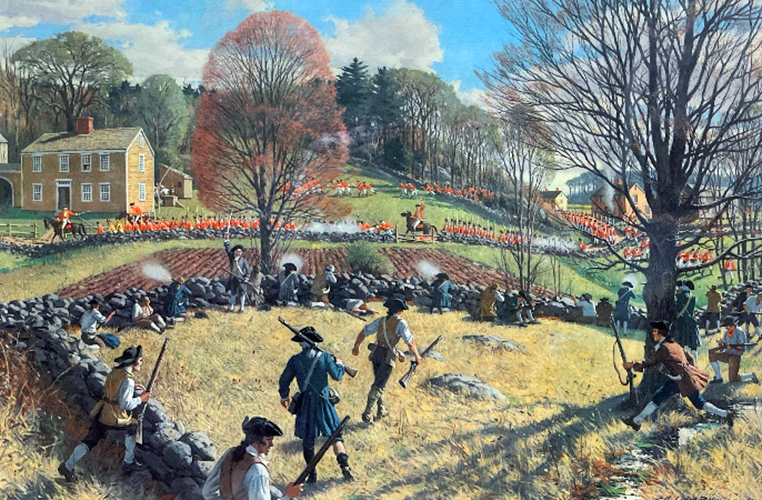
Aiden Lassell Ripley (1896-1969), Retreat from Lexington at the Foot of the Rocks. A.2.509. Arlington Historical Society Collections
Around 4:00 pm, the retreating British Regulars arrived at the village Menotomy. It was here where Samuel Whittemore, the oldest known combatant of the Revolutionary War, earned his fame. During the conflict, Whittemore took cover behind a stone wall. He reportedly fired at five soldiers but was soon overwhelmed. He suffered a gunshot wound to the cheek and a bayonet stab wound. When the Regulars continued their retreat, the locals carried him to Cooper’s Tavern, where Dr. Tufts of Medford treated his injuries.
Remarkably, Whittemore survived for another 18 years after suffering these life-threatening wounds. He lived long enough to see the birth of a new and independent nation.
Jason Russell
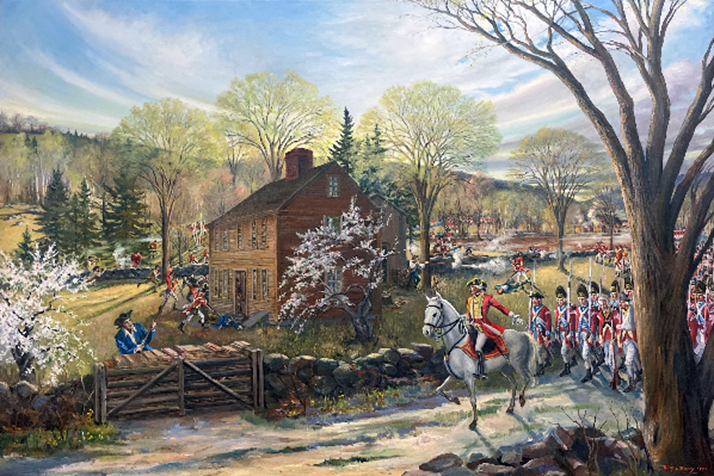
Later during their retreat, Gen. Percy ordered his men to enter the residences along Concord Road (now Massachusetts Avenue) to eliminate the Provincials who were firing from inside these houses. One notable example was the site of Jason Russell House.
Ruth L. Berry, 1975. Jason Russell House in Battle With British Soldiers 1990.19.1. Arlington Historical Society Collections
Jason Russell was a middle-aged farmer who reportedly had a leg disability. He barricaded his property and refused to leave, asserting, “An Englishman’s house is his castle.”
As British Regulars surrounded his home, several Provincials from different towns sought refuge inside. Tragically, Jason Russell and several others lost their lives on his property.
Today, the c. 1740 house, still bearing musket ball holes in the remaining structure from the fight, is at the heart of the Arlington Historical Society’s regional history museum, offering guided tours and engaging exhibits that highlight the lasting impacts of the American Revolution and Arlington’s broader history.
We are excited to announced our FIFTH annual ERW bus tour will be on November 7-9, 2025 and will cover the 1777 Philadelphia Campaign.
Author and historian Michael Harris will join us as we cover the fall of 1777 campaign. The British Army under Gen. William Howe made a concerted effort to take the American capital of Philadelphia. George Washington and the Continental Army fought major actions at Brandywine and Germantown in an effort to hold and take back the city. The tour will cover sites associated with the Philadelphia Campaign, such as Brandywine, Germantown, Paoli and others.
Tickets are $250 per person and will include Friday night lecture at the host hotel, all day bus tour on Saturday and half day bus tour on Sunday. A lunch is included for Saturday.
Our host hotel is the Holiday Inn Express and Suites – King of Prussia. Lodging is NOT included in the registration fee. A room bloc has been established under the name of “Emerging Revolutionary War.” A link will be provided in the future for hotel lodging.
Join us for our FIFTH annual tour as we take on the beginning of the American Revolution just a few months before the 250th anniversary. Learn about the dramatic events that led to some of the bloodiest days in the American Revolution. There is no better way to experience history than to stand in the footsteps of where it happened!
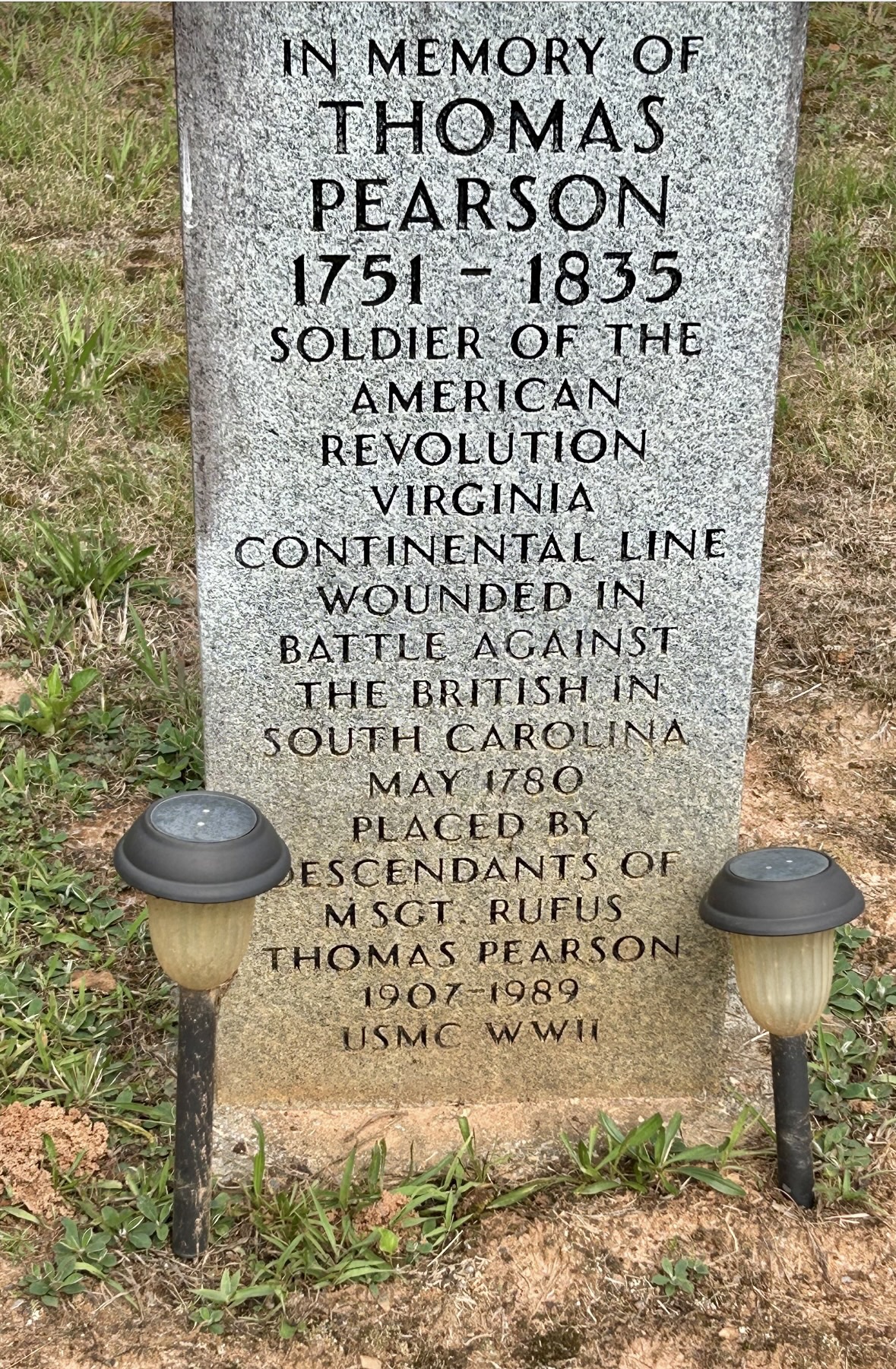
Not long ago, a good friend of mine found himself in Henry County, Va. Located southwest of Richmond, the county was named for the patriot, Patrick Henry, in 1777. Touring a local cemetery there, my friend came upon a very interesting headstone. It was the grave marker for a soldier of the American Revolution; a man named Thomas Pearson.
Grave of Thomas Pearson
According to the headstone, Thomas Pearson had served in the Virginia Continental Line and in May 1780, was wounded in battle against the British in South Carolina. My friend sent me a photograph of the headstone. Based on the place and date, he was hoping this Thomas Pearson had perhaps served at the battle of Camden. As a co-author of a book on Camden, I have to admit that I was quite intrigued myself.
But, based on my research for the book, I knew immediately that certain pieces of information on the man’s epitaph didn’t correspond to details of the Camden fight. First off, it indicates that Thomas Pearson served in the Virginia Continental Line. The Virginians engaged at Camden were actually not part of the Continental Line but, rather, state militia forces commanded by Gen. Edward Stevens. In fact, most of the troops of the Virginia Continental Line were captured by the British at the fall of Charleston on May 12, 1780.
The epitaph also reads that Pearson was wounded in May 1780, in South Carolina. The battle of Camden occurred later, on August 16, so most likely this gentleman wasn’t there. Still, the gravestone intrigued me. I decided to do a little research into Thomas Pearson and sadly, I was to discover that his story was a tragic one.
On November 30, 1812, at the age of 61, Thomas Pearson applied for a pension for his services in the Revolutionary War from the Commonwealth of Virginia. According to his application, he was “a soldier in the revolutionary war, belonging to the VA Line on continental establishment, and attached to the regiment commanded by Col. Abraham Buford.” Clearly, he was a veteran of the southern campaign.
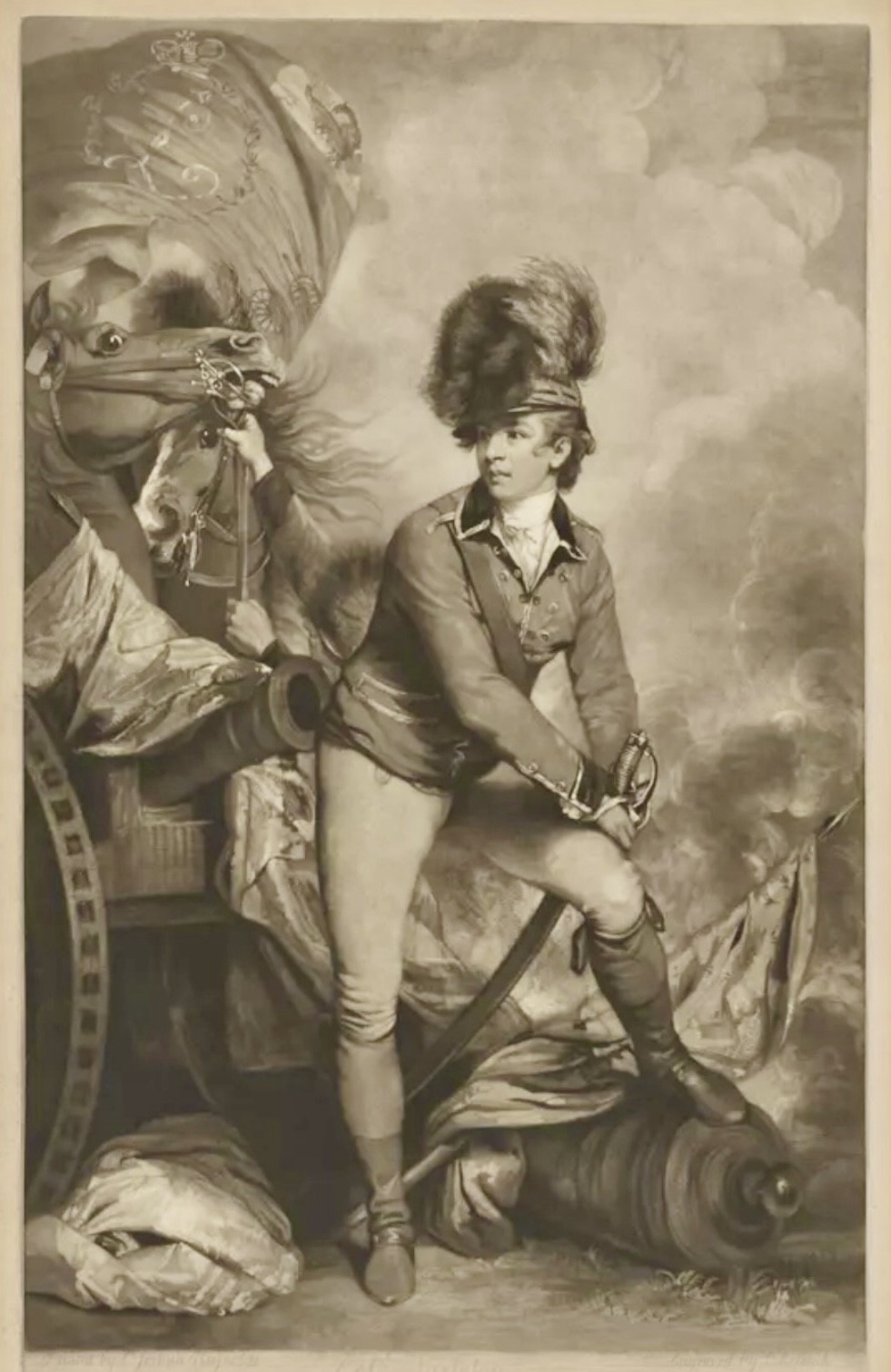
In May 1780, he was indeed serving in the Virginia Continental Line, as an officer of the 3rd Virginia Detachment of Scott’s Virginia Brigade. Commanded by Col. Abraham Buford of Culpepper County, VA, the 3rd Detachment, nearly 400 strong, was marching into South Carolina to the relief of the City of Charleston, which was under siege by the British. The city fell before Buford’s column could reach it, however. Afterwards, Buford received orders from Brig. Gen. Isaac Huger to fall back to Hillsborough, NC. In Charleston, British Lt. Gen. Charles, Earl Cornwallis, who would soon assume command of all British forces in the south, learned of the existence of these Patriot reinforcements. On May 27, he sent troops in pursuit. They were mounted troops of the British Legion, mostly loyalists under the command of the infamous Lt. Col. Banastre Tarleton. Throughout the southern campaign, the 26-year-old Tarleton would establish for himself a reputation for cruelty and blood lust that was unsurpassed. Some of the acts attributed to him during this period were true and some were not, but his dubious reputation would become cemented in the minds of many Americans during this episode.
Lt. Col. Banastre Tarleton
Tarleton set out in pursuit of Abraham Buford’s troops on May 27, leading around 300 of his Legion dragoons, some mounted infantry, and a detachment of the 17th Light Dragoons. Having a reputation for driving his forces unmercifully, Tarleton’s troops were able to quickly catch up, and closed in on Buford’s Virginians on May 29, on the border of North and South Carolina. It was farming country here, known as the Waxhaws.
When the two forces were still some miles apart, Tarleton issued a call for surrender, under a white flag of truce. In his message he wrote: “Resistance being vain, to prevent the effusion of human blood, I make offers which can never be repeated.” After conferring with his officers, Col. Buford made the decision to refuse Tarleton’s offer. He replied: “I reject your proposals, and shall defend myself to the last extremity.” The Patriot force then continued its march north towards Hillsborough, with Tarleton’s troopers continuing the pursuit.
By mid-afternoon of the 29th, Tarleton’s lead elements caught up with Buford’s column, attacking and destroying the small rear guard. Commanding that rear guard was Lieut. Thomas Pearson. Witnesses said that Pearson was sabered and knocked from his horse. While he lay on the ground, he continued to receive wounds; his face was mangled and there were cuts across his nose, lips, and tongue. Col. Buford halted his column, deploying his infantry in a single line across an open field, east of the Rocky River Road. He then issued a questionable order: his men were told to hold their fire until the dragoons were almost on top of them and then unleash a volley at point-blank range. When the charge came, the Virginians followed orders; they held their fire until the British were about 10 yards away. While their one volley did manage to empty a few enemy saddles, it wasn’t nearly enough and now the Virginians had no time to re-load their muskets. In a flash, Tarleton’s troopers were in among the Continentals, hacking men down with their sabers, wholesale.
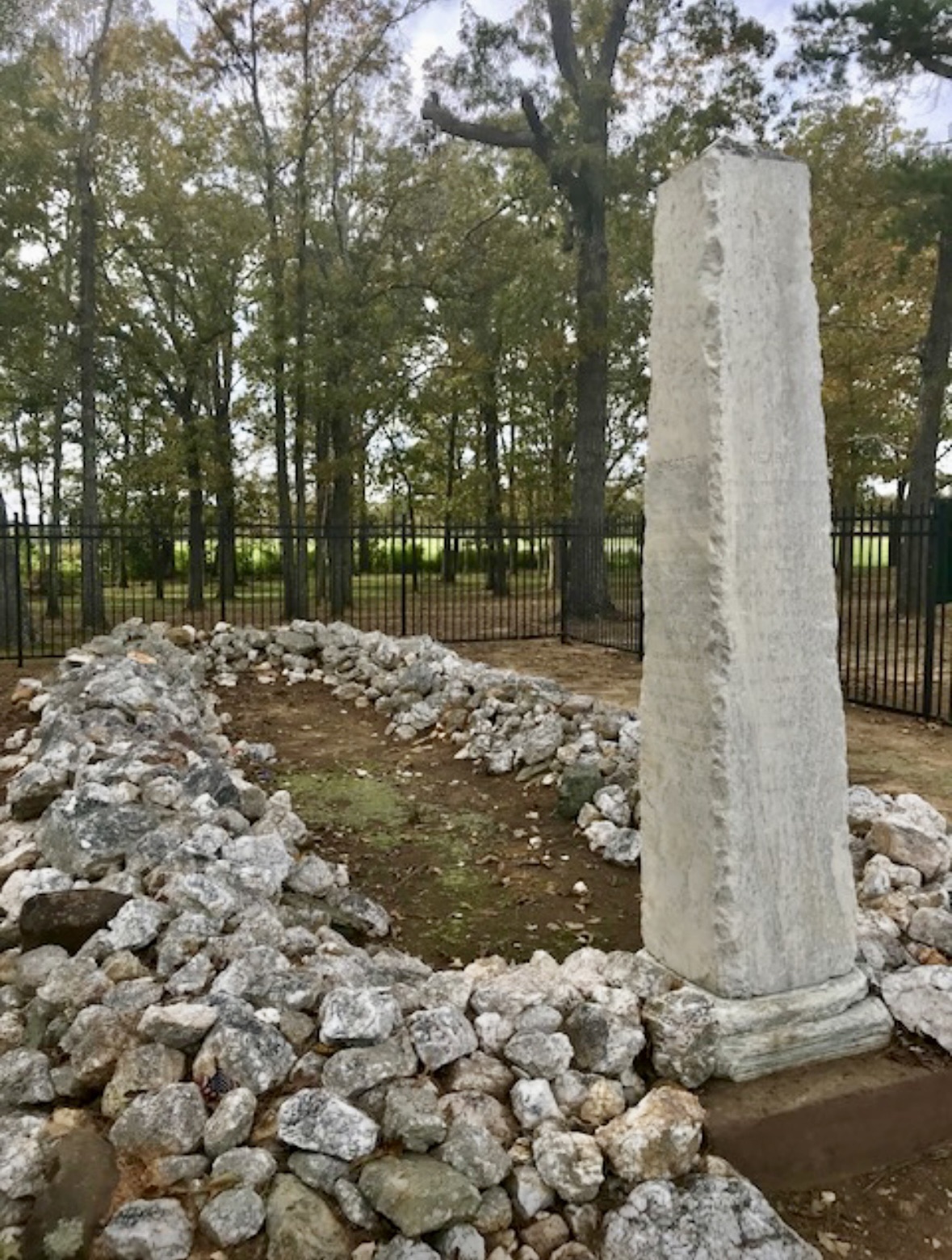
Quickly realizing the battle was lost, Buford sent forward a white flag of surrender. About this time, Tarleton’s horse was killed, going down and momentarily trapping its rider. Some of his nearby troops became enraged, believing the Patriots were not honoring their own white flag. These troops are said to have continued sabering Patriot soldiers as they tried to surrender. Abraham Buford and some of his troops did manage to escape the field but his command was destroyed. Continental casualties totaled around 113 killed, 147 wounded, and 50 captured. Two Patriot 6-pounder artillery pieces and 26 baggage wagons were likewise captured. Compared to this, Tarleton’s losses were negligible. The battle would long be remembered as “Buford’s Massacre” and many of the Patriot dead lie today in a mass grave at the battlefield site.
Mass Grave at the Waxhaws battle site
Banastre Tarleton’s reputation for cruelty was established at the Waxhaws. Nicknames like “Bloody Ban” and “Bloody Tarleton” began to be used to describe him and the phrase “Tarleton’s Quarter” would become a Patriot battle cry.
Even though severely wounded in this action, Lieut. Thomas Pearson managed to survive his injuries, living until 1835. He was 84 when he died; his last years were hard on him. According to his pension application, he “received sundry wounds in his head and arms, which have rendered him, in his present advanced stage of life, incapable of maintaining himself by labour (sic).” On January 12, 1813, the Commonwealth of Virginia granted Pearson’s request for relief. He received an immediate payment of $50, with an annual pension payment of $60.
Today, this Revolutionary War veteran lies at rest in a quiet cemetery in Henry County, VA.
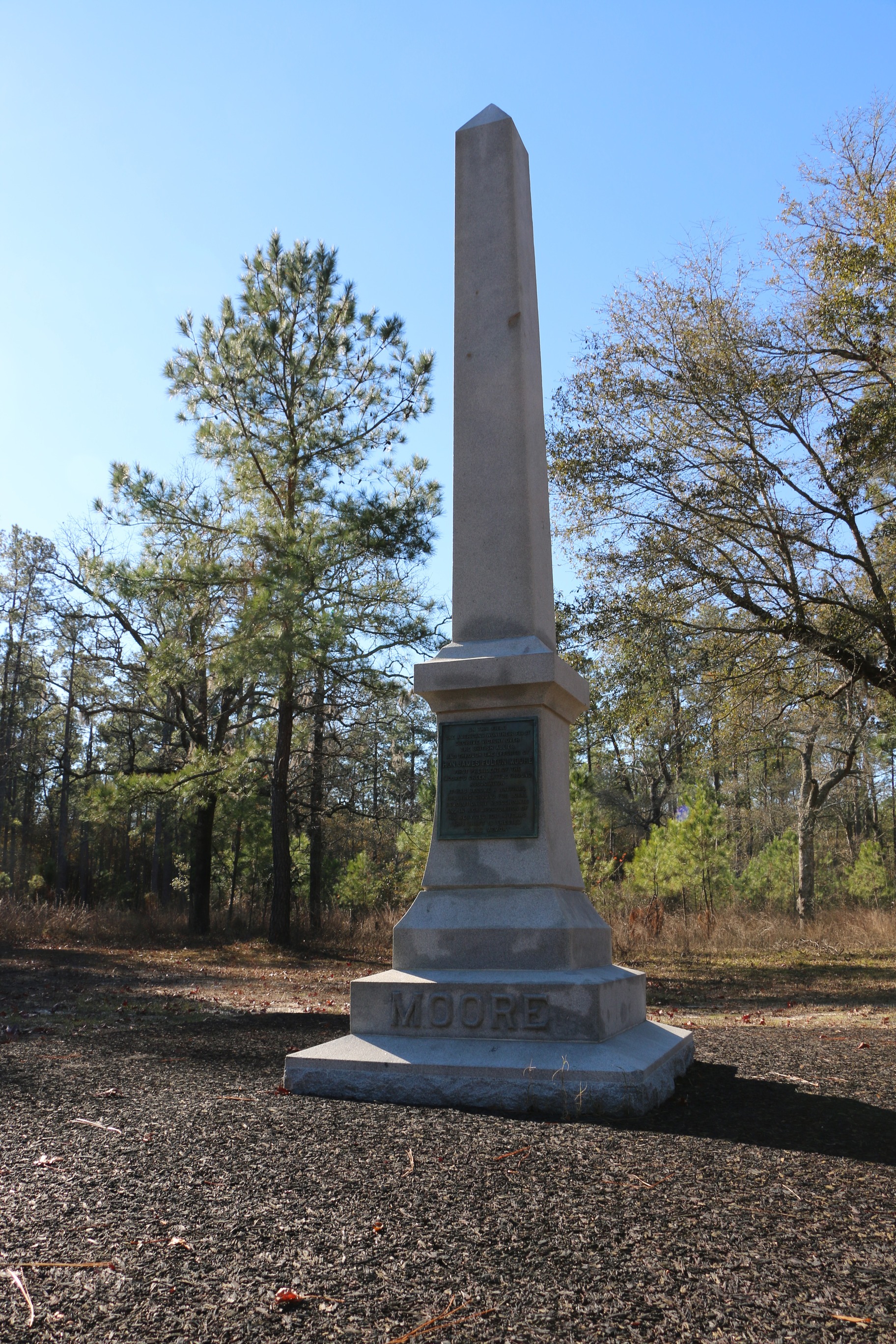
On February 27, 1776 Patriot and Loyalist forces faced off at Moores Creek Bridge in southeastern North Carolina. Loyalist forces anticipated support from a British army arriving along the North Carolina coast and planned to use this combination force to return British authority in North Carolina. Though, when help did not arrive, a mixed bag of North Carolina Patriots turned back an attack at Moores Creek Bridge. Their victory, combined with the Patriot victory at Great Bridge, VA in December 1775, solidified their control of North Carolina. Additionally, the Loyalist defeat served as a major deterrent for Loyalist support until the opening of the Southern Campaign four years later. This small action had long lasting impact on the entire war in the south.
Join us this Sunday night at 7pm on our You Tube Channel ( https://www.youtube.com/@emergingrevolutionarywar8217 ) as we welcome back our own ERW historian Bert Dunkerly. Bert has extensive knowledge on the history of this battle and experience working at the battlefield itself. We will discuss the complex situation leading up to the battle and how this small battle changed the war strategy in the south. Grab a drink and join in on the discussion!
We are excited to announce our 2024 (fourth annual!) bus tour location will be Lexington and Concord on October 11-13, 2024. Join historians Phillip Greenwalt, Rob Orrison and Alex Cain as we tour the sites associated with the beginning of the American Revolution on April 19, 1775. The tour will cover events in Lexington, Concord and sites along the “Battle Road.” Tickets are $250 per person and includes a Friday night lecture, all day tour on Saturday and half day tour on Sunday (bus tour transportation and Saturday lunch included in cost).
Join us for our FOURTH annual tour as we take on the beginning of the American Revolution just a few months before the 250th anniversary. Learn about the dramatic events that led to the first shots for the Revolution and the bloody aftermath. We will visit Lexington Green, Buckman’s Tavern, North Bridge in Concord, Battle Road including Merriam’s Corner, Parker’s Revenge and the Jason Russell House. There is no better way to experience history than to stand in the footsteps of where it happened!
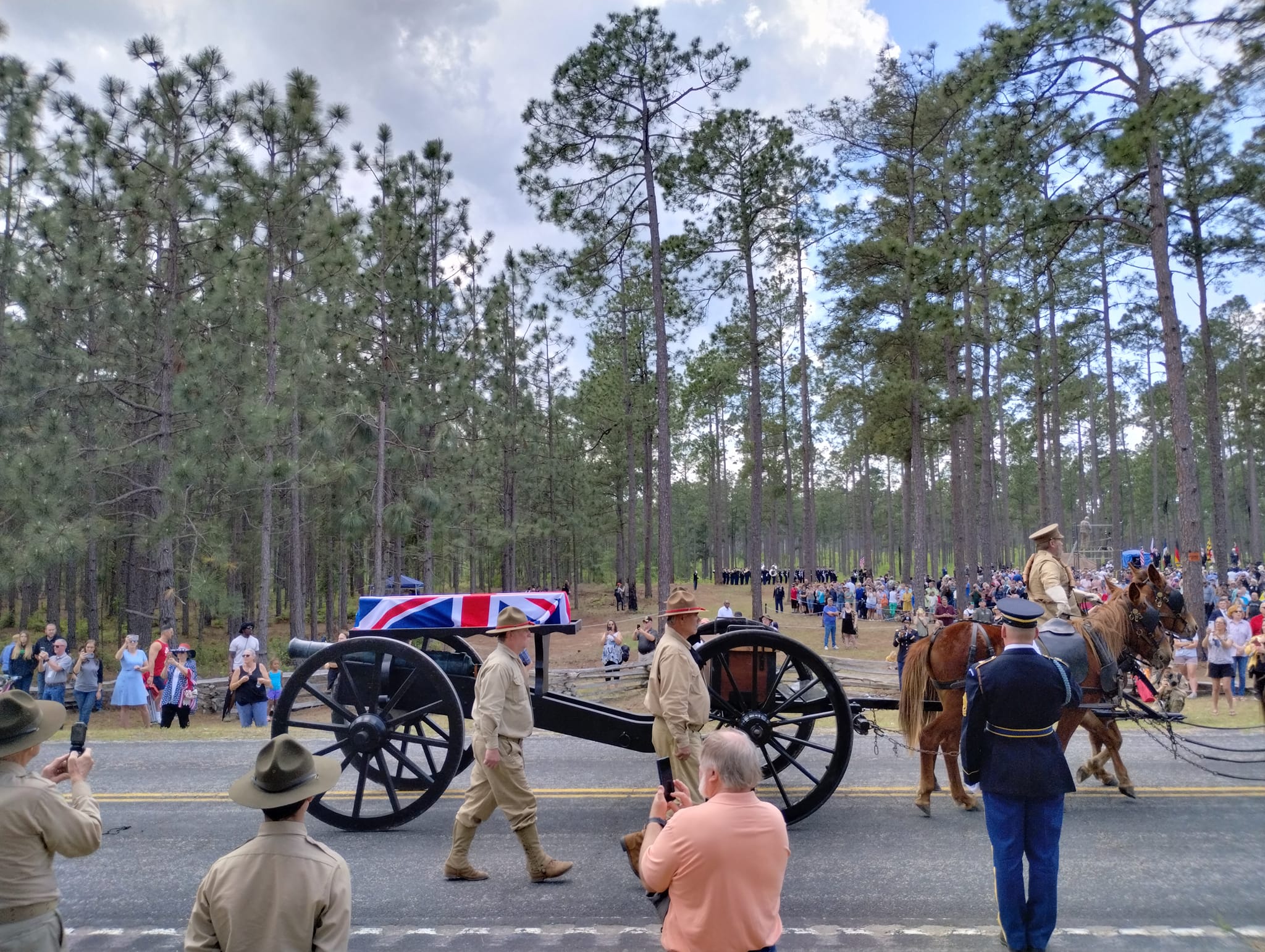
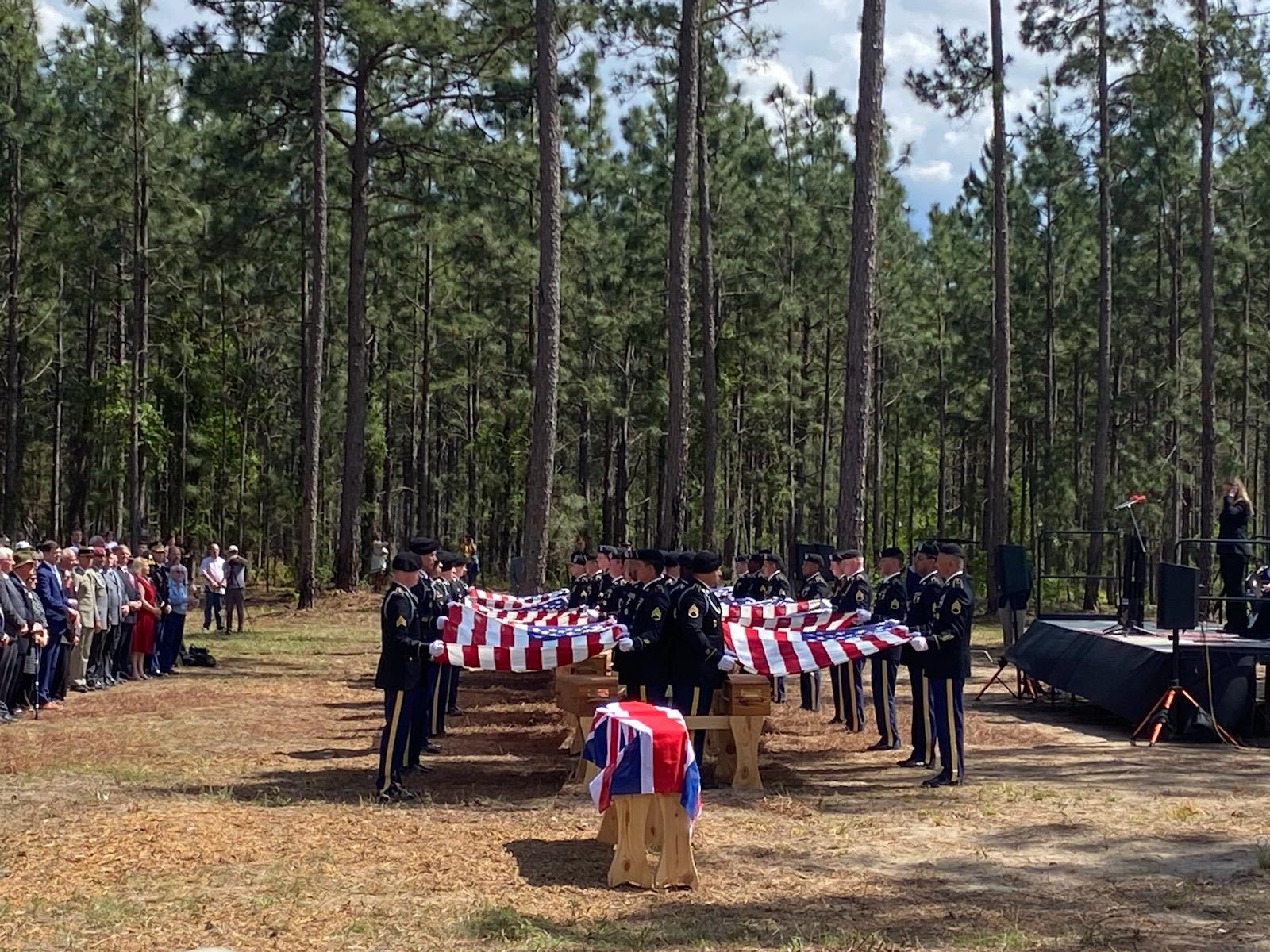
Join us as we discuss the excavation and successful recovery of the remains of 14 veterans of the August 16, 1780, Battle of Camden with James Legg and Steven Smith, Ph.D., the lead archeologists of the Camden Re-Burial Project which began in September 2022. We will discuss the indepth research conducted and the precise archaeological work that was done on the battlefield. Also learn about the reburial ceremony and where the soldiers were finally laid to rest.
This is a great opportunity to learn about a rare discovery on a American Revolutionary War battlefield. The Camden battlefield is a great archaeological site that is revealing multiple stories and helping historians piece together a better understanding of the battle. Grab a drink and join us on our Facebook page for a great evening of archaeology and history!
Opportunity knocked for Horatio Gates with the fall of Charleston, South Carlina in May 1780. A devastating loss for the Americans, with nearly 6,000 men of the Southern Army under Benjamin Lincoln surrendered to Sir Henry Clinton. Unless something wasn’t done soon, the entire southern colonies could fall and the revolution along with it. Congress needed someone who could inspire men to join the war effort and a trusted leader with a positive record. Washington put Nathaniel Greene’s name forward, but Congress in a rare move went against Washington’s wishes and appointed Horatio Gates as commander of the Southern Department on June 13th.
Major General Horatio Gates, ca. 1794 by Gilbert Stuart
The road from his victory at Saratoga to the Southern Department wasn’t an easy one for Gates. He sought independent field command and many believe he wanted Washington’s position as commander in chief. His allies in Congress and the Continental Army lobbied heavily on Gates’ behalf and were able to have Gates appointed to the powerful Board of War (the defacto Department of Defense). Though an important role (and serving as Washington’s civilian superior), Gates believed he belonged in the field. Though his role in the famous “Conway Cabal” is still debated today, he was implicated via letters in criticizing Washington’s leadership. Whether his involvement was real or not, the relationship between him and Washington (and Washington’s inner circle) was seriously damaged. Due to the situation, Gates resigned from the Board of War and accepted appointment as department commander of the Northern Department. In this role he was responsible to look after the New York Highlands and watch from British incursions from Canada or New York city. Gates was unhappy in this role and proposed another American invasion of Canada. Washington and Congress disagreed and rejected his plans. He disliked his task of dealing with enemy native tribes in the region and dragged his feet in following orders. Finally, that fall, Gates took command of American forces in New England with his headquarters in Boston. Though excited by this appointment, he quickly realized that this post was not where the action would be. The British left Boston in 1776 and since the city was peaceful and not a welcome place for a man seeking glory and military action. Finally, after much frustration, Gates asked to return to his farm in Virginia and arrived there by December 1779. Gates found himself a hero without an army and continued to brood over his situation.
Today 240 years ago in the back country of South Carolina, General Horatio Gates and his “Grand Army” were encamped around Rugeleys Mills South Carolina. He had come a long way in a short amount of time with his army from Deep Creek, NC. The men were ill fed, mostly poorly trained militia but he needed to strike a win for the American cause in the South. What he planned that evening is still debated today.
Gates had only been in command of the re comprised Southern Continental Army for a few weeks. He was tasked with turning around a disastrous year for the Americans in South Carolina. Most of the Southern army was captured at Charleston in May 1780 and then a bloody defeat of Virginia forces on May 29th at Waxhaws. American partisans such as Moultrie and Sumter had found some success, but the Continental Congress worried that they were about to lose the southern colonies. Something had to be done and many believed (though Washington and his supporters wanted Nathaniel Greene) the hero of Saratoga was the man for the job.
Now that Gates had brought his army so close to the British post at Camden, SC he needed intelligence on his next move. There could be no misstep, he was only 12 miles from the British at Camden. At that time, Gates believed he outnumbered the British under Lord Rawdon, but what he was soon to find out is he over inflated his own numbers and now Lord Cornwallis was in command. Gates’ force was still slightly larger, but it was mostly made up for militia. The British army comprised of some of the best units in North American. A very different situation indeed.
Gates ordered his engineer Lt. Col. Johann Christian Senf and Virginian Lt. Col. Charles Porterfield southward towards Camden. Senf was to find a suitable location for the American army to march and set up a defensive position. Gates had no illusions to attacking the British at Camden, and most likely he hoped they would abandon Camden all together. Senf wrote “reconnoitering a deep creek 7 miles in front was found impassable 7 miles to the right and about the same distance to the left, only at the place of the Ford interjects the great road”. (1) This creek was Saunder’s Creek and it is where Gates decided to move his “Grand Army” and await developments from Thomas Sumter who he had sent on a mission along the Wateree River in the flank and rear of Camden.







 Emerging Revolutionary War Era