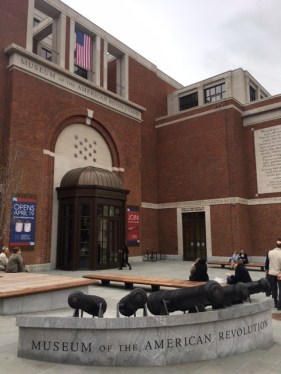
On April 19, 2017, symbolic in American Revolutionary War history, the Museum of the American Revolution opened in Philadelphia, Pennsylvania. The weekend before, I had the chance, to get a “sneak peak” of the new museum.
Museum of the American Revolution
I left thoroughly impressed as the museum fills in a critical need for telling this utmost important era in our nation’s history. Yet, the development of exhibits along with the myriad of learning styles and technology underscores the need in this 21st century to be approachable and inclusive to reach various levels of interest that the visitor may have.
Greeting visitors as they approach are a few murals depicting well-known scenes of the American Revolution–including the symbolic “Crossing of the Delaware” and the “Signing of the Declaration of the Declaration.” Along with one of the most important sections of the Declaration of Independence.
After entering the museum the exhibit area is on the second floor, beginning with the build-up to the war and ending with a nod to the upholding of the revolutionary ideals. Broken up into four segments, the exhibits cover the period of the “Road to Independence” from 1760-1775, “The Darkest Hour” 1776-1778, “A Revolutionary War” 1778-1783, and ending with “A New Nation” 1783 to present-day. A must-see is the short 15-minute film that is centered on George Washington’s command tent, which is shown behind the screen at the conclusion of the film.
Yet, do not shirk the exhibits, which include the a portion of the last remaining “Liberty Tree” from Annapolis, Maryland that fell during a hurricane a few years back. Small movie theaters dot the exhibit area depicting different aspects of the war and history. The Oneida Native Americans, the first allies of the United States are also prominently–and rightfully–highlighted as to their contributions.
Another of the interesting components of the museum is the use of interpretive questions, including “Why were they called Hessians?” with an accompanying multi-dimensional map that shows the different German principalities that contributed troops to the British war effort. Another interesting panel discusses the first use of acronym “USA.”
The museum’s display collection of artifacts is also truly amazing. From a few of the first flags carried by units in the war, to the aforementioned “Liberty Tree”, to a portion of the famous North Bridge, in Concord, Massachusetts.
Combined with the interactive displays, the chance to walk onto a privateer ship, and the assortment of artifacts on display, the museum exhibit area caters to all levels of enthusiasts and can definitely absorb a few hours of your time.
North Bridge segment
With the museum main attractions situated on the second floor, the first floor of the museum is free to house the orientation film, a cafe, and the gift shop. If you have never been to Philadelphia, the museum is another highlight to add to your bucket list itinerary. If you have ventured to the “City of Brotherly Love” before, the museum provides an excellent reason to journey back.
For information on the museum, including programs, exhibits, and the admission fee, click here.
Leading up to the anniversary of April 19, 1775, we will be sharing some short remembrances from a few people who are from Lexington and Concord.This installment is by Rich Gillespie, a native of Lexington, Massachusetts.
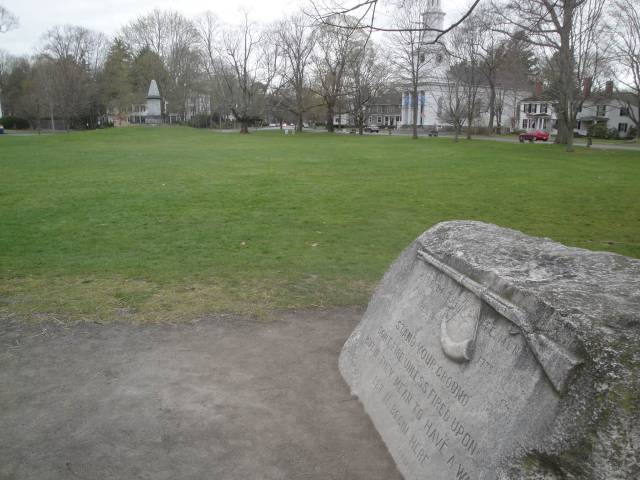
If you live in Lexington, Massachusetts, the beginning of the American Revolution is an essential piece of life. The Minuteman statue dominates the center of town, the village green where the Alarm List stood to face the Regulars is much as it once was, the Town Seal seen on your friendly snowplow quotes Sam Adams’ comment to John Hancock upon hearing the firing—“Oh, What a glorious morning for America!”, and the high school’s team is predictably the Minutemen. The British marched to and from Concord within 150 yards of my 4th grade classroom, and the spring field trip was to the key sites of Lexington and Concord. My first job (as was my sister’s) was guiding visitors on Lexington Green.
Hip-hip Huzzah-Haughty British troops leave Lexington (author collection)
Leading up to the anniversary of April 19, 1775, we will be sharing some short remembrances from a few people who are from Lexington and Concord. Our first installment is by Alex Merenyi. Alex grew up in Lexington and moved to the Washington, DC area to attend college. He shares with us how he looks back on Patriots Day..
Patriots’ Day was always weird for me growing up.
Lexington’s Tourist Season would begin with a bang on Patriots Day – one specific bang, at 5:36-ish in the morning a Monday – and carry through until the snow would scare the tour busses back home for the winter. (Ironically, it meant that the foot and a half of standing snow made getting around a lot easier.) It wasn’t until I moved to DC that I realized nobody else knew what Patriots Day was.
What it was for us, in addition to being of the part of the year where tour busses blocked off the best way to Starbucks, was two discrete parts; the historical, which was the reenactment of the Battle of Lexington; and the festival, which was that the center was shut down for a carnival-like opening of the tourist season. (There was also a 5k, which I remember my Father running once. It always seemed odd that they’d run a race that day through the heart of town, but so it went.)
You couldn’t live in Lexington and not know about The Reenactment. Every year, on the third Monday in April, a bunch of Americans would stand up to the Regulars and be cut down in a single volley of fire. I went once, when I was young enough to ride on my Father’s shoulders, and watched my dentist and his friends get shot on the Battle Green. Two minutes later we began walking home, wanting to beat the crowds that had gathered there. A second volley of fire went off, and I remember asking my Dad if that meant the British had shot the wives that ran out to their fallen husbands. (He explained they fired to clear their rifles. I was maybe seven – by this point, ‘The British Were Evil” was pretty engrained; I remained suspicious.) All told, it took us longer to walk to and from the event than watch it. Even as a kid, I had to ask myself what all the fuss was about – a fifteen minute re-enactment of, let’s call it what it is – the first American defeat – seemed rather odd.
I mention my dentist not just as an anecdote, but to illustrate how deeply The Reenactment went – the men and women who would come together at the pre-dawn hours in April and fall over, year after year, were celebrities in Lexington. It was all over my dentist’s office, photos of him marching in the 4th of July parades, scenes of him at the then-standing Foxboro Stadium firing a musket for the other Patriots’ having scored. (Back in the pre-Brady days, those were fewer and further between). Schools would give extra credit for interviewing reenactors, and of course, every student had the requisite “Go to the re-enactment and write a paper on how important it is.” As a child growing up in Lexington, it had an aura effect that made all of the rest of American History seem rather… well, underwhelming – nobody was making a huge fuss about re-enacting the signing of the Constitution. (Adding to that of course was that my Mother is quite British; her answer to my asking about how the Battle of Lexington was covered for her in school? “It wasn’t.”) Until I left Lexington, I never really appreciated why all the fuss was made about The Reenactment, or why these few people were given such a disproportionate amount of attention; It was more than just “this is a thing that we do once a year”, it was a recognition of something that nobody ever dared point out:
“If it weren’t for these guys, Lexington wouldn’t be on the map.”
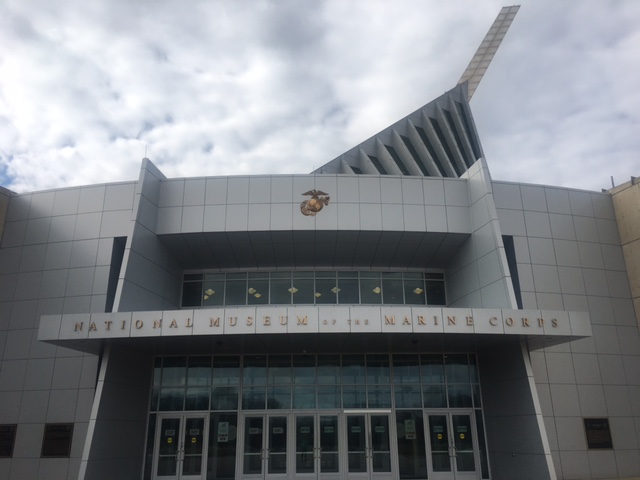
Nestled in Northern Virginia between Interstate 95 and Marine Corps Base Quantico is the National Museum of the Marine Corps. Opened in 2006 after two years of construction, the impressive building and exhibits therein, detail the history of the Marines from their founding up to the present-day conflicts. In fact new exhibits about the latest combat operations are currently in the works.
Is it too early to make plans for March? Never, right?
Well, if you are looking forward to spring and want to mix in some Revolutionary War history, look no further than the America’ History LLC Conference the weekend of March 24 through 26, 2017 in Historic Williamsburg, Virginia.
For those arriving early, you can take advantage of a Yorktown Battlefield Tour led by Bill Walsh on Friday afternoon. That evening the conference adds a new element in 2017 with a welcoming reception with the speakers. A panel discussion with all the speakers will focus on “Lies and Legends of the American Revolution.” In regards to the speakers for the event, America’s History LLC. have compiled an all-star lineup.
Spearheaded by Edward Lengel and David Preston. These two gentlemen will be joined by historians James Kirby Martin, Mark Lender, John Grenier, Michael Gabriel, Dennis Conrad, Robert Smith, and Robert Selig.
The conference wraps up on Sunday. For more information and how to register for the conference, click here.
Emerging Revolutionary War welcomes back guest historian Malanna Henderson
Part One
“It is not for their own land they fought, not even for a land which had adopted them, but for a land which had enslaved them, and whose laws, even in freedom, oftener oppressed than protected. Bravery, under such circumstances, has a peculiar beauty and merit.” – Harriet Beecher Stowe.
The words spoken by “the little woman who wrote the book that started this Great War,” so said Abraham Lincoln, according to legend, upon meeting Mrs. Stowe sometime in 1862, rang true for black patriots in the Civil War as well as those in the Revolutionary War.
The Smithsonian tome, The American Revolutionary War: A Visual History quotes a Hessian officer in 1777, as saying, “No regiment is to be seen in which there are not Negroes in abundance and among them are able-bodied and strong fellows.”
In every battle of the Revolutionary War from Lexington to Yorktown; black men, slave and free, picked up the musket and defended America; and yet, many historians as well as visual artists have omitted their contributions in the history books and their images on canvases depicting historic battles. The need for white historians to “overlook,” “underestimate,” and or “erase,” these sacrifices is a gross negligence that distorts and misrepresents American history; and furthermore, it continues to disenfranchise the patriotic heroes of the past and malign the self-image of millions of Americans today simply because of the color of their skin.
Black soldiers have always fought two wars simultaneously; wars declared by their government and the unspoken wars at home for liberty, equality and before the Civil War, for citizenship.
What kind of men fight for the liberty of others when their own liberty isn’t guaranteed?
True patriots: James Armistead Lafayette was one such person.
James Armistead Lafayette (1760-1832) Blackpast.org
Slaves serving in the rebel military was a question that manifested itself early amongst the colonial government agencies. Their presence rankled many, while others welcomed them and praised their bravery. Some men of color had fought gallantly and with distinction as they stood alongside their white compatriots, defenders of liberty on the Lexington Green in April of 1775.
For instance, in the Battle of Bunker Hill, Peter Salem, a slave, served with courage under fire, as varying accounts reported. Salem was introduced to George Washington as “the man who shot Pitcairn,” the British Royal Marine Major who shouted to his men before Salem shot him down, “The day is ours.” Despite the competence and bravery of such men on the battlefield their exploits didn’t convert the wide-spread reluctance of most colonists to accept black men as soldiers.
General George Washington, Commander-in-Chief of the Continental Army, harbored the same common prejudices of the southern-planter ruling class of which he was a member. In July, he instructed recruiters “not to enlist any stroller, negro, or vagabond, or person suspected of being an enemy to the liberty of America.” Commanders in each colony and regiment made up their own minds. Some ignored his command. Their decision was based on need and experience. Those who had already served successfully with black militia and minutemen may have seen no cause to alter their regiments.
By December of 1776, Washington back-pedaled on his decision, allowing for black veterans of Lexington, Concord and Bunker Hill to serve; but of the slave, he maintained his objection. However, some junior officers appreciated the contributions of blacks. Col. John Thomas wrote John Adams on October 24, 1775, “We have negroes, but I look upon them as equally serviceable with other men, for fatigue (labor); and, in action many of them have proven themselves brave.”
As the war raged on, the necessity for able-bodied men settled the question. White soldiers, who usually served for only a few months to a year, mustered out, died or were wounded; while others deserted. Black soldiers who expected to receive their freedom if they served were in the war for the duration. This was a positive factor for the commanding officers who had to re-train all new recruits. Around five-thousand blacks served in the Revolutionary War as soldiers. However, a vast unknown number provided a myriad of support services.
Another reason the colonials reconsidered enlisting blacks was the bold military tactic that occurred in November of 1775. Lord Dunmore, the last royal governor of Virginia, ratified a proclamation freeing all indentured servants and slaves of rebels if they would fight for the British. Thousands of people fled the plantations to gain their freedom. This single act struck a devastating blow on two fronts, it threaten their economic stability and increased the tension between master and slave, with the master fearing slave revolts and the permanent loss of their property. Moreover, it upset the social order. Enslaved men serving alongside whites put them on an equal footing in the battlefield, which violated the white supremacy dogma that governed current thought and practice.
Born into slavery on December 10, 1748, in New Kent, Virginia to owner William Armistead, James enlisted in the Revolutionary War under General Marquis de Lafayette in 1781. His owner was a patriot and most likely received the bonus James would have gotten for enlisting had he been free or white. Enlistment bonuses comprised of money, land or slaves.
By the time Armistead entered the war, the efforts of Benjamin Franklin and other colonial agents had secured a military and economic alliance with the French. A long-time imperial rival of British expansion, the French provided naval ships, money and personnel.
Marquis de Lafayette (born Marie Joseph Paul Yves Roch Gilbert du Motier) was a descendant of ancient French nobility. His father, a colonel in the French Grenadiers had died in the Seven Year’s War (known as the French and Indian War in America) when the young nobleman was only two years old. The political ideals of liberty and equality espoused by the colonials matched his beliefs and fired his military ambitions. Perchance, his yearning to play a role in America’s fight for independence from British rule may have been spawned by a desire to avenge his father’s death.
Since Lord Dunmore’s Proclamation, it was easy for Armistead to gain access in the enemy camps as a runaway slave seeking his freedom. While providing varied services to the British, he gained the confidence of Brigadier General Benedict Arnold, who by now had defected to the British. He charged Armistead with scouting, foraging and spying. Armistead was able to comfortably go between both camps, in essence becoming a double spy. He carried false and misleading information to the British but provided accurate intelligence on the movement of British forces and details of their military strategies to General Lafayette.
When Arnold left Virginia, Armistead was able to deceive General Charles Cornwallis as well, who rampaged through parts of Virginia and burned Richmond, the capital. He sent Colonel Banastre Tarleton to capture the entire legislative assembly, which included Daniel Boone, Patrick Henry and the governor. The plan was thwarted by an astute young man named Jack Jouett. Although, a few were apprehended, among them Daniel Boone; Jouett’s actions prevented the British from arresting the biggest prize: Governor Thomas Jefferson.
By early August, Cornwallis had made plans to establish fortifications in Yorktown, expecting reinforcements to increase his troops of approximately nine-thousand.
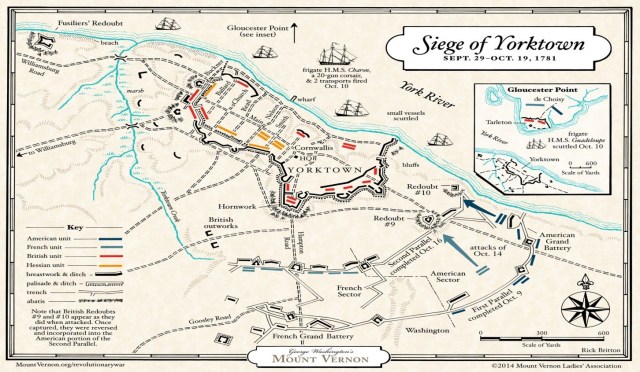
General Washington, in the meantime, had joined forces with Comte de Rochambeau to recapture New York. With intelligence supplied by James Armistead, they learned that Cornwallis was in Yorktown waiting for military support. French Admiral de Grasse, with a fleet of about twenty-eight naval ships, was on his way to the Chesapeake from St. Dominick (present-day Haiti). A plan to surround Cornwallis by land and sea appeared possible. The French naval fleet, along with the Washington’s Continental and Rochambeau’s French forces, headed to the enemy’s headquarters. Once Washington reached Yorktown, General Lafayette’s regiment joined him. Thus, Armistead’s accurate and meticulous reports were vital to the American victory that culminated in Yorktown on October 19, 1781.
Later Cornwallis met the Marquis at his headquarters and was flabbergasted to find his spy James Armistead present.
The Treaty of Paris in 1783 severed ties from Britain, the mother country, and established America as an independent nation. That same year, the Act of 1783 was passed freeing slaves who had fought in the Revolutionary War on their masters’ behalf. However, it excluded slave-spies. Ergo, James Armistead, who risked his life by providing information to help win the freedom of many, was himself denied freedom. Was his life in less danger operating under subterfuge as a spy amongst the British than it would have been, had he served as a soldier on the battlefield? I think not. Had his espionage been discovered, he surely would have had to forfeit his life.
After the war, Armistead was returned to slavery. Even his own master didn’t have the legal right to free him because of the Act of 1783, omitting slave-spies from emancipation.
When learning of his compatriot’s status, the Marquis penned a certificate to the Virginia legislator in October of 1784 imploring them to grant Armistead his freedom, declaring:
“This is to Certify that the Bearer By the Name of James Armistead Has done Essential Services to me While I had the Honour to Command in this State. His Intelligences from the Ennemy’s Camp were Industriously Collected and More faithfully deliver’d. He properly Acquitted Himself with Some Important Commissions I Gave Him and Appears to me Entitled to Every Reward his Situation Can Admit of. Done Under my Hand,” Richmond, November 21st 1784.
The legislator didn’t act upon the request straightaway. However, again in 1786, James Armistead applied for his freedom and it was duly granted on January 9, 1787, with a fair compensation to his master, William.
In honor of his benefactor, James Armistead added Lafayette to his surname. After emancipation, he moved a short distance south of New Kent, near Richmond, Virginia and acquired forty acres of less than suitable farmland. He married and had a family. He even owned slaves. History doesn’t tell us if he bought enslaved relatives to free them or if they were bought to farm his land as field hands.
It wasn’t until 1819 that he applied to the state legislature for financial assistance to ease his poverty. This time, the response was immediate; he received $60 and an annual pension of $40 for his service during the Revolutionary War.
Unlike James Armistead Lafayette, many blacks who worked as laborers, guides, messengers and spies were not as fortunate. Whether they were pressed into service or willingly answered the call, most neither received their freedom nor wages for their behind-the-scene contributions to the war.
In 1824, the Marquis de Lafayette visited the United States and was lauded as a hero of the American Revolutionary War in Richmond with festivities and a parade. Spying Armistead in the crowd, it is said he halted the procession, dismounted from his horse and embraced his old comrade.
Kareem Abdul-Jabbar and Alan Steinberg Black Profiles in Courage: A Legacy of African-American Achievement. (New York: William Morrow and Company, Inc.1996) pages 32-34.
Col. Michael Lee Lanning (Ret.) Defenders of Liberty: African Americans in the Revolutionary War. (New York: Kensington Publishing Corp. 2000) pages 45-46; 130
Emerging Revolutionary War is honored to welcome guest historian Derek Maxfield as the author of this post. A biography of Mr. Maxfield is at the end.
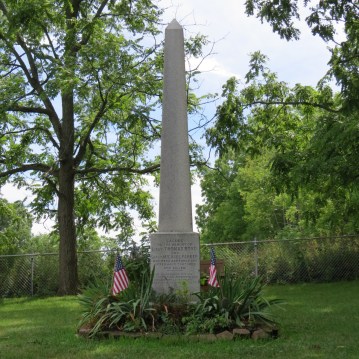
A trek to Conesus, NY, to pay my respects to Capt. Daniel Shays – who is buried in Union Cemetery – resulted in a revolutionary discovery: Groveland Ambuscade Park and Monument. Set atop the western ridge overlooking Conesus Lake is an obelisk dedicated to the memory of a group of scouts from Gen. Sullivan’s army who were ambushed there in 1779.
Monument commemorating the ambush (author collection)
Quite off the beaten track, the park has seen better days. In 1901 The Livingston County Historical Society erected a large monument commemorating the ambush of American troops near that spot. A small park, complete with a pavilion and picnic area was added – though these amenities are no longer present. More recently a wooden stairway was added leading up to the monument, which stands on high ground.
Gen. John Sullivan, under orders from Gen. Washington, mounted a punitive raid against the Iroquois in Western New York in 1779. When Sullivan’s army sought to cross the inlet at the southern end of Conesus Lake, they stalled while engineers worked to create a reliable bridge across the mire. Wishing to know the location of the British and Indian army, under Col. Butler and Chief Joseph Brant, Sullivan sent a scouting party over the western ridge. Leading the scouting party of Lt. Thomas Boyd, who was assisted by a Native American scout named Han Yost.
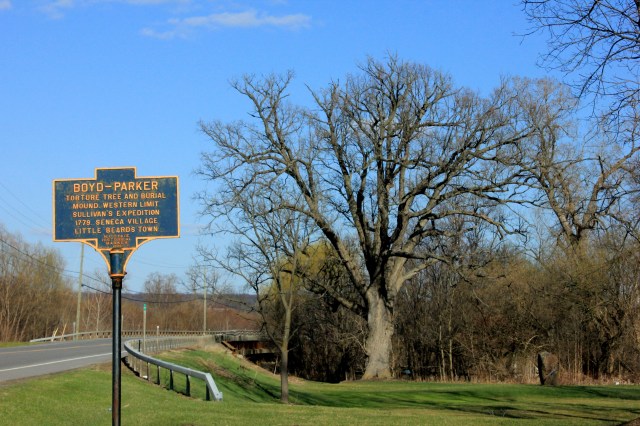
Boyd and his men were lured into a trap and ambushed on September 13th, 1779. Only a handful survived to bring word back to Sullivan. In subsequent days Boyd’s body was found in a Native American village mangled and mutilated. Boyd and Sargent Michael Parker had been captured and interrogated, but gave up little information. This resulted in their torture – fingers and toes removed, they were disemboweled and beheaded. Finally, their entrails were flung over tree branches. This tree, still standing – nearly 300 years old, now is a monument to the brave Continental soldiers who died at the hands of the Seneca. The “Torture Tree” was designated a National Historic Landmark in 2009.
The “Torture Tree” (author collection)
Sixteen of Sullivan’s men were killed at Groveland plus Han Yost, the Native American guide. The scene of the ambush would prove to be the western limit of Sullivan’s penetration into the Iroquois homeland.
Seemingly just a footnote in the history of the Revolution, it is nice to see that this courageous band that died so ingloriously is remembered today.
*Derek Maxfield is an associate professor of history at Genesee Community College in Batavia, NY, where he is also coordinator of the college’s Civil War Initiative. For his work with the Initiative, Maxfield was awarded the SUNY Chancellor’s Award for Excellence in Scholarship and Creative Activities in 2013.
Maxfield holds a Bachelors of Arts degree from SUNY Cortland and a Master of Arts degree from Villanova University. He is also a PhD candidate at the University of Buffalo, where he is ABD (all but dissertation). Among Maxfield’s research interests are 19th century politics and culture, especially Victorian death ways and the Civil War.
Maxfield lives in Churchville, NY, with his wife, Christine, two children—Quincy, 13, and Jesse, 11—a basset hound, three cats and a tortoise.*
Emerging Revolutionary War is honored to welcome guest historian Katie Turner Getty. A short biography is at the bottom of the post.
In terms of historical significance, few American cities rival Boston, where shades and shadows of the Revolution can be found around every corner. By walking the city’s famous Freedom Trail, one can follow in the literal footsteps of the inhabitants who left such an indelible mark on the city. Indeed, many heroes of revolutionary Boston—Revere, Adams, Otis—lie in their eternal repose in burying grounds mere steps from busy thoroughfares.
The presence of those revolutionaries still looms large in Boston and many of their old stomping grounds still stand. Several buildings located on the Freedom Trail played unforgettable parts in the revolution. From the fiery speeches at Old South Meeting House on the eve of the tea party to the blood shed by those massacred outside the Old State House*, these sites are popular and are frequently visited.
But there is one site not located on the Freedom Trail that is yet imbued with great historical import. Indeed, it is the site of the 1768 arrival of British warships in Boston Harbor and the troops who first took those fateful steps into Boston for the purposes of occupying the city.
East-facing view of Long Wharf and John Hancock’s office and counting house, built in 1763, and now the Chart House restaurant.
The name of this site, so often overlooked, is Long Wharf.
Long Wharf has stretched into the Atlantic from Boston for 300 years, serving as the world’s great doorway to the city. It was the longest wharf in Boston, extending 1,586 feet into the deep water of the harbor allowing up to 50 ships to dock at one time[1]. It would have been a place of great bustle—the loading and unloading of cargo by longshoremen, transporting of such cargo to the busy warehouses and shops that lined the wharf, and then the purchase of such goods by local people.
West-facing view toward Boston, from the end of Long Wharf. The Town House (now known as the Old State House), built in 1713, is in the distance.
On Friday, September 30, the Beaver, the Senegal, the Martin, the Glasgow, the Mermaid, the Romney**, the Launceston, and the Bonetta anchored in the harbor. On board the ships were “the 14th and 29th Regiments, a detachment from the 59th regiment, and an artillery train”.[2] The next day, Bostonians warily watched as “the war ships maneuvered closer to the town and ranged themselves as if for a siege.”[3] Then, carried off the warships by small boats, British troops stepped onto Long Wharf and into American history.
These ships and troops had arrived in the port of Boston as a response to colonial opposition to the Townshend Acts which were enacted by Parliament in 1767 in an effort to enforce their sovereignty over the colonies and raise revenue. The Townshend Acts imposed a tax on imports such as tea, glass, paper, and paints, as well as instituted a Customs board to help enforce British trade regulations and deter smuggling activity. Many Bostonians were opposed to the Townshend Acts and protested by gathering in mobs and harassing officials.
View of the Atlantic Ocean from the very end of Long Wharf.
Paul Revere immortalized the landing of the troops in an engraving entitled “A View Of Part of the Town of Boston In New England And Brittish [sic] Ships of War Landing Their Troops! 1768”. The image depicts the eight British ships of war arrived in the harbor, with smaller boats carrying red-coated soldiers to Long Wharf. Some troops are already amassed on the wharf, gathering into formation.
“A View of Part of the Town of Boston In New England And Brittish [sic] Ships of War Landing Their Troops! 1768” (courtesy of American Antiquarian Society http://www.americanantiquarian.org/Inventories/Revere/b2.htm )Revere’s engraving also shows many buildings running along the north side of Long Wharf in an uninterrupted line toward the town. They were warehouses, counting houses, shops, and dwellings. One of these buildings was John Hancock’s Counting House, which still stands on Long Wharf today. Currently incarnated as a restaurant called the Chart House, it is the oldest extant building on Long Wharf, built in 1763. John Hancock’s original wall safe is actually still set in the red brick wall of the second floor dining room. The safe is not off-limits; visitors may freely open and close the safe’s inner and outer doors or even run a hand over the smooth metal.
John Hancock’s original safe, still fixed in the wall of his Counting House.
When standing at the wall safe, take a few steps to the right and look out the front windows of the building. Look down to the ground level to see the path of the troops as they passed right by Hancock’s Counting House, “with insolent parade, drums beating, fifes playing, and colours flying, up King Street” as they headed down the wharf and into the town. The soldiers were marching to the Town House, at the base of King Street. And beyond that, to Boston Common.
View out a second floor window of Hancock’s Counting House, a few steps from the wall safe. The viewer is looking down at Long Wharf where the British troops marched past on October 1, 1768.
Long Wharf at the time (as it is today) was really just an extension of King Street, which ran all the way from the Town House (later to become the site of the Boston Massacre), down to the shoreline, then continued along in the form of a wharf, out into the harbor. After the Revolution, King Street was (perhaps appropriately) renamed State Street and is known by that decidedly more American moniker today.
The soldiers’ route may be traced today by any perambulating history enthusiast. Walk out past Hancock’s Counting House, to the terminus of Long Wharf and stand where the British soldiers disembarked. As you gaze out across the cold gray Atlantic, feel the stiff sea breeze rolling in off the water just as they did. Then turn your gaze away from the Atlantic and look back toward the city. The view is the same as in 1768—the Town House will be in your direct line of sight. As the soldiers marched down the wharf in a straight line, they too would have seen the Town House quite clearly.
A pamphlet published by the Boston Redevelopment Authority in the 1980s reveals that although the wooden timbers of Long Wharf are experiencing decay, the 17th and 18th century granite bulkheads beneath the wharf are still intact.[4] It is a thrill for any revolutionary history enthusiast to walk out to the end of Long Wharf, knowing that deep beneath his or her feet are the very same granite blocks, impervious to time and history, that bore silent witness to the arrival of the British soldiers who stepped onto Long Wharf and into history when they came to occupy Boston.
*The building known today as the Old State House was known in the 1770s as the Town House.
**The Romney actually arrived in Boston Harbor in May 1768 to help enforce customs and discourage the flouting of trade regulations, attempting to seize John Hancock’s ship, Liberty.
*Katie Turner Getty is a lawyer, history enthusiast, and lifelong resident of Boston. She holds an A.A. from Bunker Hill Community College in Charlestown, Massachusetts, a B.A. in History from Wellesley College, and a J.D. from New England Law Boston. She can often be found exploring historic sites both on and off the Freedom Trail.
[2] Paul Revere, A View of Part of the Town of Boston in New England and Brittish [sic] Ships Landing Their Troops! 1768, circa 1770, engraving, 26 x 40.5 cm, American Antiquarian Society, Worcester, Massachusetts http://www.americanantiquarian.org/Inventories/Revere/b2f1.jpg
[3] Richard Archer, As If An Enemy’s Country (Oxford: Oxford University Press 2010), xiv.
Recently, I had the chance to head to New England to take photos for an upcoming publication in the Emerging Revolutionary War Series. While thereI ventured to Salem, Massachusetts and New Castle, New Hampshire. Two great places filled with American history and also what could have been even more American history.
The shooting war that became the American Revolution began in Lexington and Concord, Massachusetts on April 19, 1775. Yet, these two places; Salem, Massachusetts and Fort William and Mary in New Hampshire, almost, caused the war to begin.
Here is what happened.
On December 14, 1774, local militia raided the British post garrisoned by six men at Fort William and Mary near Portsmouth, New Hampshire. Faced with over 400 militiamen the garrison proved obstinate and did not accept surrender and when faced with an assault, actually fired three cannon shots at the charging militia. Open combat ensued but no deaths occurred before the militia gained the fort.
Entrance to the fort, with the plaque commemorating the events in December 1774 to the right of the entrance.
During the afternoon, the militia would deprive the fort of over 100 barrels of precious gunpowder. By the next day, over 1,000 militiamen had arrived to lend support and within a few days, British General Thomas Gage had dispatched a small force on a British naval vessel but by the time they arrived, the commotion at Fort William and Mary had subsided.
Three months later and located approximately 50 miles south of Fort William and Mary is Salem where the following incident took place. Thomas Gage ordered 240 men of the 64th Foot Regiment under Lt. Col. Alexander Leslie on February 27, 1775 by water to the town. Upon arrival the force hovered off the coast waiting for the residents to attend their regular Sunday sermon. Soon after, the 64th Foot began to make the five mile march to Salem. A column of nearly 250 British regulars brought a lot of attention and soon riders were riding ahead to Salem to warn them of the approaching British. The men in Salem began to remove the cannon and hide them in the countryside. The main objective for Leslie was a blacksmith shop on the north side of the North River. Here is where it was reported that the ship cannons were being refitted for field use.
Historic Marker commemorating the spot of armed resistance at the Salem Bridge on February 27, 1775.
The issue at the river was a draw bridge was the only way across and as the British approached, several men raised the drawbridge so the British could not cross. By this time militia was on the opposite banks of the North River. An armed confrontation, one of many this winter, between colonials and Royal troops ensued. Leslie demand that the bridge be lowered so he could cross but the militia would not budge. Meanwhile, the cannons Leslie was looking for were being dispersed. Leslie threatened to fire on the militia, but Leslie’s senses got the best of him as he recognized hundreds of townspeople were now turned out and watching. He did not want to have blood on his hands this day. Plus the safety of his own men became in doubt as the day was getting long and he knew he had to extricate himself somehow.
Soon a local minister proposed a compromise, the bridge would be lowered and the British could cross and march to the blacksmith forge just a hundred yards beyond the bridge. If no cannon were found (which by now, they were all removed) then Leslie would turn around and march his men back to the ships on the shore. To Leslie, this was an honorable compromise as his orders were to cross the river and investigate the blacksmith forge and shop. Soon after the British crossed the North River, they re-crossed and marched back to their ships. Open rebellion was again thwarted. But a deadly precedent was set, the militia learned that the British did not intend to fire on them and such the bravery of each militia unit at each alarm was amplified.
Both of these affairs did not start the war. Both could have. We may never know why. But, what we do know is that they were example of how close the war was to starting. Lexington and Concord became the tipping point.



 Another of the interesting components of the museum is the use of interpretive questions, including “Why were they called Hessians?” with an accompanying multi-dimensional map that shows the different German principalities that contributed troops to the British war effort. Another interesting panel discusses the first use of acronym “USA.”







 Emerging Revolutionary War Era
