Lafayette at Brandywine

Marquis de Lafayette was a French aristocrat serving in the French army, and recently married, when the Revolution broke out in America.  He followed events with interst, and was motivated to come and fight with the Americans.

He arrived in March, 1777, nineteen years old and eager.  He immediately formed a friendship with Washington, and was an aide on his staff.  In the meantime British forces had invaded Pennsylvania, intent on capturing Philadelphia.  Washington’s army took a position behind Brandywine Creek, and the British attacked on September 11, 1777.  British troops had flanked the Americans, and reinforcements were rushed to the threatened sector, making a stand on Birmingham Hill.

Eager to get to the fighting, Lafayette and a group of French officers rode to the unfolding battle at Birmingham Hill, arriving as the action was at its hottest.  Approaching from the south, they rode up the Birmingham Road, and turned to the left, coming in behind the brown-coated troops of General Thomas Conway’s Pennsylvania brigade.

Continue reading “Lafayette at Brandywine”
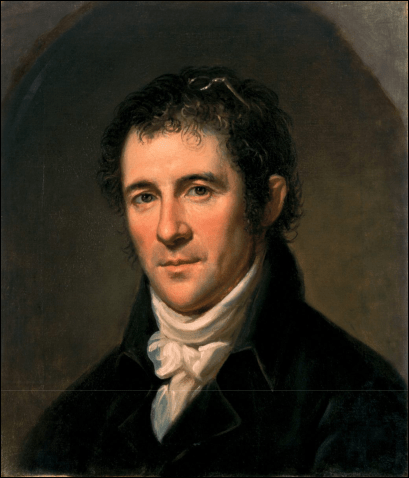
Benjamin Henry Latrobe: Architect of the Republic

Emerging Revolutionary War welcomes guest historian Darien Ashley. A short bio follows this post.

The best architecture is that which reflects clearly the ideals and activities of the people which inhabit it. This is true for both private dwellings and public buildings. The objects of architecture serve as a lasting testament to identity. These objects, once created, continue to shape minds long after the architect is gone. A nation’s capital city is a site where man can establish glorious structures which convey a sense of who the people are, where they came from, and where they intend to go. The United States Capitol building is a prime example of a structure that continues to inform American identity long after its architects have passed. This article serves as an investigation of the life of one of the most important architects of not only the Capitol, but of the nation itself, Benjamin Henry Latrobe.

Guests to the United States Capitol building often get a shock from the fact that one of its primary architects, Benjamin Henry Latrobe, was an Englishman. Indeed, the man who designed the hallowed, old halls of Congress hailed from a Moravian religious settlement located on the outskirts of Leeds, England. However, Latrobe himself would have objected to the label “Englishman”. Indeed, throughout his life, Latrobe referred to the United States as “his” country and was quick to point out that his mother, Anna Margaretta Antes, was born and raised in Pennsylvania. Latrobe’s father, Benjamin Henry Latrobe Sr., met Anna after she had been sent to London to finish her education. Both of Latrobe’s parents held prominent positions within the Moravian ministry and raised their children to follow in their example.

Continue reading “Benjamin Henry Latrobe: Architect of the Republic”

Beer Drinking in the 18th Century

Emerging Revolutionary War welcomes back guest historian Vanessa Smiley

“Beer is living proof that God loves us and wants us to be happy.” – Benjamin Franklin, Poor Richard’s Almanack

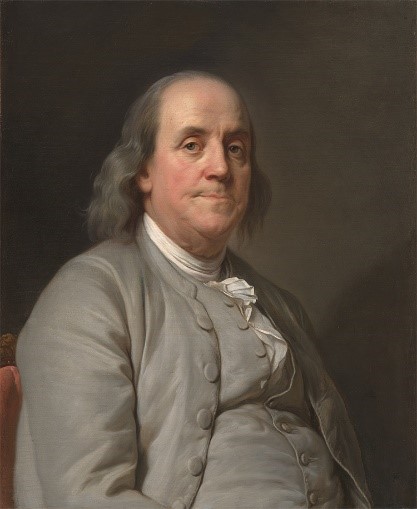
Benjamin Franklin was one of many 18th century beer lovers.
(Benjamin Franklin by Joseph Siffred Duplessis, c. 1785)

During the 18th century, Colonial society held three common beliefs about beer drinking:

  1. Drinking beer was healthier than drinking water
  2. Beer and its ingredients were a healthy supplement to the entire family’s diet
  3. It was an accepted way to promote social discourse

A little different from today’s society, except for beer connoisseurs (such as the Emerging Revolutionary War folks), these beliefs were formed from the circumstances of the time.

Though a generation away from understanding the connection between boiling water and sanitation, most folks understood that water could make you deathly ill. And yet, ale and beer drinkers did not seem to have that same risk. They did not know it at the time, but the boiling process to make these alternative drinking options neutralized much of any tainted water’s ill effects. Therefore, many substituted beer, ale, and other alternatives such as hard cider over water, making these a major dietary staple in the colonies.

Continue reading “Beer Drinking in the 18th Century”

The 245th Anniversary of "Give Me Liberty or Give Me Death"

On this date, in 1775, Virginian Patrick Henry, a delegate to the Second Virginia Convention from Hanover County, Virginia sat in on the ongoing debate at St. John’s Episcopal Church in Richmond, Virginia.

Patrick Henry

The 28-year old then stood to give his defense of his proposed amendments to the petition then being debated. Below is the last few lines of his now famous statement, with the last sentence being the one most remembered;

If we were base enough to desire it, it is now too late to retire from the contest. There is no retreat but in submission and slavery! Our chains are forged! Their clanking may be heard on the plains of Boston! The war is inevitable and let it come! I repeat it, sir, let it come.

Continue reading “The 245th Anniversary of "Give Me Liberty or Give Me Death"”

ERW Weekender: Ninety Six, The Site That Has It All

Emerging Revolutionary War welcomes historian Vanessa Smiley to the blog.

The thing about Ninety Six National Historic Site is that it’s unassuming exterior hides a wealth of history. It’s also nowhere near a major highway, meaning you have to want to get there if you’re thinking of visiting. And when you do get there, you will realize that there’s more history per acre than its demur entrance lets on. Located in the back country of South Carolina, Ninety Six has a history that speaks to the stories of Native Americans, the American frontier of the 18th century, and the American Revolution.

Entrance to the park
(courtesy of Ninety Six NHS, NPS)

The site at Ninety Six holds a treasure trove of study on these subjects. Native American, mostly Cherokee, activity was heavy in the area long before European settlers arrived. One of the earliest backcountry trading posts, established by Robert Gouedy in 1759, made Ninety Six a hotbed of trading activity thanks to its location at the crossroads of twelve different roads and paths, linking the area to nearly all parts of the colonies.

Continue reading “ERW Weekender: Ninety Six, The Site That Has It All”

March Presentations

Emerging Revolutionary War (ERW) would like to highlight from time to time some of the lectures, presentations, talks, and events that our historians are apart of.

This month, ERW historians are giving the following presentations:

Bert Dunkerly

March 27th: “The Brown’s Island Explosion Victims” at the Virginia Forum, Richmond, Virginia

Kate Gruber

March 13th: “Tenacity: Women in Jamestown and Early Virginia” Shenandoah Lyceum Lecture Series, Harrisonburg, Virginia. For more information click here.

Travis Shaw

March 29th: “Lord Dunmore.” Aldie, Virginia

ERW Weekender: Boston Massacre: 250 Years and 1-Day Later

Crispus Attucks. Every American school child learned that name in a social studies or history class in grade school. On the night of March 5, 1770, Attucks, an African-American was one of the six Bostonians that was killed by British soldiers.

Known in American history as the “Boston Massacre” the tragic event was used as fodder by the Sons of Liberty and pro-revolutionary minded individuals to propel the colonies toward rupture with Great Britain.

Continue reading “ERW Weekender: Boston Massacre: 250 Years and 1-Day Later”

“The First Blood Spilt to Freedom”: Dangerfield Newby, the Boston Massacre, and Crispus Attucks 250 Years Later

Emerging Revolutionary War welcomes back guest historian Kevin Pawlak

Every quest for liberty has its first martyr. Two-hundred and fifty years ago this evening, the cause of American liberty gained its first five when British soldiers fired on a crowd of Bostonians in an event immortalized as the Boston Massacre.

Boston Massacre depiction

The first to fall at the end of the British muskets was Crispus Attucks, a mariner of mixed African and Native American heritage. Bostonians paraded Attucks’ remains alongside the four other victims to a common grave but Attucks’ popularity did not grow until the next century when abolitionists used him as a symbol of patriotism. Abolitionists emphasized and stretched Attucks’ role. To supporters of abolition, Attucks was a household name.

Continue reading ““The First Blood Spilt to Freedom”: Dangerfield Newby, the Boston Massacre, and Crispus Attucks 250 Years Later”

Interview with Tom Chaffin, author of Revolutionary Brothers, Thomas Jefferson, the Marquis de Lafayette, and the Friendship that Helped Forge Two Nations

Last week, Emerging Revolutionary War‘s Phillip S. Greenwalt wrote a review of the above mentioned book. To find that review click here. Recently, through email, Emerging Revolutionary War had a chance to interview the author. The questions and his responses are below.

Tom Chaffin, author
Continue reading “Interview with Tom Chaffin, author of Revolutionary Brothers, Thomas Jefferson, the Marquis de Lafayette, and the Friendship that Helped Forge Two Nations”

ERW Weekender: Wheeling

Emerging Revolutionary War welcomes guest historian Jon-Erik Gilot. A short bio is attached at the bottom of this post.

Though perhaps more widely known as the birthplace of West Virginia during the Civil War, Wheeling and its environs retains several significant sites associated with the Revolutionary War. The name itself is translated from the Delaware language meaning “place of the skull,” legend having that the severed head of a white settler was placed on a pole by local Native Americans as a warning to others to stay away.

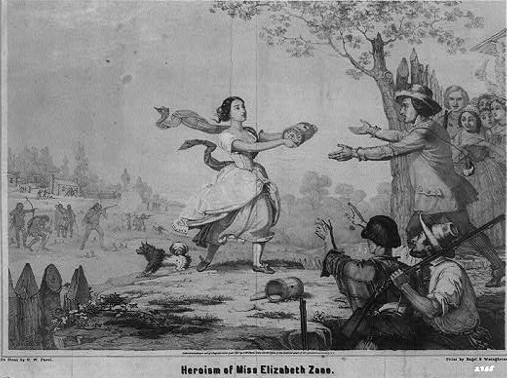
Betty Zane’s Run for Gunpowder during Second Battle of Fort Henry–1782
(image courtesy of Library of Congress)

Wheeling was founded in 1769 by Colonel Ebenezer Zane and his brothers Jonathan and Silas. Five years later in 1774 Fort Henry (originally called Fort Fincastle) was built overlooking the Ohio River to protect the growing numbers of settlers from attack. The fort was twice attacked during the Revolutionary War, first in 1777 and again on September 11 – 13, 1782, when a force of British loyalists (Butler’s Rangers) and Native Americans (under the command of outlaw Simon Girty) attacked the fort’s 47 defenders. The fort was besieged over two days, culminating in Betty Zane’s heroic run for gunpowder in a nearby cabin. The British and natives broke off the battle with the arrival of Virginia militia reinforcements. Fort Henry is acknowledged as one of the final battles of the Revolutionary War.

Continue reading “ERW Weekender: Wheeling”