Review: Revolutionary Brothers, Thomas Jefferson, the Marquis de Lafayette, and the Friendship that Helped Forge Two Nations by Tom Chaffin

Thomas Jefferson, Marquis de Lafayette, two household names from the American Revolutionary War. One the author of Declaration of Independence and one of the great political minds of the era. The other, a Frenchman, enamored with the ideals of the rebelling colonies of British North America who risked a maritime crossing, was wounded at Brandywine, and served both on the field of battle and the international sphere to help achieve American independence.

That much is known about these two gentlemen, icons of history. How about their friendship, one that spanned decades and brought both men through times of personal and professional difficulties. Although years separated visits and both men were well into adulthood before making their respective acquaintance, the friendship helped cement the bond between countries, from aid during the American Revolution to a thankful nation celebrating the return of the Marquis in the mid-1820s.

This friendship has finally been captured in narrative form by historian Tom Chaffin, author of other historical works and biographies in a book published by St. Martin’s Press in 2019.

Continue reading “Review: Revolutionary Brothers, Thomas Jefferson, the Marquis de Lafayette, and the Friendship that Helped Forge Two Nations by Tom Chaffin”

George Washington’s Birthday Celebration

During George Washington’s lifetime and maybe because he was such a great man, he had two birthdays beginning in the 1750’s. Born under the Julian calendar, George was born on February 11, 1731/32. When the English Parliament decreed in 1750 that two years hence England would switch calendars and adopt the Gregorian, used by the majority of countries/states in Europe, there was a discrepancy. So, 11-days was added (some believe that the old calendar was off by a year and a eleven days thus the slash in “1731/32” above).

Regardless, Washington’s birthday was moved to what we, in the United States, are taught now, that it fell on February 22, 1732. Just don’t tell his mother, who believed to her dying day that he was born on the aforementioned date. And who argues with mothers?

What we cannot argue with is that certain birthdays were celebrated at Gadsby’s Tavern, in Alexandria (a city a young George surveyed and helped lay out), Virginia. On October 6, 1796, John Gadsby leased the City Hotel from John Wise and quickly became the epicenter of social and political discourse in Alexandria.

Today the Gadsby Tavern and Museum is open to the public and run by Historic Alexandria a department within the City of Alexandria. For more information and to plan your visit, a bite to eat, or celebrate a birth night ball like George click here.

The balcony where musicians would sit and play at Gadsby’s Tavern (author’s collection)
The hall at Gadsby’s Tavern, which can still be rented out today for celebrations and ceremonies. (author’s collection)

McColloch’s Leap

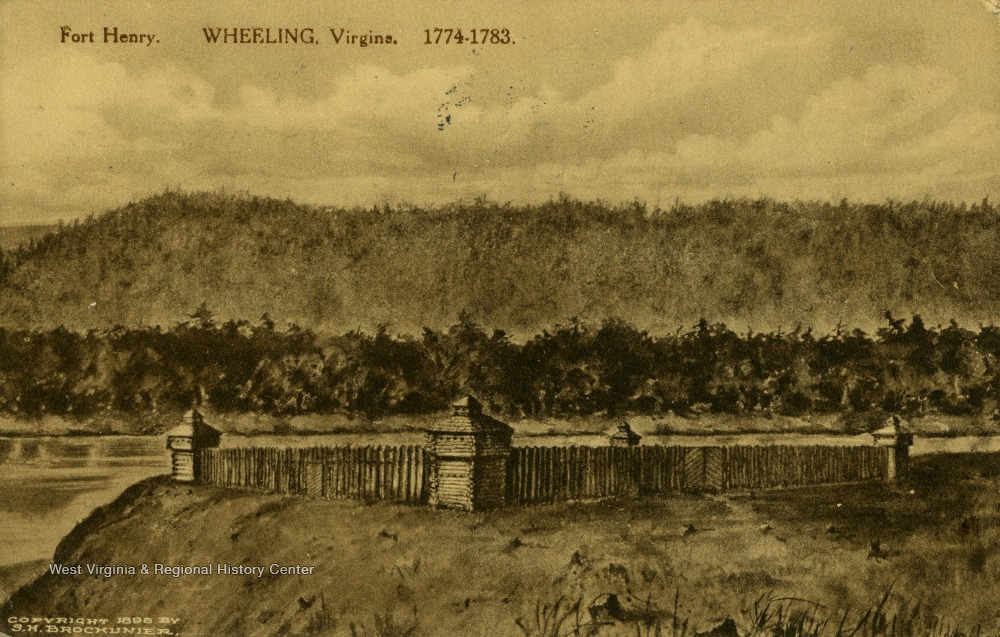
“By no means comparable with the feats of a similar character” and “performed an act of daring” and “nay, desperate horsemanship” and “seldom been equaled by man or beast.” All these describe the amazing escape of Major Samuel McColloch in September 1777 during the attack on Fort Henry around where present-day Wheeling, West Virginia.

I first encountered this amazing, daring, and crazy eluding of capture when I took my own, well not as risky, but still a leap, moving to Wheeling to attend university there. Parents were 3,000 miles away in England and I was attempting to juggle basketball, studies, getting re-acclimated to life in the United States, and unknowingly, a left knee that was about to explode. Being a history major, this was one of the first accounts learned in a freshman year seminar class about local history to inspire the incoming students to explore the area outside of campus.

Fort Henry, built in 1774, was originally named Fort Fincastle, one of the titles of Lord Dunmore, the royal governor of Virginia. When the colonies revolted, the fortification was renamed in honor of Patrick Henry.

Fort Henry
courtesy of West Virginia History OnView
https://wvhistoryonview.org/catalog/041457
Continue reading “McColloch’s Leap”

62nd Foot at Freeman’s Farm

Emerging Revolutionary War welcomes guest historian Kevin Pawlak. A short bio follows the post below.

On May 25, 1775, the 62nd Regiment of Foot stood for review. The line of men, clad in their redcoats with buff facings, did not impress the reviewing officer. He called the regiment “very much drafted” and “very indifferent.” Despite the disparaging grade, in just over two years, the 62nd Foot commendably fought in one of the fiercest actions of the War for Independence.

John Anstruther
courtesy of 62ndregiment.org

Scottish military man Lt. Col. John Anstruther led the 62nd Foot in the campaign of 1777. Anstruther faced no easy task; the 62nd was the junior British regiment in John Burgoyne’s army and most of its men were inexperienced in campaigning and battle. To make the situation even worse, roughly one-quarter of the 62nd Foot’s soldiers were German. Language barriers likely prevented complete cohesion within the unit. However, with a war on, nothing could be done to rectify the regiment’s defects as it marched south into New York.

Anstruther’s regiment was present for the operations around Fort Ticonderoga in early July 1777. After American forces abandoned the fort, the conglomerate and inexperienced 62nd remained behind to man Mount Independence overlooking Lake Champlain. As the rest of Burgoyne’s army continued campaigning, the men of the 62nd Foot spent time guarding themselves against rattlesnakes rather than the enemy. Their time came to rejoin the main army before the Battle of Saratoga commenced.

Continue reading “62nd Foot at Freeman’s Farm”

A Portrait of John Cuppy

Emerging Revolutionary War welcomes guest historian Gabriel Neville

Most of the enlisted men of the Revolutionary War are faceless and forgotten—just names on lists. Biographies and painted portraits are honors that were reserved for officers. Even so, it is possible to trace the lives of some common soldiers using original sources. Many of them applied for pensions after 1818, which required them to provide (usually brief) narratives of their service. Some gave similar attestations when they applied for military bounty land. A small number left detailed accounts of their experiences in interviews, letters, or diaries. Finally, and very rarely, we have photographs taken in the last years of some veterans’ lives. Virginian John Cuppy may be the only Revolutionary War soldier to leave us an artifact in each of these categories.

John Cuppy

Cuppy was born near Morristown, New Jersey on March 11, 1761. While still an infant, he was brought to Hampshire County, Virginia by his German parents. Their new home was on the South Branch of the Potomac River near the town of Romney, which is now in West Virginia. About forty miles west of the Shenandoah Valley, this was the very edged of settled Virginia territory. John was just fourteen years old when the war began—too young to be a candidate for service when Hampshire was directed to raise a rifle company in July of 1775. He was still too young when Dutch-descended Capt. Abel Westfall recruited a company there that winter for Col. Peter Muhlenberg’s new 8th Virginia Regiment.[1]

Continue reading “A Portrait of John Cuppy”

Review: Rick Atkinson, The British Are Coming: The War for America, Lexington to Princeton, 1775-1777

Emerging Revolutionary War welcomes guest historian Joshua Shepherd to the blog who reviewed the book mentioned above. Short bio of Joshua is at the bottom of this post.

In recent years, there’s been a fortunate resurgence of interest in the Revolution and founding era. To meet the mounting demand for Revolutionary history, some of the nation’s most gifted popular authors have written highly successful volumes that cover the War for Independence and the Early Republic.

Some outstanding books have consequently gone to press, but, by and large, the publications have very often been biographies; occasionally, publishing houses introduce monographs that cover a single campaign. From professional circles, much of the new scholarly research focuses on the currently-vogue academic preference for social history. At least in recent decades, the relative paucity of military history has left an appreciable gap in the historiography of the Revolution. With the release of The British Are Coming, author Rick Atkinson has met a vital need for an up-to-date and comprehensive military history of the American Revolution.

Continue reading “Review: Rick Atkinson, The British Are Coming: The War for America, Lexington to Princeton, 1775-1777”

Following Washington

Emerging Revolutionary War welcomes guest historian Terry Rensel.

I despise driving the Pennsylvania Turnpike, so for my drive from Fredericksburg, Virginia to Erie, Pennsylvania to visit family for Thanksgiving I decide to go cross-country to Cumberland, Maryland and then play it by ear from there. As I realized that I was going to be close to Fort Necessity, I decided to make that a stop since I’ve never been there, then see what the day held.

Although a child of NW Pennsylvania, and getting plenty of young George Washington in school, Fort Necessity was a place that I have never been before. It appealed to both my interest in, and desire to visit as many, National Park Service sites as possible. I also have an interest in travelling historic roads, so the fact that US 40, the National Road, was included made it a bit of a two-for for me.

I knew that Fort Necessity itself was a small fortification, I had no idea just how small until I saw it with my own eyes. I can’t believe that this unassuming stockade was the place was a place where the opening acts of the French and Indian War occurred.

Fort Necessity from treeline

The National Park Service has signage, and recently planted trees, where the historic 1754 tree line was. There wasn’t much room for maneuver. The Visitor Center isn’t a very large building, but their exhibits were fantastic. Along with battle related items, there is also a series of items and interpretation for the National Road.

Continue reading “Following Washington”

ERW Weekender: Remember Paoli!

On the night of September 20, 1777, while encamped in Chester County, PA just outside Philadelphia, a division of American soldiers was defeated in a swift surprise attack by a slightly smaller British force. American propagandists, in an effort to galvanize Patriot support, would make the most of this encounter to show the British Army as overly brutal and bloodthirsty. On the foggy morning of December 9, 2019, members of the ERW paid a call on this battle site; Paoli Battlefield Historical Park.

American Camp
Paoli Battlefield Historical Park

Continue reading “ERW Weekender: Remember Paoli!”

Annis Boudinot Stockton, Mythmaking, and the American Revolution (cont.)

Emerging Revolutionary War welcomes back guest historian Blake McGready for part two of the series. To read part one, click here.

While her poetry avoided wartime setbacks and conjured stories of revolutionary unity, Stockton’s poems did confront the violent realities of what she called “a most cruel and eventful war”. Her choice allusions demonstrate how, in her mind, wartime violence bound the revolutionaries together. Following the death of General Joseph Warren at the battle of Bunker Hill she lamented, “That heart, which, studious of his countries good / Held up her rights and seal’d them with his blood!” In 1776 Stockton wrote of revolutionary soldiers who “fought and bled to save their native land / From bowing to a tyrant’s stern command,” and honored great men dying on battlefields “Made fertile by the blood of heroes slain.” Whereas historians have noted how the war’s violence was often deliberately excluded from the popular imagination, by contrast, Stockton’s war and violence were inseparable.[i]

Continue reading “Annis Boudinot Stockton, Mythmaking, and the American Revolution (cont.)”

Annis Boudinot Stockton, Mythmaking, and the American Revolution

Emerging Revolutionary War welcomes guest historian Blake McGready. A short bio is at the end of this post.

In December 1776, Richard Stockton of Princeton, New Jersey, a signer of the Declaration of Independence, disavowed the American Revolution and swore allegiance to King George III. After British forces imprisoned Stockton, he accepted his captor’s amnesty offer. Revolutionaries considered Stockton’s decision an act of cold betrayal and condemned his perfidy. And yet, following his death in 1781, most biographies avoided or ignored Stockton’s questionable political commitment; one tribute claimed his conviction inspired “the utmost confidence of his associates and the country at large.” Stockton owed much of this comeback to his wife, Annis Boudinot. As a prolific and published poet, she helped erase much of her husband’s political infidelity in her writings. At the time of his death she praised him in one tribute, “Can we forget how patiently he bore / The various conflicts of the trying hour / While meekness, faith, and piety refin’d.” She carefully forgot that her husband abandoned the revolutionaries during “the trying hour.”[i]

Annis Boudinot (Mrs. Richard) Stockton by James Sharples Senior, from life, 1796-1797. Courtesy, Independence National Historical Park.
Continue reading “Annis Boudinot Stockton, Mythmaking, and the American Revolution”