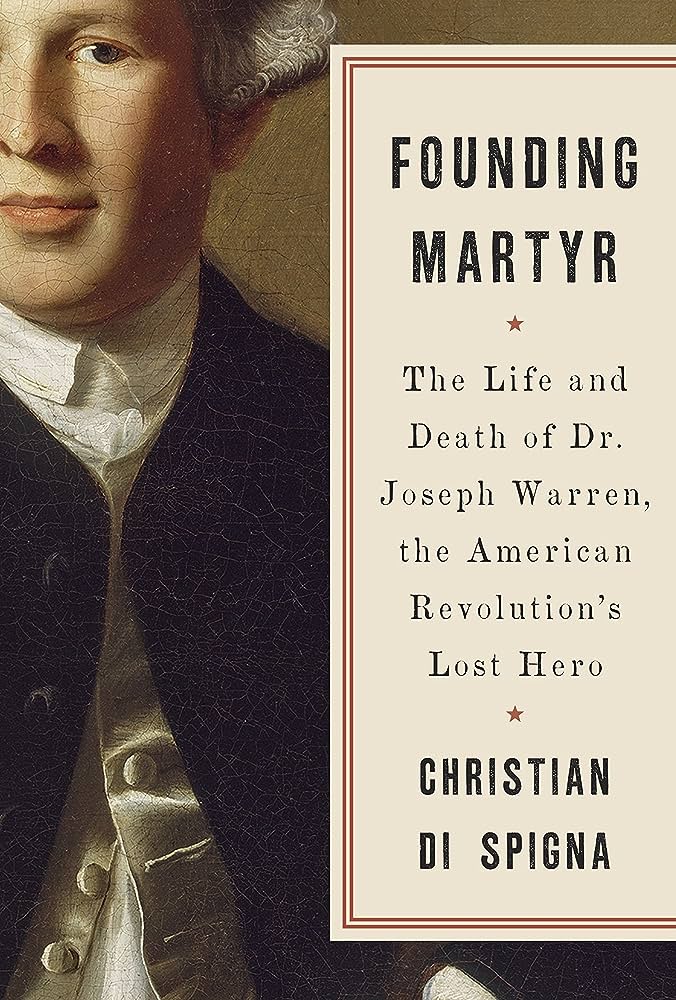
Dr. Joseph Warren is considered by many “the lost hero of the American Revolution.” Warren was the brainchild of the revolution movement in Boston. Warren was involved in almost every major insurrectionary act in the Boston area for a decade, from the Stamp Act protests to the Boston Massacre to the Boston Tea Party, and his incendiary writings included the famous Suffolk Resolves, which helped unite the colonies against Britain and inspired the Declaration of Independence.
Joining Emerging Revolutionary War will be historian and author Christian Di Spigna. He is the author of Founding Martyr: The Life and Death of Dr. Joseph Warren, the American Revolution’s lost hero. He is the Executive Director of the Dr. Joseph Warren Foundation and is the vice chairman for the Revolution 250 committee of Massachusetts Freemasons. He also serves on the board of the Bunker Hill Monument Association.
As we approach the 250th commemoration of the Boston Tea Party, we will focus on Warren’s life, his role in the Boston Tea Party and his lasting impact on the Revolution. Grab a drink and join us as we talk with author and historian Di Spigna about Warren, the patriot who once said…
“When Liberty is the prize, who would shun the warfare? Who would stoop to waste a coward thought on life?”
See you Sunday at 7 p.m. EDT on Emerging Revolutionary War’s Facebook page!
Emerging Revolutionary War welcomes guest historian Al Dickenson
Within the first few pages of his book, Brooklyn College professor Benjamin Carp illustrates all the key points about the 1776 burning of New York City. The points include how vital the city was to the war effort to both the rebels and Loyalists, a discussion on how the fire started (questioning if it was accidental or intentional, and if the latter, whose intention was it?), and furthermore, why has there never been a full investigation into the fire and its causes (Carp’s book is the first full-length work on the topic). In quick succession, readers understand what they will gain by reading this book, why the event in question is important for understanding the American Revolution, and Carp’s own thoughts on the matter.
Carp’s argument in The Great New York Fire of 1776 is that the rebels started the fire, and that the cause of the blaze was indeed arson, which previously had been in question (254). What Carp does not speak to, at least not without some speculation, is who precisely started the fire. While not totally disregarding George Washington’s potential involvement, Carp suggests the more likely culprits would be soldiers in Washington’s army. These men, and in many cases, boys, had yet to receive the disciple so desperately needed from Baron von Stueben’s efforts at Valley Forge, so it seems plausible they could start the inferno, which scorched up to a fifth of the city (244-245). As such, Carp puts his research skills to good use in this volume, sharing his thoughts on the possible origins of the fire and providing readers with a map of more than ten ignition points, illustrating how expansive the blaze was (104). Carp’s thesis is well supported by the primary material, which included letters, sermons, diaries, and other sources from the time.
Emerging Revolutionary War welcomes a guest post from historian Keith J. Muchowski. Keith is a librarian and professor at New York City College of Technology (CUNY) in Brooklyn. He blogs at thestrawfoot.com.
The plaque dedicated King Juan Carlos I in June 1976 today tucked in a corner of the visitor center. Courtesy Author
King Juan Carlos I arrived in Brooklyn’s Fort Greene Park on Saturday June 5, 1976 to great fanfare. The thirty-eight-year-old monarch had ascended to the Spanish throne just seven months previously, two days after the death of Francisco Franco. The new leader was determined to reform his nation after three and a half decades of strongman rule. Juan Carlos I’s ancestor, King Carlos III, had helped the colonists achieved their independence nearly two centuries previously with his supply of money, matériel, and men. Many of those Spaniards made the ultimate sacrifice; well over one hundred of them alone perished in British prison ships moored off Brooklyn Wallabout Bay during the war.[i] Now King Juan Carlos I was in the outer borough to recognize them, dedicate a tablet to his fallen countrymen, and help his American hosts celebrate the bicentennial of their independence. The entombed Spaniards were among the over 11,500 men commemorated by the Prison Ship Martyrs Monument. The king’s visit in the mid-1970s was the latest in a series of public commemorations of the prison ship dead dating back over a century and a half. Some of the institutions that did so much to recognize the martyrs, such as the Society of St. Tammany, are today long gone. Others however very much remain. The Society of Old Brooklynites, a civic organization founded in 1880 when Brooklyn was still an independent municipality, has been holding events since the late nineteenth century.
Emerging Revolutionary War welcomes back guest historian Kate Bitely.
In the heart of Fredericksburg, Virginia, you will find a well-preserved, Georgian-style home that once belonged to Betty Washington Lewis, the sister of George Washington. Historic Kenmore, as the home is known today, was constructed in the 1770s and originally sat on 861 acres near downtown Fredericksburg. Today, the historic house museum is open for daily tours where guests can explore the gardens, the main living floor of the home, several historic structures on the priority, and a visitor center filled with riveting artifacts and information.
Nearly 290 years ago, Betty Washington was born at Pope’s Creek in Westmoreland County, Virginia. As a young child, she lived in a few properties owned by the Washington family before relocating to Ferry Farm, located in Stafford County, Virginia, where Betty, George and their siblings grew up. On February 22, 1750, Betty married Fielding Lewis, a widowed distant cousin, and a father of two young children. In 1752, the family purchased 1300 acres in the Fredericksburg area and allocated a portion of the land as the future site for their home Millbrook, which was eventually renamed to Kenmore in the 1800’s. In total, Betty and Fielding welcomed eleven children, but only six survived to adulthood.
Fielding Lewis was a well-known member of his community. He built his wealth initially as a merchant, but was later elected as a member of the House of Burgesses and served as a colonel in the Revolutionary War. During the war, however, Lewis used his finances to personally pay for munitions and supplies for Patriot troops which ultimately drained much of the family’s resources.
The Lewis family were staunch Patriots. In 1775, when the Lewis’s were moving into their home, the spirit of independence was strong throughout the colonies. Given the Washington’s status, heritage and devotion to service, Betty and her family would become one of the biggest supporters for the Patriot cause, willing to risk their home, finances, reputation, and their safety in favor of breaking away from England. The impressive residence served as a visual representation of their wealth, which became significantly more important during the Revolutionary War.
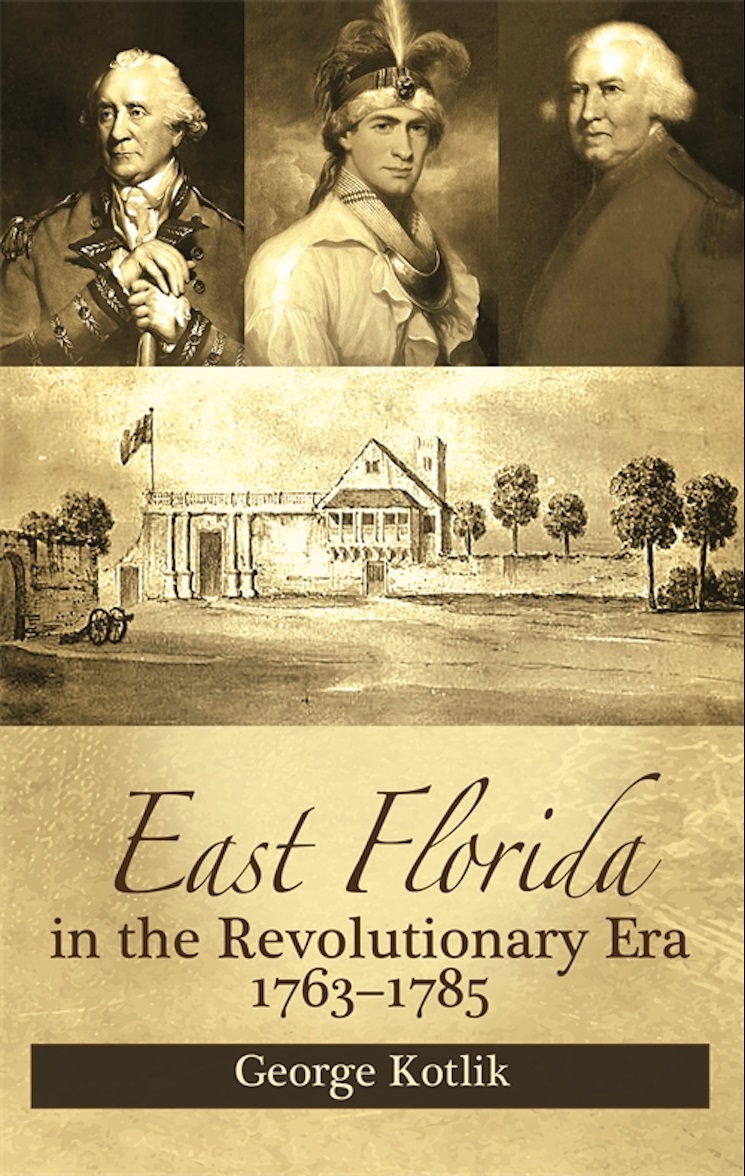
Thirteen of the Great Britain’s North American colonies moved toward independence in 1775, declaring the fact officially the following year with the issuance of the Declaration of Independence. Perched below these thirteen rebellious provinces was the colony of East Florida. Earned after the Seven Year’s War by Great Britain from Spain, the most populous city an oldest permanently established European metropolis was St. Augustine, which was also the capital of the colony. This colony, through the eight years of the American Revolutionary War, had a tenuous connection with their neighbors to the north. Largely forgotten in the pantheon of history describing this period, from the time of Britain gaining possession in 1763 through the end of the Revolutionary era in this historian’s estimation, in 1785.
Entitled, East Florida in the Revolutionary Era, 1763-1785 and penned by George Kotlik, a historian specializing in 18th century North American history, the publication offers “an accessible and detailed narrative of the East Florida during the American Revolution.” (pg. 8).
What ensues in the following pages is a brief yet complete overview of the military, political, social, and economic history within those years of East Florida. Some of the names in the pages are well known to enthusiasts of the American Revolutionary War era whereas others will be new names to add to the repertoire for further study. From Governor Patrick Tonyn, British general and last governor for England of East Florida to bringing attention to the William Augustus Bowles, a Maryland born Loyalist, sympathetic to the Muscogee Native Americans of East Florida who tried in vain from the last decade of the 18th century, to establish an independent state for the tribe, with British support. These are just two of the historical personas that Kotlik discusses in his narrative, the rest await you within the pages of the book!
Although no major military actions happened within the confines of the colony that does not mean the role of East Florida in relation to the American Revolution should not be marginalized. “Militias were raised, a general assembly was postponed, St. Augustine experienced a heightened British troop presence, planters between the St. Johns and St. Marys Rivers suffered at the hands of George raiding parties, and a constant threat of a Spanish or American invasion” all affected the psyches and lives of East Floridians. (pg. 104-105).
The hope from Kotlik is to provide the launching point for further discussion into the role of East Florida specifically and Florida in general during the revolutionary period. “Such a lack of coverage is a reminder for scholars to to emphasize East Florida’s presence in the war that made America.” (pg. 111). With this history in hand, Kotlik has provided the necessary overview for further exploration.
Publisher: NewSouth Books, University of Georgia Press, 2023 156 pages plus images
Lexington and/or Concord or both? Same question, Trenton or Princeton or both? Guilford Court House? Yorktown Battlefield? Ask any historian or history enthusiast of the American Revolutionary War period what their favorite battlefield is and you may get one of the places above. Or some other hallowed ground.
This Sunday, at 7 p.m. EDT, join Emerging Revolutionary War on our Facebook page for a panel discussion on our favorite battlefields of the American Revolution. Discussion will also include the successes, pitfalls, or failure of preservation and what one can see or not see at these sites. We look forward to a lively conversation and your comments on what is the battlefield of choice.
The summer of 1776 was tense on the Kentucky frontier. Since the spring, Shawnee raids from north of the Ohio had increased, with tribesmen raiding the white settlements with the intention of driving the settlers east, back across the mountains.
By the late spring, hardly more than 200 Americans remained in Kentucky, most forting up in the settlements south of the Kentucky River at Harrodsburg, Logan’s Station, and Boonesborough as war parties ranged nearby. Years later, an old settler remembered the rancid conditions of long confinements in “a row or two of smoky cabins, among dirty women and men with greasy hunting shirts.” By the summer, conditions in the forts were almost unbearable as supplies of salt and meat began to run low.
On the quiet Sunday afternoon of July 14, 1776, 13-year-old Jemima Boone, daughter of frontiersman Daniel Boone, slipped out of the log gates of Boonesborough with her friends Elizabeth (Betsy) and Frances (Fanny) Calloway. Tired of the confinement of the fort, the three girls untied the lone canoe of the settlement and pushed out into the Kentucky River for an old-style joy ride. Jemima would remember years later that her father had warned her to stay near the cabins and never cross to the other side of the river.
Betsy Calloway, 16, guided the canoe but it was soon caught up in the current and taken downstream toward the northern bank. A small mixed war party of Shawnees and Cherokees were watching the settlement from the woods across the river. They had been in the area for at least a week when they spotted the girls in the canoe. As the craft got close to the shore a warrior jumped into the river and grabbed the towline. Understanding immediately the danger they were in all three girls began to scream. The warriors brought the canoe to shore and quickly made signs to the girls of what would happen if they continued screaming. But the sounds had already alerted the settlers in the fort.
It was Sunday, the Sabbath and, as was his normal custom, Daniel Boone was lying down for his Sunday afternoon nap when he heard the commotion from out in the fort. Running out of his cabin in his bare feet, Boone joined with Richard Calloway, father of Betsy and Fanny, and several other men of the settlement as they eventually made their way to the opposite shore of the river and began tracking the war party as it made its way towards the crossing of the Licking River at the upper Blue Licks.
One of the Cherokee men in the party was named Scolacutta but known to the Americans as Hanging Maw. He knew Daniel Boone and his family and spoke a bit of English. He recognized Jemima as Boone’s daughter. Hanging Maw laughed at the joke they were playing on old Boone, Jemima remembered many years later, and confirmed they were headed for the Shawnee towns north of the Ohio. If the party managed to get across the big river, the rescue of the girls would most likely become impossible. As they were forced along the trail, the three girls dug their heels into the earth or dropped bits of material from their clothing; anything to give signs to anyone who may be following that they were on the right path.
By the morning of the second day, Boone and his party were roughly 10 miles behind the kidnappers. Now with a pretty good idea of where the war party was heading and understanding that, continuing to follow the tracks would slow them down considerably, Daniel Boone made the decision to break from the trail and speedily head for the Blue Licks. It was certainly a gamble but the men with Boone trusted his judgment. The Kentuckians moved out, setting a jogging pace.
As they got closer to the war party, the rescuers began finding the signs left for them by the kidnapped girls. They also came across muddled waters at a creek crossing, a dead snake along the trail and finally the carcass of a recently butchered buffalo calf. They knew they were getting close. Boone figured the warriors would stop to cook at the next water they came across. At a branch known today as Bald Eagle Creek, east of the current town of Sharpsburg, KY, the trail ended. Boone divided his party, with four men going up stream and four heading down.
After two days of hard travel with no sign of pursuit, the warriors began relax a bit. They would soon cross the Licking River and link up with other war parties so they began feeling confident. They made camp and began to roast the buffalo meat. The terrified girls were exhausted by being on the march. The camp was in a small, open glen. As the warriors lolled about the girls were sitting near the cook fire. Suddenly, Jemima Boone heard a noise in the brush. The sound caught the attention of one of the Shawnees who looked up but, seeing nothing, returned to his work. Glancing up along the nearby ridge, Jemima suddenly caught sight of her father. The girl remembered he was “creeping upon his breast like a snake.” Around 100 yards or so apart, the father and daughter locked eyes. Boone gave a quick signal for the girl to remain quiet.
The rest of Boone’s party were gathered up on the ridge when, in a fit of excitement, one of them fired his rifle down into the camp. Before she heard the shot, Fanny Calloway saw blood spurt from the chest of the warrior standing next to the campfire. He managed to hobble off into the brush. “That’s Daddy!” Jemima cried as she and the other girls hit the ground with shots filling the air from the rescue party above. Boone’s party rushed down into the camp among the startled warriors. Those tribesmen not hit by rifle fire managed to escape into the woods. All at once the terrible ordeal was over, for both father and daughter. “Thank Almighty Providence, boys,” Boone said, “for we have the girls safe. Let’s all sit down by them now and have a hearty cry.” Jemima Boone would long remember that “there was not a dry eye in the company.”
The story of the kidnapping and rescue would be retold in the Boone and Calloway families for generations. In the 19th century, historian Lyman Draper collected accounts of the story from at least forty people. This would become one of the most famous episodes in the life of Daniel Boone and provide the inspiration for author James Fenimore Cooper in his novel “The Last of the Mohicans”.
Emerging Revolutionary War welcomes the contribution of Eric Olsen, Park Ranger/Historian at Morristown National Historical Park
Military history tends to be a lot of “so and so’s” brigade advanced on the left wing, while “what’s his face’s” division withdrew.” Lots of movements of large faceless masses of soldiers. Personally, I prefer the little personal stories of individuals in the face of battle. Here is one such story from the battle of Monmouth in June 1778.
Sir Henry Clinton
I recently ran across this little tidbit in a July 7, 1778, letter written by the Adjutant General of the Hessian forces in America, Major Carl Leopold Baumeister. He described an incident during the battle of Monmouth involving the British commander in chief, Sir Henry Clinton. “General Clinton in the thickest fire, was saved by one of his adjutants, Captain Sutherland, when a rebel colonel aimed at him, but missed. Captain Sutherland’s horse was wounded. Another adjutant, Lloyd, stabbed the colonel.”
The story sounded vaguely familiar. Then I recalled something I’d read written by a British officer named Thomas Anbury. He was a prisoner of war, part of Burgoyne’s captured “Convention Army.” Anbury and the other prisoners were being held near Charlottesville, Virginia. At a place called Jones’s Plantation, Anbury related the following story on May 12, 1779,
“A very singular circumstance took place in that battle [Monmouth], which fully marks the coolness and deliberation, though in the heat of action, of Sir Henry Clinton: As he was reconnoitering, with two of his Aide de Camps, at the short turning of two roads, they met with an American officer, exceedingly well mounted upon a black horse, who, upon discerning them, made a stop, and looked as if he wished to advance to speak to them, when one of Sir Henry Clinton’s Aid de Camps fired a pistol at him, and he instantly rode off. Sir Henry was much displeased at his Aide de Camp, and censured him for being so hasty, adding, he was confident that the man wished to speak to him, and perhaps, might have given intelligence that would have been very essential, remarking, that when he was in Germany last war, and reconnoitering with Prince Ferdinand, a man rode up in a familiar manner, and gave such intelligence as decided the fate of the day.”
To read more about the Battle of Monmouth, check out “A Handsome Flogging, the Battle of Monmouth, June 28, 1778 by William Griffith, part of the Emerging Revolutionary War Series.
On December 16, 1773, a protest orchestrated by the Sons of Liberty in Boston, Massachusetts turned words into action. Upset over recently passed legislation and the belief that “no taxation without representation” 116 people dumped 342 chests of tea owned by the British East India Company into Boston Harbor. The event was one of the milestones on the way to the American Revolution and American independence. As the Boston Tea Party, as it is known to history, closes in on its 250th anniversary, Emerging Revolutionary War will invite Evan O’Brien, the creative director for the Boston Tea Party Ships and Museum this Sunday, June 25, evening for the next “Rev War Revelry.”
We hope you can join us at 7 p.m. EDT on Emerging Revolutionary War’s Facebook page for a discussion of the history behind and on December 16, 1773 and the efforts to commemorate and interpret that time frame. If you are contemplating venturing up to Boston in December to be in the city for the 250th anniversary of this event, you will not want to miss this discussion, as Evan will share some of what the museum has been planning to commemorate when Boston Harbor became a “tea-pot.”
On September 14, 1814, United States forces defending Fort McHenry in Baltimore repelled the British attempt to capture the city. Flying defiantly over the brick parapets was a 30 x 42 -foot the following day, clearly seen by the British and one captive American, Francis Scott Key. Over 100 years later the poem Key began writing on September 15 became the national anthem of the United States of America. But, what about the flag that the military commander of Fort McHenry, Major George Armistead had made? Well, this iconic flag became a part of the Armistead family for almost the next century as well.
Now, historian Tom McMillan, who has written on another member of the Armistead family, returns with his latest publication, Our Flag Was Still There: The Star-Spangled Banner that Survived the British and 200 Years–and the Armistead Family Who Saved It. This fascinating read, tracing the flag and its intertwined connection with the Armistead family, will be the subject of this week’s “Rev War Revelry.” McMillan gave a bit of a teaser to entice you to listen in on Emerging Revolutionary War’s Facebook page Sunday at 7 p.m. EDT.
“OUR FLAG WAS STILL THERE details the improbable two-hundred-year journey of the original Star-Spangled Banner — from Fort McHenry in 1814, when Francis Scott Key saw it, to the Smithsonian in the 21st century – thanks to three generations of an enduring military family, the Armistead’s, who defended, kept, hid, and ultimately donated the most famous flag in American history.”
We hope you grab your favorite beverage and tune in. The book is now available for purchase and Tom will have details on how to attain a copy!






 Emerging Revolutionary War Era