After you give out the last piece of candy or consume the last piece of candy or just need a break from the doorbell ringing and handing out candy, join Emerging Revolutionary War for our latest “Rev War Revelry” this Sunday, at 7 p.m. EDT, on our Facebook page. This next installment of the historian happy hour will discuss Headless Hessians and other German tales from the American Revolution.
Joining Emerging Revolutionary War historians Kevin Pawlak and Mark Wilcox will be guest historian Ross Schwalm who specializes in the history of Hessians and their role in the American Revolutionary era. Besides diving into this tale on Halloween night, the history behind Washington Irving’s fictional tale will also be discussed.
Questions such as; Was the Headless Horsemen really a Headless Hessian? What is fact and what is fiction? The answers to these questions and more (and we encourage questions from the viewers) will be answered this Sunday. Grab your favorite pumpkin beverage and/or Halloween treat and tune in to this exciting “Rev War Revelry.”
When one thinks of December 1776 in American Revolutionary War history, one’s mind immediately goes to Washington crossing the Delaware River and the Battle of Trenton, fought on December 26th. Historians refer to that engagement as the beginning of the “Ten Crucial Days” that culminated with the American victory at the Battle of Princeton on January 3, 1777.
However, days prior, American militia under Colonel Samuel Griffin fought an engagement with Hessian troops under the command of Colonel Carl von Donop. The actions occurred on December 22 and 23, 1776. Although the American forces were pushed out of their positions, the end result was the occupation of Bordentown by Donop and his troops, approximately 10 miles from their fellow Hessian comrades at Trenton.
To discuss these engagements, collectively known as the Battle of Iron Works Hill, Emerging Revolutionary War welcomes historian Adam Zelinski to “Rev War Revelry.” Zelinski is a writer and published historian and has worked on various projects with the American Battlefield Trust and the American Revolution Museum in Philadelphia. He will also speak on some exciting news coming out of the Iron Works battlefield too.
Emerging Revolutionary War looks forward to you tuning in, this Sunday, at 7 p.m. EST on our Facebook page as we discuss another component of the 1776 campaign season as we prepare for our inaugural bus tour of the Trenton and Princeton battlefields next month (only 4 tickets left!). If you can’t make it on Sunday night, you will be able to find it later (along with all our videos) on our YouTube page.
Our monthly recap of what our good friend and fellow historian Tom Hand has written on his blog, AmericanaCorner. Also, check out Emerging Revolutionary War’s YouTube page for a “Rev War Revelry” with Tom Hand done earlier this month.
September 21st: Americans with a Shared Future Meet at the Stamp Act Congress
The Stamp Act Congress was held in New York in 1765 in response to the Stamp Act, a piece of legislation passed by Parliament. The Act itself and the events that transpired because of it would prove to be hugely impactful on the destiny of America. Read it here.
September 14th: Fort Ticonderoga: A Key Component in America’s Quest for Independence
Fort Ticonderoga in upstate New York is arguably the best-preserved fort from the 1700s in North America. It was the site of several engagements in both the French and Indian War and the American Revolution. Its military significance is matched only by the natural beauty that surrounds the site. Read it here.
September 7th: British Colonies Work Together During the Albany Congress of 1754
The Albany Congress was held in the summer of 1754 and represents the first time the British colonies in North America ever attempted joint action. Unlike the conventions held in later decades, which focused on pushing back against England, the goal of this conference was to help the British in their fight against the French and their Indian allies. Read it here.
Here is what our friend, Tom Hand was up to in August on his blog, Americana Corner. Be sure to join us on Sunday, September 5th at 7pm as we host our next ERW Happy Hour where we will talk with Tom about his passion for early American history, some of his thoughts on our Founders and learn more about his project Americana Corner.
August 24th: George Washington Discourages Debt and Foreign Entanglements
In his Farewell Address, President Washington shared his thoughts on several topics, including our national debt and the need for our country to remain fiscally prudent. Read it here.
August 17th: George Washington Calls for Unity in Farewell Address
After eight years in office, President Washington was ready to step down. He had planned to retire at the end of his first term but was talked out of it. During this second run at saying goodbye to public life, Washington was determined to finally retire. Read it here.
August 10th: Washington’s Farewell Address: One of Our Nation’s Most Significant Documents
George Washington’s Farewell Address is one of the greatest documents in our nation’s history. It was a letter written by President Washington to his fellow citizens as he neared the end of his second term as President. Read it here.
August 3rd: Pickney’s Treaty Opens Up the Mississippi, Encouraging Westward Expansion
The Treaty of San Lorenzo, also known as Pinckney’s Treaty, was an agreement signed on October 27, 1795 between the United States and Spain. It settled a dispute between the two nations over the boundary of Spanish Florida and granted navigation rights on the Mississippi River to Americans. Read it here.
Emerging Revolutionary War welcomes back guest historian Karl G. Elsea
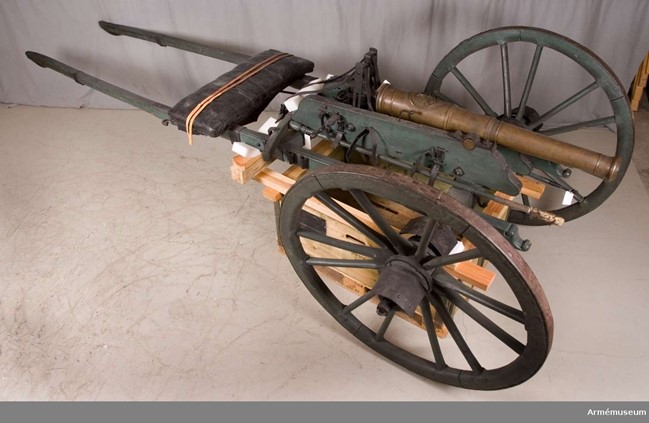
History can be fun; for example, when a war trophy in Sweden and the popular television series “Antiques Roadshow” can be combined to explain an American Revolutionary War legend. There are a number of books, articles, an actor impersonator, and even an U. S. Postal stamp from 1975 showing Peter Francisco carrying a cannon barrel to save it from falling into British hands at the Battle of Camden. Sadly, their stories of Peter carrying a barrel weighting 600 pounds, or even an amazing 1,100 pounds, are not close to true. Here is the likely story. The kind of barrel Peter actually carried is shown in the next picture. The barrel likely weighed between 200 and 300 pounds.
An original amusette is located at the Armémuseums’s magazine in Stockholm. This amusette was constructed in 1768 and captured by the Swedes in the battle at Berby in 1808. The following picture shows this amusette:
As soon as one reads the title of this post, I am willing to bet a handful of names pop into your mind. This initial thought is most likely followed by a quick passing of puzzlement that the “Father of Modern Military History” would most likely been after the era of the American Revolution. More closely connected with the French Revolution or Prussia or even later after the unification of Germany in the 19th century.
None of those thoughts land on what European historians contend is the “Father of Modern Military History.” Bear with me a moment though before you click off this post. Have you ever browsed the aisles of Barnes and Noble? Of course you have, history enthusiasts tend to be book enthusiasts. A few weeks back that is what I was doing over my weekend. I strayed too far, however, and left the “United States History” section and ventured into the “World History” section. Ever done that?
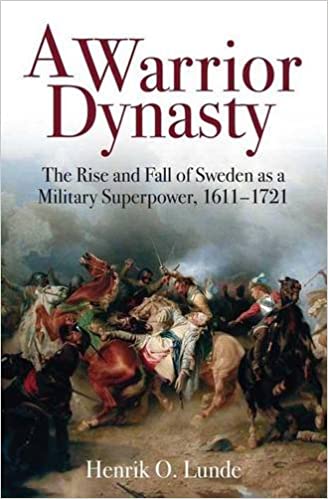
That is when this book caught my eye, “A Warrior Dynasty, The Rise and Fall of Sweden as a Military Superpower, 1611-1721.” I can safely say, I knew exactly nada about Sweden and their era of being a “military superpower.” So, I figured I would take the plunge. One more book in the personal library cannot hurt right?
After an introduction outlining the need for a book of this history in English and a brief overview of Sweden up to the 17th century, the author, who happens to reside in Southwest Florida now, introduced me to the monarch of Sweden. In addition to being the king, he was the greatest military mind in Europe during this time frame of the Thirty Years War.
Gustav II Adolf or his Latinized name, Gustavus Adolphus. He served as King of Sweden from 1611 to 1632, when he was killed in action and was the primary reason that Sweden rose to such military prominence during this time frame. After his premature death he was posthumously given the title Gustav Adolfden store which translated means Gustavus Adolphus the Great by the Riksdag, the Swedish Parliament.
Besides the other title he earned posthumously, “Father of Modern Military History.” Why is he deserving of this title? Let’s examine.
Emerging Revolutionary War welcomes guest historian Andrew Waters
Appearing this month at the Journal of the American Revolution (JAR) is an article I wrote on William “Bloody Bill” Cunningham and his infamous raid known as the “Bloody Scout.” The article attempts to provide a single-source narrative of the Bloody Scout and some of the contexts for it, although it is based on a previous article I wrote (though never published) that attempted to explore more deeply its sociological implications.
Anyone who comes to western South Carolina and has any interest in the American Revolution will soon encounter Bloody Bill. As I attempted to explain over at JAR, “without veering too deeply into sociological speculations, I can only say that his (Cunningham’s) presence is still palpable here, embedded in the cultural DNA. Though he may be only a curiosity in other parts of the United States, if he is known at all, in the South Carolina Upstate, it seems there will always be Bloody Bill.”
As July 4th approaches, many of us turn our thoughts to the Declaration of Independence and the early years of the Revolution. I do too, but I also recall another July 4th, the one in 1754 when a Virginia militia officer named George Washington surrendered the crudely built Fort Necessity to the French. The battle touched off the French and Indian War.
General George Washington looks back at us from marble statues or stiff paintings with a grim-faced and determined look. Known for his dignity, resolve, and sound leadership, he seems cold and reserved. Yet he was also quite sentimental. In the midst of a grueling campaign, with a massive British invasion force set to descend on him at New York City in July, 1776, Washington paused to pen these words: “I did not let the Anniversary of the 3rd or 9th of this Inst pas[s] of[f] without a grateful remembrance of the escape we had at the Meadows and on the Banks of the Monogahela. [T]he same Providence that protected us upon those occasions will, I hope, continue his Mercies, and make us happy instruments in restoring Peace & liberty to this once favour’d, but now distressed Country”.
Washington was writing to General Adam Stephens, his subordinate in the French and Indian War twenty years earlier, who now commanded a division in the Continental Army. These lines give us a unique insight into the mind of the Revolution’s commanding general.
The French and Indian War years were Washington’s formative years as a military officer. He learned the art of war on the Pennsylvania, Virginia, and Maryland frontier: tackling supply and logistical challenges, dealing with recruitment and discipline, and working patiently-though not always successfully- with elected officials.
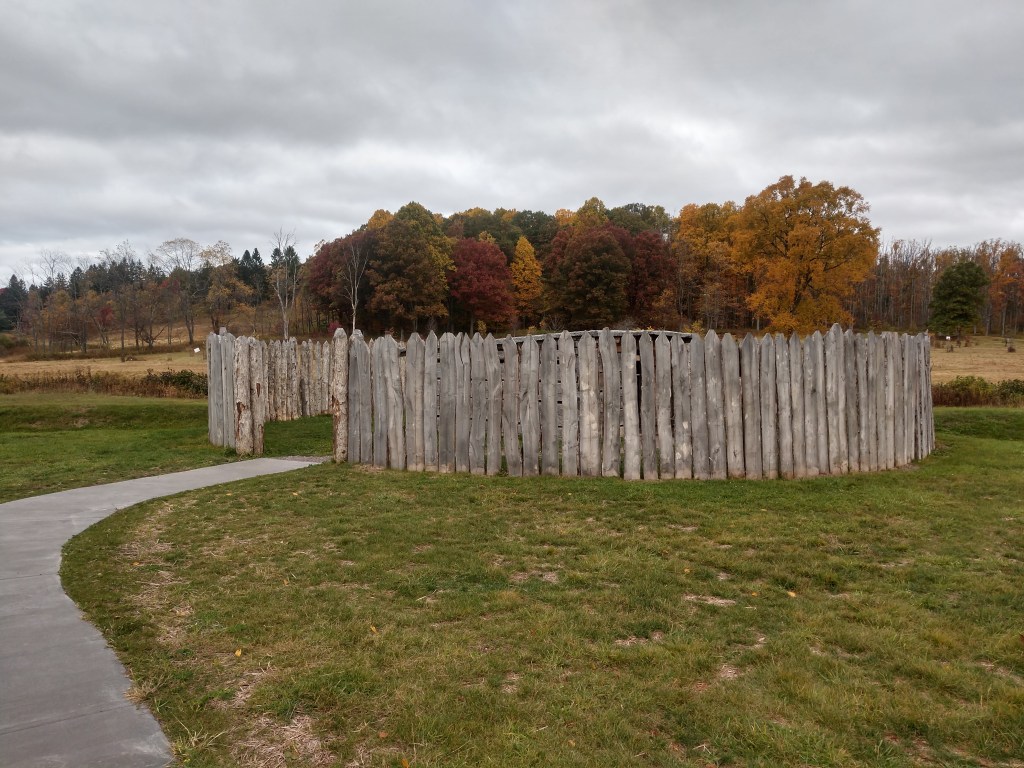
Fort Necessity. Author photo.
He lost his first major battle (Fort Necessity) to the French, fighting with the British. He won his last major battle (Yorktown) against the British, with the help of the French. The irony is deeper, for the surrender at Fort Necessity (the only time Washington ever surrendered), was July 4, 1754. Twenty years later, when celebrating American independence, he no doubt reflected on the juxtaposition.
The two battles Washington reflected upon, Fort Necessity (the Meadows) and Braddock’s Defeat (the Monongahela) were both defeats- disasters, really. Yet the experiences were powerful for the young Virginian; Braddock’s Campaign especially.
British troops and colonial forces were attempting to remove the French from western Pennsylvania and the Ohio country. The first few campaigns ended in failure, but Washington was able to participate in the final victorious effort in 1758.
Washington saw good and poor leadership, good and poor discipline, and good and poor coordination. When making decisions on conducting the war and running the army twenty years later, his decisions were informed by his earlier experiences.
He wrote of these experiences again later, and their impact on him was clearly profound. Washington also kept the sash and pistols that Braddock had given him before he died. These treasures reside in the collection at Mount Vernon today.
So strong were the memories of his youth in the woods of the frontier, that he even purchased the very land on which the battle of Fort Necessity was fought (How many Generals in American history can claim that?). In 1784 he visited the area, bought lands, and tried to find Braddock’s Grave. Washington wrote that he was “desirous of erecting a monument over it.” Unable to find the grave, Washington satisfied himself with viewing places where he learned the art of war three decades earlier.
A swivel gun at Fort Necessity. Author photo.
Washington himself was one of the new nation’s first battlefield tourists. He enjoyed visiting battlefields and retracing the movements of the armies. During his Presidency, he visited many Revolutionary battle sites, including some where he commanded. One has to wonder what ran through his mind as he re-examined the ground as a seasoned veteran and commander, without the urgency and chaos of battle unfolding around him.
Most of us have had close calls: an accident, medical emergency, or in military service. These events are life- changing. Reading Washington’s reflections allows us to better know the person, and understand his complex personality.
Being sentimental as he was, we might also wonder, what might Washington have thought of those battle sites today. Many are preserved as historic sites, though a good many have been lost to development. Hopefully he would applaud our current efforts at preservation, scholarship, and interpretation.
Emerging Revolutionary War welcomes back guest historian Karl G. Elsea
When visiting Revolutionary War battlefields there are often replica field guns (sometimes with original barrels) on the grounds. What is often not shown is the equipment needed for the gun to get to the field. That movement required horse(s) and harness and a limber. An earlier article provided information on Patriot limbers. This article concerns the horse harness.
NPS Yorktown, Author’s photo. Original 4-pounder barrel on reproduction carriage
There are inventories and paintings that show British harness used during the war. Muller’s A Treatise of Artillery shows the horse harness hook-ups on British limbers for medium and heavy artillery, and it is somewhat unique. The British hook-up appears more restrictive as to horse size. The cart-saddle used by the British was ubiquitous. It seems reasonable that the Patriots would have used the same harness with the exception of the specialized hook-up hardware on the limber. The following part of a Philipp Loutherbourg painting of Warley Camp detailing a review in 1778 clearly shows the cart-saddle with chain on the thill horse and the rest of the British harness.
Writing over thirty years after the fact, Henry “Light Horse Harry” Lee summed up the events of February 14, 1780 with the line, “Thus ended, on the night of the 14th of February, this long, arduous, and eventful retreat” (190). Upon hearing of General Nathanael Greene’s exploits in this movement, General George Washington wrote, “You may be assured that your Retreat before Lord Cornwallis is highly applauded by all Ranks and reflects much honor on your military Abilities.” (198).
What Lee would remember as “eventful” and Washington and fellow military ranks “highly applauded” is remembered today as the “Race to the Dan.” This retrograde movement, undertaken by Greene’s forces from South Carolina to the Dan River in southern Virginia, is sandwiched between the engagements at the Battle of Cowpens in January 1781 and the British pyrrhic victory at Guilford Court House in March 1781. Yet, this retreat may be on the turning points in the southern theater that led the British, under Lord Charles Cornwallis to his eventual demise at Yorktown in October 1781.
Great historians, such as John Buchanan is his monumental work The Road to Guilford Court House have covered with broad strokes this period of time but a dedicated study was much needed in the historiography of the American Revolution. Insert Andrew Waters, writer, editor, and conservationist, whose name may be familiar from previous works such as The Quaker and the Gamecock: Nathanael Greene, Thomas Sumter, and the War for the Soul of the South. His latest book, To The End of the World, Nathanael Greene, Charles Cornwallis, and the Race to the Dan, captures this important military movement while providing an expose on the leadership of Greene woven in. The title of the book is pulled from a quote by Brigadier General Charles O’Hara, Cornwallis’s second-in-command during this campaign. With a background in land conservation with a focus on river corridors and watersheds, Waters found a connection with Greene, who studied the various waterways—or ordered subordinates—to study the various rivers, to better understand the topography for military campaigns.
After a stint in Salisbury, North Carolina, Waters became fascinated with the Race to the Dan story and decided to plunge in to understanding this period of the American Revolution. He found that “the Race to the Dan is a remarkable tale, fit for cinema or an epic novel, and not only for its accounts of four narrow escapes across its four rivers” (xv). He was drawn “to its story” (xx) and any reader of the book is the beneficiary of that discovery.
Along with weaving in the innate leadership qualities of Greene, Waters brings to light the importance of military leaders not as well-known such as William Lee Davidson, William R. Davie, and Edward Carrington with more household names of Lee, Daniel Morgan, and Otho Holland Williams. Throw in the names of Cornwallis, O’Hara, and Banastre Tarleton, and the pantheon of American Revolutionary personas is complete.
In this approximate month-long retreat, Greene saved the American Revolution in the southern theater and set in motion the events that led to the climactic victory at Yorktown. Waters, with his 2020 publication, has now helped save the story of the Race to the Dan from its unintended lapse into obscurity.
Information:
Published: 2020 (Westholme Publishing)
264 pages, including index, footnotes, images, and maps






 Emerging Revolutionary War Era