Eutaw Springs

Emerging Revolutionary War is pleased to welcome back historian Bert Dunkerly, who is the co-author (with Irene B. Boland) of the upcoming book; “Eutaw Springs; The Final Battle of the American Revolution’s Southern Campaign” slated to be released this month. 

Part One

The weather was warm and the men had been marching for days, but their morale was high.  They had been through a lot recently: caught off guard and defeated at Hobkirk’s Hill, a month of grueling siege work – and for naught, at Ninety Six.   Not to mention the engagements that many of them had fought in previously: Kings Mountain, Cowpens, Guilford Courthouse, and dozens of smaller battles.

Yet the army that General Nathanael Greene led forward on the morning of September 8, 1781, was confident and ready to come to grips with its adversary.  Everyone from the private in the ranks on up to the commanding general knew that ahead lay an opportunity.

Battles in the Revolution were, in fact, rare opportunities for commanders.  Engagements were the short, pulse-pounding events that broke up the monotony of marching and maneuvering.  An army spent most of its time in garrison, in camp, or on the road.  In battle the infrequent opportunity came to crush an opponent and influence the outcome of a campaign, or the war.  These chances were few and far between.

Fig 8
“Eutaw Springs” by Benson Lossing

Both commanders at Eutaw Springs appreciated this fact.  General Nathanael Greene’s forces had experienced a series of close calls at Guilford Courthouse, Ninety Six, and Hobkirk’s Hill.  The American army fought well in all of these engagements, save Hobkirk’s Hill, yet they met defeat in every one.  Greene hoped Eutaw Springs would put the finishing touches on his South Carolina campaign, and end it with a clear cut victory.[i]

Eutaw Springs was a rare chance for Greene to pick the time and place of engagement, array his forces to his choosing, and initiate the battle, and control its \tempo.  It was the only set engagement of the campaign, other than Guilford Courthouse, in which Greene chose the ground and initiated the battle.  Commanders do not often have this luxury, and Greene earnestly hoped to make the most of it. Continue reading “Eutaw Springs”

#Alarmed

A special thanks to Stacey Fraser at the Lexington Historical Society for the update on the new exhibit described below.

If one asked what a buzzword for 21st century communication would be today, what would be your answer?

Text? Tweet? Snap?

exhibit-poster_1_orig
(courtesy of Lexington Historical Society) 

What if the follow up question was that some of the same buzzwords of the 21st century could describe the 18th century? Thanks to the Lexington Historical Society at Buckman Tavern, you can see the similarities yourself.

Opening on April 8th, the interactive exhibit is part of the admission ticket to the tavern. Titled #Alarmed! 18th Century Social Media “explores how news went viral  250 years ago” in addition to letting “visitors  imagine how colonials might have made use of modern media tools to kick start a revolution. Continue reading “#Alarmed”

“Boston Harbor a tea-pot this night!”

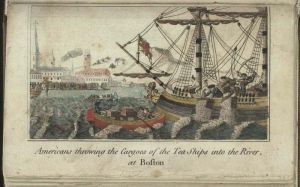
boston-tea-partyThe town meeting held on the night of December 16, 1773 at the Old South Meeting House was no ordinary meeting. Boston was well known for its public meetings, but this one was different. Frequently city leaders called town meetings to discuss important political, economic and social decisions facing the city or colony. The town meeting was a foundation of the political process for Massachusetts and much of the New England colonies.  Royal authorities had watched these meetings more closely since the 1760s during the opposition to the Stamp Act. Colonial Whigs (anti Royal leaders) had used these meetings to protest British policies that they saw as threats to their liberties.

This town meeting was a follow up assembly to previous meetings held in November originally called for Faneuil Hall. The large turnout, however, required the crowd to move to the more spacious Old South Meeting House. Nearly 5,000 people attended the meeting to discuss the city and colony’s response to a new tax on tea and more directly, the ships in the harbor that held tea from the East India Company. The colonial Whigs did not want the cargo unloaded but the captain of the ships could not leave the harbor with the tea unless they had approval from the Governor. Governor Thomas Hutchinson did not believe he had the authority to allow the ships to leave without unloading the tea.  Adding to that decision, Hutchinson was more than frustrated with those who had rejected Royal authority over the years. Thus, a legal and theoretical standoff ensued. That night, the people of Boston took the matter into their own hands.

On the surface, the Tea Act of 1773 was rooted in helping pay off the debt of the British Empire, caused in part by fighting the Seven Year War (French and Indian War) with France. Also, the revenue raised would pay British officials in the colonies, thus making them more loyal to Parliament and the British Crown. The Tea Act was one of many Parliamentary laws or “Acts” passed to raise revenue in the colonies. More importantly, the underlying purpose was for Parliament to display their authority to pass laws that were binding on the British colonies. Due to colonial opposition and resistance, many of these acts were repealed.  However, the Tea Act, passed in 1773, sparked an immediate response throughout the colonies.

The Tea Act was also seen as a mode for saving a British held company, the British Eastbritish-east-india-tea-company-logo India Company.  Before 1773, the company had to sell its tea in London and was subject to duties. The company had collected large quantities of tea in warehouses in London and was looking for a way to disperse the tea at a bargain.  The Tea Act allowed the company to sell directly to American ports without paying the duties. This also forced American buyers to only purchase their tea from the East India Company, which was subject to a tax. The good news was the price of tea was reduced because the Company no longer had to pay the duties in London. Colonists resisted the notion that Parliament could force them to buy tea from the East Indian Company (many made a good living off of smuggled tea sales) and that they were required to pay a tax on the tea.
The popular notion, “taxation without representation,” had been around since the 1750’s and became well-known in 1764 in response to the highly unpopular Sugar Act and Stamp Act. Colonial Whigs believed they had no representation in Parliament because they did not elect representatives to Parliament. British political theory and law believed in the model of “virtual representation” which meant the colonists did not vote for individual members of Parliament though that body, as a whole acted in the best interest for all British subjects. Colonial leaders, who for decades were allowed to vote for their representative bodies in their respective colony, did not accept this theory. The opposing views on representation began to open opposition to British authority over colonial matters.

Though passed in May 1773, the Tea Act did not impact the people in the colonies until fall. Seven ships of tea were sent to four American ports, Boston, New York, Philadelphia and Charleston. Meanwhile, colonial Whig leaders began to organize a resistance to the East India Tea that was en route. In fact, in every other city but Boston the tea was refused and forced to either be returned to England or confiscated by local officials. It was in Boston that a determined governor and history of Royal opposition led to a signal event in American history.

On November28th, the ship Dartmouth arrived loaded with tea. British law gave ships with imports twenty days to pay the duties or the local custom officials could confiscate the cargo. Hutchinson, when petitioned, would not allow the ship to leave the port without paying the duty. His sons, who acted as the Tea Consignees (authorized to receive the tea and see to its distribution) for Boston, also refused to back down and resign their positions, which happened in other American ports. Soon two more ships arrived in the harbor with the unwanted tea. Unable to return the tea to England and without being able to unload the tea due to the threats of local groups such as the Sons of Liberty, the captains of the ships were in a tight and dangerous spot.

On the night of December 17th, one of the largest public meetings in Boston convened at the Old South Meeting House. Speeches by Sam Adams, John Hancock, Joseph Warren and other Boston Whig leaders called for the return of the tea to England. Later in the evening, word came that a last minute plea to Governor Hutchinson to let the ships return was refused. Sam Adams announced publicly, “This meeting can do nothing further to save the country.”

The events that happened next have been debated since 1773, soon men arrived outside the Meeting House disguised as Mohawk Indians. Whether or not these men were signaled to move towards the ships with tea is unknown. As the “Mohawks” marched down Milk Street towards Griffin’s Wharf where the three ships of tea were docked, the thousands gathered inside the Old South Meetinghouse began to pour out of the building. Chants of “Boston a Teapot Tonight” and “Hurrah for Griffin’s Wharf” were reportedly heard. Some people followed the “Mohawks”, others continued to protest in the streets, while still others headed home believing that a confrontation was about to take place.

boston-tea-party-2Many details remain unknown about who exactly the “Mohawks” were that marched on Griffin’s Wharf that night. The men used lamp soot and red ochre to disguise their faces and carried a wide assortment of weapons. As they made their way to the wharf, they yelled and “whooped” as Indians in a war party. If they had coordinated the timing with leaders in the Old South Meetinghouse, it is still unknown. The identities of most of these men either were never recorded or are lost to history; that is how tight their veil of secrecy was coupled with their sophisticated organization.  As they made their way to the ships, the Whig leaders inside the Old South Meetinghouse stayed behind and were never directly part of what happened next.

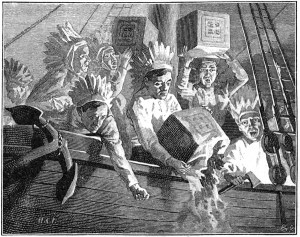
The men, with a crowd behind them, approached the wharf. There they divided into three different groups, one for each of the ships, Dartmouth, Beaver and Eleanor. Being a port city, most of the men knew where to find the cargo they were looking for and how to operate on a ship. Respectively, most of the other cargo and private property on the ships were not touched.  They were only after the tea.  Hauling the chests to the deck, they were broken open and dumped into Boston Harbor. Some of the men watched to make sure no one was trying to steal any of the tea that they were dumping. The group of approximately 150 men worked quickly as the crowd of spectators grew.

The American Revolution did not just “happen.” It was the culmination of various events and acts that individually did not guarantee separation. As a collective, one can retroactively see how the accumulation of these events led to the inevitable. The Boston Tea Party was one of these events. This time it was different; this time Great Britain would respond in a way it never had before. The Tea Party gave the tinder box of revolution in America more fuel and many believed a small incident would cause a spark leading to open war between colonies and mother country. The spark would come on April 19, 1775 in the Massachusetts countryside.

Defending the New Nation: The Fredericksburg Gun Manufacturing Plant

Emerging Revolutionary War is honored to welcome back historian Malanna Henderson. 

Part One

n-7-fredericksburg-gun-manufactory-state-marker
N-7 Fredericksburg Gun Manufactory State Marker

Located at 200 Gunnery Road between Dunmore and Ferdinand Streets is the Old Walker-Grant public school. The three-acre campus is home to the Fredericksburg Regional Head Start educational program. Built in 1938, Walker-Grant was the first publically financed high school for black youth in Fredericksburg. The institution was named for Joseph Walker and Jason Grant.

Walker, born into slavery in Spotsylvania County in 1854, was freed after the Civil War and moved to Fredericksburg. Employed in a paper mill, Walker was self-taught and had a keen interest in expanding educational opportunities for black youth. He served as the sexton at St. George’s Episcopal Church for more than 50 years.  Jason Grant was born free in Chatham, Ontario, Canada, in 1861 to a middle-class family. He attended Wilberforce Educational Institute in Ohio. He met an inspiring educator from Fredericksburg and decided to move there and teach.  Grant taught at the county and city schools and also served as principal. His career spanned 42 years. Both Walker and Grant worked diligently to establish a learning institution for black children whose educational opportunities were marginalized by the social order of the day: segregation and racial discrimination.

Over two-hundred years ago, this location was once the site of the Fredericksburg Gunnery plant; the first government ran factory of its kind in the nation. Established in 1776, its existence was paramount to the victory of the Continental forces in winning the Revolutionary War.

By then, the colonists had interpreted an array of British economic policies as threatening their rights as Englishmen. When a slew of taxes were demanded of the colonists who were accustomed to governing themselves, their rebellious cry became, “no taxation without representation.” Until then, the planter-statesmen and other notables still felt they could reconcile with the mother country, despite the occurrences of the Boston Massacre in 1770 and the Boston Tea Party in 1773. However, in Virginia an odious act by the royal governor put the colonists on notice that the British were willing to spill more blood in an effort to vanquish the rebellion.

In the dead of night, on April 21, 1775, a mixed military unit of His Majesty’s Navy and Marines confiscated gun powder and armaments from the Williamsburg Magazine. This vital repository of weapons was stockpiled for the defense against Indian raids, slave revolts and riots. The action of the British soldiers left Virginia virtually defenseless.

John Murray, Fourth Earl of Dunmore and the last royal governor of Virginia ordered the raid. Many colonists saw this as the last straw. Dunmore had repeatedly rebuked the colonial statesmen’s demands, dissolving the House of Burgess and other political committees. An aristocrat, accustomed to having his word obeyed without question, Dunmore saw the burgeoning independence of the statesmen as an affront to his authority and responded by acts of retribution instead of compromise.

Blood had already been spilt at the Battles of Lexington and Concord a few days prior. Thus, disarming the colonists seemed a logical strategy to weaken their resolve. The shot heard around the world occurred in the north and in the south; the stealth act of a midnight raid struck a wedge between Britain and the American colonies that was irreparable.

The colonists had to arm themselves if they were going to war with England, whose military might seemed Herculean to the limited martial skills of the local colonial militias. There was no standing army. Each of the thirteen colonies had their own reservists, comprised of farmers, merchants and tradesmen who were needed sporadically for lawless incidents.

On July 17, 1775, the Third Virginia Convention convened in Richmond to create a working government structure. Delegates were elected to serve on the Committee of Safety, which replaced the Committee of Correspondence. Its powers were comparable to the defunct House of Burgess. The most important resolutions that sprung from those meetings were to raise two regiments, a total of sixteen companies of sixty-eight men each to serve one year tours. In addition, sixteen districts of Minutemen were planned.  In all of the county militias, the remaining free white males between the ages of fifteen to fifty were to muster, eleven times a year. Below is a page from Colonel Lewis’s manual on military exercises and drills, dated 1777.

excercises-and-evaluation-of-military-drills-1777
(Courtesy of The George Washington Foundation)

The last meeting of the convention took place on the 26th of August. An ordinance to build a gun manufacturing plant was enacted. One prominent Virginian intellectual described it as, a first step “in open defiance of British parliamentary law.”

The five commissioners appointed to operate the gun factory were Mann Page; William Fitzhugh; Samuel Selden; Charles Dick and Fielding Lewis, George Washington’s brother-in-law, husband to his sister Betty Washington. Lewis was elected chairman of the Committee. As it turned out, the only men who stayed the course was Charles Dick and Fielding Lewis.

Initially, the convention issued to Lewis 2,000 pounds to construct the gun manufacturing plant. Early in November, Lewis purchased a ten-acre tract of land located south of town. He also leased a nearby mill on four town lots.

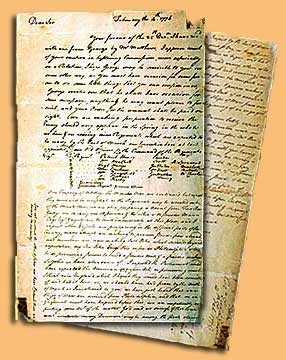
Knowing how desperate the Continental Army was for arms, Lewis penned a letter, on February 4, 1776, to George Washington in haste. Now the Commander-in-chief of the Continental Army, George received this letter from Fielding describing the developments of the factory and the formation of the army regiments they were establishing. Of note, in August of 1775, Patrick Henry was named Colonel of the 1st Regiment, and the 2nd Regiment was commanded by William Woodford with Alexander Spotswood serving as major. In January of 1777, Hugh Mercer was named Colonel of the 3rd Regiment.

fielding-lewis-letter-to-george-washington-on-the-building-of-the-gunnery
(Courtesy of The George Washington Foundation)

“…our Gunn Manufactory is now beginning & expect by New Years day to have near fifty Men imploy’d who will make about Twelve Gunns compleat a Day…”

The gunnery was close to the Hunter Iron Works, an important supplier. James Hunter, the owner, added the manufacturing of muskets to his production output, independent of government funding.  He also supplied regiments with axes, spades, shovels and mattocks.

The items produced at the Fredericksburg Gunnery were muskets, bayonets, flint locks, ramrods and more. The plant encompassed a main manufactory, a stone powder magazine, cartridge works, repair shops and a vegetable garden, for the benefit of the employees.

Charles Dick ran the day to day operations, hiring a master workman and artisans. Although, the very capable Mr. Dick never discussed his origins or even his birthdate; the self-made man wasn’t a member of the established gentry. However, he easily found his place amongst Fredericksburg’s leading citizens. Dick was a successful merchant, land owner, Mason and a well-respected member of the community. He served on several important civic organizations; the Committee of Correspondence and later the Committee of Safety.  A business partner and personal friend of Fielding Lewis, Dick was godfather to Lewis’ first son.

On September 22, 1775 an advertisement for locksmiths was published, most likely in the Virginia Gazette. Dick needed gunsmiths, artisans and a variety of other laborers to make the gunnery productive. It was evident, early on, that there was a deficiency of expert gunsmiths ready for hire. The House of Delegates passed an apprentice act so Dick could train a class of artisans from the white youth in the area. The young men would be housed, fed and clothed; all paid for by the government. Dick forbade the drinking of beer and rum at the establishment, a drastic change from Eighteenth Century practices. Three black men were engaged to cook, bake and do an assortment of odd jobs. Whether they were slave or free is unknown.

In an emergency the aristocrats of the town, women, too, worked at the factory stuffing cartridges, etc., for the more than one hundred guns hastily readied for the Fredericksburg and Spotsylvania militia. The most commonly used weapon at the time was the British Brown Bess, a muzzle-loading smoothbore musket. It fired a single shot ball or a cluster shot which fired multiple projectiles like a shotgun. About four shots per minute was the typical output from most soldiers. By May of 1777, the factory produced similar muskets to the British Brown Bess by the rate of twenty per week.

a-musket-produced-from-the-fredericksburg-gun-manufactory
(Courtesy of The George Washington Foundation)


April 19, 1775 – Minute Men vs. Militia

12797-21913
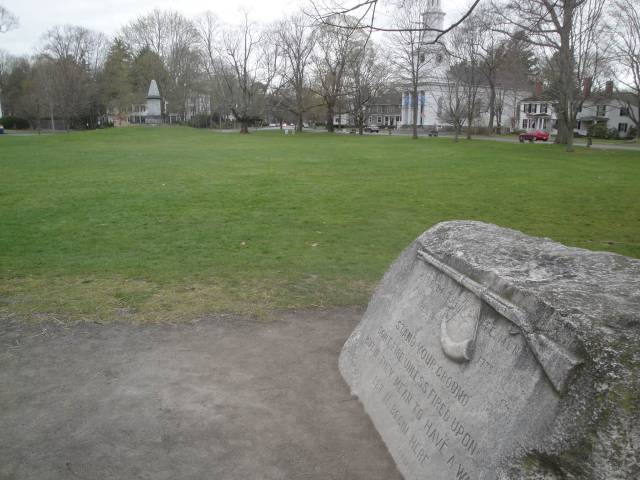
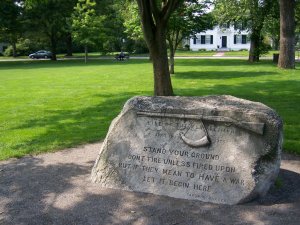
Monument to the “Lexington      Minute Men”

“Minutemen” on April 19, 1775 at Lexington and Concord have always been grouped together in history and textbooks. But, is that completely historically accurate? Well, no. There is a common misperception that most of the Americans that went to arms on the morning of April 19, 1775 were “Minutemen.” This view has become part of American mythology and popular memory, referenced in most histories dealing with this April day. Despite all of this, the fact remains that many of the men who answered the call that day were not “Minutemen” at all.

The British colonies in North America had a long standing tradition of locally based military units. Most men between the ages of sixteen and thirty five were required to be part of the local militia and these units would meet periodically throughout the year for basic training. Many of these occasions became festive events for the local community. The colonial militia was called out often by the colonial governor to defend against Native American attacks or foreign invasions. Frequently, the militia would supplement a professional force for short campaigns.  This was especially common in the French and Indian War, fought between 1756 and 1763.

But the militia was far from a professional and well trained force. Colonies, such as Massachusetts, began to create select companies of men chosen from the local militia regiment. These companies would train more often and be better equipped. They were to be the “elite” force of the militia. Also, these men would be required to respond to an emergency at a short notice. The rise of the “Minuteman” concept can be found as early as 1645. In response to an Indian tribe disturbance, the Massachusetts Council of War created a new regulation. This regulation ordered militia companies to “appoint out and to make choice of thirty soldiers of their companies in ye hundred, who shall be ready at a half an hour’s warning.” The need for a quick response force was already recognized by colonial leaders.

Though the idea of the “Minuteman” can be found in 1645 Massachusetts, the more popular idea of the “Minuteman” came from Worcester, Massachusetts. In 1774 the town was in the forefront of opposing Governor (and General) Thomas Gage’s efforts to enforce Royal authority. The Worcester County Convention passed new militia regulations that highlighted/reinforced how the populace was getting closer and closer to open confrontation with the British Crown. In these new regulations, the Worcester Convention called for “officers in each town of the county, to enlist one third of the men of their respective towns, between sixteen and sixty years of age, to be ready to act at a minute’s warning…” Thus the “Minuteman” was born.

parker
Monument on the Lexington Green marking the place where the “Lexington Minute Men” stood

As events in Massachusetts spiraled into open confrontation between the Whigs (Patriots) and the Crown, every town in Massachusetts ramped up their military training of their militia and created “Minuteman” companies. These units became a source of local pride. Along with the militia forces, towns and counties created a complex network of communication via riders that could notify hundreds if not thousands of militia units of possible threats. As Gage began to use his growing military force in Boston to search for colonial military stores, these riders and “Minutemen” showed their effectiveness.

On the morning of April 19, 1775 riders rode out to a very well prepared countryside west of Boston. Paul Revere, William Dawes and many others connected each town with the news that the British regulars were marching on Concord to capture provincial military stores (and possibly capture colonial leaders). Militia and “Minutemen” by the hundreds began to arrive along the road from Cambridge to Concord.

The first Americans the British confronted on the road to Concord were members of Captain Parker’s Lexington Militia. These men, gathered the night before at Buckman’s Tavern in Lexington after an early warning, were still in the area in the early morning of April 19th as the vanguard of the British column neared Lexington. As they formed up in two lines on the Lexington Green, the British quickly came onto the Green to confront the armed colonials.  What happened next set off a shockwave not just through Massachusetts, but the entire British colonies in North America. These first shots were fired by militia, not the famed “Minutemen.”

It is here in Lexington that the confusion and myth of the “Minutemen” was born. Several of the monuments around the Lexington Green are dedicated to the “Lexington Minutemen.” But the men on the green were typical militia; they ranged in age and skill levels. They were not highly trained like a “Minutemen” company.

davismnt
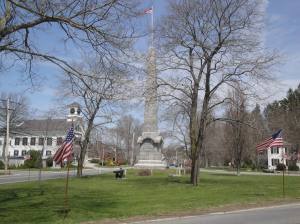
Isaac Davis Monument in Acton, MA. The Acton Minute Men were one of several Minute Men units to take part in the action at Concord.

As the British made their way to Concord, Militia and “Minuteman” companies began to answer the well-traveled call that the British were marching on to Concord. After the skirmish at the North Bridge in Concord, more and more colonials answered the call and began to confront the British column as it made its way back to Charlestown. Thousands of militia and “Minutemen” made their way to the towns of Lexington, Menotomy, and Cambridge to confront the British. Because of the great response of these men, there was no turning back after April 19th.

The importance of the “Minutemen” cannot be exaggerated but neither can the importance of the militia. They were two distinct colonial military forces, both created with their own specific uses. In modern times, most wanted to attach their local story to that of the famed “Minutemen.” Though it is most likely that more militia turned out on April 19th than “Minutemen.”

Many monuments in Lexington, Concord and along Battle Road mention the “Minutemen” of 1775. Also, many of the sites associated with the events of April 19th are preserved by Minute Man National Park.  I guess “Militia National Park” didn’t have as good of a ring to it.

Recommended Reading:

The Minute Men: The First Fight: Myths and Realities of the American Revolution by John Galvin


ERW Weekender: Battle of King’s Mountain

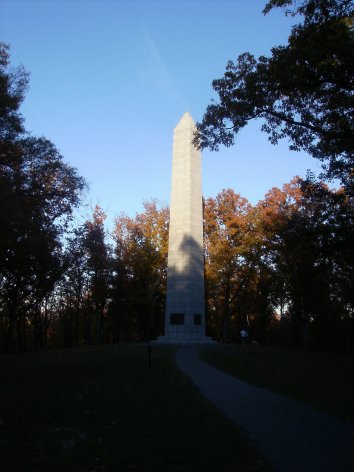
On October 7, 1780, one of the most pivotal battles of the American Revolution fought in the South occurred on a hillside in northwest South Carolina.The engagement brought militia from both sides; those loyal to the British and those adhering to the independence movement against each other. In fact, only one regular British soldier was present on that autumn day; the British commander Major Patrick Ferguson.

How did Ferguson and his militia end up on King’s Mountain? This was due to the campaign being waged by British General Lord Cornwallis in the Southern colonies.

Ferguson’s role was to protect the flank of Cornwallis’ force as it turned north from South Carolina. After issuing a call of bravado, where Ferguson gave Patriot militia an ultimatum; lay down your weapons or suffer the consequences, the British officer began to move through the South Carolina countryside. This decree emboldened the Patriot militia, some of which would come from across the Appalachian Mountains–or “Overmountain”–to join in the fight against Ferguson. This combined force would gather around Sycamore Shoals in present day Tennessee.

Word quickly reached Ferguson near Gilbert Town, North Carolina by way of deserters that a large force of Virginia, Carolinas, and militia from the area of Tennessee had arrived and were planning to march toward his encampment.

Still showing a high degree of disdain for the Patriot militia, Ferguson did not act immediately on the intelligence. Three days later, the Loyalist militia and the British officer started their retrograde movement toward Charlotte and Lord Cornwallis’s main army.

By October 4, 1780 now joined by a sprinkling of Georgia militia, the Patriots had reached Ferguson’s old encampment site. Two days later the militia forced marched through the Cowpens of South Carolina, which had not witnessed the hard hand of battle yet. Just a day’s march ahead was Ferguson’s forces.

SANYO DIGITAL CAMERA
Colonial Road trace near Kings Mountain (author collection)

At this juncture, Ferguson made a fateful decision. Instead of continuing his retreat and he was less than a full-days march away from the main British army, the British officer held up his forces on a forested hill just inside South Carolina and laid out his camp on the highest point; Kings Pinnacle.

Realizing that time was of the essence, the Patriot force, now numbering 900 men, found plentiful horseflesh to mount up and close the gap between the two sides. Riding through the rain and darkness of the night of October 6, the fifteen-mile gap between forces was erased and by late morning the Patriot militia was reining up within striking distance of Kings Mountain.

By mid-afternoon, at approximately 3:00 p.m. the fighting erupted. The Patriot militia broke into smaller commands, numbering between 100-200 men and started to ascend the slopes. Luckily for the Patriots, Ferguson had not detected just how close the enemy was and had also neglected to fortify his encampment. His force though, outnumbered the Patriots by approximately 200 men.

Some of the Loyalist militia did not realize that the enemy had arrived until the Patriot militia came hollering and yelling up the slope of the hillside. With the conglomerate of various militia, there was no unified command of the Patriot forces and the fight quickly boiled down to independent maneuvering and fighting. Using the terrain, the Patriot militia fired from behind trees and boulders. Answering this tactic, Ferguson ordered a bayonet charge down the hill. This caused the Patriot force to retreat to the base of the hill as most of the men were carrying rifles which did not accommodate the bayonet.

Virginia militia Colonel William Campbell and North Carolinian militia Colonel John Sevier helped rally the militia that had broken and sent the force back up the hillside. This back and forth would happen a few more times; Ferguson’s force charging down hill with bayonets, the militia backtracking, than reforming, and charging back up after the Loyalist momentum had waned.

Finally, after an hour of combat the Patriot militia forced their way to the crown of the hill and was able to flank the Loyalist force and attack in rear of their position. This maneuver forced the Loyalists back into their encampment where numbers of them began to surrender.

SANYO DIGITAL CAMERA
Marker to the memory of Major Patrick Ferguson (author collection)

Ferguson sensing the tide turning against the Loyalists, tried to rally his troops, supposedly yelling, “Hurrah,brave boys, the day is ours!” Gathering a few stalwarts, Ferguson made a desperate move to fight his way out of the encircling Patriot militia. A volley from Colonel Sevier’s militia force unhorsed Ferguson who fell entangled in his stirrups. Unfortunately, the horse, spooked with the musketry and smell of gunpowder dragged Ferguson through the Patriot line. After getting untangled from the straps on the horse, Ferguson lay prone on the ground, where a Patriot officer demanded his surrender. Still with some fight in him, Ferguson shot and killed the man. Other Patriot militia responding to the scene fired a collective volley at the downed British officer, killing Ferguson.

Some of the Patriot militia were opposed to accepting the Loyalist surrender, as they remembered the massacres and atrocities committed to their brethren in arms by the infamous Banastre Tarleton. Cooler heads prevailed and the firing died down.

By the time the second white flag was sent out by Captain Abraham DePeyster, Patriot militia officers were finally able to reign in their commands and over 600 Loyalist soldiers surrendered.

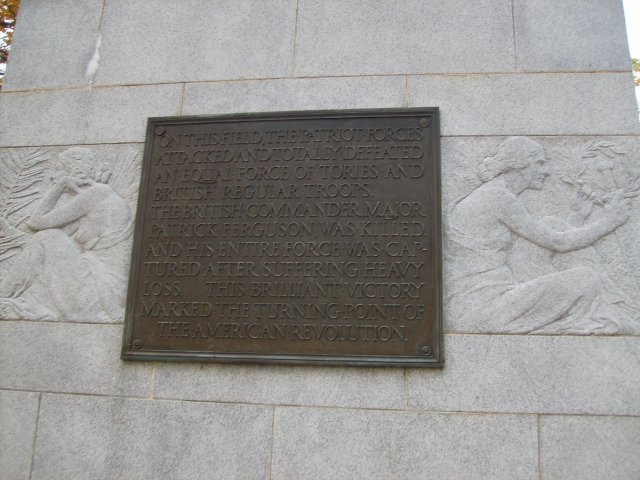
Within the one-hour and five minute engagement, Ferguson’s force ceased to exist. Total casualties for the Loyalist force was 290 killed, 163 wounded, and 668 captured. The Patriots suffered a total of 87 casualties; 29 killed and 58 wounded.

The Patriots, with the close proximity of Cornwallis’s forces, who the day after the battle would finally get the request for reinforcements from his slain subordinate, quickly retreated back into the safety of the South Carolina countryside.

However, the Battle of Kings Mountain would become a critical turning point, not only in the Southern Campaign of the American Revolution, but in the entire war itself. The victory, which demolished the Loyalist militia force covering his flank, forced Cornwallis to altere his strategy for the campaign. He would be forced to return to South Carolina, giving up advancing further than Charlotte into North Carolina in order to re-solidify control of territory in his rear. When Cornwallis finally returned to the Tar Heel State the following year, he would suffer eventually suffer a Pyrrhic victory at Guilford Court House in March 1781.

All that was in the future and so is your visit to this battlefield of the American Revolution.

SANYO DIGITAL CAMERA
Kings Mountain Battle Monument commemorating the Patriot victory (author collection)

On March 3, 1931, Kings Mountain National Military Park was formed by an act of Congress and placed under the control of the United States War Department. Two years later, in March 1933, the property was transferred to the National Park Service by an executive order. At this juncture, the entire land mass of the park was comprised of 40 acres that had been originally donated by the Kings Mountain Battlefield Association. The park has grown since that time and now preserves slightly under 4,000 acres.

For further details on how to visit the battlefield, which includes trails, a visitor center, exhibits, and a bookstore, click here. The park is open daily 9:00 a.m. to 5:00 p.m. with extended hours on the weekend between Memorial and Labor Days. Even better there is no fee to access this national military park!

*All the photos taken for this post was done by the author during a visit to the battlefield in autumn.*


The Battle of Kings Mountain, From Those Who Were There

Emerging Revolutionary War welcomes back historian Bert Dunkerly. The accounts below come from Mr. Dunkerly’s book on the battle.

9e68818e-8f86-4871-83ad-e24e9f58afb9
“The Battle of Kings Mountain, Eyewitness Accounts” by Bert Dunkerly  (Acadia Publishing)

The battle of Kings Mountain was an intense, one-hour battle fought just below the North Carolina-South Carolina border.  The October 1780 engagement pitted about 900 American militia from five states (Virginia, the two Carolinas, Georgia, and modern-day Tennessee) against 1,100 Loyalists under Maj. Patrick Ferguson.  With Ferguson’s wounding late in the action, command fell to his subordinate, Captain Abraham DePeyster.  As the Americans closed in, the Loyalists surrendered.

Eyewitness accounts provide details of the battle, especially its lesser known aspects like the conclusion of the battle and subsequent Loyalist surrender.  Here are a few detailed accounts, presented with original spelling and grammar.

Virginia militiaman Leonard Hice had quite an experience in the battle, being wounded four times.  He would spend two years recovering:

“I was commanded by Captain James Dysart where I was dreadfully wounded, I received two bullets in my left arm and it was broken.  We were fighting in the woods and with the assistance of my commander who would push my bullets down, I shot 3 rounds before I was shot down.  I then received a bullet through my left leg.  The fourth bullet I received in my right knee which shattered the bone by my right thigh and brought me to the ground.  When on the ground I received a bullet in my breast and was bourne off the ground to a doctor.”

Andrew Cresswell was a militiaman from Virginia who found himself too far in front during the final phase of the battle.  He also was fortunate to witness the surrender and provided one of the only accounts of Captain Abraham DePeyster surrendering to Colonel William Campbell.  His account also speaks to the brutal nature of the fighting between Loyalist and Whig.

“I saw the smoke of their guns and as I saw but one man further round than myself I  spoke to him and told him we had better take care least we might make a mistake.  I retreated about ten paces where I discharged my gun. About that moment they began to run.  I waited for nobody.  I ran without a halt till I came to the center of their encampment at which moment the flag was raised for quarters.  I saw Capt. DePeyster start from amongst his dirty crew on my right seeing him coming a direct course towards me.  I looked round to my left I saw Col. Campbell of Virginia on my left DePeyster came forward with his swoard hilt foremost.  Campbell accosted him in these words “I am happy to see you Sir.  DePeyster, in answer swore by his maker he was not happy to see him under the present circumstances at the same time delivered up his sword – Campbell received the sword, turned it round in his hand and handed it back telling him to return to his post which he received.  Rejoining these words, God eternally damn the Tories to Hell’s Flames and so the scene ended as to the surrender.”

Lt Anthony Alliare was a New York Loyalist in Ferguson’s command.  He recounts the experience of the New York detachment, which launched a series of unsuccessful bayonet charges early in the battle.  His reference to the “North Carolina regiment” refers to local Loyalist troops fighting alongside his men.

“The action continued an hour and five minutes, but their numbers enabled them to surround us.  The North Carolina regiment seeing this, and numbers being out of ammunition, gave way, which naturally threw the rest of the militia into confusion.  Our poor little detachment, which consisted of only seventy men when we marched to the field of action, were all killed and wounded by twenty, and those brave fellows were soon crowded as close as possible by the militia.’

Ensign Robert Campbell of Virginia also witnessed the close of the battle, and recounts a white flag being raised.

“It was about this time that Colonel Campbell advanced in front of his men, and climbed over a steep rock close by the enemy’s lines to get a view of their situation and saw they were retreating from behind the rocks that were near to him.  As soon as Captain Dupoister observed that Colonel Ferguson was killed, he raised flag and called for quarters.  It was soon taken out of his hand by one of the officers on horseback, and raised so high that it could be seen by our line, and the firing immediately ceased.  The Loyalists, at the time of their surrender, were driven into a crowd, and being closely surrounded, they could not have made any further resistance.”

Isaac Shelby, from the Carolina frontier (modern Tennessee) was a militia commander in the battle.  He also provides insights in the battle’s final moments.

“They were ordered to throw down their arms; which they did, and surrendered themselves prisoners at discretion.  It was some time before a complete cessation of the firing, on our part, could be effected. Our men, who had been scattered in the battle, were continually coming up, and continued to fire, without comprehending in the heat of the moment, what had happened; and some, who had heard that at Buford’s defeat the British had refused quarters to many who asked it, were willing to follow that bad example.  Owing to these causes, the ignorance of some, and the disposition of other to retaliate, it required some time, and some exertion on the art of the offices, to put an entire stop to the firing.  After the surrender of the enemy, our men gave spontaneously three loud and long shouts.”

In one hour, the entire Loyalist force of 1,100 was killed, wounded, or captured.  October 7 marks the anniversary of this battle which, in the words of Thomas Jefferson, was the “turn of the tide of success.”

SANYO DIGITAL CAMERA
Plaque at Kings Mountain National Military Park


Robert M. Dunkerly (Bert) is a historian, award-winning author, and speaker who is actively involved in historic preservation and research. He holds a degree in History from St. Vincent College and a Masters in Historic Preservation from Middle Tennessee State University. He has worked at nine historic sites, written eleven books and over twenty articles. His research includes archaeology, colonial life, military history, and historic commemoration. Dunkerly is currently a Park Ranger at Richmond National Battlefield Park. He has visited over 400 battlefields and over 700 historic sites worldwide. When not reading or writing, he enjoys hiking, camping, and photography.

Defense in Depth as a Revolutionary War Battlefield Tactic

Part 4
(click here for first three parts)

DanielMorgan
General Daniel Morgan,

As we have seen, two untrained, amateur, but very effective soldiers perfected the concept of the defense in depth during the campaigns of 1781. Morgan was the first to experiment with the concept, and he did so with great effect at Cowpens, thoroughly defeating Tarleton’s Legion and sending “Bloody Ban” flying in a wild panic. Greene then adopted the tactic and applied it on a much larger scale at Guilford Courthouse. Even though he lost the battle, he scored a major strategic victory by punishing Cornwallis’ army and inflicting enormous losses on it for little gain—Greene’s army escaped to fight another day. His stand at Guilford Courthouse set the stage f Continue reading “Defense in Depth as a Revolutionary War Battlefield Tactic”

Defense in Depth as a Revolutionary War Battlefield Tactic

Part Three (click here for first two installments)

Determined to avenge his embarrassing defeat at Cowpens, Lt. Gen. Charles Lord Cornwallis set his army out in a determined pursuit of the American army. Knowing that he was too weak to face Cornwallis in a pitched battle, Maj. Gen. Nathanael Greene, the Southern Department commander, retreated northeastward from Salisbury, North Carolina toward the Virginia state line, where he hoped that additional militia troops would reinforce his army and he would receive supplies. The British chased Greene to the Dan River, near the Virginia border, but Greene wisely put the river between his army and the enemy. Cornwallis and his weary soldiers arrived at the rain-swollen river on February 15, too late to catch Greene’s army, which had finished crossing earlier that day. Frustrated, Cornwallis withdrew to Hillsborough, North Carolina.

LC
Lord Charles Cornwallis

After receiving both the expected supplies and reinforcements, and after an opportunity to rest his command, Greene soon marched back into North Carolina to face Cornwallis’ tired and poorly supplied army, which now numbered less than 2000 men. After several weeks of skirmishing with Loyalist militiamen and a great deal of maneuvering Greene assumed a defensive position around Guildford Courthouse (near modern Greensboro, North Carolina) on March 14, 1781. Greene had more than 4000 Continentals, militiamen and cavalry, meaning that his army outnumbered Cornwallis’ by more than twice their strength. Continue reading “Defense in Depth as a Revolutionary War Battlefield Tactic”