On a recent trip to Boston, I was shown by fellow Emerging Revolutionary War historian Rob Orrison, Dorchester Heights. One of my favorite quotes of the entire American Revolutionary War was in reference to the Continental Army’s move to fortify the very heights at Dorchester.
“My God, these fellows have done more work in one night than I could make my army do in three months.” Uttered by General William Howe the morning after the Americans had used the night to build an entire fortification network on the commanding hillsides of Dorchester.
This move, conducted in the secrecy of the night, led to the British evacuation of Boston, after an aborted offensive by the British do a providential snowstorm. Less than two weeks after that influential night, on March 17, 1776, the British evacuated Boston, never to return.
I did not get to spend too much time on the heights but I was able to snap a few pictures, shown below. But, I did have the great fortune to be on the heights at night, looking out over Boston, which has grown just slightly since 1776. A few moments of silence ensued, where I had the chance to mull over what that view must have looked like and what the soldiers who hurriedly dragged the fascines and gabions, and shoveled dirt that night must have worried about as they feverishly tried to finish their duties.
Stone monument marking the spot where the cannon that Henry Knox brought from Fort Ticonderoga to Boston stood. You can see the lights of Boston in the background with the reflection of the lights on the water past the first row of houses in the foreground.
The cannon that bore down on Boston from the heights of Dorchester Heights were a product of one of the greatest feats of the entire war. Former Boston bookseller turned artillerist extraordinaire had brought the heavy armament on an arduous trek, through the late stages of winter from upstate New York to the Continental Army besieging Boston.
Henry Knox was the man behind the delivery and he would serve as George Washington’s Chief of Artillery before the war was over. Afterwards, Knox would become the first Secretary of War in Washington’s Administration. At Dorchester Heights, with Washington’s planning and Knox’s delivery the city of Boston was liberated without firing a shot.
A view of the monument
The heights retained its military importance through the end of the War of 1812. By the end of the 19th century, in 1898, the General Courts of Massachusetts had commissioned a monument to stand on what remained of the heights. The white marble Georgian revival tower that stands 115 feet, commemorates that night in 1776 that American soldiers did what British soldiers would take months to complete. By 1978, after a listing on the National Register of Historic Places, the monument and remaining hill site was handed to the National Park Service by the city of Boston. Dorchester Heights became part of Boston National Historical Park which was established in 1974.
When planning a visit to Boston National Historical Park and to Dorchester Heights, which is open to visitation, both during the day and at night please consult the website for the national park here. That way you can familiarize yourself with the regulations and how to make the most of your visit.
Debuting yesterday, the Campaign 1776, an initiative by the Civil War Trust, released an animated map that covers the “entirety of the American Revolution,” according to Civil War Trust Communications Manager Meg Martin.
At eighteen minutes in length, the video is a “succinct and engaging” access to gaining an overview of the entirety of the American Revolution, from the first shots in Massachusetts at Lexington and Concord to the culmination of the Siege of Yorktown in 1781. The video even includes a segment entitled “The Twilight Years” which explains the two years the war continued on after the victory at Yorktown; from 1781 to 1783. One can also jump to different parts, as the video has subheadings at the bottom to break the eighteen minute video into segments.
The video combines modern photography,with “live-action footage, 3-D animation, and in-depth battle maps” to give the viewer a sense of what the American Revolution, the pivotal event that “shaped America” was like.
Furthermore, “The Revolutionary War” animated map is part of a larger series of animated battle maps of battles on Civil War battles, which can be found here.
This animated map may be the first in the series of American Revolution and War of 1812 battles that the Campaign 1776 and Civil War Trust team is contemplating doing. We will all have to stay tuned and find out.
Yet, this animated map, of the entire American Revolution, is a great beginning introduction, so sit back, dedicate eighteen minutes, and learn about this defining moment in American history.
*Emerging Revolutionary War would like to thank Meg Martin of the Civil War Trust for the information about this release.*
On this date, 241 years ago, the first salvo of what would become the American Revolutionary War, was fired on Lexington Green and North Bridge in Concord.
Historian John Galvin once wrote about the Battles of Lexington and Concord that they were the “least known of all American battles.” I never really understood what Galvin meant, as I had read extensively about April 19, 1775 and thought I understood the details of that day in history.
Yet, until this past weekend, when I spent the better part of four days touring the sites and walking the trails, talking to the historians around the towns, I did not realize how much more there is to what actually happened on that April day.
For starters, did you realize that Paul Revere did not go town-to-town calling out, “The British are Coming” to homesteads and roadside taverns? Instead, he was the catalyst that started a chain reaction of messengers and runners to different towns throughout the countryside that cast the alarm in a wide net.
He also would have told farmsteads and meetinghouses along the way that the “Regulars are Coming,” since the colonists still thought of themselves as British.
Or that the unofficial birth of the United States Army is attributed to the militia that followed Colonel James Barrett and Colonel John Buttrick down the hill toward the British at the North Bridge?
The field where the militia under Colonel James Barrett and Colonel John Buttrick began their advance from toward the North Bridge. The militia would be coming toward us to descend toward the span.
That was the first time that men, formed in regiments with officers, made an advance against what they perceived as an enemy force, and did so in a “very military manner.”
What prompted the various militia companies, which came from other towns than just Concord, to sally forth from the hill toward the now infamous North Bridge? The main reason was what was happening in Concord was the mistaken reason behind the smoke emanating from the town?
In the town, the British were burning military supplies and the wooden gun carriages found in the hamlet. Sparks landed one of the nearby dwellings and British soldiers actually put down their muskets to form a bucket brigade, with civilians, to help put out the flames. The smoke that billowed from the doused fires is what prompted the militia and minutemen response.
With water being dumped on the flames, smoke billowed up, which prompted milita Adjutant Joseph Hosmer to ask the officers; “Will you let them burn the town down?” That prompted the forward movement of the militia down the hill and against the British.
Or did you realize that some of the militia, from the nearby town of Acton, suffered some of the first casualties at North Bridge, including their militia captain, Isaac Davis, who was one of the first killed in the engagement?
View of the Old Manse, built in 1770 for Reverend William Emerson. View from the Concord River/North Bridge direction.
Somewhere in the midst of the action in Concord was Reverend William Emerson, the grandfather of Ralph Waldo Emerson who would later write that the action on April 19, would be known as the “shot heard round the world” years later.
These are just a few of the interesting tidbits that I picked up this past weekend. Altogether, they reinforce the historic events that I knew unfolded on this day in American History. However, along with reflecting on what transpired in my visit to Massachusetts, these new tidbits of valuable information underscore the important stories and accounts that shape this spring day that are beckoning to be told.
There is so much to be gained by walking the grounds, talking to the historians and historical enthusiasts of the area, and just taking time to appreciate what this day, April 19th, meant to the future of the United States and the era it was leaving behind as part of the British Empire.
For the last nineteen years, the Civil War Trust has done their own sort of “spring cleaning.” On the first weekend of April, the Trust has promoted clean-up at various battlefields and historic sites across the nation. Officially called “Park Day” this year’s date is April 2nd.
This year, the Civil War Trust is expanding their park clean up day to include American Revolution and War of 1812 battlefields, as part of their “Campaign 1776” initiative. Hallowed ground such as Guilford Court House and River Raisin Battlefield are just two of the battlefields on the list.
Volunteer activities include everything from picking up trash to building trails to painting. All ages are welcome and even groups, such as Boys Scout packs, Lions Club members, and like-minded groups are encouraged to seek out the opportunities close to their home.
In return for volunteering, a free t-shirt commemorating your work in Park Day along with the chance to hear local historians describe the history that unfolded on that sacred ground.
For more information on participating in this “annual hands-on preservation event” and to find a historic site and/or battlefield near you, click the link below.
When a historian, author, or student of the American Revolutionary War mentions the following three words, “Green Mountain Boys” there is usually one name that comes to the forefront.
Seth Warner is usually not that name. Yet, he is one of the two names that should be forever linked with the great history of the “Green Mountain Boys.”
For those that are drawing a blank, the other name usually associated with this famous unit is Ethan Allen.
Warner, born in hilly Woodbury, Connecticut on May 17, 1743, the fourth of ten children to Dr. Benjamin Warner and Silence Hurd Warner. The young Seth was a product of the western frontier, growing up on the fringes of the English world, and thus learning from an early age to live and survive in the woods, rivers, and hills of Connecticut and what would become Vermont.
He did attend what limited schooling was available and from his father, rudimentary medical practice. In an 18th century biography, Warner was remembered to have vast information on the nature and uses of indigenous plants.
During the French and Indian War, Warner served two summers fighting in the cause of the British and would serve as a captain in the “Green Mountain Boys” following the French and Indian War. One biography states that Warner was part of the famous ranger outfit known as Major Roger’s Rangers, yet there is no primary evidence that supports this biographical claim.
With war on the horizon following the action at Lexington and Concord, Warner was elected third in command, with Ethan Allen being elected in top command, on May 8, 1775 for the task of capturing Fort Ticonderoga in western New York.
Born where Native American still threatened the westward-minded colonists, with the training during two summers in the last major war on the American Continent, Warner would now play a major role in the upcoming American Revolution.
With that, Seth Warner and the “Green Mountain Boys” marched off to help make the dream of American independence a reality. Following Ethan Allen, Warner found himself embroiled in the first campaign outside the environs of Boston when on May 10, 1775 he took part in the American capture of Fort Ticonderoga in western New York. Following up the next day, Warner, serving as second-in-command, attacked and captured the British garrison at Crown Point, approximately 13 miles away from Fort Ticonderoga. When news broke of the exploit, the “Green Mountain Boys” and subsequently Warner quickly became a household name for the patriot cause.
With the turn of the season to summer, Allen and Warner appeared in Philadelphia to appeal directly to the Continental Congress. Their aim was to achieve recognition as a regiment for the “Green Mountain Boys.” On June 23, 1775, the day the two men appeared in front of the governing body of the American cause, the Congress agreed and sent the endorsement to the state of New York. After some debate in provincial Congress of the Empire State, the endorsement was finally agreed upon.
With the ensuing vote of officers, surprisingly, Allen was not elected as commander, but Warner survived in an officer capacity, garnering 41 of 46 votes for lieutenant colonel. No reason or notes from this convention, held on July 6, 1775 has ever surfaced.
Before 1775 was out, Warner, who would lead the command, found themselves on the way to Canada. Initially stationed along the St. Lawrence River on the way to Montreal and near the end of October, Warner’s men repulsed an amphibious landing and attack by Sir Guy Carleton, the British Governor-General of Canada. With the repulse, at the Battle of Longeuill led to the surrender of Fort St. John on November 3, 1775.
Ten days later Montreal fell to the American forces and Warner and his “Green Mountain Boys” entered the fallen city later that same day. The American commander, General Richard Montgomery wanted this crack unit to continue with him by canoe to Quebec but because of the lack of winter clothing, the command was forced to head south, for supplies.
Not to stay in a support role for long, Warner’s men marched north shortly after the turn of the year in January 1776 to reinforce the Americans laying siege to Quebec. While there Warner showed the depth of his concern for the welfare of his men. With the smallpox epidemic ravaging the American ranks–in fact more American soldiers would die of that disease than any single other cause–Warner allowed his men to be inoculated, which was not not akin to what inoculations are like today.
Click this link, courtesy of Mount Vernon, on what smallpox inoculation was like in Colonial America.
After the return from Canada, on July 5, 1776, Warner was elevated to the rank of colonel and tasked with raising another regiment from the New Hampshire Grants (the area now comprising Vermont). Yet, it was one year and one day later that Warner showed how valuable his role as a general officer was.
During the Battle of Hubbardton, Warner oversaw the rearguard of General Arthur St. Clair’s retreating American forces. Outside this frontier settlement, Warner’s men suffered more casualties and eventually yielded the field to the British, but the toll extracted from the British (over 200 killed, wounded, and captured) was high enough to cause the British to stop their pursuit of the retreating American army.
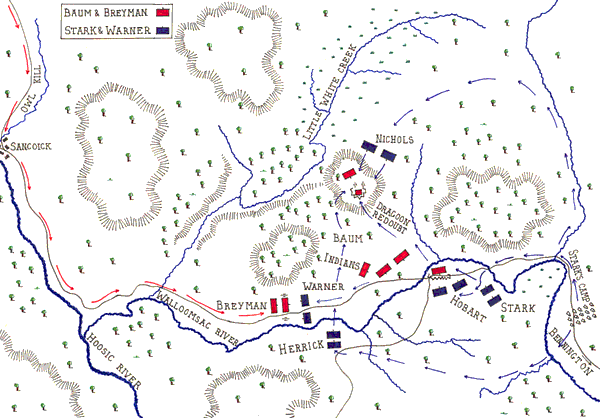
A month later, on August 16, 1777, Warner played another critical role in the American victory at Bennington. Under the overall command of General John Stark–another of the fiery, yet competent, and overlooked American general officers–Warner provided invaluable assistance because of his familiarity with the region. His home was a scant few miles from where the engagement would unfold.
Warner would oversee the left wing of the American assault and have as his goal the “Tory Redoubt” that fell on the east side of the Walloomsac River, which would be a dominant feature in the ensuing battle.
Battle of Bennington (courtesy of British Battles)
The Americans routed the German, British, and Loyalist forces, even halting a 600-man reinforcement column under German Lieutenant Colonel Heinrich Breymann who arrived on the field in the latter stages.
Stark reported to Congress that Warner showed “superior skill in the action.”
Unbeknownst to Warner at the time, the campaign that culminated with British General John Burgoyne’s surrender at Saratoga, was the defining moment in Warner’s American Revolutionary War career. Warner would stay in the service, reaching the rank of brigadier general, bestowed upon him in 1778 by the new state of Vermont courtesy of the state legislature. That made him the only brigadier general in the newly formed state. On September 6, 1780 Warner received his only wound of the war, in an ambush by Native Americans outside Fort George in New York.
Unfortunately for the old “Green Mountain Boys” commander, the years after his retirement in 1780 were not kind. He fell out of favor with his former commander, Ethan Allen which led Warner to confront him in 1781 about contact with the British when Allen was a prisoner-of-war. This was all in conjunction with some contact Vermont had with British Canada about possible negotiations in reunifying Vermont with the British Empire. The extent of the negotiations and the seriousness of the idea has been in question by historians ever since.
Regardless, Warner, in failing health in 1784, returned to Woodbury, where he died on December 26, 1784, at the age of 41. Warner’s remains lay in Roxbury, Connecticut.
*For more information on the campaigns of New York in which Warner played a role in, consult Michael O. Logusz’s two-volume “With Musket and Tomahawk” series published by Savas Beatie LLC. at http://www.savasbeatie.com*
The night was chilly, snow laid on the streets and walks of Boston, and the cold air kept people bundled up around the port town of Massachusetts colony.
Yet, the cold air could not dampen was the seething resentment a growing number of Bostonians were feeling toward the occupying British military. Minor brawls and exchanges had taken place in the various taverns and around the bustling harbor; common places where alcohol and/or hard work created short tempers.
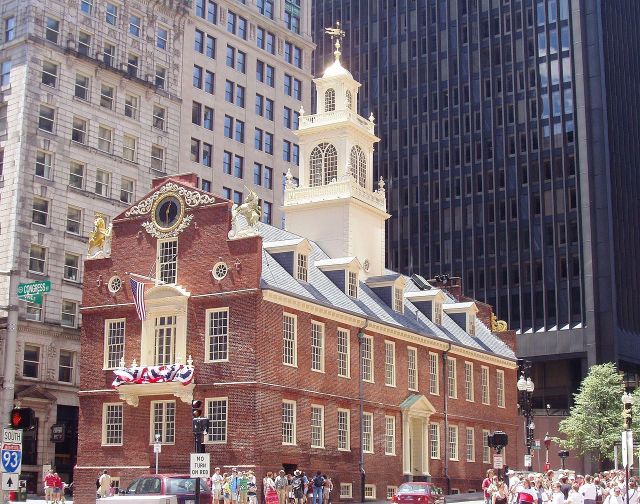
However, on this night, March 5, 1770, outside the Custom House on King Street a British redcoat infantrymen, the sentry, kept his post. Private Hugh White, whose shift it was to stand guard, would have noticed the approach of Edward Garrick, who had come calling for a British officer who owed Garrick’s boss money for his wig services. Unbeknownst to Garrick, the apprentice, the debt had been paid, so no response from the field officer was forthcoming.
Old State House (Custom House) scene of the Boston Massacre on March 5, 1770
A response from White was forthcoming, who admonished the young man to have a more respectful tone when speaking to an officer in His Majesty, the King’s service. Garrick did not take too kindly to this tone and responded with an insult of his own toward White.
This prompted White to leave his post and literally knock some sense into Garrick by way of a musket strike to the side of the head. Garrick yelped in agony and a companion took up the verbal barrage toward the British soldier.
The cacophony created by the yelling of insults and as the colonial version of a game of telephone spread the message about what was transpiring at the Customs House. Church bells were rung, a telltale sign that something was afoot, led to the crowd surging past 50 in number by the evening.
White, prudently, had left his post and retreated up onto the steps of the Customs House summoned a runner (messenger) to race to the local barracks for extra manpower.As was custom, there was an officer of the watch, in this case, Captain Thomas Preston and seven soldiers responded.
En route, Henry Know, destined to become chief of artillery for the Continental Army in the American Revolution urged Preston, “For God’s sake, take care of your men, if they fire, you must die.”
Against this sage advice, shouts of “Fire” were emanating from the crowd, which had also resorted to throwing snowballs and spitting in the direction of the red-coated soldiers. Other derogatory names for British soldiers, like “lobsterbacks” which took into account the red uniforms adorned by the British infantry were also heard being shouted.
The British soldiers, with loaded muskets, and Captain Preston reached White’s station, the British officer ordered the large crowd to disperse. Preston had taken a position in front of his soldiers and had told a member of the crowd that his soldiers would not fire unless ordered.
No order was ever given.
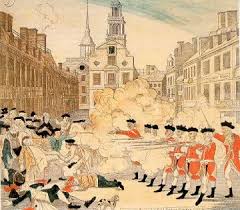
Shortly after Preston spoke those words to a Bostonian, a foreign object hurtled toward Private Hugh Montgomery and knocked the infantryman off his feet. His musket clattered onto the steps. Standing up, Montgomery reportedly yelled “Damn you, fire!” and pulled the trigger of his musket. The accompanying “bang” reverberated in the square.
Copy of the lithograph by Paul Revere on the Boston Massacre
And then there was a pause of an uncertain length.
This silence was broken by the staccato of other muskets being fired. A few rounds belched forth from the British soldiers. Screams and shouts along with deafening echo of the discharge of black-powder muskets in an enclosed city square mixed with the sickening thud of lead impacting bone and body.
All told, eleven colonists were hit from the volley fire. Three were killed outright; Samuel Gray, James Caldwell, and Crispus Attucks. One more, Samuel Maverick, who was struck by a ricocheting round would die later that same evening. One more, a recent immigrant from Ireland, Patrick Carr, would succumb to his wounds a fortnight later.
In the immediate aftermath, Preston would call the majority of his unit, the 29th Regiment of Foot to the scene. With the mob spilling out of the Customs House Square, Governor Thomas Hutchinson, the acting governor, was able to temporarily restore a semblance of tranquility with the promise that a fair trial of what transpired that March 5th evening would happen.
The trial would be a major event for the city of Boston, but, that was in the near future. With the shots fired and the citizens struck, the burgeoning independence movement had a rallying point. Lives were lost that night, but, the events that followed would, to the proponents of American independence, make them martyrs for the cause.
Numerous biographies grace the shelves of book stores, museum shops, and the personal libraries of American Revolutionary Era history enthusiasts. Yet, until 2015, not a single dedicated biography was written about an extraordinary American general that rose from the ranks during the war to assume such a lofty position by the successful conclusion of the conflict.
That unintentional omission has now been filled with the excellently detailed oriented and primary source driven biography entitled Otho Holland Williams in the American Revolution by John Beakes. The author is a graduate of the United States Naval Academy in Annapolis, Maryland and a resident of Ellicott City, Maryland.
I had a chance to interview the author via email and one of the questions I asked him was if there was one takeaway you wanted your readers or those interested in the book to know, what would it be? His answer is below and sums up the importance of Williams and soldiers like him:
“Otho Holland Williams was a vibrant, healthy young man with distinctive intellectual gifts and leadership capabilities when he joined the army at age 26 in 1775. Had there been no War of Independence, he might well have lived a long life enjoying the family relationships that he cherished so deeply, and have risen to a position of prominence and wealth.
Instead, Williams died at age 45, spitting up blood and much weakened in body and spirit from the tuberculosis that he had contacted while a prisoner-of-war in New York after the Battle of Fort Washington.
We owe much to the young men like Williams who gave so much in the fight for our nation’s independence, and yet he is largely forgotten.
Here, truly, was a life laid in sacrifice on the altar of our freedom.”
This biography is part of an ongoing effort by The Nautical and Aviation Publishing Company of America to publish a biography on the chief lieutenants that served under and with George Washington and were instrumental in winning American Independence. Previous volumes in the series include titles on John Eager Howard and Henry “Light-Horse” Lee. The series is entitled, “George Washington’s Best Officers Book Series” and definitely worth the read for the enthusiastic and/or serious student of the American Revolution.
So, why was Otho Holland Williams chosen as the third installment? I asked the author and his response is below;
“Otho Holland Williams kept appearing in all of the key moments of the story of the war in the South, but always tantalizingly just beneath the surface, hidden in the shadow of larger figures like Nathanael Greene and Daniel Morgan. Williams was a compelling writer, and his descriptions of battles like Camden and Eutaw Springs are superbly written and deeply insightful observations of a first-hand participant. His leadership of the Screening Force during the Race to the Dan displayed combat leadership skills of the first order, but his life story was largely untold.”
Furthermore, the reader will glean that Williams is the quintessential depiction of the American soldier, rising from the ranks to one of the top positions in the Southern theater by war’s end. The process, superbly told by Beakes, winds the reader from the early days of the revolutionary movement in western Maryland to the Siege of Boston, to the defeats of the New York Campaign. Those achievements and setbacks combined to give Williams the invaluable training as a military officer. For Williams, like a majority of the men who would hold rank in the American forces;
“Military knowledge and experience were scant commodities in the colonies at the start of the Revolutionary War, and young men like Howard, Lee and Williams joined the army in their twenties with virtually no prior military experience. There were no institutions such as military academies, officer candidate schools, or ROTC to help them learn. They read all the available military literature. They observed leaders like Washington, and took in the written guidance that he provided, often in General Orders, for how to develop into effective officers. And most importantly, they learned by experience in the daily rigor of military discipline and in their various combat engagements.
Starting with such “bare bones” learning opportunities, in the short years between 1775 and 1780, when the Southern Campaigns began, these young officers had become exceptional military leaders, and the army that they led was as fine a combat organization as any on earth. It is a story of grit and determination and persistence that brought these young civilians to such a high state of military capability.”
During this early part of the war, Williams also became a prisoner-of-war after the fall of Fort Washington during the New York Campaign of 1776. After being exchanged, Williams would feel the affects of his imprisonment which would eventually cause his death in 1794 from tuberculosis.
Yet Williams, like many other junior officers, are still worth studying in history, as Beakes claims, because,
“With the resources available today, we have a powerful opportunity to take a fresh look at these stories. Unfortunately, our fresh look at original sources sometimes reveals that writers along the way have perpetuated false information, sometimes from honest mistakes, but also sometimes from blatant political motives.
We have an important opportunity to correct the record. Stories like those of Otho Holland Williams give readers a look at the War of Independence from the front-lines and from ground level, a perspective that fills out and enriches the more strategic insights of the well-known works on the Founders.”
This book, like two previous volumes in the series, is definitely a worthy addition to any avid reader of the American Revolutionary Era. If these great in-depth biographies already grace your private library, don’t worry there is more biographies in the works. Beakes is currently working on research for a volume on Baron de Kalb.
Stay tuned and enjoy the read!
*Book Information*
Publisher: The Nautical and Aviation Publishing Company of America
Published Date: November 5, 2015
346 pages, including appendices, bibliography, notes, and index
Click here to view the website where further information, including how to purchase the book, is available.
A fisherman by trade before the war, the savior of the American Continental Army during the war on two occasions, and returned to civilian life with personal, physical, and economic hardships because of the war.
John Glover
That one line could simply sum up John Glover of Marblehead, Massachusetts. Unfortunately, Glover has received scant attention; a few lines here, a page in this publication, or a reference in passing when talking about the engagements around New York or the Crossing of the Delaware.
Daniel Glover is more than well deserving of the epithet, “one of the greatest leaders of the American Revolution you have never heard of.”
Born on November 5, 1732 in what is now Danvers, Massachusetts, where he lived until the death of his father when he was just four years old. His mother Tabitha Bacon Glover moved young Daniel to Marblehead, on the coast of Massachusetts where he would apprentice, when he came of age, as a shoemaker. He eventually looked toward the sea and made a living as a merchant.
Daniel became well-entrenched in Marblehead society, he joined the local militia in 1759 and entered politics, aligning himself with the Whig party in 1760. By the time of the first shots on the Green of Lexington and the North Bridge at Concord, Glover was a colonel of militia in the Marblehead Regiment.
Although his regiment made the march to Boston and took part in the siege, Glover was away on detached duty when the Battle of Bunker (Breed’s Hill) was fought. When George Washington rode into Cambridge, Massachusetts and assumed command of the American forces, Glover lost his headquarters. A product of Glover’s fine taste, the Marblehead sailor had picked the home of a loyalist as his own command post. Washington chose the mansion, which now is a national historic site, as his own. Yet, a company of Glover’s Marblehead soldiers was also chosen to be the guard of Washington’s new headquarters.
Showing his importance and marshaling his background in shipping, Glover donated one of his own ships, the Hannah, named after his spouse, to build a hodgepodge navy for use by the Americans. One of the ships that made this volunteer navy actually captured a British ship, the brig HMS Nancy in which held as its cargo, 2,000 muskets, 30,000 rounds of artillery ammunition, and one brass mortar amongst other crucial military supplies much in need by Washington’s army.
After the siege of Boston was lifted with the evacuation of the British, Glover, with the rest of the Continental Army, headed south to New York City where another campaign and another chance to show his worth to the cause awaited.
On the night of August 29 and into the early morning hours of August 30, Colonel Glover and his able Marblehead regiment sailed the majority of Washington’s forces from Brooklyn across the East River to safety. Altogether, approximately 9,000 soldiers, plus artillery and supplies escaped from under British General Sir William Howe’s command. With Marylanders under Lord William Stirling launching ferocious rear-guard suicidal charges, Glover’s men saved Washington’s army that late August night.
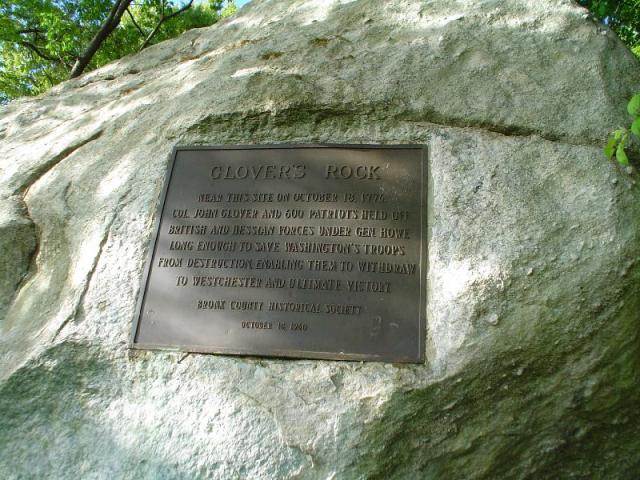
A month and a half later, on October 18th, Glover’s Brigade of Massachusetts soldiers held off a large contingent of British and Hessian mercenaries as Washington’s army retreated to safety. With approximately 750 men at his disposal, Glover’s rearguard action held over 4,000 enemy soldiers from threatening the retreat of the American forces.
Glover’s Rock, commemorating the action at Pell’s Point
Showing his humility, Glover would write about seeing the enemy come ashore before the engagement at Pell’s Point, that his first inkling was to give “a thousand worlds to have General [Charles] Lee or some other experienced officer present.” Luckily for the Americans, Glover did not get his wish and led admirably.
Glover’s command stuck with Washington’s forces during their retreat across New Jersey and into Pennsylvania and eventually to the banks of the Delaware River. In the prelude to the pivotal “Crossing of the Delaware” the former Marblehead sailors and their 43-year old commander would prove crucial.
To complete the surprise, Washington had to get his men across the ice-clogged Delaware River and to Trenton, New Jersey. Washington laid his eyes on Glover and outlined his thoughts and the big issue at hand; how to ferry his men across?
The response to his commander in chief was simple; to “not be troubled about that, as his boys could manage it.” Another primary account said that Glover and his command showed “perseverance…accomplished what at first seemed impossible.”
With Washington’s daring plan and Glover’s practicality, the “impossible” happened and the Americans scored a cause rallying victory at Trenton on December 26, 1776 and another equally important victory at Princeton, New Jersey on January 3, 1777.
After these winter battles, Glover went home to care for his gravely ill wife, Hannah, but there was nothing he could do. After a year long struggle, Hannah died on November 13, 1778 leaving John with eight children, including the oldest John who was a captain in his father’s Marblehead regiment.
While at home, George Washington petitioned the Continental Congress to promote Glover to brigadier general. Congress agreed and on February 21, 1777 the former Marblehead merchant became a general in the Continental Army.
When Glover returned to active duty, he was given the task of escorting the British and Hessian prisoners captured at the Battle of Saratoga and also took part in the unsuccessful attempt to expel the British from Newport, Rhode Island in 1778.
The end of the war saw him still in service in the Hudson Highlands where most notably he was on the board of officers that sentenced British spy Major John Andre to death. At the very end of the war, on September 30, 1783, Glover received a brevet to major general.
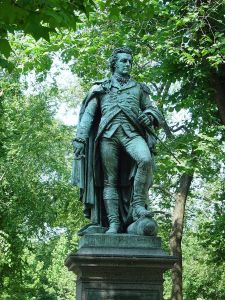
John Glover Statue Commonwealth Avenue, Boston
With the war over, Glover and his second wife, Francis Fosdick resided in Marblehead. However, Glover’s health and family were devastated by the war. Glover’s health was impaired by years of hard campaigning, including struggling with malaria in 1777. He lost his first wife Hannah during the war and his oldest son, John, disappeared as a prisoner-of-war while being transported over the Atlantic Ocean. Even his pre-war career, as a merchant, was greatly impacted by the seven-year conflict.
Glover rebounded as best he could and did serve in a few political positions, including in the Massachusetts State Legislature and as a Selectman for Marblehead. One highlight of the post-war years was when President George Washington stopped over in Marblehead and was entertained by his former subordinate.
On January 30, 1797, Glover passed away from hepatitis at the age of 64 and became one of the greatest leaders of the American Revolution you have never heard of.
Washington Crossing the Delaware, by Emanuel Gottlieb Leutze The Metropolitan Museum of Art, http://www.metmuseum.org
One of the iconic images of the Revolutionary War is Emanuel Gottlieb Leutze’s 1851 painting, Washington Crossing the Delaware. It is the night of December 25, 1776. The Continental Army is being transported across the Delaware River to attack a Hessian garrison at Trenton, New Jersey, some nine miles to the south. In the foreground, anonymous men (and possibly one woman) of varying nationalities and races row an overloaded boat across the river, pushing great slabs of ice out of the way. Two of the boat’s occupants are not anonymous: General George Washington, standing resolutely near the bow, and young Lieutenant James Monroe, holding the stars and stripes.
Leutze’s painting is glorious–and wrong in almost every detail. The river resembles the Rhine more than the Delaware; the boat is too small and of inaccurate design; there is too much light for what was a night crossing; Washington did not cross standing up; the stars and stripes had not yet been adopted by the Continental Congress; and James Monroe was not holding the flag, not in the boat, and not even present with the army.
He was already across the river, and he was busy.
Washington’s plan for a surprise attack on Trenton was a risky attempt to reverse the sagging fortunes of the Patriot cause. During the summer of 1776 British forces, including Hessian mercenaries, had driven the Continental Army from New York across New Jersey and into Buck’s County, Pennsylvania. Expired enlistments and outright desertion had thinned the American ranks, and many of those who remained were despondent. Washington gambled that a successful attack against an isolated British outpost would boost the army’s morale and stiffen the resolve of Congress and the people.
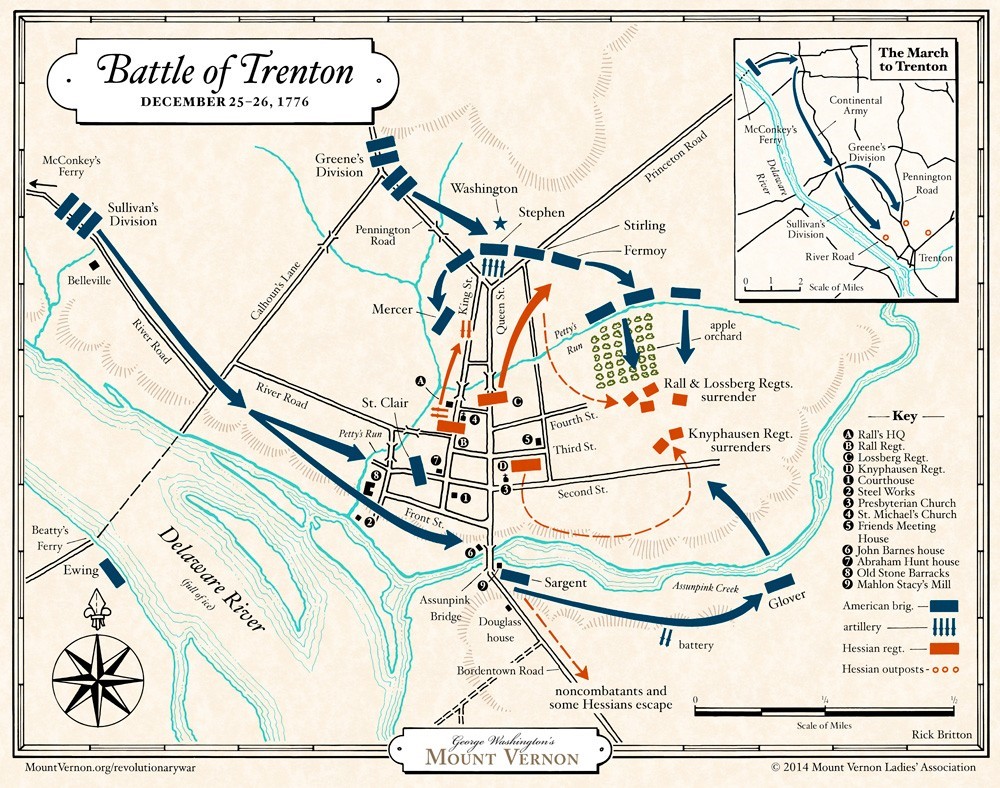
Three Hessian regiments, comprising about 1,400 men, were stationed at Trenton under the command of Colonel Johann Rall (also spelled Rahl). Washington planned to bring 2,400 Continental soldiers across the river overnight at McKonkey’s Ferry, march to Trenton, and attack before dawn. Two other elements of the army were part of the plan. A 1,900-man force under Colonel John Cadwalader would make a diversionary attack against British troops at Bordentown, New Jersey. General James Ewing would lead 700 men across the Delaware at Trenton Ferry, control the bridge over Assunpink Creek, and intercept any Hessian troops retreating from Trenton. Bad weather prevented both of these deployments, meaning that everything would depend on the main body’s effort. The army’s password for the evening was “Victory or Death.”
Washington’s plan included sending a small detachment of troops over the Delaware first to secure the army’s route of march. James Monroe was with this contingent. In his autobiography (written in the third person late in life and not completed before his death), Monroe described the mission:
The command of the vanguard, consisting of 50 men, was given to Captain William Washington, of the Third Virginia Regiment . . . Lieutenant Monroe promptly offered his services to act as a subaltern under him, which was promptly accepted. On the 25th of December, 1776, they passed the Delaware in front of the army, in the dusk of the evening, at [McKonkey’s] ferry, 10 miles above Trenton, and hastened to a point, about one and one-half miles from it, at which the road by which they descended intersected that which led from Trenton to Princeton, for the purpose, in obedience of orders, of cutting off all communication between them and from the country to Trenton.
Monroe noted that the night was “tempestuous,” and that snow was falling. While manning their post, the detachment was accosted by a local resident who thought the Continentals were British troops. Describing the incident many years later at a White House dinner during his presidency, Monroe recalled that the man, whose name was John Riker, was “determined in his manner and very profane.” Upon learning that the soldiers were Americans, he brought food from his house and said to Monroe, “I know something is to be done, and I am going with you. I am a doctor, and I may help some poor fellow.” Dr. Riker proved remarkably prescient.
Battle of Trenton map courtesy George Washington’s Mount Vernon
The main army’s river crossing and march to Trenton took longer than planned, meaning that the attack would occur well after sunup. Outside the town Washington divided his force, sending a division commanded by Major General Nathaniel Greene to attack from the north while the other, led by Major General John Sullivan, attacked from the south. At 8:00 AM the assault began, and here we return to Monroe’s account from his autobiography:
Captain Washington then moved forward with the vanguard in front, attacked the enemy’s picket, shot down the commanding officer, and drove it before him. A general alarm then took place among the troops in town. The drums were beat to arms, and two cannon were placed in the main street to bear on the head of our column as it entered. Captain Washington rushed forward, attacked, and put the troops around the cannon to flight, and took possession of them. Moving on afterwards, he received a severe wound and was taken from the field. The command then devolved upon Lieutenant Monroe, who attacked in like manner at the head of the corps, and was shot down by a musket ball which passed through his breast and shoulder. He was also carried from the field.
The Capture of the Hessians at Trenton December 26 1776, by John Trumbull (Yale University Art Gallery) (James Monroe lies wounded on the ground at left center)
Monroe was brought to the same room where William Washington lay, and their wounds were dressed by the army’s surgeon general and Dr. John Riker. Riker’s prediction of helping “some poor fellow” came true as he repaired a damaged artery in Monroe’s shoulder. What neither man realized at the time was that the intrepid physician had saved the life of a future president.
George Washington’s gamble in initiating the Battle of Trenton paid off. The victory was complete, and came at a surprisingly small cost in terms of American casualties. Two enlisted men froze to death during the nighttime march, and two were wounded in combat. The only losses among officers were the nonfatal wounds sustained by William Washington and James Monroe. Washington followed up his success at Trenton with another at Princeton on January 3, 1777, where the Continental Army proved that it could prevail over regular British troops.
The best commentary upon James Monroe’s performance at Trenton, and his Revolutionary War service generally, comes from no less an authority than George Washington. Writing to an acquaintance in 1779, Washington noted Monroe’s “zeal he discovered by entering the service at an early period, the character he supported in his regiment, and the manner in which he distinguished himself at Trenton, where he received a wound.” The general concluded that James Monroe had “in every instance maintained the reputation of a brave, active, and sensible officer.”
Scott H. Harris is the Executive Directors of the James Monroe Museum in Fredericksburg, Virginia. Harris became director of the James Monroe Museum and Memorial Library in July 2011, following ten years as director of the New Market Battlefield State Historical Park (administered by Virginia Military Institute). From 1988 to 2001, Scott was the first curator of the Manassas Museum and later director of historic resources for the City of Manassas, Virginia. Prior to his work in Manassas, he was a consulting historian with the Association for the Preservation of Virginia Antiquities in Richmond and an historical interpreter with the Colonial Williamsburg Foundation. He has been a board member of the New Market Area Chamber of Commerce, Prince William County/Manassas Convention and Visitors Bureau, Shenandoah Valley Travel Association, and Virginia Civil War Trails, Inc. He is a past president of the Virginia Association of Museums and serves as a peer reviewer for the Museum Assessment and Accreditation programs of the American Association of Museums.
Scott received his BA with honors in History and Historic Preservation from the University of Mary Washington in 1983. In 1988, he received an MA in History and Museum Administration from the College of William and Mary. Scott is also a graduate of the Seminar for Historical Administration, the nation’s oldest advanced museum professional development program.
The last battle of the Revolutionary War was fought in 1951 in Winchester, Virginia. Daniel Morgan, the “Old Wagoner” or ‘Old Morgan” as he was known to his soldiers, was front and center of the maelstrom once again just as he was on many a battle field from Quebec to South Carolina during the War for Independence.
Daniel Morgan Statute in Winchester, Virginia (courtesy of Winchester Star)
Residents of Cowpens, South Carolina, a small town near Spartanburg named for Morgan’s dramatic and strategically critical victory of 1781, arrived in Winchester, Virginia to claim the earthly remains of their revered hero. Morgan’s grave was overgrown and in decrepit condition. In Winchester, only one out of forty people queried by the Carolinians knew who Morgan was. Armed with shovels, a mortician, and a letter of authorization from Morgan’s great-great granddaughter, the Carolinians showed up at Mount Hebron Cemetery to dig up the general, take him “home” and reinter him at the site of his greatest victory. There he could rest among a populace that revered his name and cherished his significant contributions toward American independence. However, word of the Carolinians’ attempted exhumation of Morgan quickly spread through town and a contingent of devoted local admirers quickly headed to Mt. Hebron to stop the Carolinians initiative. In the end, a court ruled that the “Old Wagoner” would remain interred at Mt. Hebron in Winchester. Not only did he stay, but this episode kindled a reverence for the General’s legacy and place in history among Winchester’s populace.
Seventeen year-old Daniel Morgan moved into the Shenandoah Valley in 1753, with nothing but sheer determination to carve out a life for himself in the rugged frontier of western Virginia. His early years are shrouded in mystery that Morgan himself kept secret from even his closest associates throughout his life. He was born of Welsh parentage in 1836 in Bucks County Pennsylvania or Hunterdon County, New Jersey, the fifth of seven children. It was a hard life of work on the family farmstead with no opportunity for even a rudimentary education. His time was spent chopping wood, hoeing fields and other taxing physical labor. His mother died when he was young, and his father remarried. A dispute with his father prompted the fiery Morgan to head west on the Great Wagon Road to Carlisle, Pennsylvania where he worked briefly during the winter of 1752-53, before continuing south to the Shenandoah.
Although Morgan lacked an education, the work on the family farm had hardened his six-foot, two-hundred pound frame into a powerful and muscular young man who was well suited for the physicality of life on the frontier. The blue-eyed youth initially obtained employment as a farm laborer in eastern Frederick County in what is now Clarke County. He worked hard and soon earned an offer of better employment. In spite of his youth, Morgan eared employment as the overseer of a saw mill where he learned to manage older and more experienced men, developing his leadership ability. Morgan’s energy and work ethic impressed Robert Burwell who offered Morgan a position as a teamster hauling valley produce across the Blue Ridge to Fredericksburg and other towns in the Virginia Piedmont and carrying badly needed supplies back to the frontier that was the Shenandoah Valley of the 1750’s.
Morgan enjoyed the freedom of the open road and in less than two years had earned enough money to buy his own team and Conestoga wagon. During this time, Morgan had become close friends with fellow teamster John “Captain Jack” Ashby, grandfather of the Virginia Civil War cavalryman. Ashby was noted for his “horsemanship, marksmanship and daring exploits.” Ashby taught Morgan to shoot, hunt, ride and live in the wilderness along the Blue Ridge. The two men were kindred spirits and became good friends.
In 1755, the French and Indian War came to the Shenandoah Valley when British Maj. Gen. Edward Braddock’s column passed through the Winchester area on its way to wrest Fort Duquesne from the French at the “Forks of the Ohio,” now the site of Pittsburgh. Morgan signed on the haul supplies to Fort Cumberland in western Maryland and soon found himself as a teamster with the army, rolling into western Pennsylvania. When the French and Indians routed Braddock at the battle of the Monongahela in July, the teamsters emptied their wagons of supplies and carried wounded soldiers back to Fort Cumberland. At some point in this campaign, Morgan’s actions or words angered a British officer who violently chastised the young teamster and struck him with the flat of his sword. Morgan’s temper exploded, and the young wagoner knocked the officer out with one strong punch. A court martial sentenced Morgan to 500 lashes, a punishment that often killed its recipients. The stout Morgan endured the suffering and noted that the drummer miscounted and he had only received 499 lashes. He would proudly wear the scars suffered at the hands of the British for the rest of his life.
Depiction of Daniel Morgan on the frontier (courtesy of Fort Edwards)
With Braddock’s devastating defeat, the French and Indians went on the offensive raiding into western Virginia. Morgan enlisted in a Ranger Company commanded by his friend, “Captain Jack” Ashby. Morgan spent much of his time patrolling the wilds of the Allegheny Mountain posts of Hampshire County and building stockades to defend against the marauding French and Indians. On one occasion while carrying messages to one of the forts along with two other men, Indians waylaid his party at Hanging Rock on the Cacapon River, killing his comrades. They shot Morgan in the neck, but he raced away on his horse, narrowly escaping the tomahawk of a pursuing Indian. Morgan lost consciousness from blood loss, but luckily the horse had the path to fort ingrained in her memory and carried him back to safety. Morgan remained in the Ranger Company until Col. George Washington disbanded it in October. Morgan began a period of multiple pursuits. He sojourned himself in the wilds for several months trying his hand as a hunter. He likely spent time as a militiaman in Frederick County. By 1758, however, he almost instinctively returned to the open road, hauling wheat, tobacco and hemp across the Blue Ridge to eastern Virginia commercial centers such as Alexandria, Dumfries or Fredericksburg. In driving the wagons, Morgan had found his calling. The harsh life of the teamster suited his rough and tumble personality. He quickly gained a reputation as on the leading pugilists of the Shenandoah Valley. He could often be found at Berry’s Tavern in what is now Berryville but at the time was known as Battletown because of the constant brawling that occurred at the tavern. These were brutal affairs that included wrestling, punching, choking and gouging of eyes, but Morgan reigned as the champion. Although not always victorious, the stout teamster made sure there was a rematch which he usually won. In spite of his reputation for drinking and fighting, Morgan prospered as a successful teamster, even if his brawling occasionally landed him on the docket of the Frederick County Circuit Court. In 1762, he found love with Abigail Curry who became his common-law wife, introduced him to the Presbyterian religion and bore him two girls. At her request, he cut back on drinking and brawling. He also rented a tract of land began farming marketable crops. Morgan had finally found the good life he sought in the Valley of Virginia.
With talk of independence in the air in 1774, Morgan participated in Lord Dunmore’s War. He was part of a column that operated in the Wheeling, Virginia area. They attacked Indians along the Muskingum River in the Ohio Country and drove them off, but he did not participate in that war’s decisive action at Point Pleasant. As the war drew to a close, word of the troubles in Boston circulated among the men, and Morgan was among those who committed to solidarity with the Massachusetts patriots.
Part Two will cover Morgan in the opening years of the American Revolution, so check back next week.
A life-long student of military history, Scott C. Patchan is a graduate of James Madison University in the Shenandoah Valley. He is the author of many articles and books, includingThe Forgotten Fury: The Battle of Piedmont (1996),Shenandoah Summer: The 1864 Valley Campaign (2007), andSecond Manassas: Longstreet’s Attack and the Struggle for Chinn Ridge (2011).
Patchan serves as a Director on the board of the Kernstown Battlefield Association in Winchester, Virginia, and is a member of the Shenandoah Valley Battlefield Foundation’s Resource Protection Committee.




 Debuting yesterday, the Campaign 1776, an initiative by the Civil War Trust, released an animated map that covers the “entirety of the American Revolution,” according to Civil War Trust Communications Manager Meg Martin.








 Emerging Revolutionary War Era