April 19th in American Revolutionary War history is usually remembered as the day the “shot heard around the world” happened in the towns of Lexington and Concord, Massachusetts. For the 2022 edition of that day, Emerging Revolutionary War invites you to turn your attention to Valley Forge and a virtual event hosted by the Valley Forge Park Alliance.
Starting at 7 p.m. EDT, Emerging Revolutionary War historian, Phillip S. Greenwalt will present a virtual talk entitled, ‘Timely and Handsome’: Transformation of the Continental Army at Valley Forge. A synopsis of the talk is below.
“As spring began to blossom over Valley Forge, Baron von Steuben’s drilling of the Continental army was in full effect. Although the men and officers of Washington’s army had become proficient on the drill field, there was still the simple question of how would they fare against the British in the upcoming campaign season? A month prior to the end of the winter encampment on June 19, 1778, a small-scale action, at Barren Hill, by a detachment of the Continental army would prove a snapshot into possible future battlefield behavior. The signs were promising. This talk will focus on the training of von Steuben, the composition of the Marquis de Lafayette’s force that marched out of the encampment in middle of May, the action at Barren’s Hill, and the insight this small scale action showed about the transformation of the army during the winter at Valley Forge.”
To register for the event, click here. The link will take you to the Valley Forge Park Alliance website. To learn more about this important aspect of the Valley Forge encampment, Emerging Revolutionary War invites you to click the link on the title bar at the top of this blog labeled “2022 Bus Tour” and secure one of 14 remaining tickets to attend the November 11-13, 2022 tour that will cover Valley Forge and Monmouth.
Reenactors portraying Continental soldiers being trained at Valley Forge (courtesy of Valley Forge Park Alliance)
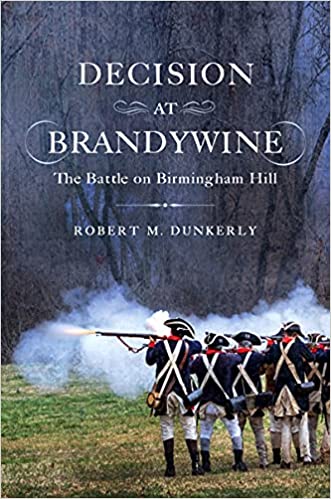
This Sunday on the Emerging Revolutionary War’s Facebook page, Robert Dunkerly will join the “Rev War Revelry” to discuss his newest publication, Decision at Brandywine: The Battle of Birmingham Hill.
The Battle of Brandywine, fought on September 11, 1777, saw the defeat of the American forces in southeastern Pennsylvania. The victory by the British opened the road to Philadelphia, which fell to Sir William Howe’s forces on September 26, fifteen days after the battle.
Dunkerly, a park ranger with Richmond National Battlefield Park and a contributing historian for Emerging Revolutionary War will discuss the pivotal action that happened around Birmingham Hill on that Thursday in 1777. The engagement at Brandywine was the largest and longest battle in the entire American Revolution and the third bloodiest. This new publication examines the action near Birmingham Hill and Meeting House where the action that day turned against George Washington’s forces.
Thus, this Sunday, at 7 p.m. EDT, tune into ERW’s Facebook page for the next historian happy hour as the popular “Rev War Revelry” series continues with this author spotlight.
On October 17, 1777, British General John Burgoyne surrendered his joint British, Canadian, and Hessian and Brunswicker forces to patriot General Horatio Gates near Saratoga, New York. Over 6,000 soldiers, the number placed by one historian is 6,222, became captives of war. Under the terms of the convention agreed upon by Burgoyne and Gates, the vanquished army was to march to Boston, Massachusetts, board British ships, and sail to England, to await formal exchange and to not participate in the war in America further.
When news reached the Continental Congress of this concession, that political body demanded a complete list of the troops surrendered to ensure the terms of the convention was to be upheld. When this was not forthcoming by the British, Congress reacted by vowing to not adhere to the stipulations of the convention. Burgoyne’s forces would not head back to Great Britain to await an exchange that year. Instead, these men were to be confined in camps both in New England and Virginia for the duration of the war. This force came to be called the Convention Army.
This Sunday, March 6, at 7 p.m. EDT, join Emerging Revolutionary War on our Facebook page for the next historian happy hour, as Dan Welch and Phillip S. Greenwalt discuss the Convention Army and what happened after the pivotal battle of Saratoga in October 1777.
After a circuitous journey, from Paris, France across the Atlantic Ocean and then into Pennsylvania, an eager participant trekked to join the American effort. After an introduction to the Continental Congress this European officer headed toward the Continental army encampment. Baron Frederich William Ludolf Gerhard Augustin von Steuben, 47-years old, rode into camp drawn by horses and relaxing, as much as one can on the roads of Pennsylvania during 1770s, in a sleigh, with a Russian wolfhound dog strolling beside the wooden vehicle. On this date, 244 years ago, General George Washington, his staff, and any inquiring eyes around camp saw von Steuben for the first time.
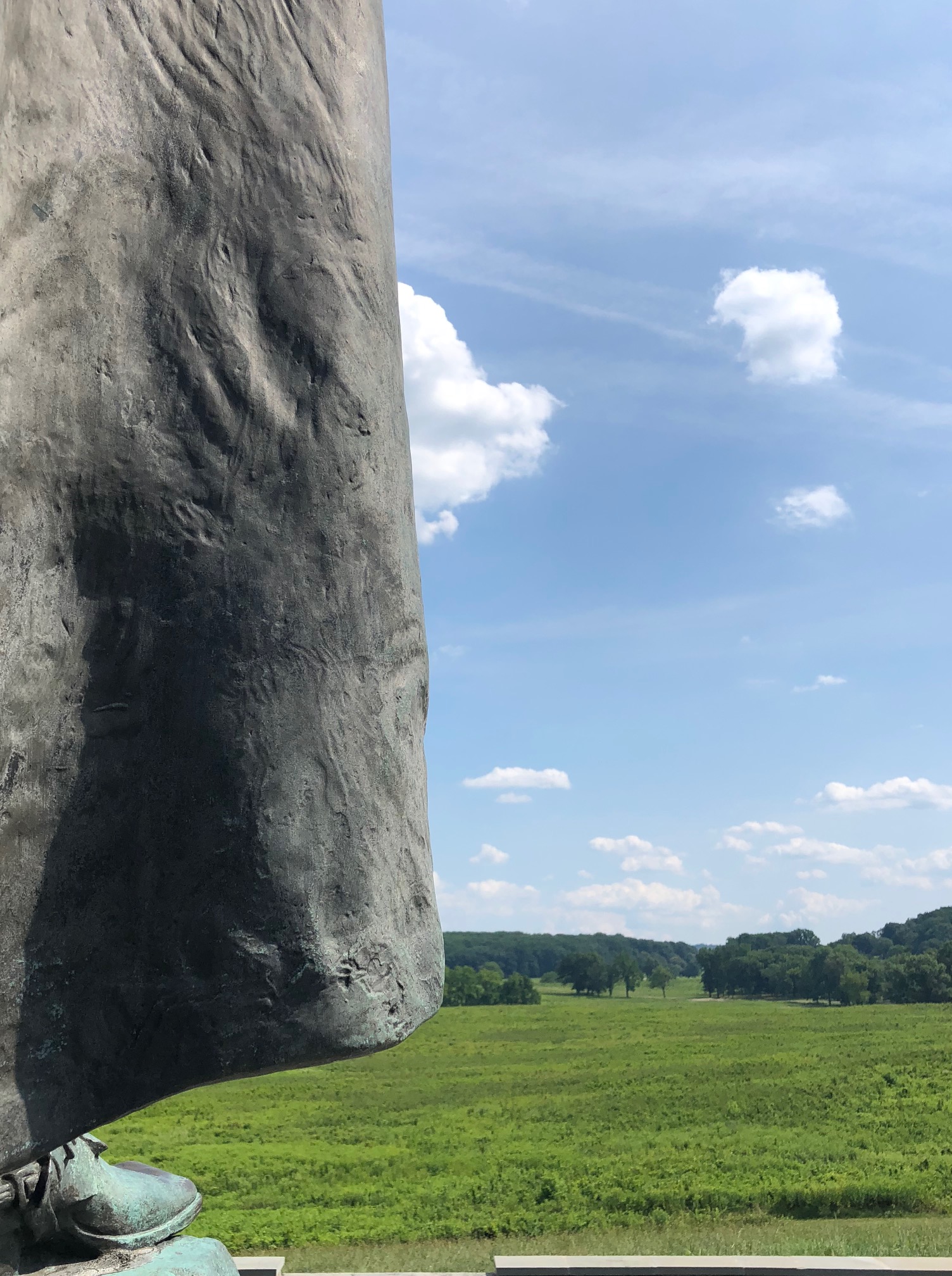
Baron von Steuben Statue, Valley Forge NHP
Although Christmas was almost two months in the past, von Steuben became a late blessing for Washington and his Continental army. Through an adaptation of a military training regimen from continental Europe which became a manual known as the “Blue Book” (this guide was used to train United States Army recruits for decades into the future as well), von Steuben began to morph the rank-and-file and junior officer corps of the Continental army into an actual army that knew how to follow commands and change formations. This training aided the Continentals in the battles of 1778, from a small engagement in May at Barren Hill to the last major fighting in the northern theater at Monmouth in June and into other theaters of the conflict.
Today, the field in which he trained the first model company is preserved by the National Park Service within the boundary of Valley Forge National Historical Park.
This November, during the second annual Emerging Revolutionary War bus tour, attendees will see the field and stand at the foot of the statue to von Steuben, looking over the same ground he first saw on this date, February 23, 1778. To secure your tickets, click the link on the header bar above titled “2022 Bus Tour.”
In the throes of the winter of 1778, spent at Valley Forge, General George Washington and his staff formulated a mountain of paperwork to multiple recipients of the American cause. On February 16, 1778, Alexander Hamilton composed a letter for the commander-in-chief of the Continental army to a gentleman who had moved from the military to the political ranks; George Clinton of New York.
George Clinton
He had seen service in the Hudson Highlands and had been commissioned a brigadier general in the Continental army on March 25, 1777. Later that same year both governor and lieutenant governor of New York, formally resigning the latter and accepting the former on July 30, 1777. In that capacity, he received the letter, excerpts below, from Valley Forge.
“It is with great reluctance, I trouble you on a subject, which does not properly fall within your province; but it is a subject that occasions me more distress, than I have felt, since the commencement of the war; and which loudly demands the most zealous exertions of every person of weight and authority, who is interested in the success of our affairs.”I mean the present dreadful situation of the army for want of provisions and the miserable prospects before us, with respect to futurity. It is more alarming, than you will probably conceive, for to form a just idea, it were necessary to be on the spot.2 For some days past, there has been little less, than a famine in camp. A part of the army has been a week, without any kind of flesh & the rest three or four days.3 Naked and starving as they are, we cannot eno⟨ugh⟩ admire the incomparable patience and fidelity of the soldiery, that they have not been, ere this, excited by their sufferings, to a general mutiny and dispersion. Strong symptoms however of discontent have appeared in particular instances; and nothing but the most active effort⟨s⟩ every where, can long avert so shocking a catastrophe.
Washington then asks for any help or supplies that Clinton can send his way, even though the army is outside the state lines of New York. Washington’s mindset is that the cause of the army in Pennsylvania is the cause of American independence and that Clinton, who had served would recognize that and do his utmost to provide what he can.
“I am calling upon all those, whose stations and influence enable them to contribute their aid upon so important an occasion, and from your well known zeal, I expect every thing within the compass of your power, and that the abilities and resources of the state over which you preside, will admit. I am sensible of the disadvantages it labours under, from having been so long the scene of war, and that it must be exceedingly drained by the great demands to which it has been subject, But though you may not be able to contribute materially to our relief, you can perhaps do something towards it; and any assistance, however trifling in itself, will be of great moment, at so critical a juncture, and will conduce to keeping the army together, ’till the Commissary’s department can be put upon a better footing, and effectual measures concerted to secure a permanent and competent supply. What methods you can take, you will be the best judge of; but if you can devise any means to procure a quantity of cattle or other kind of flesh, for the use of this army, to be at camp in the course of a month, you will render a most essential service to the common cause.“
Not only did Clinton receive this missive from Washington, dated February 16, but the following day Gouverneur Morris from a camp committee established by the Continental Congress also sent the New York governor a letter asking for any assistance he could provide for the army at Valley Forge.
These letters underscore the seriousness of the plight of the army encamped at Valley Forge as the winter slowly turned to spring. The action at Washington’s headquarters and from the camp committee helped create a path forward through that pivotal winter. To learn more about what transpired during those six months from December 1777 to June 1778, follow the link above to the “2022 Bus Tour” and join Emerging Revolutionary War on our second annual bus tour November 11-13, 2022.
The entire letter from Washington (Hamilton) to George Clinton can be found here.
On Sunday, January 23, Emerging Revolutionary War will journey, virtually, into the heart of the Mohawk Valley of New York in a discussion with Brian Mack of the Fort Plain Museum and Historical Park.
Established in 1961 the museum and park now encompasses over 75 acres and includes the site of Fort Plain/Fort Rensselaer, the foundation of a Revolutionary era bridge, the Fort Rensselaer Redoubt and works constructed by British forces, along with sites of colonial farmsteads, industry, and settlement. The museum also covers a wide era of the history of the area.
Mack lives out his passion for his family & for history in everything he does. A family vacation always includes a stop to a historic site or two. He is involved with the Fort Plain Museum & Historical Park as a member of their Board of Trustees, a Board member with The Stone Arabia Preservation & Battlefield, and a Board Member with The Mohawk Country Association. Most recently, he joined the Board with the Dr. Joseph Warren Foundation.
We look forward to a great discussion about the American Revolution in the Mohawk Valley of New York with Brian this Sunday, at 7 p.m. on Emerging Revolutionary War’s Facebook page.
244 years ago this week is when the Continental army, under the command of George Washington, marched into what would become their winter encampment as the year turned from 1777-1778. Recently, Phillip S. Greenwalt, one of the Emerging Revolutionary War historians was a “talking head” on a documentary about the Valley Forge encampment and what the soldiers and civilians faced during the ensuing six-month cantonment.
The documentary which features historians and park rangers is airing on Fox News Nation, the streaming service that is part of the Fox News network. Below is a screen shot of Phillip, who is also the author of Winter that Won the War, the Winter Encampment at Valley Forge, 1777-1778, which is part of the Emerging Revolutionary War Series published by Savas Beatie LLC.
So, if you need a break from the holiday specials that are airing, tune in for your history fix and learn more about the history at Valley Forge. If you want to dive even deeper into this period of the American Revolution, check out the link above labeled “2022 Bus Tour” and secure your tickets to join ERW at our second annual bus tour next November, which will include Valley Forge.
On both banks of the Hudson River, in 1776, sat two forts the patriots hoped would stop any British excursions up the waterway. Named for the top two military leaders of the Continental army–George Washington and Charles Lee–the fortifications both fell to the British by late November of that same year.
Join Emerging Revolutionary War this Sunday, at 7 p.m. EDT on our Facebook page as the forts become the focal point for this week’s “Rev War Revelry.” Joining ERW will be Charlie Dewey who will help break down and discuss the implications of these actions in November 1776.
Dewey, an officer in the New York Army National Guard and a graduate of the Virginia Military Institute has been a museum educator and special events coordinator for Fort Lee Historic Park since May 2018. He has been publishedin the Journal of the American Revolution along with being the author of various other scholarly articles on the Revolutionary time period.
Fort Washington, the last toehold of the Americans on Manhattan Island that fell and Fort Lee, the beginning of the long trek by Washington’s army across New Jersey late in 1776 have a unique part in American Revolutionary history. We look forward to you joining us this Sunday for this historian happy hour.
In June 1778, the Continental army marched out of their winter encampment in Valley Forge, Pennsylvania and headed toward New Jersey in pursuit of the retreating British army. The past six months, from December 1777 to June 1778, ushered in a period of suffering, renewal, and change.
Valley Forge is imprinted into the psyche of Americans as the the toughest winter of the entire American Revolution. In fairness, it was one of many tough winters that the Continental army survived. However, the reasons why this winter stands out will be part of the discussion of this Sunday evening’s “Rev War Revelry” which can be found on Emerging Revolutionary War’s Facebook page at 7 pm. EDT.
This week’s historian happy hour includes a discussion with Philip S. Greenwalt author of the recently released Emerging Revolutionary War Series title, The Winter that Won the War. This is the fourth volume in the series, with previous ones covering Lexington and Concord, Trenton and Princeton, and Monmouth.
Greenwalt will discuss how the Valley Forge winter was the intersection of various issues and how the decisions made and the determination of survival by the army made this the winter that won the war.
Tune in as well to hear how you can purchase a copy of this book to take with you as you plan that summer trip to Valley Forge and the Philadelphia area!
On this date, in 1778, the Continental army, under the command of General George Washington broke winter camp and began the spring campaign. Their objective was to catch the British army, under Sir Henry Clinton, retreating across New Jersey to the safety of New York City.
Nine days later, in the last major action in the northern theater, Washington’s forces would engage their adversary in the Battle of Monmouth. The army that fought this engagement in one of the hottest recorded days of any battle in American history, was a much improved military organization. Not perfect but much improved from the force that marched into Valley Forge six months prior.
During that half-year, from December 19 to June 19, the army saw an improved quartermaster department, the formation of a military handbook and tactical training, and the news that a powerful European nation had agreed to become allies in the quest for American independence.
Much is made of turning points or the critical importance of an event so I do not want to retread that argument here. However, what happened at Valley Forge was significant in the path to eventual American victory and the formation of the United States of America.
There is an old saying that even the greatest fiction writers cannot envision a story that is unbelievable as actual events can be. Or to sum it up more succinctly, a coincidence. After delays due to the pandemic, the latest volume of the Emerging Revolutionary War Series was released, in time for the 243rd anniversary of the end of the winter cantonment at Valley Forge.
The book is authored by yours truly and can be found via the publisher’s website by clicking here or through your favorite bookseller or by emailing Emerging Revolutionary War.
Then follow in the footsteps of Washington’s forces to Monmouth.






 Emerging Revolutionary War Era