After you give out the last piece of candy or consume the last piece of candy or just need a break from the doorbell ringing and handing out candy, join Emerging Revolutionary War for our latest “Rev War Revelry” this Sunday, at 7 p.m. EDT, on our Facebook page. This next installment of the historian happy hour will discuss Headless Hessians and other German tales from the American Revolution.
Joining Emerging Revolutionary War historians Kevin Pawlak and Mark Wilcox will be guest historian Ross Schwalm who specializes in the history of Hessians and their role in the American Revolutionary era. Besides diving into this tale on Halloween night, the history behind Washington Irving’s fictional tale will also be discussed.
Questions such as; Was the Headless Horsemen really a Headless Hessian? What is fact and what is fiction? The answers to these questions and more (and we encourage questions from the viewers) will be answered this Sunday. Grab your favorite pumpkin beverage and/or Halloween treat and tune in to this exciting “Rev War Revelry.”
On the afternoon of June 4, 1782 in the grasslands of western Ohio, a Pennsylvania volunteer named Francis Dunlavy spent a portion of his time trying to shoot a Native American he later called “Big Captain Johnny.” For his part, the Indian attempted with equal passion to kill Dunlavy. At some point, they worked themselves into a position on opposite sides of a recently fallen tree at the edge of a wood that adorned a modest, but noticeable rise that could pass for a hill in the surrounding plain. Even dropped on its side, the tree still held a full canopy of leaves, and the two combatants stalked each other around it. Eventually, “Big Captain Johnny” saw his opening. He was close enough to rise and hurl tomahawks at Dunlavy. Fortunately, he missed and Dunlavy survived to relate the tale to his friends and family. In 1872, more than 30 years after Dunlavy passed, his family related the tale to C.W. Butterfield, who wrote the first history of the Crawford Campaign. Before telling the story again, I wanted to confirm it. That meant searching for Francis Dunlavy and Captain Johnny anywhere, and everywhere, they might have left footprints in history.
George Washington and John Adams, arguably, were America’s two most influential Founding Fathers. While General Washington was fighting for our country on the fields of battle, John Adams was fighting for it in the halls of the Continental Congress and overseas in the palaces of Europe.
As our first two Presidents, they guided our young nation through the formative first dozen years of life under the United States Constitution. They wisely and bravely set the example for others to follow.
Join Emerging Revolutionary War this Sunday at 7 p.m. EDT on our Facebook page for this week’s “Rev War Revelry” as we discuss the contributions of George Washington and John Adams to America’s fight for independence. Tom Hand will join ERW to discuss how these two men helped to shape our great nation.
Tom is the creator and publisher of Americana Corner, a site he started in 2020 to celebrate the positive stories, great events, and inspirational leaders who helped create and shape our country. Tom is a West Point graduate who founded Gilman Cheese Corporation after leaving the military.
Tom sold the business and now spends most of his time writing for Americana Corner and helping charities with a focus on early America. Tom serves on the Board of Trustees for the American Battlefield Trust and the National Park Foundation’s National Council.
Please join ERW historians and Tom Hand on September 5 for this lively discussion. We look forward to seeing you.
Here is what our friend, Tom Hand was up to in August on his blog, Americana Corner. Be sure to join us on Sunday, September 5th at 7pm as we host our next ERW Happy Hour where we will talk with Tom about his passion for early American history, some of his thoughts on our Founders and learn more about his project Americana Corner.
August 24th: George Washington Discourages Debt and Foreign Entanglements
In his Farewell Address, President Washington shared his thoughts on several topics, including our national debt and the need for our country to remain fiscally prudent. Read it here.
August 17th: George Washington Calls for Unity in Farewell Address
After eight years in office, President Washington was ready to step down. He had planned to retire at the end of his first term but was talked out of it. During this second run at saying goodbye to public life, Washington was determined to finally retire. Read it here.
August 10th: Washington’s Farewell Address: One of Our Nation’s Most Significant Documents
George Washington’s Farewell Address is one of the greatest documents in our nation’s history. It was a letter written by President Washington to his fellow citizens as he neared the end of his second term as President. Read it here.
August 3rd: Pickney’s Treaty Opens Up the Mississippi, Encouraging Westward Expansion
The Treaty of San Lorenzo, also known as Pinckney’s Treaty, was an agreement signed on October 27, 1795 between the United States and Spain. It settled a dispute between the two nations over the boundary of Spanish Florida and granted navigation rights on the Mississippi River to Americans. Read it here.
As soon as one reads the title of this post, I am willing to bet a handful of names pop into your mind. This initial thought is most likely followed by a quick passing of puzzlement that the “Father of Modern Military History” would most likely been after the era of the American Revolution. More closely connected with the French Revolution or Prussia or even later after the unification of Germany in the 19th century.
None of those thoughts land on what European historians contend is the “Father of Modern Military History.” Bear with me a moment though before you click off this post. Have you ever browsed the aisles of Barnes and Noble? Of course you have, history enthusiasts tend to be book enthusiasts. A few weeks back that is what I was doing over my weekend. I strayed too far, however, and left the “United States History” section and ventured into the “World History” section. Ever done that?
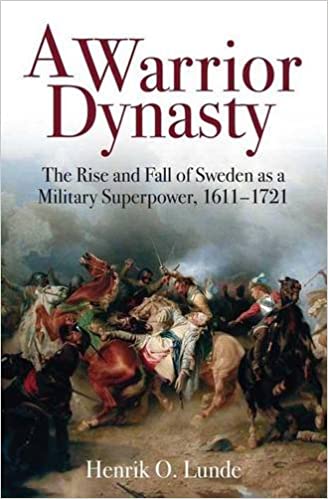
That is when this book caught my eye, “A Warrior Dynasty, The Rise and Fall of Sweden as a Military Superpower, 1611-1721.” I can safely say, I knew exactly nada about Sweden and their era of being a “military superpower.” So, I figured I would take the plunge. One more book in the personal library cannot hurt right?
After an introduction outlining the need for a book of this history in English and a brief overview of Sweden up to the 17th century, the author, who happens to reside in Southwest Florida now, introduced me to the monarch of Sweden. In addition to being the king, he was the greatest military mind in Europe during this time frame of the Thirty Years War.
Gustav II Adolf or his Latinized name, Gustavus Adolphus. He served as King of Sweden from 1611 to 1632, when he was killed in action and was the primary reason that Sweden rose to such military prominence during this time frame. After his premature death he was posthumously given the title Gustav Adolfden store which translated means Gustavus Adolphus the Great by the Riksdag, the Swedish Parliament.
Besides the other title he earned posthumously, “Father of Modern Military History.” Why is he deserving of this title? Let’s examine.
Early histories of the American Revolution in the west relied on oral tradition, local lore, legend, and even a bit of inventive myth-making as a young United States spread beyond the Appalachians and sought to develop its own, new identity. Considerable effort, but not always the most rigorous methodology, often went into combining these sources into a narrative and telling an integrated story of how events in Boston, New York, Philadelphia, Charleston or London eventually affected communities “over the mountains.” The first historians overlapped with the Revolutionary generation. Often, the writers were children in the early 1800s and heard stories from veterans and settlers themselves (or their relations, descendants, and neighbors) in their old age.
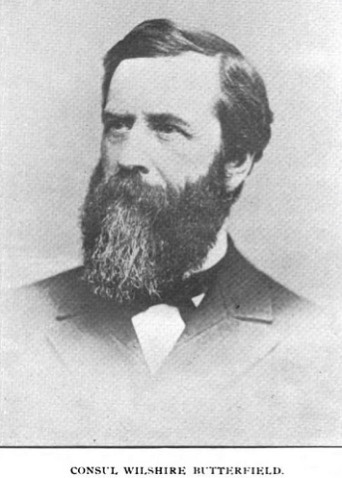
A second generation came along in the mid-19th century. The most notable was Lyman Draper. He set out to write the definitive history of the war on the frontier, but ended up amassing the definitive archive. While working on his never-published history, Draper crossed paths with Consul Wilshire Butterfield, who had moved to Madison, Wisconsin in part because of Draper’s success building libraries in the city and state. Like many of his contemporaries, including Draper, Butterfield did not start as a professional historian. Born in Oswego, NY, he moved with his family as a boy to Seneca County, Ohio in 1834, briefly attended school in Albany, and then took a brief tour of Europe in 1846. The following year, he wrote a history of Seneca County, which was published in 1848, the same year he was elected the county’s Superintendent of Schools. The job didn’t last long as he set out for California during the Gold Rush. Rather than becoming a “Forty-Niner” he ran for Superintendent of State Schools, but narrowly lost. Then it was back to Ohio, where he studied law, served briefly as Secretary of a Railway Company, and eventually opened a legal practice in Bucyrus, Ohio. Along the way, Butterfield, who lacked much in the way of formal education but was clearly adept at learning, took the time to publish a book on punctuation. Then, in 1873, the Cincinnati publisher Robert Clarke & Company issued Butterfield’s An Historical Account of the Expedition Against Sandusky Under Col. William Crawford, in 1872. (The campaign’s climatic battle took place about 20 miles from Butterfield’s law practice.) The book was a hit and the transplanted Ohio lawyer changed careers.
Life, liberty, and the pursuit of happiness made their way into the American revolutionary project most explicitly in the second paragraph of the Declaration of Independence. So, I hope you’ll forgive my taking of liberties in reviewing a book that starts in the Revolutionary War Era and peaks during the Madison administration. Peter Cozzens’ new book, Tecumseh and the Prophet (Alfred A. Knopf, 2020), is a dual biography of the legendary Shawnee leader and his younger brother, Tenskwatawa, aka “the Prophet,” whose mid-life inspiration reawakened nativist aspirations among the Native American nations living in Ohio, Indiana, Illinois, and Michigan. Together, the two sought to build a pan-Indian movement to resist the growth of the young American nation into the Midwest in the country’s first decades.
Emerging Revolutionary War welcomes guest historian Sean Chick
On October 7, 1780, Britain’s attempt to regain at least part of the rebellious North American colonies was dealt a major blow at King’s Mountain. The rebels rejoiced, since it was their first major victory since 1777 and it came after the twin disasters at Charleston and Camden. Thomas Jefferson, then governor of Virginia, considered it the decisive battle of the war. Years later, Theodore Roosevelt echoed that sentiment. In 1930, when the site was set to become a national park, Herbert Hoover gave a speech. For the embattled president, it was an attempt to shore up his falling support and vindicate his strategy to peel southern states away from the Democratic Party. Hoover said “This is a place of inspiring memories. Here less than a thousand men, inspired by the urge of freedom, defeated a superior force entrenched in this strategic position. This small band of Patriots turned back a dangerous invasion well designed to separate and dismember the united Colonies.”
Hoover, understandably, never mentioned the atrocities committed. Many were executed after the battle. Nor did he mention that King’s Mountain was not a contest between redcoats and rebels, but brother against brother. The only British man present was Major Patrick Ferguson. His command was made up entirely of Loyalists. His second in command, Captain Abraham de Peyster, was from New York City.
Joseph Galloway (courtesy of NYPL)
Few groups in American history are as forgotten as the Loyalists and few were as complex. They were a varied lot, often making up the highest in colonial society, including wealthy merchants and colonial officials. They often included the very lowest in the society, such as recent immigrants, slaves, indigenous, and subsistence farmers. Their ideology was in many ways not radically different from those who rebelled. They were generally not in favor of absolute monarchy or the supremacy of Parliament but simply favored union with Britain and slow reform. A few, such as Joseph Galloway, were part of early protests against British colonial policy, but were unwilling to jump into the chasm of revolution. Some, such as South Carolina merchant David Fanning, were merely aggrieved and sought to settle scores. Others were on the margins of society and saw the colonists, or at least the revolutionary colonial elite, as their real oppressors.
The Loyalists were at first spurned by the British high command. Major General William had over 30,000 men under his command in 1776 and Loyalists would have added to the logistical strain. He also thought a soft war policy that he hoped would induce the colonies to return, and therefore it was reasonable to avoid civil war. Yet, by 1777 the British were using some Loyalist regiments. They would fight in John Burgoyne’s ill-fated drive on Albany and served as rangers at Brandywine.
On October 3, 1789, President George Washington issued a “Thanksgiving Proclamation” to the people of the United States. In this declaration, Washington designated “Thursday, the 26th day of November” to “the People of the United States a day of public thanks-giving.”
On Thursday, November 26, 2020, Emerging Revolutionary War will give to the “People of the United States” a live Facebook presentation of this proclamation at 7 p.m. EST.
courtesy of Mount Vernon
In addition to the reading of the proclamation, ERW invites you to gather questions and comments that you would want our historians to chat about, as we return on Sunday, November 29 with the next historian happy hour. Our historians will recap some of their favorite moments of research, of the annual trip, and some of the happenings on tap.
But, mostly, it will be an hour dedicated to good beer, good discussion, and staking opinions. So, wake up from that turkey coma by Sunday and click on over to our Facebook page for this “Rev War Revelry.”
Join Emerging Revolutionary War this Sunday as we discuss the role of digital history in 2020 with another public history group: the Sons of History.
The Sons of History describe their concept via their website as:
“Literally, we are just two guys who love history. We also understand the importance of knowing history and learning from it. But more important than knowing and learning history, we believe we should be teaching it to others.” (https://www.thesonsofhistory.com/)”
Through a website, podcast, and social media, the Sons of History teach numerous aspects of American history to the general public in a similar fashion that ERW does.
We’ll discuss more who they are, why they got into doing digital history, what time periods they cover, and the powerful stories of the past that both ERW and Sons of History tell the public. Also, how and why they matter today.
So, set your schedule for Sunday evening and tune in at 7 pm ET on ERW’s Facebook page for the next historian happy hour.








 Emerging Revolutionary War Era