Part Two: The Battle of Groton Heights, September 6, 1781: The Fort Griswold Massacre

For Part One, click here.

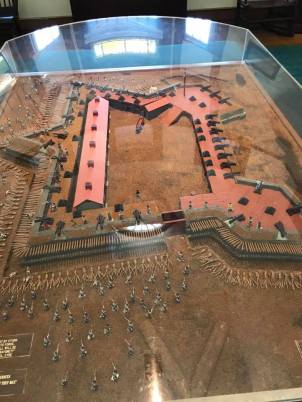
Lt. Col. Edmund Eyre’s battalion of 800 Regulars and Loyalists landed on the east bank of the Thames River, facing tangled woodlands and swamps. The New Jersey Loyalists, in fact, had so much difficulty moving the artillery that they did not participate in the assault on Fort Griswold.

19554343_10159163061815413_6728549902399513958_n
Model of Fort Griswold (author collection)

Eyre sent a Captain Beckwith to the fort under a flag of truce to demand its surrender. Ledyard called a council of war and consulted with his officers. The Americans believed that a large force of militiamen would answer the call, and that this augmented force could defend the fort. Ledyard responded by sending an American flag to meet the British flag bearer. The American told Beckwith, “Colonel Ledyard will maintain the fort to its last extremity.” Displeased by the response, Eyre sent a second flag, threatening no quarter if the militia did not surrender. Ledyard gave the same response even though some of the Americans suggested that they should leave the fort and fight outside instead.  Continue reading “Part Two: The Battle of Groton Heights, September 6, 1781: The Fort Griswold Massacre”

ERW Weekender: Bunker Hill Monument & Museum

Emerging Revolutionary War welcomes back guest historian Katie Turner Getty. 

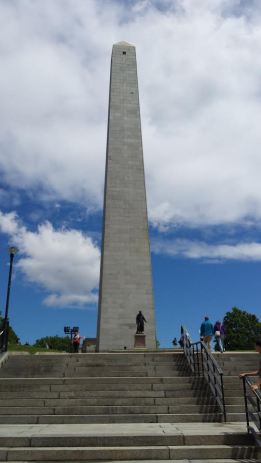
Towering over Charlestown, Massachusetts, its foundation set in sacred battleground soil, the Bunker Hill Monument is a 221 foot obelisk commemorating the Battle of Bunker Hill. The cornerstone of the monument was laid by the Marquis De Lafayette in 1825, fifty years after the battle was fought on June 17, 1775.

BunkerHillMon-KTGetty
Bunker Hill Monument (author collection)

Although the land surrounding the monument has been greatly developed since the battle, visitors today can get still get a sense of the 18th-century landscape just by walking through Charlestown and climbing the hill to reach Monument Square. Approaching visitors are greeted by the statue of Colonel William Prescott, the gray granite of the monument serving as an impressive backdrop behind him. Continue reading “ERW Weekender: Bunker Hill Monument & Museum”

After Eutaw Springs

Part Two
Click here for Part One.

Fig 37
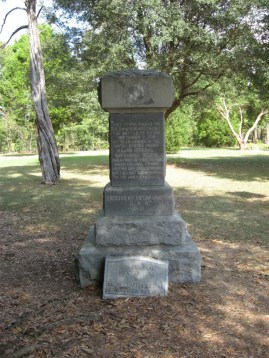
Daughter’s of the American Revolution (D.A.R.) Monument, Eutaw Springs Battlefield (author collection)

In many ways, the battle of Eutaw Springs was a disappointment for both commanders.  Greene’s troops at one point broke through the British lines, but they recovered, and the Americans failed to drive them off the field.  Stewart, in a letter to Cornwallis, wrote that there were two things he would regret the rest of his life: the loss of an early morning supply gathering party and his lack of cavalry.  Having them, he felt, would have enabled him to decisively defeat Greene.  Probably both commanders, and many of their officers, reflected upon these events and second guessed themselves for the rest of their days.  Although both armies fought well at Eutaw Springs, a clear cut victory eluded both of them. Continue reading “After Eutaw Springs”

Eutaw Springs

Emerging Revolutionary War is pleased to welcome back historian Bert Dunkerly, who is the co-author (with Irene B. Boland) of the upcoming book; “Eutaw Springs; The Final Battle of the American Revolution’s Southern Campaign” slated to be released this month. 

Part One

The weather was warm and the men had been marching for days, but their morale was high.  They had been through a lot recently: caught off guard and defeated at Hobkirk’s Hill, a month of grueling siege work – and for naught, at Ninety Six.   Not to mention the engagements that many of them had fought in previously: Kings Mountain, Cowpens, Guilford Courthouse, and dozens of smaller battles.

Yet the army that General Nathanael Greene led forward on the morning of September 8, 1781, was confident and ready to come to grips with its adversary.  Everyone from the private in the ranks on up to the commanding general knew that ahead lay an opportunity.

Battles in the Revolution were, in fact, rare opportunities for commanders.  Engagements were the short, pulse-pounding events that broke up the monotony of marching and maneuvering.  An army spent most of its time in garrison, in camp, or on the road.  In battle the infrequent opportunity came to crush an opponent and influence the outcome of a campaign, or the war.  These chances were few and far between.

Fig 8
“Eutaw Springs” by Benson Lossing

Both commanders at Eutaw Springs appreciated this fact.  General Nathanael Greene’s forces had experienced a series of close calls at Guilford Courthouse, Ninety Six, and Hobkirk’s Hill.  The American army fought well in all of these engagements, save Hobkirk’s Hill, yet they met defeat in every one.  Greene hoped Eutaw Springs would put the finishing touches on his South Carolina campaign, and end it with a clear cut victory.[i]

Eutaw Springs was a rare chance for Greene to pick the time and place of engagement, array his forces to his choosing, and initiate the battle, and control its \tempo.  It was the only set engagement of the campaign, other than Guilford Courthouse, in which Greene chose the ground and initiated the battle.  Commanders do not often have this luxury, and Greene earnestly hoped to make the most of it. Continue reading “Eutaw Springs”

Remembering Patriots Day

Leading up to the anniversary of April 19, 1775, we will be sharing some short remembrances from a few people who are from Lexington and Concord. Our first installment is by Alex Merenyi. Alex grew up in Lexington and moved to the Washington, DC area to attend college. He shares with us how he looks back on Patriots Day..

Patriots’ Day was always weird for me growing up.

Lexington’s Tourist Season would begin with a bang on Patriots Day – one specific bang, at 5:36-ish in the morning a Monday  – and carry through until the snow would scare the tour busses back home for the winter. (Ironically, it meant that the foot and a half of standing snow made getting around a lot easier.) It wasn’t until I moved to DC that I realized nobody else knew what Patriots Day was.

What it was for us, in addition to being of the part of the year where tour busses blocked off the best way to Starbucks, was two discrete parts; the historical, which was the reenactment of the Battle of Lexington; and the festival, which was that the center was shut down for a carnival-like opening of the tourist season. (There was also a 5k, which I remember my Father running once. It always seemed odd that they’d run a race that day through the heart of town, but so it went.)

You couldn’t live in Lexington and not know about The Reenactment. Every year, on the third Monday in April, a bunch of Americans would stand up to the Regulars and be cut down in a single volley of fire. I went once, when I was young enough to ride on my Father’s shoulders, and watched my dentist and his friends get shot on the Battle Green. Two minutes later we began walking home, wanting to beat the crowds that had gathered there. A second volley of fire went off, and I remember asking my Dad if that meant the British had shot the wives that ran out to their fallen husbands. (He explained they fired to clear their rifles. I was maybe seven – by this point, ‘The British Were Evil” was pretty engrained; I remained suspicious.) All told, it took us longer to walk to and from the event than watch it. Even as a kid, I had to ask myself what all the fuss was about – a fifteen minute re-enactment of, let’s call it what it is – the first American defeat – seemed rather odd.

I mention my dentist not just as an anecdote, but to illustrate how deeply The Reenactment went – the men and women who would come together at the pre-dawn hours in April and fall over, year after year, were celebrities in Lexington. It was all over my dentist’s office, photos of him marching in the 4th of July parades, scenes of him at the then-standing Foxboro Stadium firing a musket for the other Patriots’ having scored. (Back in the pre-Brady days, those were fewer and further between). Schools would give extra credit for interviewing reenactors, and of course, every student had the requisite “Go to the re-enactment and write a paper on how important it is.” As a child growing up in Lexington, it had an aura effect that made all of the rest of American History seem rather… well, underwhelming – nobody was making a huge fuss about re-enacting the signing of the Constitution. (Adding to that of course was that my Mother is quite British; her answer to my asking about how the Battle of Lexington was covered for her in school? “It wasn’t.”) Until I left Lexington, I never really appreciated why all the fuss was made about The Reenactment, or why these few people were given such a disproportionate amount of attention; It was more than just “this is a thing that we do once a year”, it was a recognition of something that nobody ever dared point out:

“If it weren’t for these guys, Lexington wouldn’t be on the map.”

 

Charleston’s Horn Work Offers Glimpse Into the Walled City’s Colonial Fortifications

Charleston Horn Work.JPGIn Charleston’s Marion Square, an odd chunk of limestone, sand, and oyster shells sits inside a wrought-iron fence just beyond the normal boundaries of the weekend market. While shoppers buy their weekly produce or shop for gifts, the food court along King Street tempts them with just about anything you can image. Someone usually plays live music on the park-side of the market—and there, nearby, sits the hunk of rock. Continue reading “Charleston’s Horn Work Offers Glimpse Into the Walled City’s Colonial Fortifications”