This March brings the 241st Anniversary of the pivotal battle of Guilford Courthouse, NC. While this battle is of immense importance to the Southern Campaign, several smaller battles leading up to it have been largely overlooked. Through February and early March of 1781, detachments of the American and British armies maneuvered across the modern-day counties of Alamance, Guilford, Orange, Chatham, and Caswell. This is the first of a series of three articles.
Having unsuccessfully chased General Nathaniel Greene’s small, ragged army across North Carolina, British forces under Lord Charles Cornwallis moved to the state capital at Hillsborough to announce their liberation of the state and call Loyalists to come forward and support them. Greene’s army retreated across the Dan River into Virginia, where he awaited supplies and reinforcements.
After a circuitous journey, from Paris, France across the Atlantic Ocean and then into Pennsylvania, an eager participant trekked to join the American effort. After an introduction to the Continental Congress this European officer headed toward the Continental army encampment. Baron Frederich William Ludolf Gerhard Augustin von Steuben, 47-years old, rode into camp drawn by horses and relaxing, as much as one can on the roads of Pennsylvania during 1770s, in a sleigh, with a Russian wolfhound dog strolling beside the wooden vehicle. On this date, 244 years ago, General George Washington, his staff, and any inquiring eyes around camp saw von Steuben for the first time.
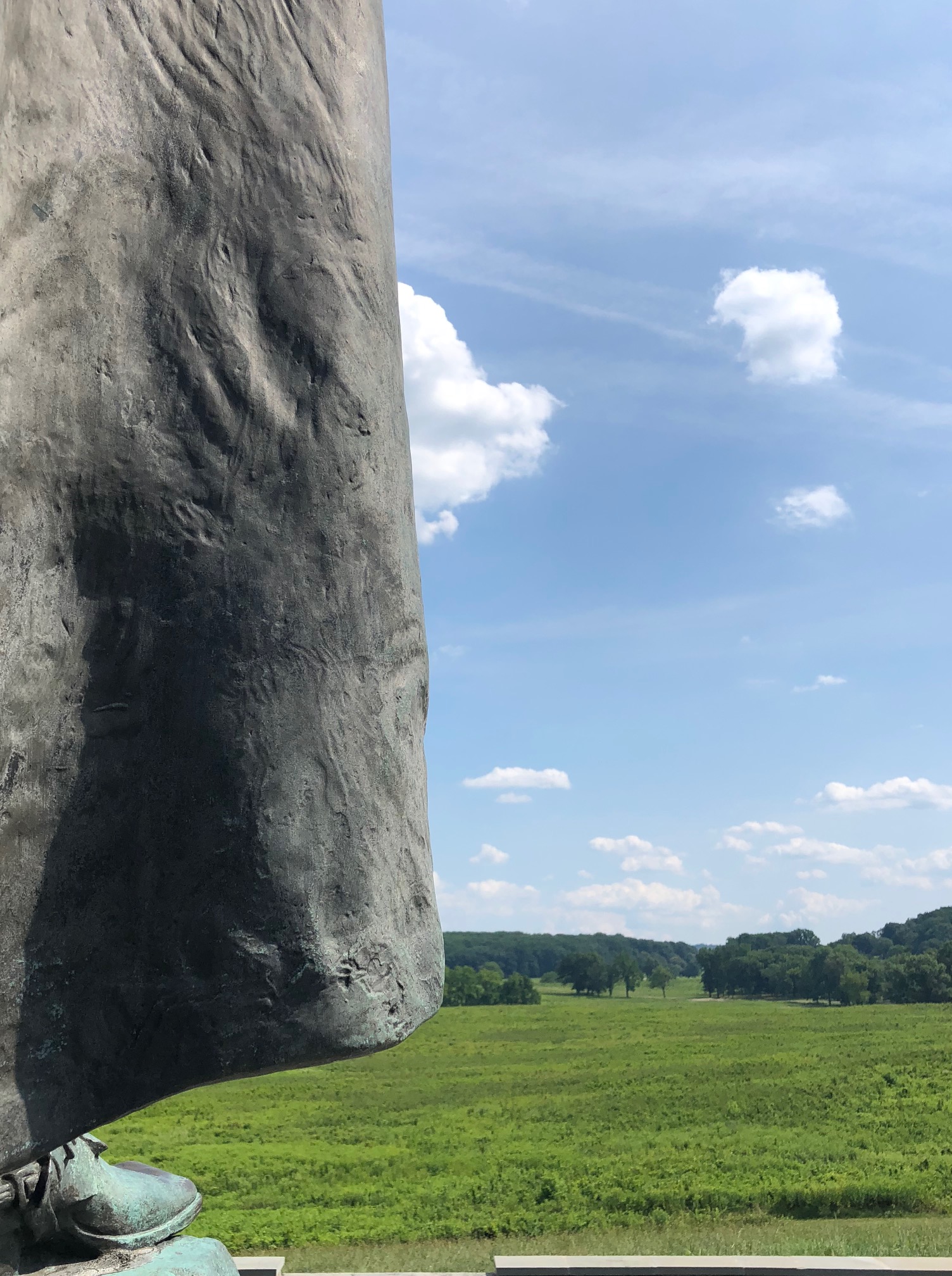
Baron von Steuben Statue, Valley Forge NHP
Although Christmas was almost two months in the past, von Steuben became a late blessing for Washington and his Continental army. Through an adaptation of a military training regimen from continental Europe which became a manual known as the “Blue Book” (this guide was used to train United States Army recruits for decades into the future as well), von Steuben began to morph the rank-and-file and junior officer corps of the Continental army into an actual army that knew how to follow commands and change formations. This training aided the Continentals in the battles of 1778, from a small engagement in May at Barren Hill to the last major fighting in the northern theater at Monmouth in June and into other theaters of the conflict.
Today, the field in which he trained the first model company is preserved by the National Park Service within the boundary of Valley Forge National Historical Park.
This November, during the second annual Emerging Revolutionary War bus tour, attendees will see the field and stand at the foot of the statue to von Steuben, looking over the same ground he first saw on this date, February 23, 1778. To secure your tickets, click the link on the header bar above titled “2022 Bus Tour.”
In the throes of the winter of 1778, spent at Valley Forge, General George Washington and his staff formulated a mountain of paperwork to multiple recipients of the American cause. On February 16, 1778, Alexander Hamilton composed a letter for the commander-in-chief of the Continental army to a gentleman who had moved from the military to the political ranks; George Clinton of New York.
George Clinton
He had seen service in the Hudson Highlands and had been commissioned a brigadier general in the Continental army on March 25, 1777. Later that same year both governor and lieutenant governor of New York, formally resigning the latter and accepting the former on July 30, 1777. In that capacity, he received the letter, excerpts below, from Valley Forge.
“It is with great reluctance, I trouble you on a subject, which does not properly fall within your province; but it is a subject that occasions me more distress, than I have felt, since the commencement of the war; and which loudly demands the most zealous exertions of every person of weight and authority, who is interested in the success of our affairs.”I mean the present dreadful situation of the army for want of provisions and the miserable prospects before us, with respect to futurity. It is more alarming, than you will probably conceive, for to form a just idea, it were necessary to be on the spot.2 For some days past, there has been little less, than a famine in camp. A part of the army has been a week, without any kind of flesh & the rest three or four days.3 Naked and starving as they are, we cannot eno⟨ugh⟩ admire the incomparable patience and fidelity of the soldiery, that they have not been, ere this, excited by their sufferings, to a general mutiny and dispersion. Strong symptoms however of discontent have appeared in particular instances; and nothing but the most active effort⟨s⟩ every where, can long avert so shocking a catastrophe.
Washington then asks for any help or supplies that Clinton can send his way, even though the army is outside the state lines of New York. Washington’s mindset is that the cause of the army in Pennsylvania is the cause of American independence and that Clinton, who had served would recognize that and do his utmost to provide what he can.
“I am calling upon all those, whose stations and influence enable them to contribute their aid upon so important an occasion, and from your well known zeal, I expect every thing within the compass of your power, and that the abilities and resources of the state over which you preside, will admit. I am sensible of the disadvantages it labours under, from having been so long the scene of war, and that it must be exceedingly drained by the great demands to which it has been subject, But though you may not be able to contribute materially to our relief, you can perhaps do something towards it; and any assistance, however trifling in itself, will be of great moment, at so critical a juncture, and will conduce to keeping the army together, ’till the Commissary’s department can be put upon a better footing, and effectual measures concerted to secure a permanent and competent supply. What methods you can take, you will be the best judge of; but if you can devise any means to procure a quantity of cattle or other kind of flesh, for the use of this army, to be at camp in the course of a month, you will render a most essential service to the common cause.“
Not only did Clinton receive this missive from Washington, dated February 16, but the following day Gouverneur Morris from a camp committee established by the Continental Congress also sent the New York governor a letter asking for any assistance he could provide for the army at Valley Forge.
These letters underscore the seriousness of the plight of the army encamped at Valley Forge as the winter slowly turned to spring. The action at Washington’s headquarters and from the camp committee helped create a path forward through that pivotal winter. To learn more about what transpired during those six months from December 1777 to June 1778, follow the link above to the “2022 Bus Tour” and join Emerging Revolutionary War on our second annual bus tour November 11-13, 2022.
The entire letter from Washington (Hamilton) to George Clinton can be found here.
On Sunday, January 23, Emerging Revolutionary War will journey, virtually, into the heart of the Mohawk Valley of New York in a discussion with Brian Mack of the Fort Plain Museum and Historical Park.
Established in 1961 the museum and park now encompasses over 75 acres and includes the site of Fort Plain/Fort Rensselaer, the foundation of a Revolutionary era bridge, the Fort Rensselaer Redoubt and works constructed by British forces, along with sites of colonial farmsteads, industry, and settlement. The museum also covers a wide era of the history of the area.
Mack lives out his passion for his family & for history in everything he does. A family vacation always includes a stop to a historic site or two. He is involved with the Fort Plain Museum & Historical Park as a member of their Board of Trustees, a Board member with The Stone Arabia Preservation & Battlefield, and a Board Member with The Mohawk Country Association. Most recently, he joined the Board with the Dr. Joseph Warren Foundation.
We look forward to a great discussion about the American Revolution in the Mohawk Valley of New York with Brian this Sunday, at 7 p.m. on Emerging Revolutionary War’s Facebook page.
244 years ago this week is when the Continental army, under the command of George Washington, marched into what would become their winter encampment as the year turned from 1777-1778. Recently, Phillip S. Greenwalt, one of the Emerging Revolutionary War historians was a “talking head” on a documentary about the Valley Forge encampment and what the soldiers and civilians faced during the ensuing six-month cantonment.
The documentary which features historians and park rangers is airing on Fox News Nation, the streaming service that is part of the Fox News network. Below is a screen shot of Phillip, who is also the author of Winter that Won the War, the Winter Encampment at Valley Forge, 1777-1778, which is part of the Emerging Revolutionary War Series published by Savas Beatie LLC.
So, if you need a break from the holiday specials that are airing, tune in for your history fix and learn more about the history at Valley Forge. If you want to dive even deeper into this period of the American Revolution, check out the link above labeled “2022 Bus Tour” and secure your tickets to join ERW at our second annual bus tour next November, which will include Valley Forge.
On the edge of the historic town of Litiz, Pennsylvania in Lancaster County stands an impressive, unique, and solemn, historic site. Two stone monuments and a plaque comprise the complex, marking the final burial of Continental soldiers from the hospital that stood nearby.
The historic marker says that wounded from the battles of Brandywine (September 11, 1777) and Germantown (October 4, 1777) were received here. Yet that does not match what I uncovered in researching this. The dates of the Lititz hospital seem to coincide more with the Valley Forge (winter 1777-78) timeframe.
In late summer, 1777, British General William Howe and his army left New Jersey and invaded Pennsylvania with the object of capturing Philadelphia. General George Washington’s army tried to stop the British at Brandywine but met defeat. The British occupied Philadelphia, and Washington struck back at Germantown, but again came up short. There were many smaller battles across southeastern Pennsylvania like Paoli, Fort Mifflin, and Whitemarsh.
From November 2, 1777 until early-December, General George Washington and the Continental Army occupied a defensive position at White Marsh, approximately 13 miles northwest of Philadelphia. In early December, a series of small skirmishes erupted along the American lines in the last actions of the campaigning season of 1777. Frustrated by Washington’s refusal to emerge from his entrenchments, Sir William Howe led his British columns back to their winter abode in Philadelphia.
Washington moved the army shortly thereafter toward Valley Forge and their winter cantonment, arriving in that vicinity on December 19. As Washington prepared for the winter of 1777-1778 you can also start the preparations to follow this route with Emerging Revolutionary War on the weekend of November 11 – 13, 2022 on the Rise of the American Army: Valley Forge and the Battle of Monmouth Bus Tour. To secure your spot and further information, click here (or the link on the banner at the top of this page).
Emerging Revolutionary War welcomes back guest historian George Kotlik
Introduction
By 1775, King George III ruled over nineteen provinces in British North America.[1] Six remained loyal to the Crown during the Revolutionary War. Historians have so far explored, in great depth, the various reasons why the thirteen original colonies rebelled. On the flipside, why did some colonies remain loyal? What role did colonial governors play in securing their province’s loyalty during the rebellion? In an attempt to answer these questions, this research will focus on British North America’s mainland colonial governors and general assemblies during 1775. Data on the backgrounds of each British colonial governor on the North American mainland was gathered from their respective biographies. Hereafter, each governor’s background is considered by colony, listed in alphabetical order. Each biography is brief and not meant to be comprehensive. There is not enough time or space in this paper to accomplish that end. Instead, the biographies help determine the type of individual who governed each province at the rebellion’s onset – a unique factor that I argue contributed, in whatever small way, to a colony’s political disposition during the American Revolution. In addition to looking at provincial executive leadership, I have also inspected general assemblies. General assemblies were an important aspect in this research due to the fact that the mere presence of an assembly influenced a colony’s political disposition in 1775. What’s more, colonial governors wielded the authority to dissolve assemblies. That connection, in addition to the assemblies’ influence on provincial loyalty, I argue, merits their inclusion in this study.[2]
Our monthly recap of what our good friend and fellow historian Tom Hand has written on his blog, AmericanaCorner.
The Legacy of Paul Revere November 2, 2021
Paul Revere began his famous ride from Boston to Concord, around 11:00pm on April 18, 1775, informing the residents and militiamen that the British were on the march. He arrived in Lexington, a town about 10 miles from Boston, around midnight. Read more here.
Lexington and Concord: Minutemen in Arms November 9, 2021
The Battles of Lexington and Concord, fought on April 19, 1775, marked the start of America’s war for independence from England. The story of that fight is an inspiring account of how everyday Americans came together to resist the power of Great Britain. Read more here.
Lexington and Concord: The Shot Heard Round the World November 16, 2021
The fight between our Minutemen and the British regulars at Lexington was over in a matter of minutes, and the British began the seven-mile march to Concord. By now, reports of the shooting had reached the minutemen in the surrounding area, and they began to assemble. A bad day for the British was about to begin. Read more here.
The Battle of Bunker Hill November 23, 2021
The Battle of Bunker Hill, fought on June 17, 1775, is one of the most iconic and familiar events in American history. It was our first pitched battle against the British army and, although technically a defeat, the efforts of the American militiamen were inspirational. Read more here.
Our monthly recap of what our good friend and fellow historian Tom Hand has written on his blog, AmericanaCorner.
The Midnight Ride of Paul Revere October 26th
The story of Paul Revere and his Midnight Ride is one of the many fascinating subjects of the grand American past. Taking place in conjunction with the Battles of Lexington and Concord, on April 19, 1775, the tale has passed down from generation to generation. Read more here.
Forefathers Gather at Historic First Continental Congress October 19th
The First Continental Congress was a key link in the chain of events that led to our nation’s gaining its independence from England. The brief convention brought together most of the influential leaders from colonial America to determine an answer to Parliament’s recently enacted Coercive Acts. Read more here.
The Boston Tea Party Takes Colonists Past the Point of No Return October 12th
The Boston Tea Party is one of the most iconic moments in American history. In some ways, it sealed our fate to separate from England and become our own nation. The road that led to this watershed event began several years earlier with the Townshend Acts. Read more here.
Aftermath of the Boston Massacre October 5th
The violence on the evening of March 5, 1770, in Boston is known to us today as the Boston Massacre. It was an unfortunate incident that left five people dead and growing anger between American colonists and leaders in England. Read more here.






 Emerging Revolutionary War Era