In March 1781, General Charles Lord Cornwallis finally caught up with his antagonist, General Nathanael Greene and his joint Continental and militia forces in North Carolina. On March 15, 1781, the British scored a pyrrhic victory over the American forces, securing the field but losing approximately 25% of their field force in the process.
With the victory, Cornwallis was forced to retreat to the North Carolina coast, to Wilmington, where he could rest and refit. He then led his forces north and into Virginia, to his destiny at Yorktown.
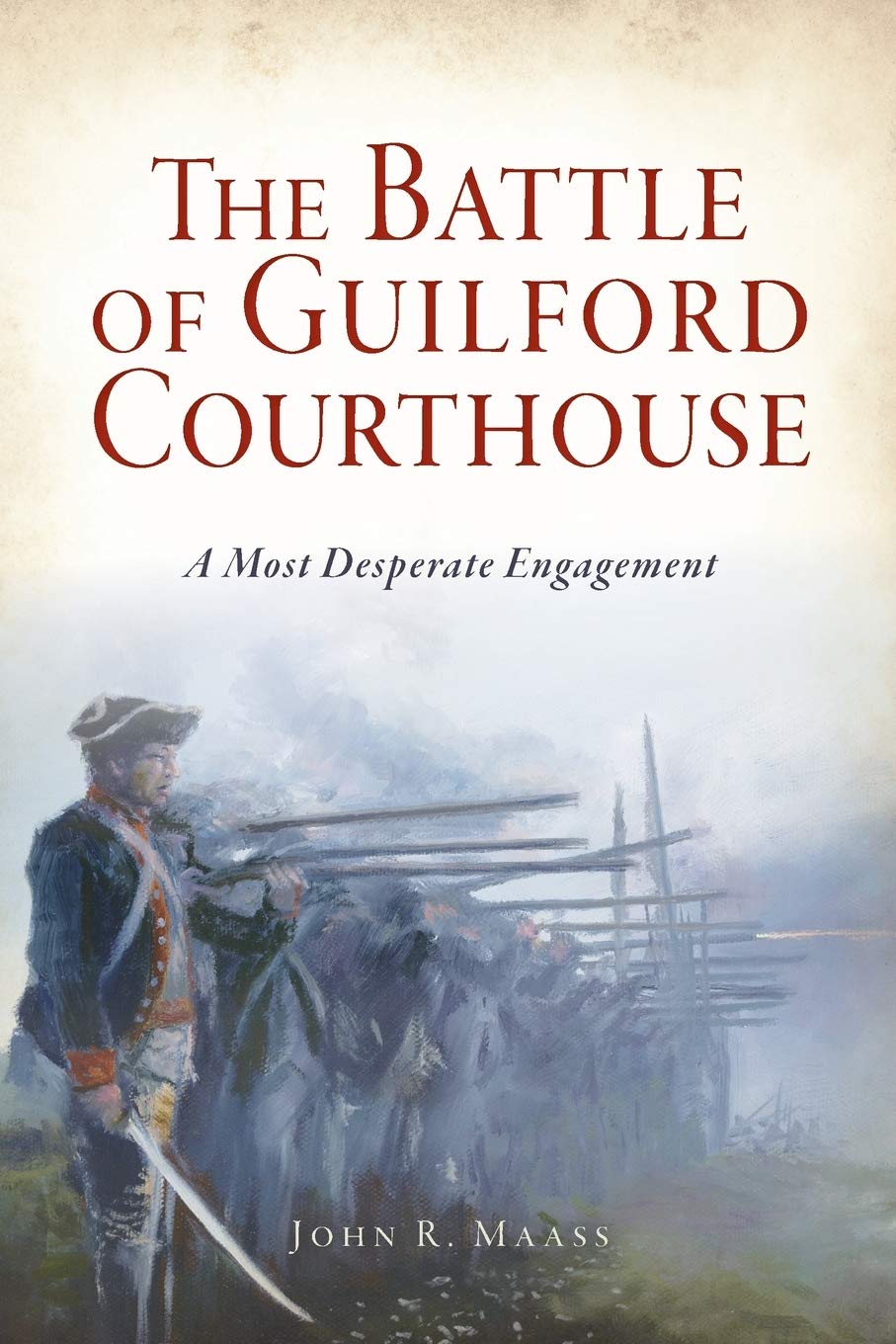
Yet, the road to Guilford Court House, for both sides, started in South Carolina, across the entire breadth of North Carolina, and into the southern reaches of Virginia before returning to the Old North State. This road and the history of the campaign, along with the March 15th engagement, unfolds in a new history by Dr. John Maass, author and historian, currently at the U.S. Army Center of Military History in Washington D.C.
His book, The Battle of Guilford Court House, A Most Desperate Engagement will be the focus of this week’s “Rev War Revelry.” The book is now available from book retailers and online. We hope you can join us this Sunday, at 7 p.m. EST, for our next installment of a historian happy hour.
To access, just head to Emerging Revolutionary War’s Facebook page, go to the “Events” tab and follow the prompt at 7 p.m.
Emerging Revolutionary War welcomes back guest historian Karl G. Elsea
If you want to know the process of how field guns were fired in a battle such as Trenton or Monmouth, watching the National Park Service or re-enactors fire a cannon, you will only get part of the story. Important parts of the procedure are almost always missing. Here is a more complete presentation of the process; and, how leveling, pointing (aiming), and elevating a field gun were performed.
Major William Congreve said it best in his instructional training works at the Royal Military Repository in the late 1700’s: “It is of the utmost Consequence to the Service to fire so as to do Execution, for Shot flying over the Enemies head only hardens them and discourages your own Troops.” “Rounds must never be fired with-out pointing the Gun carefully each time and paying great attention to the Elevation.”[i]
After the commands, unlimber piece (un-attach the gun from the limber), take off apron (remove the vent cover), take out tompion (remove the “plug” at the muzzle of the gun), the gunners would perform the following activity with-out a specific command. This was a critical function and is not usually shown when firing a gun. It was to level the piece. As stated in their training, “and which ever Wheel stands too high, the Earth must be loosened in the rear, and the Gun drawn gently back until the Bubble rest in the Center of the Tube.”[ii] The science was simple, the trunnions on the barrel must be level or the barrel will move in a non-vertical plane and thus be off target. Leveling the gun was of great importance. The Artillerist’s Companion 1778 states it was an artillerist’s function, “Quadrating a piece [barrel] mounted, is to see whether it be directly placed, and equally poised in the carriage, which may be found by a gunner’s instrument called a level or perpendicular.”[iii]
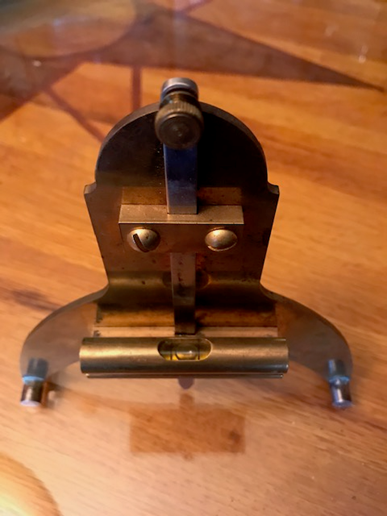
The following picture shows what was called the Gunner’s level or the Spirit Level. It was the quintessential instrument carried by gunners to level the gun. In a cylinder in the middle of the gunner’s level was a vial and when the trunnions are level the bubble in the vial will be in the middle. At that point the gun was leveled.
(Author’s Level and Photograph)
The next activity was sometimes required to point the gun and it also required the Gunner’s Level. The level could be used to place a noticeable mark indicating the top of the base ring and the top of the muzzle ring. These two marks constitute what was called the “centre” [center] line of the cannon. The activity of marking the “centre” line was performed immediately after leveling the cannon unless the points or the line were already marked on the cannon. This line on the barrel was called the “gun metal line.” On many of the guns of the period the metal line marks were discretely engraved into the design on the barrel. For example, on this patriot cast Byers’ gun the base ring line, touch hole, and liberty pole mark one end of the “gun metal line.”
After these tasks (leveling and marking) were complete the gun was ready for pointing (aiming). With regards to the Patriot’s drill, there was a distinct difference between the primary source drills of William Stevens and Louis de Tousard. Stevens records that “Take Aim” happens after the command “Prime.”[iv] In Tousard’s drill “Take Aim” takes place before “Prime.”[v] There was a reason for these differences, and it depended on how the gun was primed. The use of a priming tube, whether tin, reed, or quill, could potentially block the sighting line. Tousard’s drill avoided this problem by sighting before the priming tube was inserted. It should be noted the centre line passed over the touch hole. It was noteworthy that the British drill specifically mentions pointing before the tube was inserted into the touch hole. The British drills for a six-pounder stated, “The man who serves the Vent … not put the tube in until the Gun is pointed.”[vi] With regards to Steven’s drill, the priming likely consisted of using powder to touch off the charge, thus the “take aim” command could take place after priming. Using powder only to prime did not block the sighting line. Tousard’s drill assumed tubes were used in priming. British and Patriots used tubes as the preferred manor in priming field guns.
(Author’s Photograph)
Last came the task of elevating the gun barrel. The need for proper elevation of the barrel was demonstrated by noting the psychological impact of cannon fire as shown in the following contemporary quote, “it having been often proved that Soldiers have been more alarmed and put in confusion, by seeing Shot hopping to them, than by having double the Number of their Comrades killed by their sides without seeing it.”[vii] That quote showed the importance for shot to land and bounce somewhat in front of the soldiers. Elevation was adjusted to accomplish that task.
For elevation the gunners would know their individual piece and the characteristics concerning how the various types of shot with varying powder charges would fall. The Officers would likely have some recordation measuring the needed elevation for the distance to first graze. First graze was the range at which the shot would first touch the ground. That recordation would allow the gunners to know what elevation to use for their barrel.
The gunners would also know what the dispart (half the difference between the diameter of the base ring and muzzle ring) was for their individual gun. Dispart was the key to understanding that aiming the gun on the centre line automatically elevates the barrel. Dispart could be quickly measured in the field by placing the vent pick into the touch hole until it reached the bottom, and then subtract that measurement taken at the muzzle from the bottom of the tube to the top of the muzzle ring. As noted above, when the cannon was aimed using the centre line (“gun metal line”) then the resulting cannon ball strike on level ground was called the “Common range.” Common range was different from “point blank range” which was the distance when a cannon ball first touches ground when fired from a level barrel on level ground.
There was an exception to aiming and elevating the gun. The exception was if a gun were to be overrun. British training materials stated, “Case Shot may be fired as quick as the Dragropemen can draw the Gun up to its proper Position in the Interval again, which will allow the Non Commissioned Officer a sufficient time to direct the Gun nearly to the Center of the Enemies Battalion and give a pretty good guess at the Elevation.”[viii]
[i] Adrian B. Caruana, The Light 6-Pdr. Battalion Gun of 1776, (Alexandria Bay, NY: Museum Restoration Service, 1993), 27.
If you are from a certain geographical area of the United States the title of this post is a saying you have heard numerous times. Heck, you may even use it yourself. I’ll admit that I have found usage of this American style vernacular a few instances in my lifetime.
Did you know that there is one version that connects the popular saying to a figure in American history and has its origin dating back into the 18th century?
While reading a history of Osceola, I came across the mention of Benjamin Hawkins and as many of you know, did some internet research, consulted other books on the Seminoles, Creeks, and other Native Americans and the research took off from there. This is just a brief overview of Hawkins and his possible, albeit tenuous, connection to this saying.
A possible first mention of the saying above is attributed to Hawkins, whose name probably does not ring a bell for a large segment of people, historians included. Hawkins, born in North Carolina on August 15, 1754 into a family of six, was a gifted individual who attended the College of New Jersey, now known as Princeton University with an aptitude for linguistics, which apparently including learning Native American dialects.
On January 29, 1756, Henry Lee III is born at Leesylvania Plantation in Prince William County, Virginia. Part of the prestigious Lee family of Virginia, his father was a cousin of Richard Henry and Francis Lightfoot Lee, two brothers who signed the Declaration of Independence.
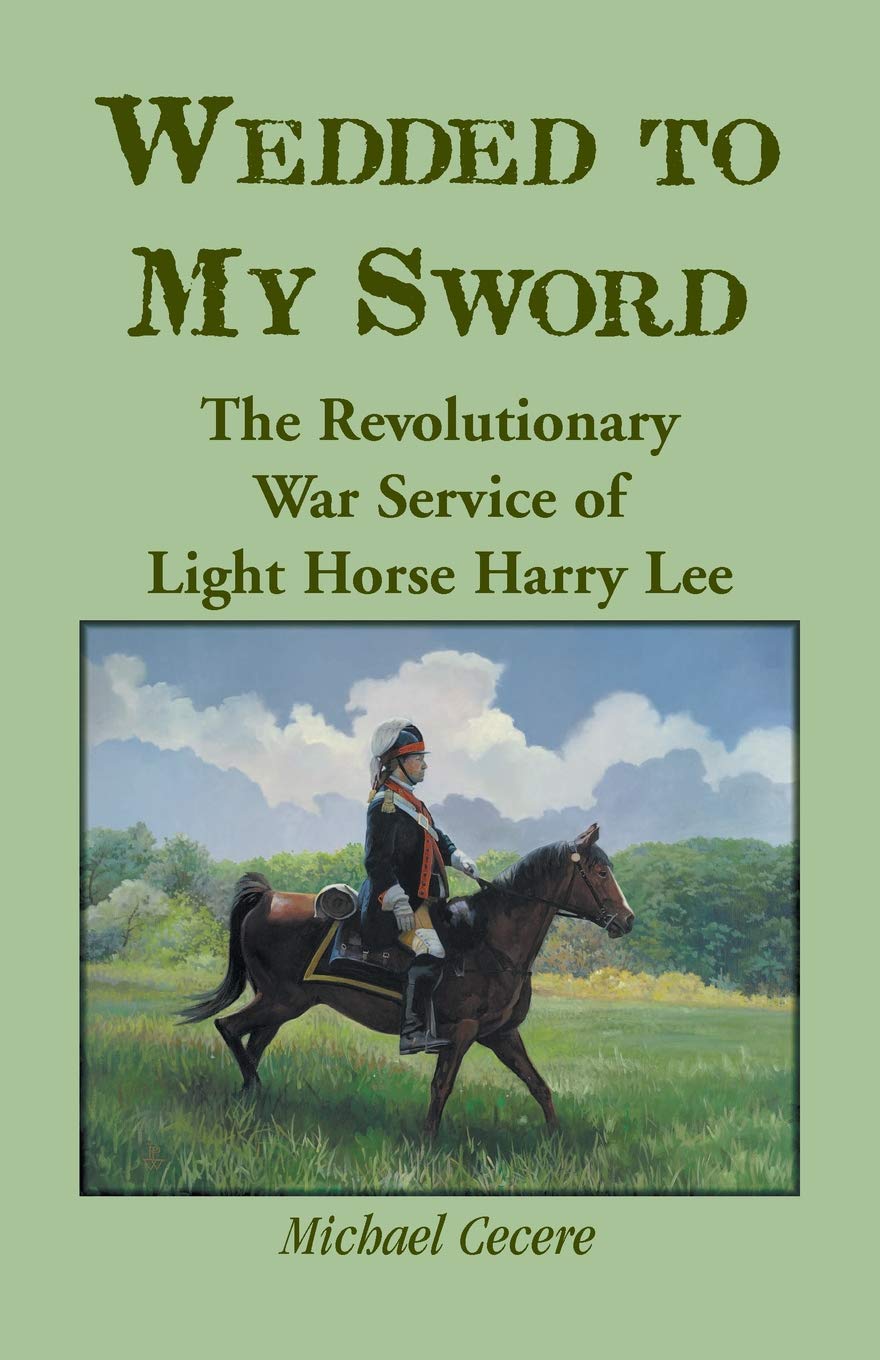
Henry Lee would blossom into one of the better cavalry commanders in the American Revolution, earning the nickname, “Light Horse Harry” Lee because of his accomplishments. With January being his birth month, Emerging Revolutionary War welcomes historian and author Mike Cecere, who will discuss his book, “Wedded to my Sword, The Revolutionary War Service of Light Horse Harry Lee.”
Cecere, former high school and community college history teacher is the author of thirteen books on the American Revolution, most focused on aspects of the colony of Virginia and/or her native sons.
This Sunday we hope you spend some time joining us on the next installment of “Rev War Revelry’ as we discuss the Lee that was born in January and became a military hero of the American Revolution. This historian happy hour will be live on our Facebook page at 7 pm EST.
(Yes, we do know there is another Lee that is born in January and plays a prominent role in history).
Two hundred and forty years ago, January 17, 1781, Brigadier General Daniel Morgan strategically manuevered his Colonial forces to defeat the British, led by Lieutenant Colonel Banastre Tarleton, at the Battle of Cowpens.
What can we learn from the Battle of Cowpens? Military strategy, yes. Historical knowledge, absolutely. But as we near the 250th commemoration of the American Revolutionary War, how do we turn the battle into relevancy for today’s modern society?
As historians, we can find meaning and connection to places and events at their face value. It’s a natural ability we have ingrained in our knowledge-seeking souls. What about those that can’t and don’t? How do we make them relevant to them so that our history is not forgotten?
The answers lie in the stories we tell and how we tell them. Instead of rehashing the specific details of the Battle of Cowpens, I’m going to try something a little different: think of a time when you were able to not only prove that someone’s opinion of you was wrong, you used it to your advantage to achieve a goal. Go ahead, I’ll wait.
Now recall that a key element of Morgan’s strategy was his use of the British underestimation of the Colonial militia forces. Before the Battle of Cowpens, Tarleton, like many British commanders, believed that the militia were mostly untrained or inexperienced civilians that would flee in face of a real battlefield. To be fair, this was witnessed at several battles (Battle of Camden on August 16, 1780 immediately comes to mind) so it’s a fair assessment.
Using this knowledge to his advantage, Morgan set a trap. Putting his militia front and center of his second battle line, he ordered them to fire off two volleys at the oncoming British before falling back. The perspective fueled the British assumption that the militia were fleeing the battlefield, and Tarleton drove his men forward… and right into Morgan’s trap.
Fighting between soldiers from Tarleton’s Legion (British) and Morgan’s Army (American Continental) by Don Troiani. NPS Commissed Artwork.
Perhaps if Tarleton had not underestimated the militia, he would not have found himself in the only successful double envelopment in the American Revolution. But more to the point, Morgan took strategic advantage of the British perception of the militia’s capabilities.
While this battle’s lessons learned are easily applied to modern military education, how can we apply them to our everyday civilian life, particularly the lesson that comes from Tarlton’s mistake and Morgan’s strategy relating to the militia? The motto “never assume” comes to mind first. At the very least, it compels the message “Don’t let what other people may or may not think of you prevent you from achieving what matters most to you.” I personally like the potential of “If someone doesn’t see value in your abilities, prove them wrong.”
What life lesson do you pull from the battle’s story?
Emerging Revolutionary War welcomes back guest historians Karl G. Elsea and William W. Welsch
1778 sketch-map drawing of Battle of Trenton by Lt. Fischer (courtesy of William S. Stryker, The Battles of Trenton and Princeton, Riverside Press, Cambridge, 1988, page128)
The v. Knyphausen artillery detachment:
Lieutenant Friedrich Fischer was about 37 years old and had about 20 years military experience. He was the senior artillery officer in Trenton. For administrative purposes he saw to the needs of the men, and horses, and equipment for the artillery in Trenton. However, for tactical considerations he was a detachment commander to two three-pounder field guns and crews and horses and equipment assigned to support the v. Knyphausen Regiment. He was to follow their orders unless overridden by the Brigade leader, Colonel Rall. Lt. Fischer never made it to his assigned regiment. The reason was the rapid advance by the Patriots on all fronts.
Each regiment of the Hessians as they came to Trenton in mid-December was assigned a significant building, usually a church, to form its “center of gravity.” The v. Knyphausen regiment was assigned the Presbyterian church, the Jagers were assigned the Old Stone Barracks, the v. Lossberg regiment the English church, the dragoons were assigned the Quaker meeting house, and the Rall regiment several taverns. The Artillery was assigned the Methodist church at the northeast corner of Queen Street and Fourth Street. Thus, the artillery horses, harness, and limbers were at the Methodist church for the three detachments. Three of the neighboring houses to the Methodist church each contained the men for an artillery detachment.
Emerging Revolutionary War welcomes back guest historians Karl G. Elsea and William M. Welsch.
Part I
1770 drawing of Hessian three-pounder barrel (Drawing of Hessian three-pounder gun, dated 1770, at Kriegskarten from Hessisches Staatsarchiv Marburg, Germany at http://www.digam.net/?str=177)
The Rall Artillery Detachment:
It is well known that the Battle of Trenton saved the American Revolution from defeat. What is not well known is the story of two of the three Hessian artillery detachments and the description of their field guns. This series of articles tells the story of the three Hessian artillery engagements at the First Battle of Trenton. These three fights largely determined the victory for the patriots.
The field guns used by the patriots in the artillery engagement at Trenton were fairly well documented. The Patriots used British Armstrong design M1736 six-pounders, British commercial iron four-pounder barrels on Patriot designed carriages, and the Common Pattern British designed three-pounders (looked like scaled down six-pounders).
The Hessian three-pounder field guns were primarily designed to be beautiful, symmetric and fill both the roles of field (light) artillery and garrison (medium) artillery. The “brass” barrel was one caliber (caliber was equal to 3.01 English inch) thick at the breech, one half caliber thick at the muzzle, and was twenty calibers long from breech ring to muzzle. This symmetry came at a price, namely, the barrel alone weighted over 700 pounds. As a comparison, the 1776 designed British Congreve three-pounder barrel had a weight of 212 pounds and was 12.4 calibers long while the “Common” pattern three-pounder barrel used by the Patriots was 287 pounds and 14.5 calibers long.[i] This flaw in the Hessian guns concerning the weight required four horses to pull each gun and made each gun more vulnerable to sinking in mud. Field guns were supposed to be” light,” something these Hessian guns were not.
Part 1 of this article showed that a total of 23 ferry trips were required to move all of Knox’s artillery men, guns, horses, and carts across the Delaware River. In addition, there were other horses needed for the march to Trenton. Many of the likely 35 horses associated with senior officers and aids could fit in with the above 23 trips at a rate of a couple per trip, especially the ferry with only one cart.
There were six ferries operating to move the Continental Army across the river at McKonkey’s ferry site. Each of the six ferries could likely carry a maximum weight of roughly 8,750 pounds. That weight estimate comes from the intelligence report from Capt. Losbiniere on 22 December 1776 concerning the “7 flat-bottom boats which may carry about 50 men each and two ferry Boats, which may carry the like number” that were with Col. Cadwalader at Bristol ferry.[i] There is no reason to believe those ferries were different from those at used at McKonkey’s. If it is assumed a man weighed 150 pounds plus 25 pounds of musket and gear, then the weight for 50 men comes to 8,750 pounds. With those capabilities the Philadelphia Light Horse needed 3 ferries for their unit (8 horses and riders per ferry).
Possibly one more ferry trip for any leftover senior officers and aids horses was necessary. That is 27 trips total needed. With six ferries working that is four trips for all with three additional trips required. Those five round trips by the ferries were estimated by Washington in his plan to require six hours; however, it actually took a nine-hour period (6 pm to 3 am). The additional hours required for the crossing was likely explained by the floating ice and the increased river current driving the ferries out of position.
The question was raised about how difficult it would have been to transport the horses across the river. The somewhat surprising answer may be that it was not as difficult as many assume. No doubt a few horses were a problem; however, the majority of the horses probably presented few problems. How we surmise this is as follows:
Firstly, we can safely speculate that at least some of the horses had participated in earlier ferry crossings during the army’s previous movements and retreats. Those horses would remember that nothing was amiss in the crossing. Secondly, many of the farm horses transferred to pull guns had previous experience pulling carts and wagons across ferries to take produce to market. Thirdly, each team had a driver who knew the horses and he could strategically place the lead horse with a horse who had experience. As for the cavalry, each horse rider likely slowly leads his horse onto the ferry. Horses who see a previous horse move onto a ferry without incident generally lose their fear.
The following picture of a contemporary ferry crossing (1779) shows a typical crossing.[ii] This period ferry appears to measure about 48 feet long (without the two four-foot ramps) by eight feet wide. If one replaces the carriage in the painting with a field gun and limber then the person holding the reins would be the driver. Note the horses are in a pair; whereas, on a gun team there would be a thill horse in front of the limber and additional horse(s) in front of the thill horse.
Many of the campaigns and battles of the Revolutionary War are better understood if a study of horses was included in the analysis. Often, it was all about horses, or the lack thereof. Both General Burgoyne’s march south in the Saratoga campaign and General de Kalb’s march toward South Carolina show that the lack of horses was very important. As for the crossing of the Delaware, General Washington showed his skill in planning. More important, Washington was lucky. It was not the horses that drove the outcome but rather the bad weather and severe river conditions. These bad conditions set in place the delay that assisted the surprise attack.
[i] William S. Stryker, The Battles of Trenton and Princeton (The Riverside Press, Cambridge, 1898), 338
Emerging Revolutionary War welcomes guest historians Karl G. Elsea and William W. Welsch. Short bios of both historians are at the bottom of this part.
Part I:
The purpose of thisarticle is to further investigate General George Washington’s Christmas night crossing of the Delaware River in December, 1776, with added emphasis on the role of the artillery and horses This is the result of discussions and collaboration between the two authors.
In an earlier article published by The Journal of the American Revolution, the second author posed the question of just how difficult was the crossing. Given the weather, the river conditions, the expertise of the crews, and available original sources, this remains an unanswerable conundrum. However, new research is able to provide a better understanding of the challenges posed in crossing the cannons and horses.
In calculating the number of horses needed to move the artillery, authors have been initially tempted to use the numbers provided from John Muller’s Treatise on Artillery. Muller (about 1757) wrote that “A 3 pounder requires but 1 horse, a 6 pounder 2, a 12 pounder 3 of the light [field artillery] sort.” That quote assumed roads as they were in England and Europe, and relatively flat and firm, dry surfaces with well-fed and conditioned horses. Those conditions do not apply well for Revolutionary War America.[i]
There is a primary source that states a three-pounders was pulled by at least 2 horses. John Greenwood, a fifer in the 15th Continental, recorded “the ball … struck the fore horse that was dragging our only piece of artillery, a 3-pounder.”[ii] This was important information because a three-pounder gun could be pulled by a single horse according to Muller. Because the weather was rainy and sleety, with the ground becoming muddy, an extra horse was required. That Patriot three-pounder gun had at least two horses.
There were old expressions that give important insight into what a horse could pull. For example, “on flat, firm ground a horse or mule can pull its own weight ten hours a day, every day.” Also, “on rough ground a horse can pull half its weight with large wheels.”[iii] While those expressions offer what a well-fed horse could accomplish, we have no way of assessing the condition of the army’s horses, given that forage was a constant problem.
There was another issue concerning horses pulling in harness. Not all of their effort can be applied to the load being pulled. If there was more than one horse pulling a gun, then they were harnessed in tandem in America. The horse between the shafts for the limber was called the thill horse. In tandem the horse in front of the thill horse only had 3/4 of its draught applied to the load. If there was a horse before that one, then only half of that horse had the draught apply to the load. If there was a fourth horse in tandem, then only 1/4 of the draught can be applied. More than four horses in tandem provided no gain in pull and might make pulling harder. For example, cresting a hill with the Fore horse on down side and the Thill horse on the rise side of the hill would result in the forces being against each other.
There was another problem, if the ground was rough or muddy then one must reduce the draught for all the horses by half. If a horse had a rider, then that horse’s ability to pull a load was reduced by half.
A typical Colonial farm horse available for pulling battalion guns in Colonial America was probably between 14 and 15 hands tall and weighed between 850 and 1,000 pounds. Large draft horses like the Conestoga were not used on battalion guns, they were reserved for large wagons.
It seems very reasonable that each gun in Washington’s force had an extra horse added due to the conditions of the ground. With the information presented above, the following presents the math for a light six-pounder guns as used by Hamilton and Forest.
The “old” six-pounder (Armstrong design 1736) with carriage and limber and everything with which to utilize the gun weighted about 1,800 pounds. Adding 24 rounds of ready fixed ammunition adds 202 pounds for a grand total of 2002 pounds that must be pulled.[iv] The “old” six-pounder would normally be pulled by two horses according to Muller. The thill horse would provide about 1000 pounds of draught and the fore horse about 750 pounds for a total of 1750 pounds of draught with 2 horses. As the math suggests, there was a shortfall in draught (2002 vs 1750) which means that the horses would likely wear out in less than 10 hours of work. The shortfall noted could be significantly greater when the condition of the ground was considered. With the thill horse and two fore horses added as a pair, then an additional 750 pounds of draught was available (for a total of 2,500 pounds of draught). Because the army was moving by a road then the horses in front of the thill horse did not have to be in tandem and could be added as a pair. This calculation demonstrates the six-pounder likely had an additional horse. The calculations would be similar for the howitzers. That means the six-pounders, the four-pounders, and the howitzers each had three horses and the three-pounders each had two horses.
A typical colonial period ferry (flat) designed to carry a large farm wagon to market, as would be case at McKonkey’s and Johnson’s ferries, would typically be about 48 feet long and 9 feet wide. A light six-pounder gun with three horses (fore horses in a pair) would be almost 40 feet long. Same for the 5.5-inch howitzer. The track of a six-pounder would be 4 feet, 8 inches leaving some room on the side(s). A three-pounder gun with 2 horses (thill and fore) would be about 35 feet long. With that information one can see that each gun would require a trip on the ferry, and there would be some space along the side(s) for some artillerymen and/or horses.
At least seven artillery ammunition carts had to be used – one for each artillery company. In addition, Forest’s artillery company needed an additional cart because he had two types of cannon, and thus a cart for each type of cannon. It may be that Moulder also required two ammo carts to carry adequate ammunition for his three guns. Each cart with horses would require about 24 feet, so two carts could be taken on a ferry.
Thus, Knox’s artillery would require eighteen ferry trips to move all eighteen cannons, one for each cannon and team. Two trips required on a ferry for the four ammo carts (two carts per ferry) associated with Greene’s column (Forest, Hamilton, Bauman). Three trips required on a ferry for the five ammo carts (two carts per ferry) associated with Sullivan’s column (Sargent, Neil, Hugg, Moulder).
Company
Number and Type Cannon
Ferry Trips
Forest
Two 6-pounder gunsTwo 5.5-inch howitzersTwo ammo carts
222
Hamilton
Two 6-pounder gunsOne ammo cart
21/2
Bauman
Three 3-pounder gunsOne ammo cart
31/2
Sergeant
Two 6-pounder gunsOne ammo cart
21/2
Neil
Two 3-pounder gunsOne ammo cart
21/2
Hugg
Two 3-pounder gunsOne ammo cart
21/2
Moulder
Three 4-pounder gunsTwo ammo carts
31
[i] John Muller, A Treatise of Artillery the second edition (John Millan, Whitehall, London, 1768), 178.
[ii] John Greenwood, Revolutionary Services of John Greenwood of Boston and New York, 1775-1783, 40-41. “the first intimation I received of our going to fight was the firing of a 6- pound cannon at us, the ball from which struck the fore horse that was dragging our only piece of artillery a 3-pounder.” Retrieved from https://archive.org/details/revolutionaryser00gree/page/38/mode/2u
[iii] First author’s grandparents (paternal and maternal) farmed with horses in early 1900’s. Grandparent that farmed in Blue Ridge Mountain’s foothills and clay mud taught these expressions. The reader may find references to a horse pulling 1.5 times its weight on a road. That reference assumes roads with firm surfaces and includes, in its averaging of 1.5, roads with asphalt and concrete from more modern times.
[iv] Adrian B. Caruana, The Light 6-Pdr. Battalion Gun of 1776, (Alexandria Bay, NY: Museum Restoration Service, 1993), 14.
*Bios*
Karl G. Elsea graduated with a B.S. in Electrical Engineering from Va. Tech. and a MBA from UNCC. Son, daughter, and I participate in Revolutionary War reenactments. Have ridden horses most of my life. Was a coxswain in the U. S. Coast Guard and earned the Trident. Taught disadvantaged youth at a juvenile detention center. Own horses and pull a bronze four-pounder cannon and limber for living history.
William M. Welsch, a retired administrator at Montclair State University in New Jersey, is the current and founding president of the American Revolution Round Table of Richmond, and co-founder of the Congress of American Revolution Round Tables. He is a tour guide of Revolutionary War battlefields, frequent presenter and author of multiple articles on the Revolution. His interest areas include the Revolution in New Jersey, Pennsylvania and the generals of the Continental Army. Welsch served in the United States Marine Corps and is married with two daughters and five grandchildren.
Emerging Revolutionary War welcomes back guest historian Dan Welch.
It’s December 9, 1775. Not only was the future of the fledgling Patriot’s cause at stake, but the future of our yet-to-be created Supreme Court was as well.
Over the previous months, rebel forces in the area had been engaged with Lord Dunmore’s troops for control of military supplies in the colony of Virginia. This eventually led towards the area around Norfolk, where Dunmore’s forces had fortified a position opposite a river crossing that was strategic both militarily and economically. The position, south of Norfolk, at Great Bridge, was not uncontested. Just opposite Dunmore’s stockade, known as Fort Murray, on the other side of the river, rebel forces settled in, arriving on December 2.
Col. William Wofford, in command of the 2nd Virginia Regiment and about 100 men of the Culpeper Minutemen battalion, began entrenching their position opposite Fort Murray while more militia from surrounding Virginia counties and North Carolina marched towards their aid. As more men arrived, as well as several pieces of field artillery, Lord Dunmore grew wary. He believed his only course of action was to attack Wofford’s men and drive them from the field. The attack was set to begin by dawn’s early light on December 9, 1775.
Found in the ranks of Wofford’s command that morning as the battle opened was a father and son, Thomas and John Marshall. Thomas, a vestryman, High Sheriff, and a member of the House of Burgesses had brought his son with him into the patriot ranks from Fauquier County. By the time of the battle, Thomas, who had been active in the organizing and raising the Culpeper Minutemen, had been appointed its major. His son John, age 20, its first lieutenant.
John Marshall’s biographer later recounted the importance of this moment on the young nineteen-year-old, writing “The young soldier in this brief time saw a flash of the great truth that liberty can be made a reality and then possessed only by men who are strong, courageous, unselfish, and wise enough to act unitedly…He began to discern, though vaguely as yet, the supreme need of the organization of democracy.”
John Marshall went on to serve as the fourth Chief Justice of the United States Supreme Court in 1801. Marshall remained at the post for thirty-four years, and, during his tenure, the Marshall Court brought the role of the Supreme Court to the fore, issued more than 1,000 decisions, and set the precedent of handing down a single majority opinion. These accomplishments and influences are just some of many that Marshall had on the Court, the federal government, and American history. Today, on the 245th anniversary of the battle of Great Bridge, it’s interesting to pause, reflect, and wonder how very different the United States and the Supreme Court might have been had Colonel Wofford’s forces, among them John Marshall, been defeated that day at the “second Bunker’s Hill affair….”
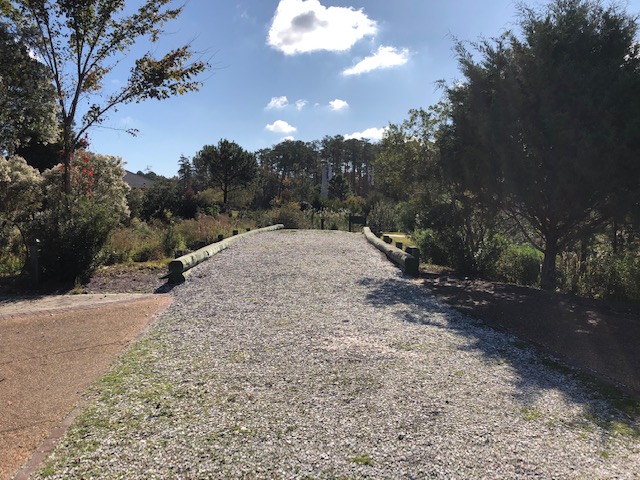
Pictures of Great Bridge Battlefield and monuments.







 Emerging Revolutionary War Era