“Rev War Revelry” The Winter that Won the War, Valley Forge

In June 1778, the Continental army marched out of their winter encampment in Valley Forge, Pennsylvania and headed toward New Jersey in pursuit of the retreating British army. The past six months, from December 1777 to June 1778, ushered in a period of suffering, renewal, and change.

Valley Forge is imprinted into the psyche of Americans as the the toughest winter of the entire American Revolution. In fairness, it was one of many tough winters that the Continental army survived. However, the reasons why this winter stands out will be part of the discussion of this Sunday evening’s “Rev War Revelry” which can be found on Emerging Revolutionary War’s Facebook page at 7 pm. EDT.

This week’s historian happy hour includes a discussion with Philip S. Greenwalt author of the recently released Emerging Revolutionary War Series title, The Winter that Won the War. This is the fourth volume in the series, with previous ones covering Lexington and Concord, Trenton and Princeton, and Monmouth.

Greenwalt will discuss how the Valley Forge winter was the intersection of various issues and how the decisions made and the determination of survival by the army made this the winter that won the war.

Tune in as well to hear how you can purchase a copy of this book to take with you as you plan that summer trip to Valley Forge and the Philadelphia area!

Patriot Field Gun Horse Harness

Emerging Revolutionary War welcomes back guest historian Karl G. Elsea

When visiting Revolutionary War battlefields there are often replica field guns (sometimes with original barrels) on the grounds. What is often not shown is the equipment needed for the gun to get to the field. That movement required horse(s) and harness and a limber. An earlier article provided information on Patriot limbers. This article concerns the horse harness.


NPS Yorktown, Author’s photo. Original 4-pounder barrel on reproduction carriage

There are inventories and paintings that show British harness used during the war. Muller’s A Treatise of Artillery shows the horse harness hook-ups on British limbers for medium and heavy artillery, and it is somewhat unique. The British hook-up appears more restrictive as to horse size. The cart-saddle used by the British was ubiquitous. It seems reasonable that the Patriots would have used the same harness with the exception of the specialized hook-up hardware on the limber. The following part of a Philipp Loutherbourg painting of Warley Camp detailing a review in 1778 clearly shows the cart-saddle with chain on the thill horse and the rest of the British harness.

Continue reading “Patriot Field Gun Horse Harness”

Marching Out of Valley Forge

On this date, in 1778, the Continental army, under the command of General George Washington broke winter camp and began the spring campaign. Their objective was to catch the British army, under Sir Henry Clinton, retreating across New Jersey to the safety of New York City.

Nine days later, in the last major action in the northern theater, Washington’s forces would engage their adversary in the Battle of Monmouth. The army that fought this engagement in one of the hottest recorded days of any battle in American history, was a much improved military organization. Not perfect but much improved from the force that marched into Valley Forge six months prior.

During that half-year, from December 19 to June 19, the army saw an improved quartermaster department, the formation of a military handbook and tactical training, and the news that a powerful European nation had agreed to become allies in the quest for American independence.

Much is made of turning points or the critical importance of an event so I do not want to retread that argument here. However, what happened at Valley Forge was significant in the path to eventual American victory and the formation of the United States of America.

There is an old saying that even the greatest fiction writers cannot envision a story that is unbelievable as actual events can be. Or to sum it up more succinctly, a coincidence. After delays due to the pandemic, the latest volume of the Emerging Revolutionary War Series was released, in time for the 243rd anniversary of the end of the winter cantonment at Valley Forge.

The book is authored by yours truly and can be found via the publisher’s website by clicking here or through your favorite bookseller or by emailing Emerging Revolutionary War.

Then follow in the footsteps of Washington’s forces to Monmouth.

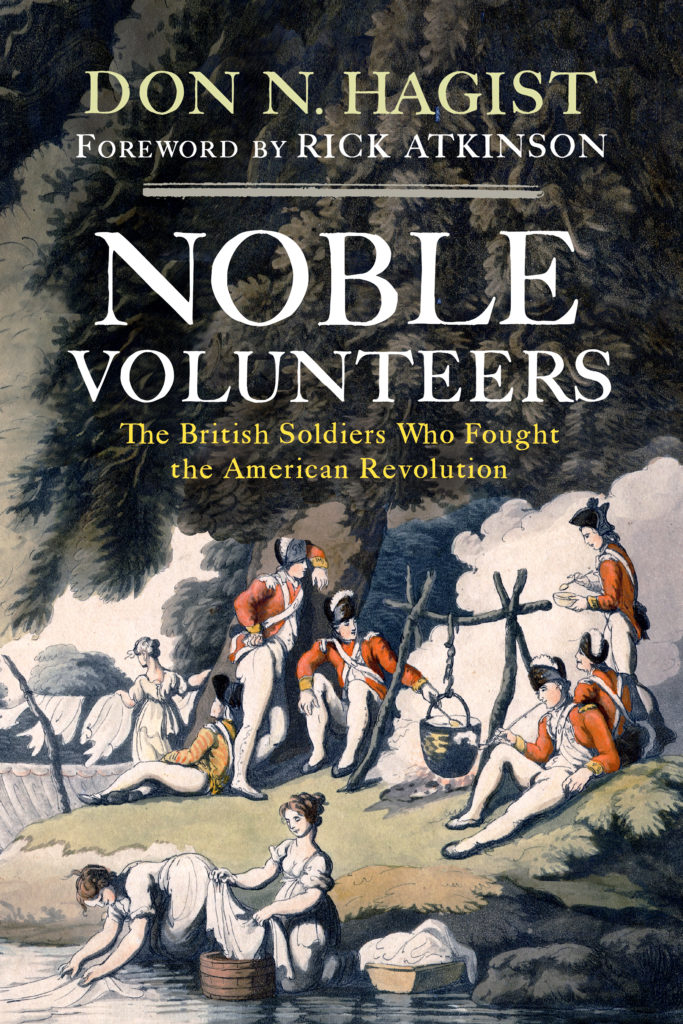
Review: Noble Volunteers: The British Soldiers Who Fought the American Revolution by Don Hagist

Don Hagist is one of our foremost American authorities on the common British soldier during the American Revolution. His latest book, Noble Volunteers: The British Soldiers Who Fought the American Revolution, is an institutional portrait of the British army that fought the American Revolution. Hagist has walked this ground before, most notably in British Soldiers, American War, which dedicated a chapter to a specific individual as a way of illustrating the experience of the common soldier. Noble Volunteers extrapolates on that, using soldier accounts, regimental paybooks, muster rolls, pension applications, and any other available material to give us an integrated picture of the entire army and how it functioned. It’s an extraordinarily valuable book.

Continue reading “Review: Noble Volunteers: The British Soldiers Who Fought the American Revolution by Don Hagist”

Review: To The End of the World, Nathaniel Greene, Charles Cornwallis, and the Race to the Dan by Andrew Waters

Writing over thirty years after the fact, Henry “Light Horse Harry” Lee summed up the events of February 14, 1780 with the line, “Thus ended, on the night of the 14th of February, this long, arduous, and eventful retreat” (190). Upon hearing of General Nathanael Greene’s exploits in this movement, General George Washington wrote, “You may be assured that your Retreat before Lord Cornwallis is highly applauded by all Ranks and reflects much honor on your military Abilities.” (198).

What Lee would remember as “eventful” and Washington and fellow military ranks “highly applauded” is remembered today as the “Race to the Dan.” This retrograde movement, undertaken by Greene’s forces from South Carolina to the Dan River in southern Virginia, is sandwiched between the engagements at the Battle of Cowpens in January 1781 and the British pyrrhic victory at Guilford Court House in March 1781. Yet, this retreat may be on the turning points in the southern theater that led the British, under Lord Charles Cornwallis to his eventual demise at Yorktown in October 1781.

Great historians, such as John Buchanan is his monumental work The Road to Guilford Court House have covered with broad strokes this period of time but a dedicated study was much needed in the historiography of the American Revolution. Insert Andrew Waters, writer, editor, and conservationist, whose name may be familiar from previous works such as The Quaker and the Gamecock: Nathanael Greene, Thomas Sumter, and the War for the Soul of the South. His latest book, To The End of the World, Nathanael Greene, Charles Cornwallis, and the Race to the Dan, captures this important military movement while providing an expose on the leadership of Greene woven in. The title of the book is pulled from a quote by Brigadier General Charles O’Hara, Cornwallis’s second-in-command during this campaign. With a background in land conservation with a focus on river corridors and watersheds, Waters found a connection with Greene, who studied the various waterways—or ordered subordinates—to study the various rivers, to better understand the topography for military campaigns.

After a stint in Salisbury, North Carolina, Waters became fascinated with the Race to the Dan story and decided to plunge in to understanding this period of the American Revolution. He found that “the Race to the Dan is a remarkable tale, fit for cinema or an epic novel, and not only for its accounts of four narrow escapes across its four rivers” (xv). He was drawn “to its story” (xx) and any reader of the book is the beneficiary of that discovery.

Along with weaving in the innate leadership qualities of Greene, Waters brings to light the importance of military leaders not as well-known such as William Lee Davidson, William R. Davie, and Edward Carrington with more household names of Lee, Daniel Morgan, and Otho Holland Williams. Throw in the names of Cornwallis, O’Hara, and Banastre Tarleton, and the pantheon of American Revolutionary personas is complete.

In this approximate month-long retreat, Greene saved the American Revolution in the southern theater and set in motion the events that led to the climactic victory at Yorktown. Waters, with his 2020 publication, has now helped save the story of the Race to the Dan from its unintended lapse into obscurity.

Information:

Published: 2020 (Westholme Publishing)

264 pages, including index, footnotes, images, and maps

Secrets of the Patriot Limbers

Emerging Revolutionary War welcomes back guest historian Karl G. Elsea

When visiting Revolutionary War battlefields there are often replica field guns on the grounds. Not shown, in almost all cases, is the vehicle that pulled the gun to the battle – the limber. Though less “cool” it was essential.

Author’s limber and photo. Obsolescent British design with cart hook-up hardware modification

Today, there is no surviving original Patriot field gun limber from the American Revolutionary War. That is a problem when attempting to reproduce representative Patriot field gun limbers. The normal starting place, Muller’s A Treatise of Artillery, does not include information concerning British field (light) gun limbers. Muller’s Treatise only contains information on limbers for medium and heavy guns.

The absence of any original limbers is especially gulling because the Patriots had access to both obsolescent designs and the most advanced designs. The Hessian field gun limber was probably the most advanced limber design in 1776, and the Patriot forces captured six of them at Trenton on December 26, 1776. The Hessian limber design had three important improvements; firstly, the pintle (pin that connects the gun carriage to the limber) was behind the axle of the limber thus allowing a shorter turning radius and less likely damage to the gun carriage. Secondly, an ammunition box containing sixty rounds was on the limber. Thirdly, two wheel-horses were used instead of one thill horse thus providing twice the braking power. It would be interesting to know if the Patriots reproduced or incorporated those design elements.

Continue reading “Secrets of the Patriot Limbers”

“Rev War Revelry” 18th Century Weaponry

Brown Bess. Grasshopper. Charleville. May seem like random names with no connection to the title of this post. On the contrary though, these names, be it nicknames or the actual name, of the firearm or artillery piece were all used by the soldiers and militia of the American Revolution.

This Sunday, at 7 p.m. EST, on Emerging Revolutionary War’s Facebook page, the next “Rev War Revelry” will dive into the weaponry that was prevalent during the era of the American Revolution. Joining ERW will be T. Logan Metesh of High Caliber History LLC of which he is the founder.

With over a decade of experience working for the Smithsonian Institution, National Park Service, and the National Rifle Association Museums, Metesh is a sought after consultant, writer, and museum professional. He will use his interpretive ability to present history and research on firearms and firearms development to this historian happy hour.

We look forward to welcoming Logan Metesh to the “Rev War Revelry” Sunday night chat and hope you will join us as well.

“This Sudden Expedition”: The Capture of Fort Ticonderoga – 246 Years Later

On this date in 1775, an early victory was secured for the American cause along the western shore of Lake Champlain in New York. Led by Colonel Benedict Arnold and Ethan Allen, over eighty men surprised and overwhelmed Fort Ticonderoga’s garrison, capturing the strategic stronghold and much needed supplies and cannon for the Americans. On May 22, the Pennsylvania Packet reported on the news received from the north:

On Wednesday evening last arrived here, John Brown, Esq; from Ticonderoga, express to the General Congress, from whom we learn, that on the beginning of this instant, a company of about fifty men, from Connecticut, and the western part of Massachusetts, and joined by upwards of one hundred from Bennington, in New-York government, and the adjacent towns, proceeded to the eastern side of Lake Champlain, and on the night before the 11th current, crossed the Lake, with 85 men, (not being able to obtain craft to transport the rest,) and about daybreak invested the fort, whose gate, contrary to expectation, they found shut, but the wicker open, through which, with the Indian war whoop, all that could, entered one by one, others scaling the wall on both sides of the gate, and instantly secured and disarmed the sentries, and pressed into the parade, where they formed the hollow square;  but immediately quitting that order, they rushed into the several barracks on three sides of the fort, and seized on the garrison [commanded by Captain William Delaplace], consisting of two officers, and upwards of forty privates, whom they brought out, disarmed, put under guard, and have since sent prisoners to Hartford, in Connecticut. All this was performed in about ten minutes, without the loss of a life, or a drop of blood on our side, and but very little on that of the King’s troops.

In the fort were found about thirty barrels of flour, a few barrels of pork, seventy odd chests of leaden ball, computed at three hundred tons, about ten barrels of powder in bad condition, near two hundred pieces of ordnances of all sizes, from eighteen pounders downwards, at Ticonderoga and Crown Point, which last place, being held only by a corporal and eight men, falls of course into our hands.

By this sudden expedition, planned by some principal persons in the four neighboring colonies, that important pass is now in the hands of the Americans, where we trust the wisdom of the Grand Continental Congress, will take effectual measures to secure it….

The story of the capture of Fort Ticonderoga is as confusing as it is epic. Arnold, a Connecticut man, held a colonel’s commission to take the fort from the Massachusetts Committee of Safety, but he rode ahead to be part of the action without the men he was ordered to raise for the expedition; and Ethan Allen and his Green Mountain Boys of the Hampshire Grants were anti-New York and in search of their own glory after being asked to join a separately organized assault on the fort by Colonel Edward Mott sanctioned by Connecticut.

Ethan Allen demands the surrender of Fort Ticonderoga in this dramatized illustration. NYPL

The irony of all of this is that each plan formulated by those involved was done entirely without the advice or consent of New York, the very colony whose boundaries the fort was within. This occurred all during the commencement of the Second Continental Congress when New York was still weary of escalating hostilities with the King. Regardless of the awkward and unconcerted circumstances, it is undeniable that the fort’s capture helped secure victory for the Americans during the siege of Boston when fifty-eight pieces of ordnance were transported to assist General Washington in driving the British out of the city. Whether or not Allen heroically demanded Capt. Delaplace to surrender, “In the name of the Great Jehovah and the Continental Congress!” as is remembered (he almost definitely did not), is an entirely different question.

Hindsight is 2020 (or 2021)

Emerging Revolutionary War welcomes guest historian Liz Williams, from Historic Alexandria, the host of the second annual symposium

When we planned our 2nd Annual Revolutionary War Symposium for 2020, our theme came easily – Hindsight is 2020. Little did we know that our cheeky title would take on a different meaning as we had to navigate a global pandemic. But I am excited that we can still offer our symposium (yes 6 months later) and virtual!  In this format, we can zoom our experts to computers and smartphones across the country. And this year we have a great variety of topics – from Drunken Hessians to African American Continentals. Learn about Loyalists, battles in the Southern Theatre, and along a creek in southeastern Pennsylvania.

As we move toward the 250th anniversary of the nation, it is critical for us all to look with fresh eyes at our founding. At Gadsby’s Tavern Museum, we engage with the complexity and challenges of early America, many of which were rooted in what transpired before and during the Revolutionary War. By understanding our past, we can continue the work of creating a better United States for all.

The Symposium costs $40 per person, $20 OHA Members & Students and reservations can be made at AlexandriaVa.gov/Shop. Looking forward to seeing everyone on May 22!

North Carolina’s Response to the 1775 Battle of Lexington and Concord

Emerging Revolutionary War welcomes guest historian Travis Copeland

Rumors roared throughout the Colonies in the Spring of 1775. From Watertown, Massachusetts with an earnest pen, a letter was taken down at 10am on Wednesday Morning, April 19, 1775. Reports had been sent to New London, Rhode Island, and we’re beginning to extend south to the Carolinas. There were reports that, “action had happened between the King’s Troops and the inhabitants of Boston.” The shot fired in Lexington, Massachusetts on April 19 was “heard around the world,” and North Carolina would be no exception. The above, brief sentence recount of the battle was enclosed with the expanded statement,

To All Friends of American Liberty let it be known,

That this morning before break of day a [British] Brigade consisting of about one thousand or twelve hundred men landed at Phipp’s farm in Cambridge, and marched to Lexington, [Massachusetts] where they found a Company of our Colony Militia in arms upon whom they fired without any provocation and killed six men and wounded four others. By an Express from Boston we find that other Brigades are upon their march from Boston supposed to be about one thousand…I have spoken with several who have seen the dead and wounded.[1]

In the age of foot-speed news, a letter penned on April 19 could take weeks to reach the inhabitants of North Carolina. From the Massachusetts committee of safety, the letter was dispatched with earnest haste to Worcester and then beyond the Massachusetts borders. Connecticut, New York, and British Canada were given a recount of the events by April 25, although news by mouth spread as rapid as fire.[2] In the last week of April, no news had yet reached deep South. New Jersey and Maryland were informed by pen just before April became May, but the southern colonist was still much in the dark. Finally, on Friday, April 28th at 8pm colonists from Alexandria, Virginia sent the statement and letter to Fredericksburg and from there to Surry County, Chowan, and Onslow, North Carolina. A flurry of exchange between Virginia and North Carolina created a clamor. War! 

Each county repeated to the next, “disperse the material passages through all your parts.”[3] On May 3, Edenton and Chowan passed-on the news of the clash with his Majesty’s troops.[4] The delegates at Craven County received the news on May 6th. It was ordered that they, “in haste have sent to request you will pursue the enclosed papers and you will do by opening the packet herewith sent the moment it comes your house.”[5] No more important news than the coming of the Revolution, although unknown in the fullest sense, could create such an exasperated command. Yet, the Bath delegates were not done with their orders. They further demanded that Craven county, “get three or four of your Committee to write a line and send the whole enclosed to the next Southward Committee with the utmost dispatch.”[6]

The clamor of excitement came from a colony that was thought to be deeply sympathetic to the British. Regards for the crown were certainly present in the Southern colonies, but the circular letter’s earnest nature displays the patriotic fervor that ran through the colonists. Finally, the letter was directed to Abner Nash, who represented the provision rebel government in North Carolina. As the news reached the upper echelons of society, directions were given to extend the news to anyone using a horse or bearer.[7] Cornelius Harnett, prominent Patriot politician in Wilmington, directed those who would receive the letter to, “for God’s sake send the man on without the least delay and write…to forward it by night and day.”[8] Others shared Harnett’s tone, writing, “Pray don’t neglect a moment in forwarding” and “I cannot avoid writing to you to beg you to forward the Paper containing such important news and pray order the express you send to ride night and day.”[9] Finally, directions were given to move the letter to South Carolina, “to be forwarded to Charlestown.”[10]

Several weeks after the initial fury of letter exchange, another letter was written from Lieutenant Governor Bull of South Carolina to the Earl of Dartmouth. The provisional governor allied with the Crown reflected on the disposition of the Carolinas. Despite the growing desire to show British force against the rebellious colonists, Lt. Gov. Bull stated plainly that, “The account of the Skirmish or Engagement between the King’s Troops and the Provincials of Massachusetts near Lexington on the 19th of last month, seems to produce effects here [the Carolinas] very different from intimidation.”[11] The southern colonist of North and South Carolina would not be thrown back or made afraid by the acts of British commanders and their regulars in the North.

The Continental Congress would not be intimated. It’s North Carolina representatives William Hooper, Joseph Hewes, and Richard Casewell issued a circular letter which shared the tone of Lt. Gov. Bull’s correspondence. They stated plain, with the April 19, 1775 battles of Lexington and Concord in mind, 

Heaven seems to have assumed the protection of the injured insulted Colonists and signally to have appeared in their Favour: when in the last Battle at Lexington six hundred raw, undisciplined Provincials defeated eighteen Hundred regular Troops and pursued them into their Camp…It becomes the duty of us in whom you have deposited the most sacred trusts to warn you of your danger and of the most effectual means to ward it off. It is the Right of every English Subject to be prepared with Weapons for his defense. We conjure you by the Ties of Religion Virtue and Love of your Country to follow the Example of your sister Colonies and to form yourselves into a Militia. The Election of the officers and the Arrangement of the men must depend upon yourselves. Study the Art of Military with the utmost attention, view it as the Science upon which your future security depends.[12]

The colony of North Carolina and its leadership was moved by the initial recount of battle and the circular letter’s news of Massachusetts. The waters of Revolution were rising and the Patriot leaders were beginning to call for more than just a uniform exchange of words. They desired for the state to take its formidable place in as rebels in the South. Further, the flurry of response to the Lexington engagement shows the prominent place of North Carolina in the revolution from the earliest days. Leaders in the South did not wait until the war moved South in 1779, 1780, and 1781 to throw their pens, support, and persons behind the cause of Gen. Washington, the Continental Congress, and the New England colonies. North Carolina was revolutionary from the start.

Sources:

[1] “Letters Concerning the News of the Battle of Lexington in Massachusetts, April 20 – May 9, 1775,” Colonial and State Records of North Carolina, vol. 9, p. 1234.

[2] “Letters Concerning the News of the Battle of Lexington in Massachusetts, April 20 – May 9, 1775,” Colonial and State Records of North Carolina, Documenting the American South, https://docsouth.unc.edu/csr/index.php/document/csr09-0412. vol. 9, p. 1230-31.

[3] “Letters Concerning the News of the Battle of Lexington in Massachusetts, April 20 – May 9, 1775,” Colonial and State Records of North Carolina, vol. 9, p. 1236.

[4] “Letters Concerning the News of the Battle of Lexington in Massachusetts, April 20 – May 9, 1775,” Colonial and State Records of North Carolina,. 9, p. 1237.

[5] “Letters Concerning the News of the Battle of Lexington in Massachusetts, April 20 – May 9, 1775,” Colonial and State Records of North Carolina, vol. 9, p. 1237.

[6] “Letters Concerning the News of the Battle of Lexington in Massachusetts, April 20 – May 9, 1775,” Colonial and State Records of North Carolina, vol. 9, p. 1237.

[7] “Letters Concerning the News of the Battle of Lexington in Massachusetts, April 20 – May 9, 1775,” Colonial and State Records of North Carolina, vol. 9, p. 1238.

[8] “Letters Concerning the News of the Battle of Lexington in Massachusetts, April 20 – May 9, 1775,” Colonial and State Records of North Carolina, vol. 9, p. 1238.

[9] “Letters Concerning the News of the Battle of Lexington in Massachusetts, April 20 – May 9, 1775,” Colonial and State Records of North Carolina, vol. 9, p. 1238.

[10] “Letters Concerning the News of the Battle of Lexington in Massachusetts, April 20 – May 9, 1775,” Colonial and State Records of North Carolina, vol. 9, p. 1239.

[11] “Letter from William Bull to William Legge, Earl of Darmouth, May 15, 1775,” Colonial and State Records of North Carolina, Documenting the American South, https://docsouth.unc.edu/csr/index.php/document/csr09-0426. vol. 9, p. 1258-1260.

[12] “Letter from William Hooper, Joseph Hewes, and Richard Casewell to the Inhabitants of North Carolina, June 19, 1775,” Colonial and State Records of North Carolina, Documenting the American South, https://docsouth.unc.edu/csr/index.php/document/csr10-0011. vol. 10, p. 20-23.

Travis Copeland is a North Carolina native with a love for early American history. He holds a B.A in History and Humanities and is studying for a postgraduate history degree. His research interests include North Carolina history and the early southern United States from the Revolutionary War to the Civil War with a particular interest in military conflict, political-social integration, and local history. When not researching and writing, he enjoys teaching, the outdoors, gardening, and good food and beer. Travis lives and teaches in North Carolina.