For this week’s “Rev War Revelry” Emerging Revolutionary War ventures to the west to discuss the recently published book, “Till the Extinction of this Rebellion, George Rogers Clark, Frontier Warfare, and the Illinois Campaign of 1778-1779.” The author, Eric Sterner, is a contributor to the Emerging Revolutionary War, along with the author of An Anatomy of a Massacre: The Destruction of Gnadenhutten, 1782. When not writing history, Sterner had a career in government and public policy besides contributing to the literature and study of the American Revolutionary War era.
This book, published by Westholme Publishing, examines the viewpoints of the American, British, and Indigenous perspectives and illustrates the wide impact of the American Revolution on the peoples west of the Appalachian Mountains. What happened with Clark’s movements and campaign will lay the foundation for American expansion and the “opening of the West” following the American Revolution.
We hope you can join us for this historian happy hour this Sunday at 7 p.m. on our Facebook channel. If you miss it, we will post the revelry on our YouTube channel. Just search “Emerging Revolutionary War” to subscribe.
We are excited to announced our FIFTH annual ERW bus tour will be on November 7-9, 2025 and will cover the 1777 Philadelphia Campaign.
Author and historian Michael Harris will join us as we cover the fall of 1777 campaign. The British Army under Gen. William Howe made a concerted effort to take the American capital of Philadelphia. George Washington and the Continental Army fought major actions at Brandywine and Germantown in an effort to hold and take back the city. The tour will cover sites associated with the Philadelphia Campaign, such as Brandywine, Germantown, Paoli and others.
Tickets are $250 per person and will include Friday night lecture at the host hotel, all day bus tour on Saturday and half day bus tour on Sunday. A lunch is included for Saturday.
Our host hotel is the Holiday Inn Express and Suites – King of Prussia. Lodging is NOT included in the registration fee. A room bloc has been established under the name of “Emerging Revolutionary War.” A link will be provided in the future for hotel lodging.
Join us for our FIFTH annual tour as we take on the beginning of the American Revolution just a few months before the 250th anniversary. Learn about the dramatic events that led to some of the bloodiest days in the American Revolution. There is no better way to experience history than to stand in the footsteps of where it happened!
Although 1781 is most known for the pivotal and successful victory at Yorktown, action in the American Revolution unfolded throughout the eastern seaboard. In early September 1781, Benedict Arnold returned to the land of his birth to lead a raid on New London and the port that harbored preying privateers.
During this raid, the American militia under Lieutenant Colonel William Ledyard especially, stoutly defended Fort Griswold until overcome by superior numbers. The town of New London was also torched and saw a rarity like the battle of Trenton, in that combatants fought through the very streets of the town.
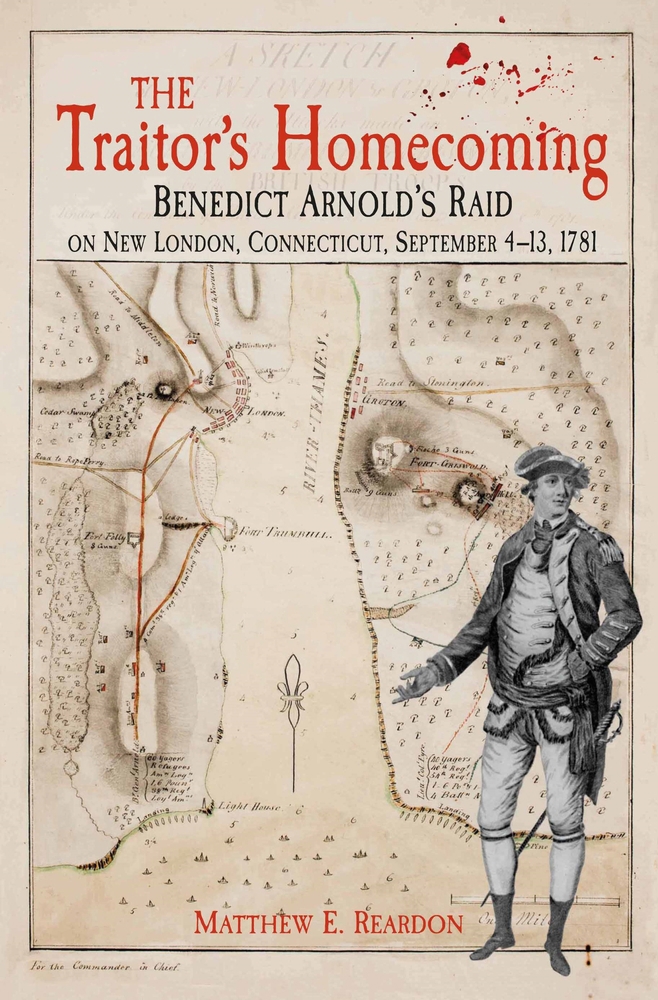
Capturing all this and uncovering new primary sources, Matthew Reardon weaves a narrative that balances military history, from the fighting to the strategies, with the impact on New London and Connecticut. His book, “The Traitor’s Homecoming, Benedict Arnold’s Raid on New London, Connecticut, September 4 – 13, 1781” was recently published by Savas Beatie, LLC. Matthew is a native of northeastern Connecticut and is a public educator along with being a command historian for the Connecticut Military Department. He can be reached for inquiries on speaking engagements or how to purchase the book here.
The book will be the focus of this week’s “Rev War Revelry.” We hope you can join us on our Facebook page on Sunday, 7 p.m. EDT.
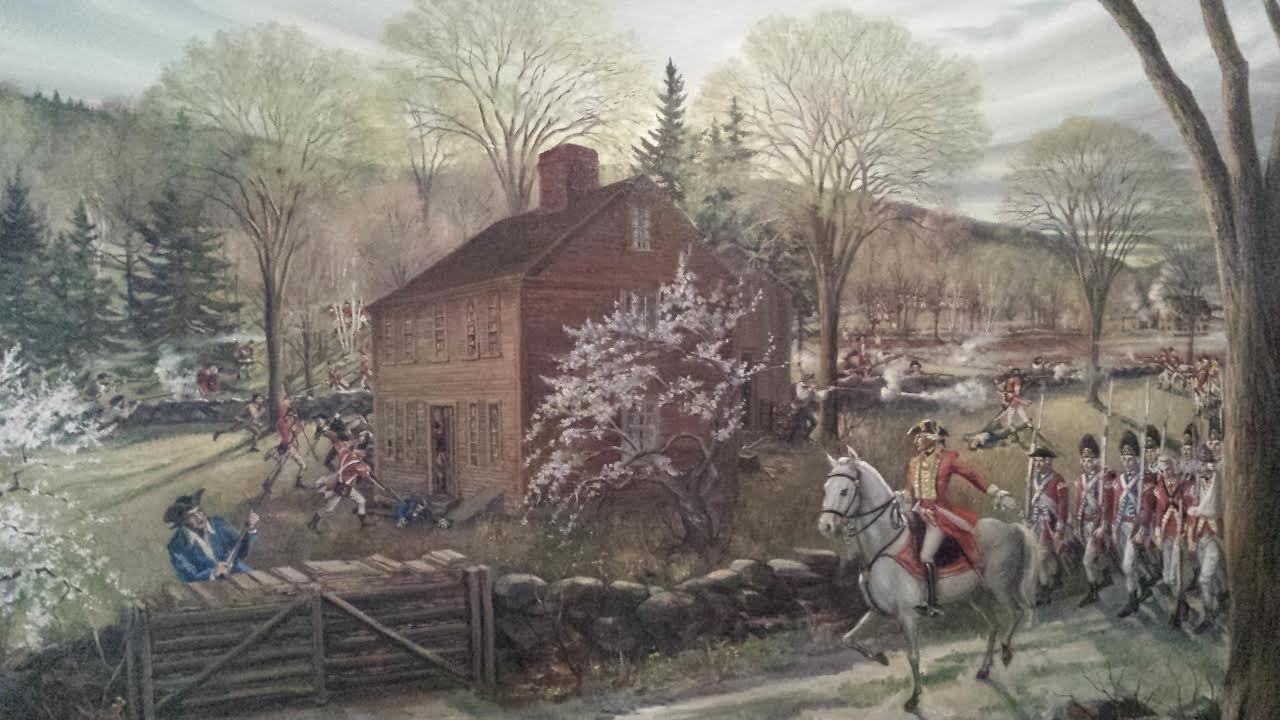
*Note* This “Rev War Revelry” will be recorded in advance as the Emerging Revolutionary War crew will be in Lexington and Concord, Massachusetts for the 4th Annual Emerging Revolutionary War bus tour.
Fredericktown, Maryland, August 1, 1775, a gentleman on business wrote to his contact in Philadelphia the following observation of a company of volunteers answering the call to head north to Boston to join what would become the Continental Army
“Notwithstanding the urgency of my business, I have been detained three days in this place by an occurrence truly agreeable. I have had the happiness of seeing Captain Michael Cresap marching at the head of a formidable company of upwards of 130 men, form the mountains and backwoods, painted like Indians, armed with tomahawks and rifles and dressed in hunting shirts and moccasins, and though some of them had travelled near eight hundred miles from the banks of the Ohio, they seemed to walk light an easy and not with less spirit than at the first hour of their march. Health and vigour, after what they had undergone, declared them to be intimate with hardships and familiar with danger. Joy and satisfaction, were visible in the crowd that met them. Had Lord North been present, and been assured that the brave leader could raise thousands of such to defend his country, what think you, would not the hatchet and block had intruded upon his mind? I had an opportunity of attending the Captain during his stay in Town, and watched the behavior of his men, and the manner in which he treated them; for it seems that all who go out to war under him do not only pay the most willing obedience to him as their commander, but in every instance of distress look up to him as their friend or father. A great part of his time was spent in listening to and relieving their wants, without any apparent sense of fatigue and trouble. When complaints were before him he determined with kindness and spirit, and on every occasion condescended to please without losing is dignity.”
esterday the Company were supplied with a small quantity of powder from the magazine, which wanted airing, and was not good for rifles ; in the evening, however, they were drawn out to show the gentlemen of the town their dexterity at shooting. A clap board, with a mark the size of a dollar, was put up ; they began to fire at it off band, and the bystanders were surprised, few shots being made that were not close to or in the paper. When they had shot for a time in this way, some lay on their backs, some on their breast or side, others ran twenty or thirty steps, and firing, appeared to be equally certain of the mark. With this performance the company were more than satisfied, when a young man took up a board in his hand, not by the end, but by the side, and holding it up, his brother walked to the distance, and very coolly shot into the white ; laying down bis rifle, he took the board, and holding it as it was held before, the second brother shot as the former had done. By this exercise I was more astonished than pleased. But will you believe me, when I tell you, that one of the men took the board, and placing it between hia legs, stood with his back to the tree while another drove the centre. What wonld a regular army of considerable strength in the forests of America do with one thousand of these men, who want nothing to preserve their health and courage but water from the spring, with a little parched corn, with what they can easily procure in hunting ; and who wrapped in their blankets, in the damp of night, would choose the shade of a tree for their covering, and the earth for their bed.”
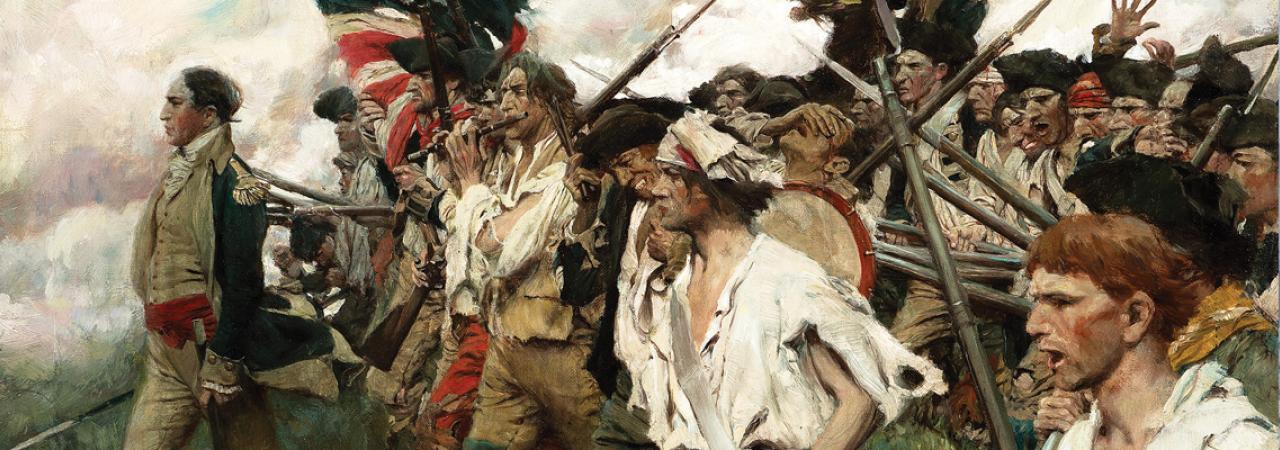
Although a depiction of the 1st Maryland at Guilford C.H in 1781 some of these men are dressed similar to the riflemen mentioned above (wikipedia)
*Account is in “Papers Relating Chiefly To the Maryland Line During the Revolution” Thomas Balch, editor. pgs. 6-7.
Not long ago, a good friend of mine found himself in Henry County, Va. Located southwest of Richmond, the county was named for the patriot, Patrick Henry, in 1777. Touring a local cemetery there, my friend came upon a very interesting headstone. It was the grave marker for a soldier of the American Revolution; a man named Thomas Pearson.
Grave of Thomas Pearson
According to the headstone, Thomas Pearson had served in the Virginia Continental Line and in May 1780, was wounded in battle against the British in South Carolina. My friend sent me a photograph of the headstone. Based on the place and date, he was hoping this Thomas Pearson had perhaps served at the battle of Camden. As a co-author of a book on Camden, I have to admit that I was quite intrigued myself.
But, based on my research for the book, I knew immediately that certain pieces of information on the man’s epitaph didn’t correspond to details of the Camden fight. First off, it indicates that Thomas Pearson served in the Virginia Continental Line. The Virginians engaged at Camden were actually not part of the Continental Line but, rather, state militia forces commanded by Gen. Edward Stevens. In fact, most of the troops of the Virginia Continental Line were captured by the British at the fall of Charleston on May 12, 1780.
The epitaph also reads that Pearson was wounded in May 1780, in South Carolina. The battle of Camden occurred later, on August 16, so most likely this gentleman wasn’t there. Still, the gravestone intrigued me. I decided to do a little research into Thomas Pearson and sadly, I was to discover that his story was a tragic one.
On November 30, 1812, at the age of 61, Thomas Pearson applied for a pension for his services in the Revolutionary War from the Commonwealth of Virginia. According to his application, he was “a soldier in the revolutionary war, belonging to the VA Line on continental establishment, and attached to the regiment commanded by Col. Abraham Buford.” Clearly, he was a veteran of the southern campaign.
In May 1780, he was indeed serving in the Virginia Continental Line, as an officer of the 3rd Virginia Detachment of Scott’s Virginia Brigade. Commanded by Col. Abraham Buford of Culpepper County, VA, the 3rd Detachment, nearly 400 strong, was marching into South Carolina to the relief of the City of Charleston, which was under siege by the British. The city fell before Buford’s column could reach it, however. Afterwards, Buford received orders from Brig. Gen. Isaac Huger to fall back to Hillsborough, NC. In Charleston, British Lt. Gen. Charles, Earl Cornwallis, who would soon assume command of all British forces in the south, learned of the existence of these Patriot reinforcements. On May 27, he sent troops in pursuit. They were mounted troops of the British Legion, mostly loyalists under the command of the infamous Lt. Col. Banastre Tarleton. Throughout the southern campaign, the 26-year-old Tarleton would establish for himself a reputation for cruelty and blood lust that was unsurpassed. Some of the acts attributed to him during this period were true and some were not, but his dubious reputation would become cemented in the minds of many Americans during this episode.
Lt. Col. Banastre Tarleton
Tarleton set out in pursuit of Abraham Buford’s troops on May 27, leading around 300 of his Legion dragoons, some mounted infantry, and a detachment of the 17th Light Dragoons. Having a reputation for driving his forces unmercifully, Tarleton’s troops were able to quickly catch up, and closed in on Buford’s Virginians on May 29, on the border of North and South Carolina. It was farming country here, known as the Waxhaws.
When the two forces were still some miles apart, Tarleton issued a call for surrender, under a white flag of truce. In his message he wrote: “Resistance being vain, to prevent the effusion of human blood, I make offers which can never be repeated.” After conferring with his officers, Col. Buford made the decision to refuse Tarleton’s offer. He replied: “I reject your proposals, and shall defend myself to the last extremity.” The Patriot force then continued its march north towards Hillsborough, with Tarleton’s troopers continuing the pursuit.
By mid-afternoon of the 29th, Tarleton’s lead elements caught up with Buford’s column, attacking and destroying the small rear guard. Commanding that rear guard was Lieut. Thomas Pearson. Witnesses said that Pearson was sabered and knocked from his horse. While he lay on the ground, he continued to receive wounds; his face was mangled and there were cuts across his nose, lips, and tongue. Col. Buford halted his column, deploying his infantry in a single line across an open field, east of the Rocky River Road. He then issued a questionable order: his men were told to hold their fire until the dragoons were almost on top of them and then unleash a volley at point-blank range. When the charge came, the Virginians followed orders; they held their fire until the British were about 10 yards away. While their one volley did manage to empty a few enemy saddles, it wasn’t nearly enough and now the Virginians had no time to re-load their muskets. In a flash, Tarleton’s troopers were in among the Continentals, hacking men down with their sabers, wholesale.
Quickly realizing the battle was lost, Buford sent forward a white flag of surrender. About this time, Tarleton’s horse was killed, going down and momentarily trapping its rider. Some of his nearby troops became enraged, believing the Patriots were not honoring their own white flag. These troops are said to have continued sabering Patriot soldiers as they tried to surrender. Abraham Buford and some of his troops did manage to escape the field but his command was destroyed. Continental casualties totaled around 113 killed, 147 wounded, and 50 captured. Two Patriot 6-pounder artillery pieces and 26 baggage wagons were likewise captured. Compared to this, Tarleton’s losses were negligible. The battle would long be remembered as “Buford’s Massacre” and many of the Patriot dead lie today in a mass grave at the battlefield site.
Mass Grave at the Waxhaws battle site
Banastre Tarleton’s reputation for cruelty was established at the Waxhaws. Nicknames like “Bloody Ban” and “Bloody Tarleton” began to be used to describe him and the phrase “Tarleton’s Quarter” would become a Patriot battle cry.
Even though severely wounded in this action, Lieut. Thomas Pearson managed to survive his injuries, living until 1835. He was 84 when he died; his last years were hard on him. According to his pension application, he “received sundry wounds in his head and arms, which have rendered him, in his present advanced stage of life, incapable of maintaining himself by labour (sic).” On January 12, 1813, the Commonwealth of Virginia granted Pearson’s request for relief. He received an immediate payment of $50, with an annual pension payment of $60.
Today, this Revolutionary War veteran lies at rest in a quiet cemetery in Henry County, VA.
Emerging Revolutionary War welcomes back guest historian Michael Aubrecht
In 1777 Thomas Jefferson and a committee of revisors came to the City of Fredericksburg for the purpose of revising several Virginia statutes. This led to Jefferson drafting the Virginia Statute for Religious Freedom.
When Jefferson and his comrades arrived in Fredericksburg they were met with a town bristling with military activity. Troops were drilling in the public square and filled the crowded streets, buildings and shops. Awaiting travel orders were the men of the Second Virginia and the Seventh Virginia, ordered here on January 9 for a rendezvous just prior to marching to join General Washington at the front. By the time Jefferson arrived in Fredericksburg, sixty of the more than two hundred battles and skirmishes of the war had already taken place.
On February 27, 1776 Patriot and Loyalist forces faced off at Moores Creek Bridge in southeastern North Carolina. Loyalist forces anticipated support from a British army arriving along the North Carolina coast and planned to use this combination force to return British authority in North Carolina. Though, when help did not arrive, a mixed bag of North Carolina Patriots turned back an attack at Moores Creek Bridge. Their victory, combined with the Patriot victory at Great Bridge, VA in December 1775, solidified their control of North Carolina. Additionally, the Loyalist defeat served as a major deterrent for Loyalist support until the opening of the Southern Campaign four years later. This small action had long lasting impact on the entire war in the south.
Join us this Sunday night at 7pm on our You Tube Channel ( https://www.youtube.com/@emergingrevolutionarywar8217 ) as we welcome back our own ERW historian Bert Dunkerly. Bert has extensive knowledge on the history of this battle and experience working at the battlefield itself. We will discuss the complex situation leading up to the battle and how this small battle changed the war strategy in the south. Grab a drink and join in on the discussion!
Emerging Revolutionary War welcomes guest historian Evan Portman
Overlooking the Grand Parade at Valley Forge National Historical Park is a statue almost as solid as the man it portrays. Baron von Steuben helped transform the American army into an effective and efficient fighting force in the winter of 1777-1778, but he also aided the country nearly a century and a half later. Yes, Baron von Steuben helped the United States through World War I—or at least the social turmoil on the home front.
Friedrich Wilhelm August Heinrich Ferdinand Steuben was born in Prussia (modern day Germany) in 1730 and served in the Prussian army through the Seven Years’ War. By 1775, Steuben had accrued a considerable amount of debt (despite his stature within the aristocracy), so he sought a foreign military appointment. Failing to catch the eye of the British, French, or Austrians, the Baron set his sights on the fledgling American government. Congress arranged for Steuben to be paid, depending on the outcome of the war, and sent him to the winter encampment at Valley Forge. There, he began drilling the Continental army and instituted better hygiene and sanitation practices. He also wrote a drill manual, which he published in 1779 as Regulations for the Order and Discipline of the Troops of the United States. After the encampment at Valley Forge, Steuben participated in the Southern Campaign of the Revolutionary War. After the Siege of Yorktown, Congress awarded the Baron a tract of land in New York where he died in 1794.
This Sunday, August 3rd at 7pm we welcome back to Rev War Revelry historian and author Alex Cain. Alex is a well known expert on everything Lexington, MA (among many other topics) and hosts a well researched blog: https://www.historicalnerdery.com/ . Alex’s book, We Stood Our Ground: Lexington in the First Year of the American Revolution is highly recommended by ERW for a detailed account of Lexington and its role in the beginning of the American Revolution.
The events of Boston leading up 1775 are well documented, but it was in the countryside around Boston where the populace became militarized. Towns such as Lexington was just as influential in the push to revolution as Boston. Join us as we discuss the role of Lexington, Massachusetts before it was made famous in April 1775.
Be sure to visit our Facebook page or You Tube Channel this Sunday at 7pm as we release this prerecorded Rev War Revelry. Alex will also be joining us this October for our ERW Bus Tour of Lexington and Concord, there a few tickets left so be sure to register to experience Lexington with Alex!
Emerging Revolutionary War welcomes guest historian Nicholas Benevento.
“The Line of Splendor: A Novel of Nathanael Greene and the American Revolution” is a historical novel written by Salina Baker. In her novel, she brings to life a figure who deserves more fame and recognition for his pivotal role in the Revolution. Nathanael Greene was a selfless general and leader who fought valiantly to defend his country and provide for his troops. He was a man who defied the odds and was placed in a position of power and leadership, a favorite of General George Washington. He was a man willing to put everything on the line for the independence and freedom of the United States.
Baker’s book picks up with Nathanael Greene’s life early in the 1770s when Nathanael is about the age of thirty. At this time, there were growing tensions in the American Colonies with Mother England. Shortly before the war broke out, Nathanael married his wife Caty in 1774, and Baker does a masterful job weaving their relationship into the story of his time in the war.
Baker’s work is a fascinating depiction of Nathanael Greene and the American Revolution. Readers of history often read facts and descriptions of events, which Baker provides. But she also takes the reader into the thoughts and conversations of Nathanael Greene, as well as other key figures in his life. Therefore, while this is a fiction novel, enthusiasts of this time period in American history would love this novel. Baker weaves in the history of the war, while also providing us with dialogue and feelings of Nathanael. Baker’s novel is a reminder to the reader that the generals and soldiers who fought in the Revolutionary War were not mythical figures who fought a war that would inevitably end in an American victory. These were real men with real emotions carrying their insecurities and flaws, while experiencing the highs and many lows of the war. Greene was central to many of the key battles early in the war, from the siege of Boston, to the debacle of New York, to the triumph of Washington’s crossing of the Delaware, to the trying times at Valley Forge. Greene held a tremendous weight on his shoulders throughout the war, especially when he led the Southern Army late in the war during the Southern Campaign.