Happy Washington’s Birthday (observed) from all of us at Emerging Revolutionary War. Though commonly incorrectly referred to as Presidents Day, the federal holiday is specifically for George Washington only. The indispensable man of America’s founding, Washington was “first in war, first in peace, and first in the hearts of his countrymen.” Born on February 22, 1732, the holiday is observed every year on the third Monday in February.
We hope you celebrate the day maybe by enjoying Washington’s favorite breakfast of “hoecakes swimming in butter and honey,” or making the journey to a Washington related site such as Mount Vernon, Ferry Farm, or his birthplace. Last year ERW historians Mark Maloy and Rob Orrison were able to be at his birthplace at the same time he was born (check out the video here). His hometown of Alexandria is holding a parade in his honor as well. If you are not nearby these sites, Mount Vernon is hosting special virtual programming. Be sure to also check out our interview with Tom Hand on the character of Washington we hosted last night. We hope you enjoy the day and remember George Washington on his holiday!
On February 11, 1731/32 George Washington was born at Popes Creek Plantation in the Northern Neck of Virginia. Seems like we have the date wrong? Actually, George had two birthdays, one in the old style calendar and one with the change to the new style, which pushed his birthday to February 22, 1732. According to his mother, Mary Ball, the first date, February 11, was the real date–regardless of the calendar change–and is what is written in the Washington family bible.
That fact and story and so much more will be the focus of this “Rev War Revelry” as Emerging Revolutionary War welcomes back historian Tom Hand of Americana Corner. Tom will join us in a discussion of all things George Washington as we celebrate the 290th birthday of this great American. The talk will broadcast live on Sunday, February 20 at 7 p.m. ET on our Facebook page. If you are unable to join live, you can catch it on our Facebook page, YouTube page, and podcast later.
The link to register for the Third annual Emerging Revolutionary War Symposium on September 24, 2022 is now live! To register for this year’s symposium visit: https://shop.alexandriava.gov/EventPurchase.aspx
The Lyceum in historic Alexandria, VA
Emerging Revolutionary War is excited to continue our partnership with Gadsby’s Tavern Museum and The Lyceum of Alexandria, VA to bring to you a day-long Symposium focusing on the American Revolution. The theme for 2022 is “The World Turned Upside: The American Revolution’s Impact on a Global Scale.” The American Revolution created waves across the world with its lasting impacts felt even today. This symposium will study the effects of this revolution that transformed governments and the governed across the globe.
King Louis XVI
Our speakers and topics include:
Dr. Lindsay Chervinsky: “Peace and Inviolable Faith with All Nations”: John Adams, Independence, and the Quest for Neutrality.
Dr. Norman Desmarais: “Reevaluating Our French Allies”
Kate Gruber: “A Retrospective Revolution: England’s Long 17th Century and the Coming of Revolution in Virginia”
Scott Stroh: “George Mason and the Global Impact of the Virginia Declaration of Rights”
Eric Sterner: “Britain, Russia, and the American War”
We will be highlighting each speaker and their topics in the coming weeks. Registration fee is only $60 per person and $50 for Office of Historic Alexandria members and students. If you feel more comfortable attending virtually, the fee is $30. Again, to register visit: https://shop.alexandriava.gov/EventPurchase.aspx
This Sunday, February 6, at 7 p.m., join ERW historians and guests as we discuss General Richard Montgomery and Colonel Benedict Arnold’s epic campaigns through the north to capture Quebec and claim Canada as the 14th colony.
One of the most difficult tasks when researching the French and Indian War is uncovering primary sources that can answer the age-old question in military history: Why did men fight? What were their motives for answering the call and sustaining the struggle? What were their observations and opinions regarding the events that surrounded them?
The letter included here in this post, written by Lieutenant Colonel Nathan Whiting of the 2nd Connecticut Provincial Regiment to his wife on August 1, 1755, during the Crown Point Expedition in New York is a rarity. Not only is it filled with raw emotion, but it also highlights a soldier’s fears and concerns relating to news of the war elsewhere, as well as his hopes for the coming days and weeks. The most fascinating aspect, however, is how the letter closes with the precise reasons for why Whiting was fighting—Duty to himself, his country, and his God. The commonly cited theme of duty, honor, and country is a constant in why men fight and sustain. Even in the French and Indian War, a conflict that did not involve a fight for independence, to preserve the Union, or to free the world from oppression, Whiting’s motives were still consistent.
Here is his letter:
My dearest wife,
I am here much Longer than I expected When I left you[.] Tis unhappy on many Accounts that we have delayed so long, but know not that it could be prevented. [W]e have orders now to March and . . . tis probable I shall not have opportunity to write you again till I get to the Carrying Place [the future site of Fort Edward along the Hudson River] I doubt your tender concern for me my dear will fill you with too many uneasy apprehensions & fears for my Safety Which I fear will be much increased upon hearing of the unhappy disaster of General [Edward] Braddock [at the battle of the Monongahela] but Let Not that trouble you my dear[.] God is my Safeguard and defense & I Trust has better things in store for his people than to give them all a prey Into the hands of their enemys—we are never more discouraged on Account of that defeat but Rather Animated with the greater Resolution to go on, we may have more enemys to encounter so that we may want more Strength, or our conquests will be more Glorious or our defeat less Shameful but the Latter I hope & believe Will Not be the Case. Pray make your Self as easy as possible I know your Dayly prayers are for my preservation Let it be an article of them that it not be obtained by any unworthy means, but in the prosecution of the Duty I owe at this time to my Self, my Country & my God.
Whiting, a New Haven merchant and veteran of King George’s War, led the 2nd Connecticut Regiment with distinction at the battle of Lake George on September 8, 1755, the culmination of the British campaign to capture Fort Saint-Frédéric (Crown Point) along Lake Champlain. Another post highlighting that action can be found here.
A new year and a new way to follow Emerging Revolutionary War! For 2022, we’re proud to unveil the Emerging Revolutionary War Podcast! We have taken the audio from our “Rev War Revelry” discussions (available on Facebook and YouTube) and have used them to create a new podcast. Now you can listen wherever you are, through Spotify and Apple Podcasts, to these engaging and interesting discussions with Emerging Revolutionary War historians and guests. We have all the programs from 2020 available in podcast form now and will be adding all of 2021 over the next few weeks. Now you can listen to discussions with Emerging Revolutionary War historians any time on your mobile device and on the go!
Merry Christmas from all of us at Emerging Revolutionary War! One of our favorite Christmas movies to watch is the movie “The Crossing”. In this movie, Jeff Daniels portrays George Washington on the eve of the battle of Trenton. The movie depicts the situation in December of 1776 and dramatizes the crossing of the Delaware River and the Battle of Trenton.
Join Emerging Revolutionary War historians Mark Maloy, Dan Welch, and Kevin Pawlak as we host a watch party of the movie. You can tune in live on Sunday, December 26, 2021 (the 245th anniversary of the crossing and the battle) on our Facebook page at 7 p.m. ET.
As we watch the movie, we will comment on and explore what the movie gets right, wrong, our favorite scenes and lines, and take questions about the movie and actual events themselves. It should prove to be an entertaining and fun experience, so grab that glass of Madeira (“God be praised, it has been a year since I have tasted such Madeira.”) and join us in watching “The Crossing”.
On December 23, 1783, George Washington, the victorious commander of the Continental Army, resigned his commission and gave up his power. The only historic precedent to this action was in the days of ancient Rome when the Roman hero Cincinnatus who turned his sword into a plowshare and became a farmer. Washington was quickly hailed as the American Cincinnatus and esteemed as the greatest man of his age by his contemporaries. John Marshall, the future Supreme Court Justice, wrote from Richmond, Virginia that “at length the military career of the greatest man on earth is closed.”
The ceremony for his resignation occurred at the Maryland State House in Annapolis, where the Continental Congress was then meeting. Following his resignation at noon on the 23rd, Washington, now a private citizen, was eager to get to his home, Mount Vernon, less than 50 miles away.
Throughout the war, Washington had longed to return to his beloved Mount Vernon. He had left in the spring of 1775 and was away for more than six years. He returned, briefly, in 1781 on his way to and from the Siege of Yorktown. Other than those brief stays, by the end of 1783, Washington had spent more than eight years away from his beloved home Mount Vernon. His first desire as a private citizen was to get there as fast as he could. He hoped to live out his days on his plantation, under his “own vine and fig tree.”
He rode out of Annapolis accompanied by a few of his aides in the afternoon of the 23rd and made it halfway to Virginia before it became too dark, and he and his party stopped at a tavern for the night. The next morning, he continued his journey towards the Potomac. He crossed a ferry below Alexandria and made it to the house before dark, as snow began to fall on the ground. At Mount Vernon was his wife, Martha, who had traveled to be with Washington and his army at every winter encampment of the Revolutionary War.
Washington simply wrote a few days later on December 28, 1783 that “I arrived at my seat the day before Christmas, having previously divested myself of my official character—I am now a private Citizen on the banks of the Potomack . . .”
A fanciful lithograph of George Washington returning to Mount Vernon on Christmas Eve, 1783. (Library of Congress)
Having spent the Christmas of 1776 preparing an attack on Hessians at Trenton, and the past eight Christmases at various winter encampments (including Valley Forge), the Christmas of 1783 would have been among the happiest in his life. He wrote that “The scene is at last closed — I feel myself eased of a load of public care — I hope to spend the remainder of my days in cultivating the Affections of good Men, and in the practice of the domestic Virtues.” However, Washington would be called by his countrymen again to serve in building of a new nation. Although, he preferred the quiet walks of private life, he never would forgot his duty to his country.
To learn more about the eventful month of December 1783, including his farewell to his officers at Fraunces Tavern, his resignation and his homecoming, check out General Washington’s Christmas Farewell by Stanley Weintraub.
Merry Christmas from all of us at Emerging Revolutionary War!
Join ERW this Sunday evening, December 12 at 7 p.m. ET on our Facebook page to watch John Diaconis, President, Libby Del Greco, Secretary, and Lynn Briggs, Board Member of the Friends of Miller House/Washington’s HQ as they discuss George Washington during the battle of White Plains in late October 1776. Since their formation in 2011, the Friends of Miller House / Washington’s Headquarters have spent hundreds of hours working with Westchester County and the Town of North Castle trying to save Miller House / Washington’s Headquarters. Hear their preservation story, new exciting research and interpretation, and the importance of this site during the entirety of the Revolution.
Ms. Briggs is the Chairman of the Yorktown Heritage Preservation Commission, and a member of the Board of Trustees for the Westchester County Historical Society and the Board of Directors for Friends of Miller House/Washington’s Headquarters, Inc. She is a former executive with three Fortune 200 companies, with domestic and international management experience.
Libby Del Greco is the Board Secretary of the Friends of Miller House/Washington’s Headquarters, Inc. She has worked as a fundraiser for nearly fifteen years for the Wildlife Conservation Society at the Bronx Zoo, and holds a degree in American Studies from Siena College. She is also an alum of the Gettysburg Semester, Fall 2005 at Gettysburg College.
John S. Diaconis practices in the area of insurance and reinsurance claims and acts as an arbitrator in reinsurance matters, having been certified by ARIAS U.S. He has almost thirty years of experience in the industry as both in-house and outside counsel. He received his J.D. from Drake University Law School, where he was a member of Law Review, and his LL.M. from New York University School of Law.
As always, if you are unable to make it Sunday evening, you can catch this and dozens of other Rev War Revelries on our YouTube page!
Often around the Christmas holiday, history enthusiasts don reproduced uniforms of American, British, and Hessian soldiers and reenact the crossing of the Delaware River, the Battles of Trenton, and the Battle of Princeton. These historical reenactments are usually well attended by reenactors and visitors, and they offer an opportunity to celebrate the important military actions and give a small glimpse into the past at the sites where these historical events actually happened.
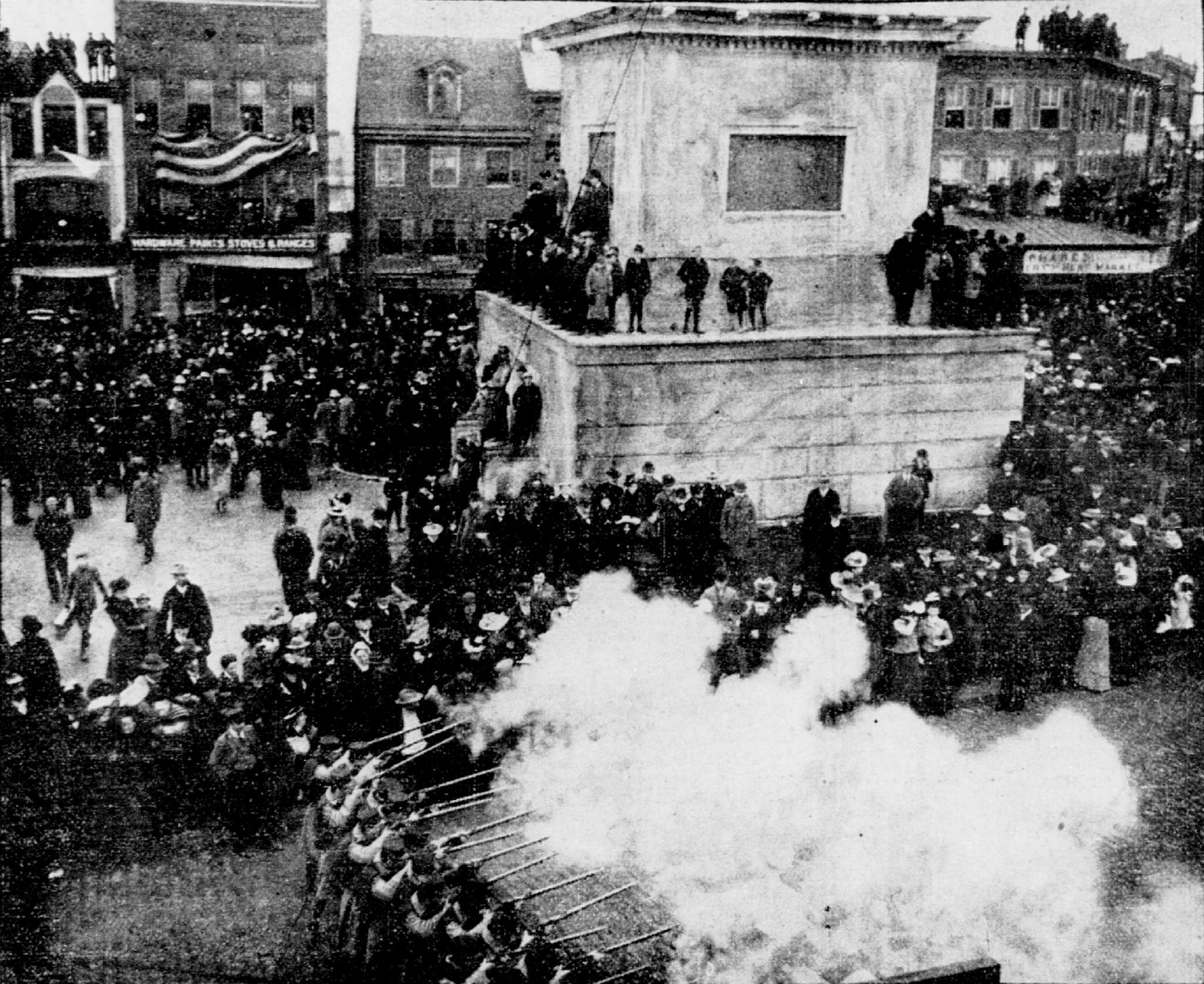
Battle reenactments are not a new phenomenon. In fact, George Washington’s army engaged in battle reenactments, or as they often described them “sham fights” or “sham battles”, at Morristown in 1780. In the early and mid-nineteenth century, many of these sham battles occurred to mark historic anniversaries of Revolutionary War battles, sometimes with veterans of the battles engaged in the sham fights themselves. Trenton would often host a sham fight in the streets of the city to mark the anniversary of that important battle in the 1840s and 1850s. But perhaps the most significant one occurred to mark the centennial of the battles of Trenton and Princeton in December of 1876 and January of 1877 when among others, veterans of the American Civil War participated in the reenactment of the battles.
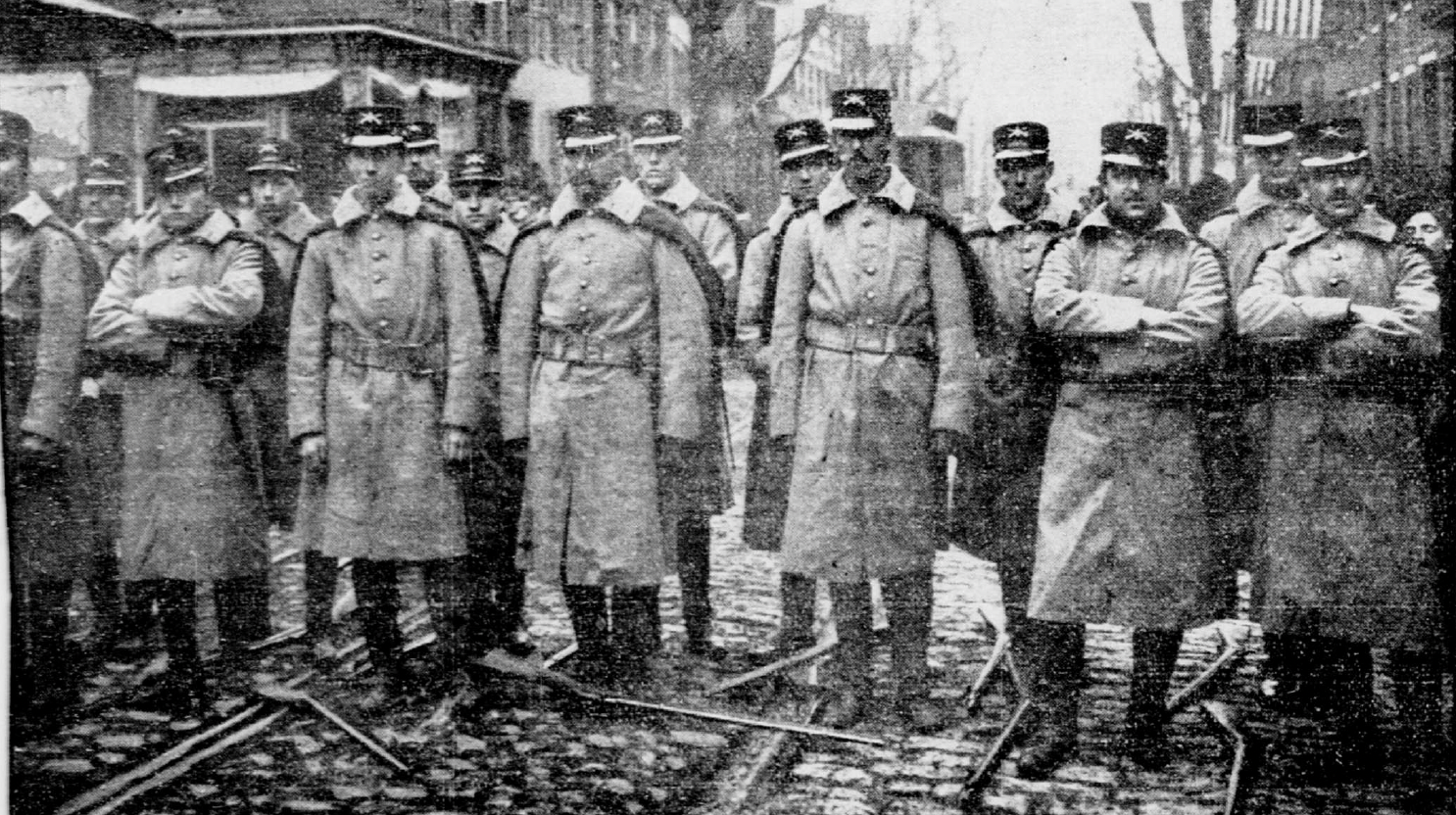
Spectators watch a sham battle at the Trenton Battle Monument in the 125th anniversary sham battle in 1901. (The New York Herald)
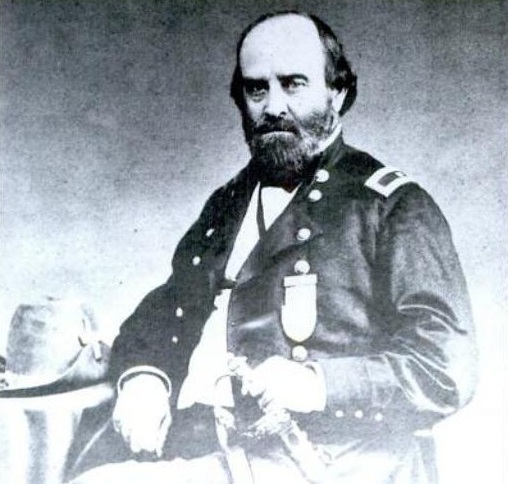
While the nation did a major anniversary celebration in Philadelphia for the centennial of July 4th in 1876, the people of Trenton and Princeton did not forget to mark the important battles that helped to secure our independence. Despite the national importance of this campaign, it was primarily a regional affair, with most participants coming from New Jersey or Pennsylvania. On December 26, 1876, about 1,200 men reenacted the crossing of the Delaware, the march on Trenton, and the battle of Trenton. Just eleven years following the end of the American Civil War, many of the participants were veterans of that recent conflict. Many local militias and national guard units formed the groups of men portraying the Continentals and Hessians. At this time, there was little emphasis on historical accuracy with regards to the uniforms and weapons that were used in 1776. Many of the men used percussion cap rifled muskets instead of the flintlocks used in during the real battle and wore 1876 style clothing. The honor of portraying General George Washington was awarded to General William Snyder Truex, who commanded a brigade of Union soldiers during the 1864 Battle of Monocacy, which played a pivotal role in preventing the Confederates from capturing Washington, DC. The New York Herald noted that Truex was “an old soldier and whose short stumpy figure and thick set, round head and dark, fall, stubbly beard, as well as the general outline of whose face, strongly reminded one of the hero of the last war, by some considered our second Washington, General Grant.”
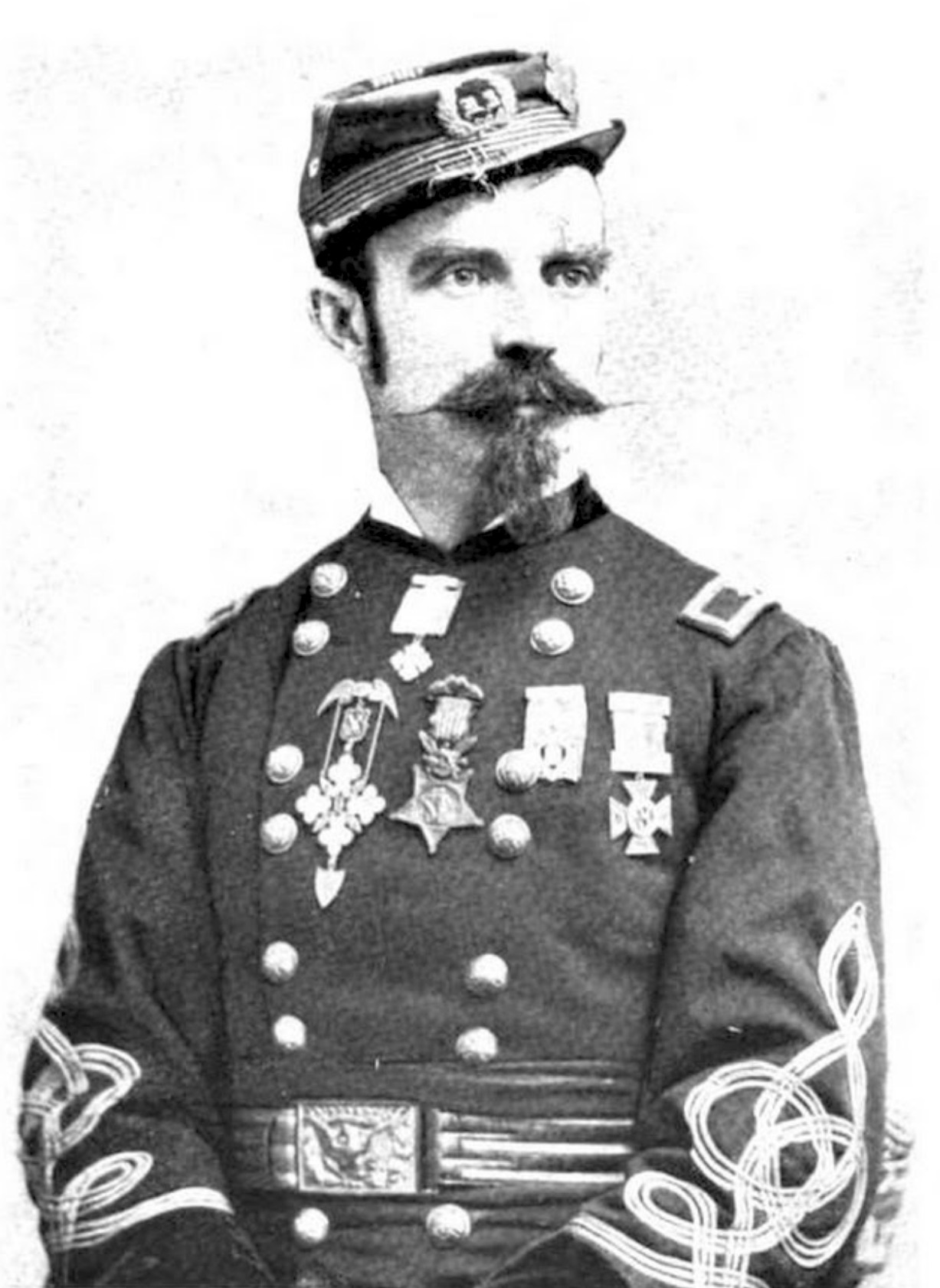
William Snyder Truex, who portrayed General Washington at the 1876 Trenton sham battle. (Find-a-Grave)
The volunteer “Continentals” began the day by marching from Trenton up to McConkey’s Ferry in the middle of the night. They arrived around one in the morning and enjoyed “centennial whiskey” by a fire at the ferry house inn before they crossed the river. However, it was so cold that the Delaware River was completely frozen over. Undaunted the men walked across the ice to the New Jersey side of the river. From there they marched 9 miles to Trenton, following the same path Washington’s troops took. They arrived at about 9 a.m. and engaged the “Hessians” in town. The two sides fired blank cartridges at each other through the town and fired cannons as well. The generals ordered the Continentals to charge into the Hessians and they engaged in mock hand to hand combat. The New York Herald noted that not all the fighting was fake, as two drunken “Continentals” engaged in a real fist fight and some other minor injuries occurred as the two sides fired at each other at point blank range. Finally, the “Hessians” surrendered and two sides enjoyed a large parade. Among the participants in the parade was Adam Exton, a mainstay in Trenton society (and interestingly, the inventor of the oyster cracker) and a major proponent of the Trenton sham battle. After the parade they all enjoyed a feast with toasts, addresses, and patriotic songs.
James Madison Drake, who portrayed General Washington at the 1877 sham battle at Princeton. (Wikipedia)
Not to be outdone by their neighbors in Trenton, on January 3, 1877, Princeton celebrated their history with another sham battle. Hundreds of militia men gathered to recreate the battle on the anniversary. Portraying General Washington in this battle was James Madison Drake, who was awarded the Congressional Medal of Honor for heroics while serving as a lieutenant in the 9th New Jersey during the Battle of Bermuda Hundred. Again, the troops largely wore their modern militia uniforms and Drake wore his Medal of Honor in the sham battle. (Drake’s ancestor was the owner of the Drake House, where Washington held a council of war in 1777 and is now a museum). Among the troops he commanded was Company C of the 3rd New Jersey National Guards (Phil Kearny Guards). General Philip Kearny had been killed during the Civil War at the Battle of Chantilly on September 1, 1862. The Sun newspaper noted that the Kearny Guards carried with them “the battle flag of the lamented General in whose honor it is named. In the center of the flag is a red Greek cross, Gen. Kearny had it with him at the battle of Chantilly, in which he yielded up his life blood on the altar of his country. It is but a remnant now; not more than half of it still clings to the staff.”
January 3 was a cold clear day, but there was more than a foot of snow on the ground. The troops paraded out of Princeton south to the site of the old battleground. The “Continentals” marched first and were followed by the “British.” On account of the snow, they didn’t make it all the way to the original battleground where the Mercer oak marked the traditional location where General Hugh Mercer was dragged to after being bayoneted. Instead, they stopped a little closer to the town and engaged each other in the sham battle. The men portraying Mercer’s brigade were driven back by the “British” and the man portraying Mercer fell to the ground “mortally wounded.” As The Sun noted, “Just then Gen. Drake, in imitation or Washington, appeared above the crest, leading the Philadelphians.” In dramatic fashion, the “Continentals” drove the “British” back onto the road and up into the town. The sham battle continued up around Nassau Hall, where the “British” finally surrendered ending the battle. The day ended with a feast for the participants.
“Hessian” soldiers throw down their arms following the 1901 sham battle in Trenton. This shows how these early reenactments were less concerned on historic clothing and weapons. (New York Herald)
The tradition of holding a reenactment or sham battle has continued off and on over the past 150 years. Usually, Washington Crossing Historic Park hosts a reenactment of Washington crossing the Delaware every Christmas and the city of Trenton and the Old Barracks Museum hosts a reenactment of the battles of Trenton on the weekend after Christmas (known as Patriots Week). While the crossing is happening this year, the 2021 battle reenactment has been canceled due to COVID. Also, this year, the Princeton Battlefield Society will be hosting a reenactment of the Battle of Princeton on the original ground on January 2. These anniversary reenactments are great ways to remember our nation’s history and a perfect time to make a pilgrimage to visit the historic sites, something we just did a few weeks ago. While it is great to see a modern reenactment and think of the sacrifice of those original patriots, it is fascinating to think of veterans of America’s bloodiest war taking part in the reenacting of America’s Revolutionary War.
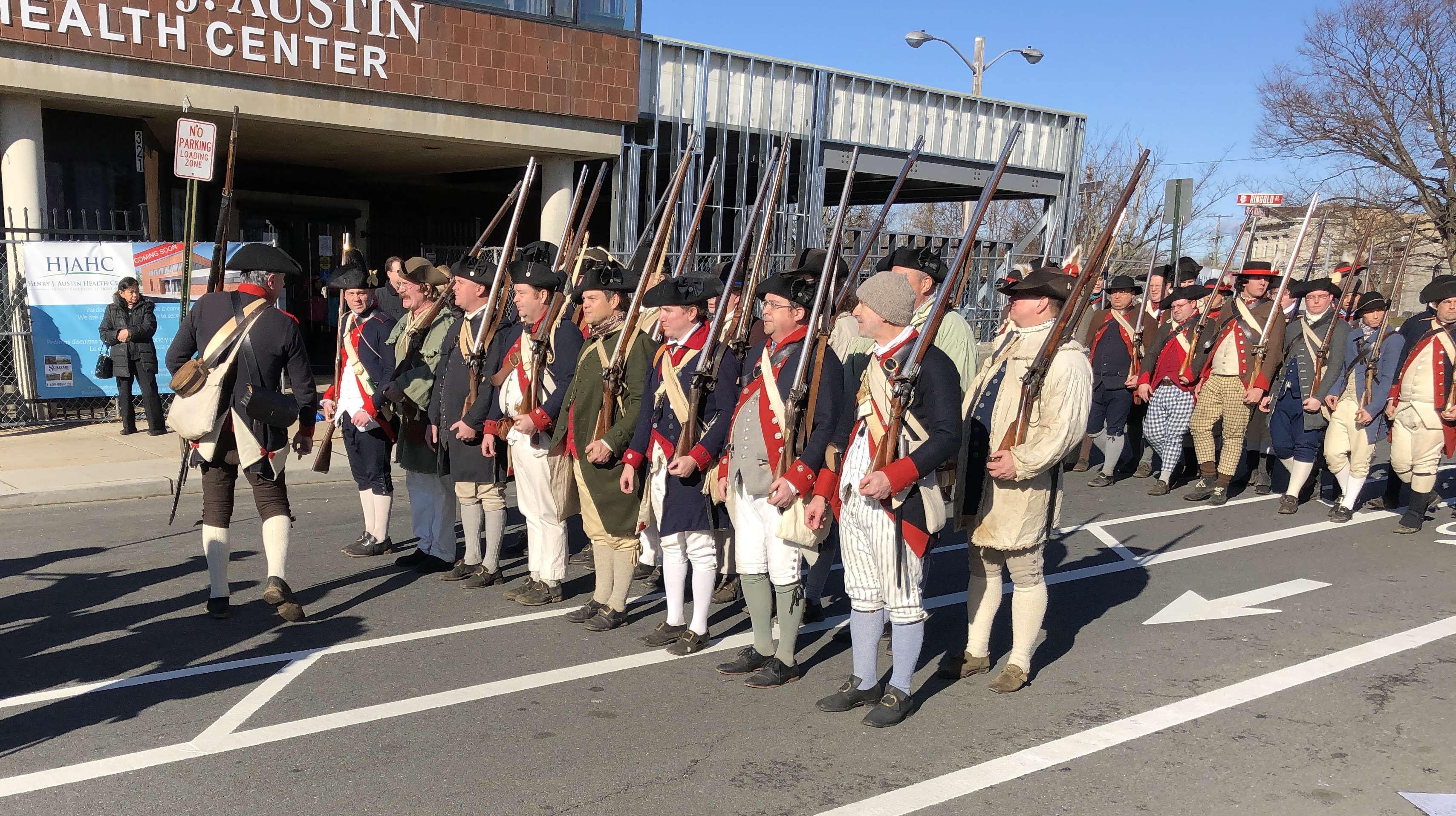
Revolutionary War reenactors (including the author) march down Warren Street in the 2018 reenactment of the Battle of Trenton. (author photo)







 Emerging Revolutionary War Era