CONFINEMENT hail! in honour's justest cause.
True to our King, our Country, and our Laws;
Opposing anarchy, sedition, strife,
And every other bane of social life.
These Colonies of British freedom tir'd,
Are by the frenzy of distraction fir'd;
Rushing to arms, they madly urge their fate,
And levy war against their parent state.
Surrounding nations, in amazement, view
The strange infatuation they pursue.
Virtue, in tears, deplores their fate in vain;
And Satan smiles to see disorder reign;
The days of Cromwell, puritanic rage,
Return'd to curse our more unhappy age.
We friends to freedom, government and laws;
Are deem'd inimical unto their cause:
In vaults, with bard and iron doors confin'd,
They hold our persons, but can't rule the mind.
Act now we cannot, else we gladly wou'd;
Resign'd we suffer for the public good.
Success on earth sometimes to ill is given,
To brave misfortunes is the gift of Heaven.
What men could do we did, our cause to serve,
We can't command success, but we'll deserve.

--- Dr. John Smyth
The American frontier west of the Appalachian mountains was a fluid place in 1775. Settlers, officials, and Native Americans were all struggling to decide where their loyalties and interests lay, with the British government in London, colonial governments, or the rebelling Americans organizing themselves to determine their own fates. Individuals often switched sides as the war unfolded
One man who was a constant in his loyalty to the crown was Dr. John Connolly of Pittsburgh. Before the Revolution, he had led Virginia’s efforts as Lord Dunmore’s agent to seize control over the Forks of the Ohio and assert its claims westward, even receiving a promise of land in far-off Kentucky. When the fighting started in Massachusetts, he developed a plan to mobilize Native Americans and Britain’s far-flung military forces on the frontier to attack Pittsburgh and then march on Virginia. Dunmore and General Gage both approved. So, Connolly and two loyalists, Allen Cameron of South Carolina and Dr. John Smyth of Maryland, plus Connolly’s enslaved servant travelled surreptitiously through Maryland, hoping to reach Detroit via Pittsburgh, the Ohio River, the Wabash River, and then anther overland trek. Local patriots recognized them outside Hagerstown, Maryland and the trio was promptly arrested on the night of November 19. A quick hearing by the local Committee of Safety decided to ship them off to Frederick, where a more thorough investigation revealed Connolly’s plan. Continue reading “Poet in a Patriot Prison”→
Every year the historians of Emerging Revolutionary War take a fall trip to research, visit Revolutionary War sites/battlefields and to promote our museum partners and preservation. The trip usually is a follow up to our Annual Symposium, but with the COVID-19 pandemic, that has been moved to May 22nd (you can get more information on speakers, topics and registration on our Symposium link from our main page).
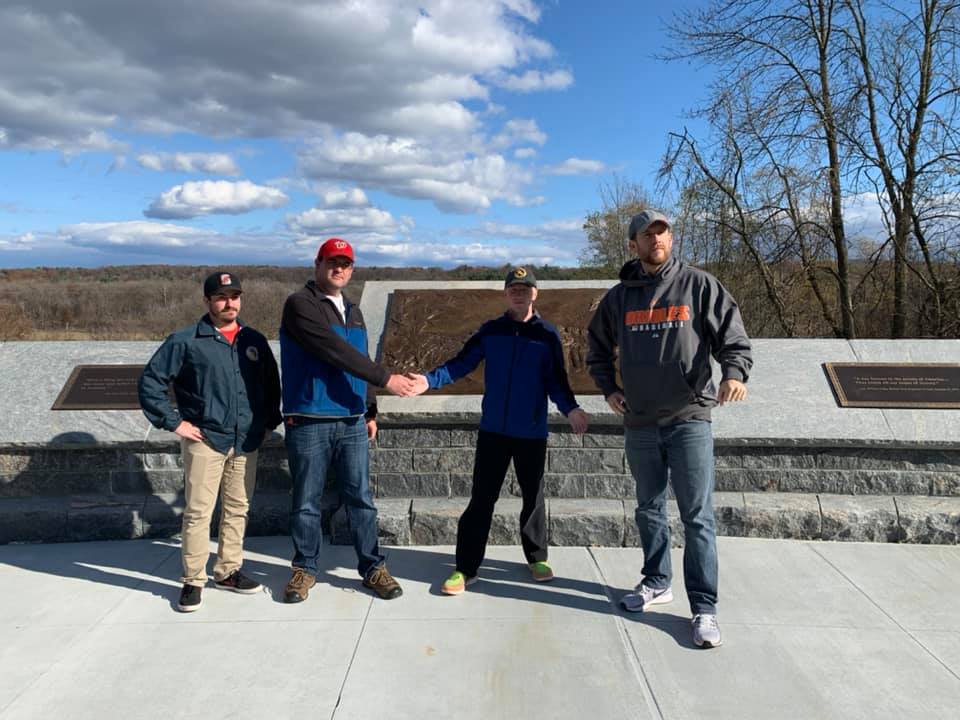
The ERW Crew recreates the surrender scene at Saratoga last fall.
After much discussion, we have decided to keep our annual fall trip tradition, but a more scaled back version. Don’t worry there will still be revelry and Facebook lives! Our original plan was to head to North and South Carolina, as a follow up to our visit there in 2018. In lieu of COVID-19, we have decided to keep it more “local” by focusing on sites in and around Yorktown, VA (many of our contributors are based in Virginia and Maryland). We will visit sites such as Gloucester, Yorktown, Spencer’s Ordinary, Green Spring, Great Bridge and Williamsburg.
Memorial at Green Spring Battlefield
We will be posting FB Live videos the entire trip, bringing you some behind the scenes opportunities with our museum partners, some exclusive talks with historians and we will wrap up the trip with a special Sunday Night Rev War Revelry. Stay tuned to our blog and social media pages starting on November 6th and continuing on to our Sunday Night Rev War Revelry on November 8th.
Our goal is not just to share with you great information and encourage support for historic sites/museums but also to share with you the fun and passion we have for interpreting the events around the American Revolution. As a public history focused effort, we feel making history fun and accessible leads to a great appreciation for our shared history. We hope you join us virtually on our trip this November.
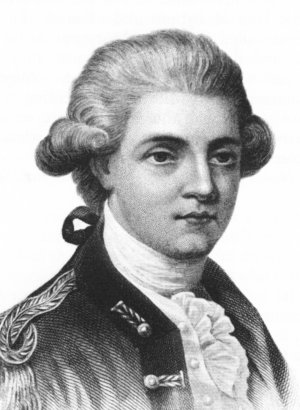
Over a week had passed since Major John Andre became the Continental Army’s prisoner near Tarrytown, New York, captured by three ragged militiamen who were probably more interested in robbing him than uncovering his intentions. For a time he had been incarcerated at Robinson House, the now defector Benedict Arnold’s former Hudson Highlands headquarters, and was eventually taken to the main American camp at Tappan, New York. There, Andre awaited his trial as a spy and eventual fate.
During his time held as a prisoner in Tappan, Andre accumulated an impressive group of intrigued and sympathetic followers, including Alexander Hamilton. Later describing his impression of the British officer to Colonel John Laurens, Hamilton wrote,
There was something singularly interesting in the character and fortunes of André. To an excellent understanding well improved by education and travel, he united a peculiar elegance of mind and manners, and the advantage of a pleasing person. ’Tis said he possessed a pretty taste for the fine arts, and had himself attained some proficiency in poe[try], music and painting. His knowle[d]ge appeared without ostentation, and embellished by a diffidence, that rarely accompanies so many talents and accomplishments, which left you to suppose more than appeared. His sentiments were elevated and inspired esteem. They had a softness that conciliated affection. His elocution was handsome; his address easy, polite and insinuating.[1]
Andre’s “elegance of mind and manner” was not enough to save him from the gallows, however, and on September 29, 1780, he was sentenced to be hanged by a board of fourteen American general officers. No witnesses were called to the stand. Andre’s previously written confession, and his admission that he had not entered American lines under a flag of truce was enough for the decision to be made. The next day, a letter was forwarded by George Washington to Henry Clinton informing him of his adjutant-general’s fate. He would be spared, however, if the British turned over Arnold. Clinton was forced to decline the ultimatum, citing military policy to his subordinates that a deserter such as Arnold must be protected. It was probably one of the most difficult responses the British general had to give in his career.
Andre’s execution was set to be carried out at 5 p.m. on October 1, but news of a delegation’s arrival sent by Clinton to make one final effort to prevent the hanging postponed it. One of the delegates, General James Robertson, met with General Nathanael Greene, and further information about Andre’s mission was forwarded to Washington. The American commander in chief would not be swayed, however. Andre would hang the next day.
This self-portrait was drawn by Andre, October 1, 1780, while he awaited his execution in Tappan, NY the next day. Wikimedia.
After first learning of the verdict issued to him by the board, Andre accepted his fate and was determined that he would face it as a gentleman and a soldier. As part of his last order of business on earth, he penned a heartfelt letter of appreciation and loyalty to Henry Clinton. Then, he made a plea to Washington that he may be executed by firing squad like a soldier rather than hanged as a spy:
Bouy[e]d above the terror of death, by the consciousness of a life devoted to honourable pursuits, and stained with no action that can give me remorse, I trust that the request I make to your Excellency at this serious period, and which is to soften my last moments, will not be rejected. Sympathy towards a soldier will surely induce your Excellency, and the military tribunal, to adapt the mode of my death to the feelings of a man of honour. Let me hope, Sir, that if aught in my character impresses you with esteem towards me, if aught in my misfortunes marks me as the victim of policy, and not of resentment, I shall experience the operation of these feelings in your breast, by being informed that I am not to die on a gibbet.[2]
Andre’s request was ignored. At 12 p.m., October 2, he would hang.
The morning of his execution, Andre breakfasted at Washington’s table, and as noon approached, he was led by an escort and fife and drum to the gallows, “with as much ease and cheerfulness of countenance as if he had been going to an assembly,” recalled Major Benjamin Tallmadge, who had become an admirer of the prisoner like Hamilton.[3] He was dressed in his scarlet, gold-laced coat, and upon approaching the gallows was seen to lean back for a brief moment as if in shock to learn that his request to Washington for a military execution had been denied.
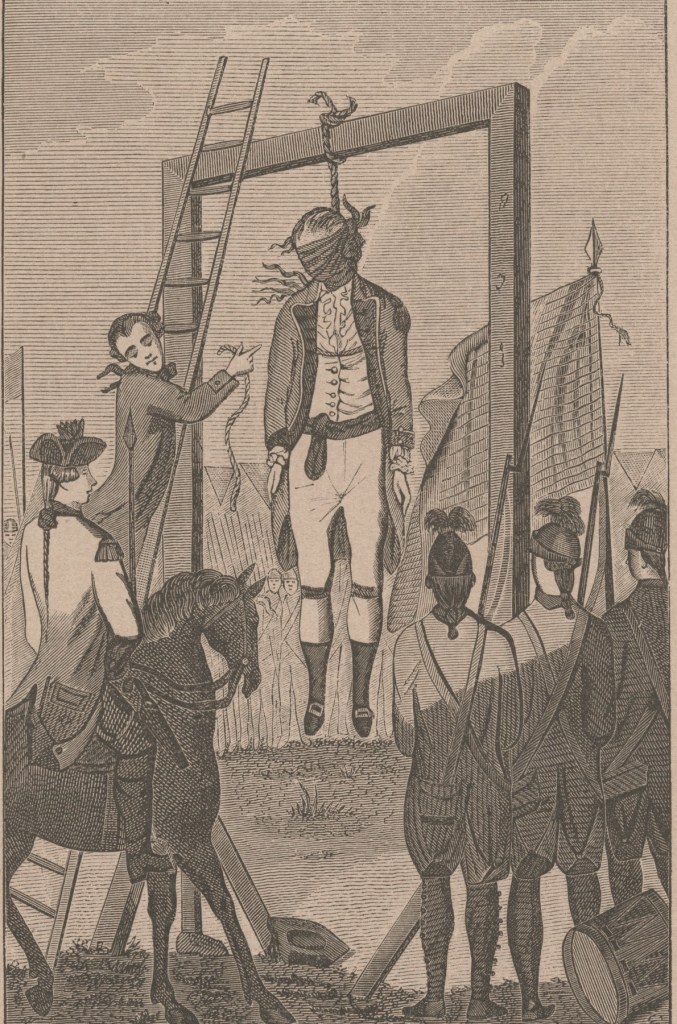
Despite this cold revelation, Andre continued on to the gallows. After struggling at first to climb the cart below the rope, he mounted it, and from the executioner’s grasp he took the noose and tied it around his own neck, then he covered his eyes with a handkerchief. The crowd surrounding him, including Maj. Tallmadge, was seen teary-eyed and sobbing. It was one more dramatic scene in the Revolutionary War, and Andre would not make it easier for anyone to witness. Lifting the blindfold, he spoke his final words, a request: “All I request of you, gentlemen, is that you will bear witness to the world that I die like a brave man.” With that, the wagon was pulled out from beneath his feet, and with one great swing and several fleeting moments, he was gone.
The Execution of Major Andre, October 2, 1780. New York Public Library.
Major Andre’s fate was a tragedy within a tragedy. Caught up within the story of an American hero’s tragic descent towards treason, Andre became a victim of one of the darkest tales in our history. Unlike Benedict Arnold, however, whose legacy had been tarnished forever, Andre was remembered as a hero, a martyr even, by the British, and romanticized by many Americans alike. Regardless, the two men will forever be linked by history. Two-hundred and forty years later, that has not changed.
Two riders rode determinedly to Benedict Arnold’s headquarters at the Robinson House across the Hudson River from West Point on the morning of September 25, 1780. The lead courier, Lt. Allen, who had initially been accompanying the captured “John Anderson,” carried with him the letters written by Lt. Col. Jameson informing Arnold of Maj. John Andre’s capture and his subsequent retrieval and return to the American camp at South Salem; the second rider possessed the incriminating papers found on Andre relating to West Point, as well as a newly signed confession the British officer had penned the day before admitting who he was. The second set of documents was meant for George Washington, who was to arrive at Robinson House to meet with Arnold and inspect the fortifications that day. It was a race against time between the two horsemen, and Arnold’s rider had the lead.
Washington was due to arrive at Robinson House for breakfast with Benedict and Peggy Arnold, but he chose to take a quick detour and inspect several American redoubts before continuing on his path from Fishkill, New York, where he had spent the evening. Instead, two of his aides, James McHenry and Samuel Shaw, were sent ahead to inform the couple to begin breakfast without him. Upon their arrival, the men sat down with the general to eat, informing him that the commander in chief would be there shortly. During this, Peggy remained upstairs.
After a few moments, Arnold excused himself from the table and stepped away to issue some daily orders. It was at this time when the walls of Benedict Arnold’s world began to close in on him. Lieutenant Allen had arrived with the news of Andre’s capture and transfer to the American camp at South Salem. The letter from Jameson also informed Arnold that the dispatches Andre carried were forwarded to Washington. If his treasonous plot had not yet been discovered, it was only a matter of time before it was. McHenry and Shaw had shown no signs of suspicion, but did Washington already know?
As the reality of the situation overtook Arnold, he ordered his horse saddled and his boat’s crew to man the vessel below on the Hudson, and told one of his aides, David Franks, that he was travelling upriver to West Point and would be back shortly—he was preparing to make a hasty escape. Before leaving Robinson House, he quickly found Peggy and explained to her that his life was in danger and he needed to leave (if Peggy was truly part of the plot, then what was actually said will probably never be known and was left out of later recollections to avoid incriminating her as well), he then mounted and spurred his horse down toward the river. After entering his barge, he ordered the crew to take him downriver to Stony Point, where he had business to attend to. As the vessel began to sail, an armed American boat passed closely by, and the quick-thinking Arnold told its crew to go up to Robinson House and inform Washington when he arrived that he would be back before dinner. They continued south, and even outran the other craft when it turned around and began to follow them in the other direction.
Arnold’s escape to the Vulture
When Arnold’s crew finally reached Stony Point, his request of them changed dramatically. Offering up two gallons of rum, he ordered his boatmen to carry him further downriver to the enemy vessel Vulture, which was originally supposed to carry Andre to the British lines. Instead, Arnold would be the one who boarded the boat and made his way to New York City, in the process taking the Americans who had just sailed him to safety as prisoners. Arnold’s defection was complete, but his plot to turn over West Point had been foiled.
An hour so after Arnold made his escape, Washington arrived at Robinson House. The commander in chief made his way across the river and was disgusted by the condition of the American defenses. The absence of Arnold perplexed him, but he did not think anything of it until he and his subordinates returned to the general’s headquarters and were greeted by the arrival of the second messenger carrying the Andre documents. Arnold’s treachery was thus revealed to the American high command, and immediately Washington ordered several aides to move downriver and see if the traitor’s vessel had been held up. It was too late, however. Arnold was gone, and as the reality of his betrayal began to set in for Washington (who had always been one of Arnold’s most ardent supporters) the general turned to the Marquis de Lafayette and asked him, “Whom can we trust now?”
Although Arnold had beat a hasty retreat to New York City, Peggy still remained behind at Robinson House. From the Vulture’s deck, her husband had scribbled off a message to Washington pleading with him for her safety and declaring her ignorance to the entire scheme. There are many versions of what transpired next, but according to the American officers at Robinson House, Peggy Arnold broke down in hysterics, seemingly going mad at the news of her husband’s treason. According to Col. Richard Varick, one of Arnold’s aides who was recovering from a fever in the house, a shriek was heard and the staff officer found Peggy with her hair “disheveled and flowing about her neck; [in] her morning gown with few other clothes remain[ing] on her—too few to be seen even by a gentleman of the family, much less by many strangers.” She then proceeded to ask if he had ordered her child to be killed and to “spare her innocent babe.”[1]
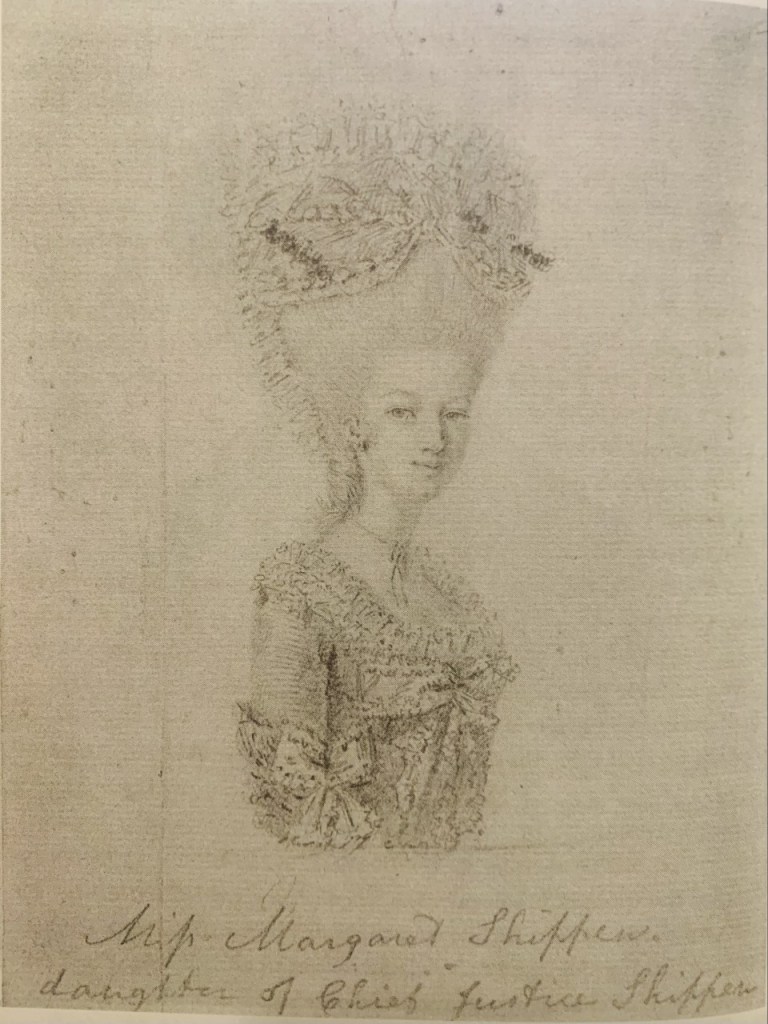
Pencil drawing of Peggy Shippen done by then Capt. John Andre during the British occupation of Philadelphia
It has been long debated if this was a genuine outburst of hysteria for Peggy, or if she was putting on a show to shield her own involvement in the plot. Multiple times Peggy was calmed down by the American officers arriving at the house, but her outbursts commenced again. Screaming about her husband, she was assured that he would return soon from West Point with Gen. Washington. Pointing to the ceiling she cried, “the spirits have carried [him] up there, they have put hot irons in his head!”[2] Then the hot iron went from Arnold’s head to her own and only Washington could remove it. With this, the general was brought in to see and she accused him of being an imposter. Peggy’s frenzy continued into the early evening when finally she regained control of herself and but still felt the despair of what had happened that day. If this was all a ploy, she had forced Washington, Lafayette, Alexander Hamilton, Varick, and countless to fall hook, line, and sinker for it. She was safe.
That evening, Washington and those who accompanied him sat down for dinner and pondered the gravity of the situation. It is impossible to image the anger, betrayal, despair, and heaviness that they must have felt. The American Hannibal was now the American Judas.
“Arnold has betrayed us. Whom can we trust now?”
[1] Quoted in Stephen Brumwell, Turncoat: Benedict Arnold and the Crisis of American Liberty (Yale University Press: New Haven, CT, 2018), 278.
Major Andre cautiously rode his horse through unfamiliar territory between American and British lines. It was a neutral zone wreathing with unforgiving bands of Cowboys and Skinners, but ground that Andre, garbed in civilian clothing, needed to cross in order to return to New York City. He had experienced several close brushes with American posts, and his guide, Joshua Smith, rather than risking any run-ins with Tories, had decided to turn around when they were some twenty miles from British lines. Andre was on his own for the final leg of the journey. All seemed to be going well until he arrived just outside of Tarrytown and three men with leveled muskets emerged from the bushes astride the path.
The capture of Major Andre during the morning of September 23, 1780 was the moment that Benedict Arnold’s plot to surrender West Point to the British officially unraveled, saving the garrison, the Hudson River, and potentially the revolutionary cause for the Americans. It was a moment that was entirely avoidable had Smith agreed to carry Andre back to the Vulture downriver rather than insisting on taking the overland route and subsequently abandoning the officer to the mercy of whatever lay between the opposing lines. Unfortunately, for Andre, his fate would be determined by a group of “volunteer militiamen,” but most likely crooked highwaymen.
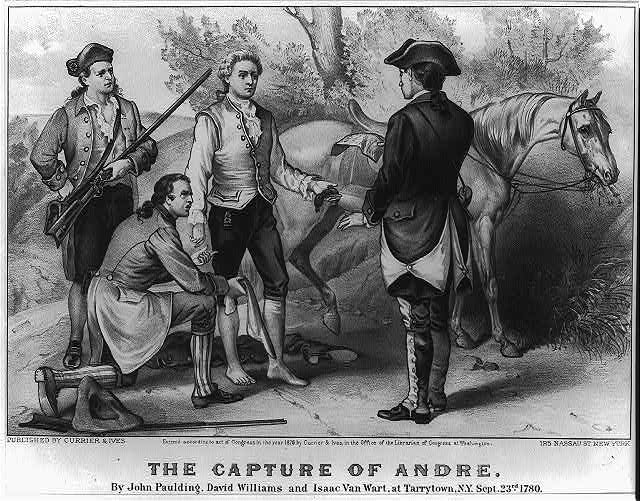
The meeting exchange that occurred between the British intelligence chief and the armed men blocking his path proved to be the most costly of the latter’s short life. Seeing that one of the militiamen was dressed in the green jacket of a Hessian jaeger, Andre incorrectly assumed that they belonged to his side, or the “lower party,” as he had asked them. The man, John Paulding, duped Andre, and answered in the affirmative. Relieved, the major revealed to them that he was in fact a British officer. Paulding then informed him that they were Americans, and after Andre handed him a pass written by Arnold, he threw it aside and began searching the rider, taking the valuables he carried with him. All this could have been ignored by Andre if they had then let him continue on to New York City, but the greedy militiamen then proceeded to remove the fine boots of a British officer he was wearing, and then his socks. What he was hiding underneath would be the evidence eventually needed to incriminate him and Arnold: documents relating to West Point and its defenses. The ragtag party of Americans had just nabbed themselves a spy.
A 19th century depiction of Andre’s capture. Library of Congress.
Following his capture, Andre was taken to the Continental camp at North Castle and turned over to Lt. Col. John Jameson of the 3rd Continental Dragoons, who examined the dispatches. Seeing Arnold’s name on the papers, Jameson was not about to accuse an American hero of conspiring with the enemy. Instead, he sent Andre with an escort back to Arnold’s camp and scribbled off a message to the general: “I have sent Lieutenant Allen with a certain John Anderson [Andre’s moniker] taken going to New York. He had a pass signed with your name. He had a parcel of papers taken from under his stockings, which I think of a very dangerous tendency … The papers I have sent to General Washington.”[1] It was only a matter of time before Arnold realized that his plot was about to be discovered.
Andre, however, would never make it back to Arnold’s headquarters. Later that day, Maj. Benjamin Tallmadge, Washington’s chief intelligence officer and famed leader of the “Culper Ring,” arrived in Jameson’s camp and after learning of the man carrying suspicious documents, convinced the lieutenant colonel to return the suspect to camp.
Riding back to Arnold with Lt. Allen, Andre must have felt relieved that he had dodged another bullet. Much to his dismay, the next day he would be turned around and delivered to Maj. Tallmadge, where his fate as a spy would be decided.
[1] Quoted in Stephen Brumwell, Turncoat: Benedict Arnold and the Crisis of American Liberty (New Haven, CT: Yale University Press, 2018), 269.
It was a meeting that decided the fates of Benedict Arnold and John Andre. Not necessarily because of what had been discussed, but because of the unraveling circumstances surrounding it. Within several days, Arnold would be fleeing his once beloved country’s cause to the safety of the British lines in New York City, and in less than two weeks, Andre, not as lucky, would be dead.
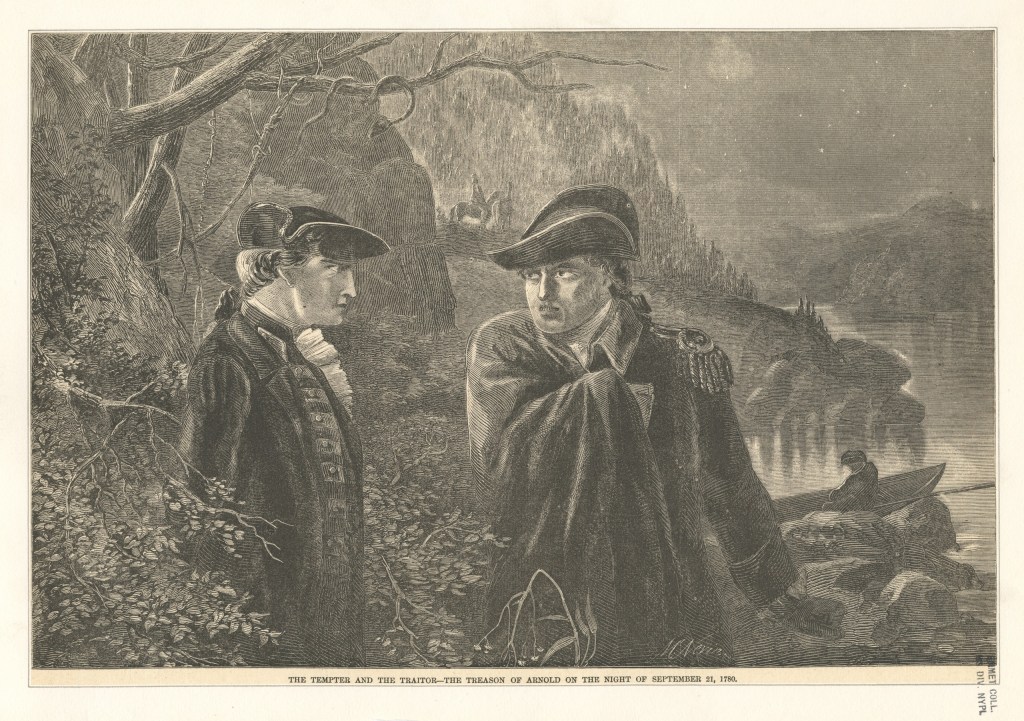
Not long after 1 a.m., September 22, 1780, Major Andre was rowed ashore near Haverstraw, New York, less than twenty miles below West Point. There, for several hours in the dark woods aside the Hudson River, he conversed with Arnold in a rendezvous that had been over a year in the making. His orders from Sir Henry Clinton stipulated that he was to confirm with Arnold “the manner in which he was to surrender himself, the forts, and troops…,” so the operation against West Point could be “conducted under a concerted plan between us … that the King’s troops sent upon this expedition should be under no risk of surprise or counter-plot.”[1] The British would attack the fortifications, and overwhelmed by superior numbers, Arnold would surrender the garrison and the river defenses.
“The Tempter and the Traitor.” Arnold and Andre’s Meeting near Haverstraw, NY. New York Public Library.
It is possible that another prize was discussed between the two men: the capture of George Washington. The American commander in chief was due to arrive to inspect the post on September 25 after meeting with the French high command at Hartford, Connecticut. Capturing West Point, as well as bagging Washington could spell an end to the rebellion once and for all.
After several hours, the meeting came to an end as daylight loomed. Waiting to procure some men to row Andre back to the Vulture, the vessel that was to return him to his own side, Arnold took the major to a house within the American lines. Everything seemed to be in order for the operation to be successfully executed now. That was until Continental artillery on the shore was directed by Col. James Livingston to open fire on the Vulture, forcing the craft to flee several miles downriver. Andre’s transportation back to New York City had been compromised. Though they did not know it yet, the plot to surrender West Point officially began to unravel. Arnold was now forced to send Andre back to British lines via an overland route through hostile territory.
[1] Quoted in Stephen Brumwell, Turncoat: Benedict Arnold and the Crisis of American Liberty (Yale University Press, New Haven, CT, 2018), 264.
Junction of Saint Mary’s, Saint Joseph’s, and Maumee Rivers/Kekionga (Indiana Historical Society)
The Revolutionary War has more than its share of adventurers, rogues, soldiers-of-fortune, and risk-takers. Augustin Mottin De La Balme combined all these characteristics in his person. In November 1780, they brought the Frenchman and his soldiers to a horrible end outside the Miami Village of Kekionga, near the confluence of the Saint Joseph, Saint Mary’s, and Maumee Rivers in modern Fort Wayne, Indiana.
La Balme was born in France in 1736, entered the Gendarmerie in 1757, served in the seven Years War, gained experience in the cavalry, received an army appointment in 1763, and retired with a pension in 1773. He wrote several books on cavalry training and tactics, but finding his fortunes stalled, left for America in 1777 with a letter of introduction from Benjamin Franklin, just one more French officer seeking rank, advancement, and his fortune in the war against Great Britain.[i] Major General William Heath, who met him in Boston, wrote Washington, “We swarm with French Officers at this Place, Two arrived in the Ship on Sunday at this Place They are much Superior to any that I have as yet Seen, One is an Engineer The other a Captain of Cavalry, They are Gentlemen of Education, Sense and Genius, The Captain has with him Two Treatises on the Discipline and management of the Horse, written by himself, and much Approved by all the Generals in the French Service.”[ii] Despite a glut of would-be foreign officers, La Balme received a commission as a Lieutenant Colonel and then Colonel and Inspector General of Cavalry. Dissatisfied with the appointment, he resigned, focused his attention on mobilizing Frenchmen still living in North America, and kept petitioning Congress to find useful work for him. Eventually, Congress tried to pay him off and send him home, but the French officer stayed, trying his hand at various schemes to contribute, including mobilizing Indians in Maine to attack the British. That short-lived campaign accomplished nothing, but resulted in La Balme’s capture and eventual escape.[iii]
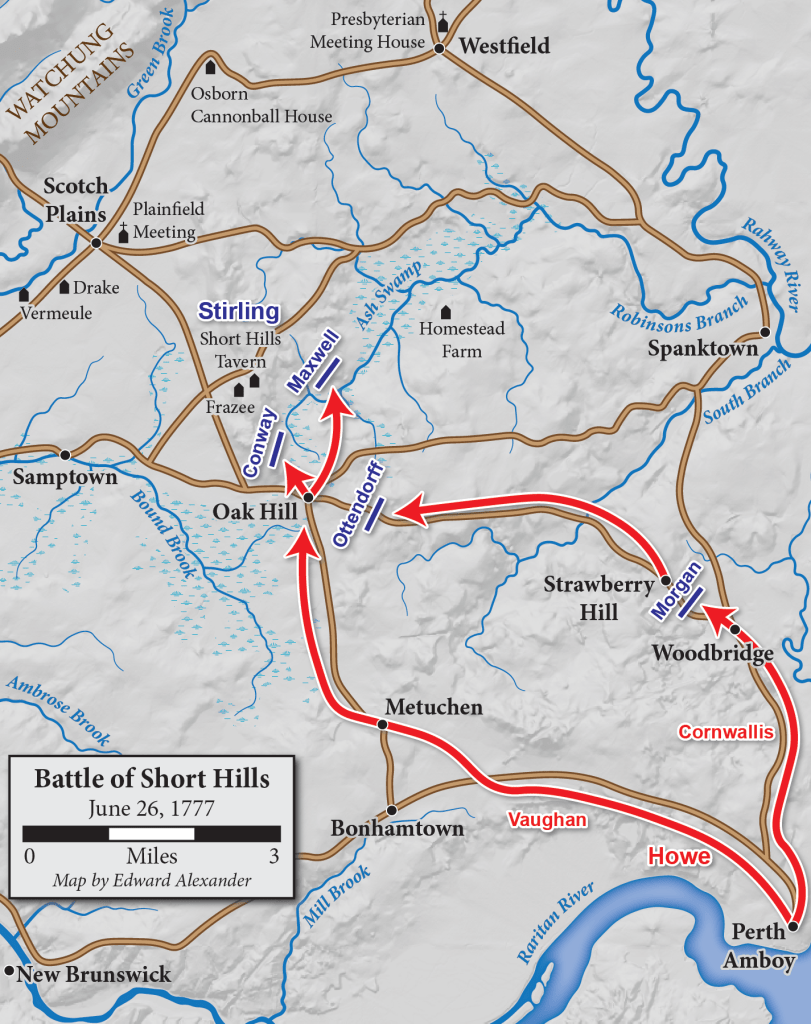
Never heard of the battle of Short Hills, NJ? That’s’ not surprising, but its finally getting some recognition. It was the largest engagement since Princeton five months earlier, and was one of the first battles for the newly reorganized Continental Army.
In June, 1777 the main American force of about 8,000 was camped at Quibbletown in Middlesex County, not far from Perth Amboy and Staten Island, both occupied by the British.
British forces under General Cornwallis left Perth Amboy at one o’clock in the morning on June 25, 1777. They engaged the Americans in the Battle of Short Hills, near the modern Union/Middlesex County Line. Another column, led by General John Vaughan, accompanied by General William Howe, moved toward New Brunswick then turned north toward Scotch Plains by a more southerly route. They planned to destroy Stirling’s isolated division between the two wings, and force Washington into an engagement. Stirling had two brigades, Brigadier General Thomas Conway’s Pennsylvanians and Brigadier General William Maxwell’s New Jersey troops. In all Stirling had about 1,798 men, more than 16,000 were bearing down on him.
On August 30, 1780, Benedict Arnold fully committed to treason by accepting the final terms presented by Sir Henry Clinton regarding the plot to turn over the fortifications at West Point to the British. Arnold’s reply to a letter written on July 24 by Clinton’s adjutant-general and chief intelligence officer, Major John Andre, was the result of over a year’s worth of on and off negotiations between the two parties. At times it had appeared to Clinton and Andre that Arnold’s defection would not be as useful as they had hoped. The American general could not obtain a field command and could only offer intelligence that was of little value or already known. However, when Arnold assumed command of the fortifications in the Hudson Highlands, including West Point, in early August, the possibility of using his services to strike a crushing blow to the American cause became a reality.
The first mention of West Point in the correspondence between Arnold and Andre appeared in a letter written by the latter in late July 1779. Andre had inquired about the “procuring of an accurate plan,” of the post. Arnold, still serving as military governor of Philadelphia and away from Continental Army headquarters, was unable to answer this request. The following month, discussions began to stall and it would not be until the next year when the prospect of Arnold obtaining command of the Hudson Highland forts reinvigorated negotiations. By this time, it was far too late for Arnold to back out. The British high command had enough correspondence and gathered intelligence from the “American Hannibal” to expose him as a traitor. Arnold knew this as well, which is why his terms for defecting and surrendering a large body of American troops and/or West Point hinged on Clinton promising him financial and personal security for himself and his new family (Peggy had given birth to their first son, Edward, in March 1780).
On July 24, 1780, Maj. Andre penned a letter to Arnold informing him that Gen. Clinton had agreed to his terms of a payment of £20,000 in exchange for the surrender of 3,000 men and the West Point fortifications. If he should be unable to accomplish this task, £10,000 was still offered for his efforts. The message did not arrive until a month later, but Arnold responded six days later under the alias “Gustavus,” and requested to set up a meeting in the near future with Andre. The dispatch never made it to the British. The courier tasked with delivering it grew suspicious of its content and instead carried it to Maj. Gen. Samuel Parsons, his neighbor, on September 10. Parsons did not believe that the letter was anything to be concerned with, since it referred only to a Mr. Moore (Arnold) and Anderson (Andre) and such topics as market goods and speculators. The message was, of course, coded. Arnold had unknowingly dodged a major bullet.
Although his August 30 correspondence did not reach the British in New York City, Arnold scribbled out another message on September 3. This time, the letter was successfully delivered by Mary McCarthy, the wife of an escaped, but recaptured member of Saratoga’s “Convention Army,” Private Charles McCarthy, 9th Regiment of Foot.
Benedict Arnold, at one point the most famous hero of America’s revolutionary war, had officially entered his treasonous plot to turn over West Point and its garrison and defect to the British into its final stage. A little over three weeks later he would meet with Maj. Andre fifteen miles south of West Point near Haverstraw, New York.
This is the first part of what will be a running series that will highlight the 240th anniversary of the events surrounding Benedict Arnold’s treason.
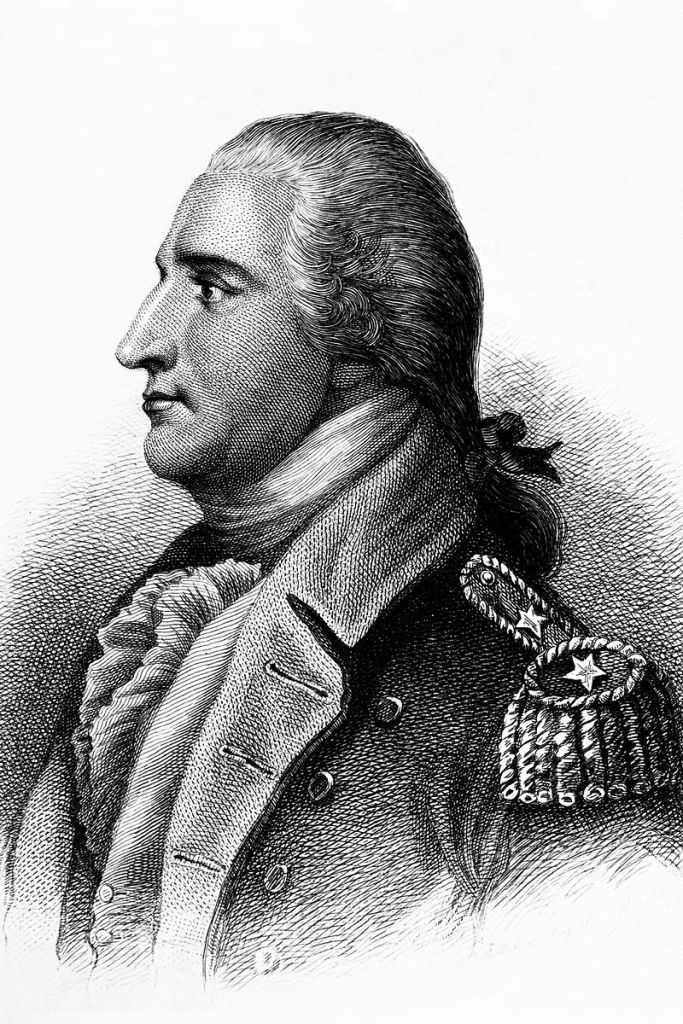
The story of Benedict Arnold’s treason during the Revolutionary War is one of the most infamous, yet tragic, in our nation’s history. He was the “American Hannibal,” the most brilliant battlefield commander during the conflict’s early stages. His patriotism, sacrifice, and commitment to the cause of independence were matched by few in the American high command, so too were his battle honors. Fort Ticonderoga, Quebec, Valcour Island, Ridgefield, the relief of Fort Stanwix, and the battles of Saratoga—he was always in the thick of things.
Maj. Gen. Benedict Arnold. Wikimedia.
Arnold’s treason was not something that was pre-determined. His ultimate defection to the British in 1780 was a result of many factors that continued to pile up as the war progressed, but it can be rooted in a long-running feeling of being underappreciated and a growing distrust in America’s political leaders.
Following his grievous leg wound at Saratoga on October 7, 1777, Arnold was appointed military governor of Philadelphia, never to command American troops on the battlefield again. While stationed there, his downward spiral towards treason began to accelerate. An open feud with Joseph Reed and Pennsylvania’s Supreme Executive Council led to a court martial and reprimand from George Washington, something beyond correction for a man with the personal honor of Benedict Arnold. The slippery slope became even more slippery. Continue reading “Arnold’s Treason: 240 Years Later”→






 Emerging Revolutionary War Era