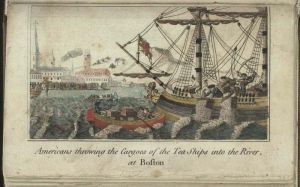
“Boston Harbor a tea-pot this night!”

boston-tea-partyThe town meeting held on the night of December 16, 1773 at the Old South Meeting House was no ordinary meeting. Boston was well known for its public meetings, but this one was different. Frequently city leaders called town meetings to discuss important political, economic and social decisions facing the city or colony. The town meeting was a foundation of the political process for Massachusetts and much of the New England colonies.  Royal authorities had watched these meetings more closely since the 1760s during the opposition to the Stamp Act. Colonial Whigs (anti Royal leaders) had used these meetings to protest British policies that they saw as threats to their liberties.

This town meeting was a follow up assembly to previous meetings held in November originally called for Faneuil Hall. The large turnout, however, required the crowd to move to the more spacious Old South Meeting House. Nearly 5,000 people attended the meeting to discuss the city and colony’s response to a new tax on tea and more directly, the ships in the harbor that held tea from the East India Company. The colonial Whigs did not want the cargo unloaded but the captain of the ships could not leave the harbor with the tea unless they had approval from the Governor. Governor Thomas Hutchinson did not believe he had the authority to allow the ships to leave without unloading the tea.  Adding to that decision, Hutchinson was more than frustrated with those who had rejected Royal authority over the years. Thus, a legal and theoretical standoff ensued. That night, the people of Boston took the matter into their own hands.

On the surface, the Tea Act of 1773 was rooted in helping pay off the debt of the British Empire, caused in part by fighting the Seven Year War (French and Indian War) with France. Also, the revenue raised would pay British officials in the colonies, thus making them more loyal to Parliament and the British Crown. The Tea Act was one of many Parliamentary laws or “Acts” passed to raise revenue in the colonies. More importantly, the underlying purpose was for Parliament to display their authority to pass laws that were binding on the British colonies. Due to colonial opposition and resistance, many of these acts were repealed.  However, the Tea Act, passed in 1773, sparked an immediate response throughout the colonies.

The Tea Act was also seen as a mode for saving a British held company, the British Eastbritish-east-india-tea-company-logo India Company.  Before 1773, the company had to sell its tea in London and was subject to duties. The company had collected large quantities of tea in warehouses in London and was looking for a way to disperse the tea at a bargain.  The Tea Act allowed the company to sell directly to American ports without paying the duties. This also forced American buyers to only purchase their tea from the East India Company, which was subject to a tax. The good news was the price of tea was reduced because the Company no longer had to pay the duties in London. Colonists resisted the notion that Parliament could force them to buy tea from the East Indian Company (many made a good living off of smuggled tea sales) and that they were required to pay a tax on the tea.

The popular notion, “taxation without representation,” had been around since the 1750’s and became well-known in 1764 in response to the highly unpopular Sugar Act and Stamp Act. Colonial Whigs believed they had no representation in Parliament because they did not elect representatives to Parliament. British political theory and law believed in the model of “virtual representation” which meant the colonists did not vote for individual members of Parliament though that body, as a whole acted in the best interest for all British subjects. Colonial leaders, who for decades were allowed to vote for their representative bodies in their respective colony, did not accept this theory. The opposing views on representation began to open opposition to British authority over colonial matters.

Though passed in May 1773, the Tea Act did not impact the people in the colonies until fall. Seven ships of tea were sent to four American ports, Boston, New York, Philadelphia and Charleston. Meanwhile, colonial Whig leaders began to organize a resistance to the East India Tea that was en route. In fact, in every other city but Boston the tea was refused and forced to either be returned to England or confiscated by local officials. It was in Boston that a determined governor and history of Royal opposition led to a signal event in American history.

On November28th, the ship Dartmouth arrived loaded with tea. British law gave ships with imports twenty days to pay the duties or the local custom officials could confiscate the cargo. Hutchinson, when petitioned, would not allow the ship to leave the port without paying the duty. His sons, who acted as the Tea Consignees (authorized to receive the tea and see to its distribution) for Boston, also refused to back down and resign their positions, which happened in other American ports. Soon two more ships arrived in the harbor with the unwanted tea. Unable to return the tea to England and without being able to unload the tea due to the threats of local groups such as the Sons of Liberty, the captains of the ships were in a tight and dangerous spot.

On the night of December 17th, one of the largest public meetings in Boston convened at the Old South Meeting House. Speeches by Sam Adams, John Hancock, Joseph Warren and other Boston Whig leaders called for the return of the tea to England. Later in the evening, word came that a last minute plea to Governor Hutchinson to let the ships return was refused. Sam Adams announced publicly, “This meeting can do nothing further to save the country.”

The events that happened next have been debated since 1773, soon men arrived outside the Meeting House disguised as Mohawk Indians. Whether or not these men were signaled to move towards the ships with tea is unknown. As the “Mohawks” marched down Milk Street towards Griffin’s Wharf where the three ships of tea were docked, the thousands gathered inside the Old South Meetinghouse began to pour out of the building. Chants of “Boston a Teapot Tonight” and “Hurrah for Griffin’s Wharf” were reportedly heard. Some people followed the “Mohawks”, others continued to protest in the streets, while still others headed home believing that a confrontation was about to take place.
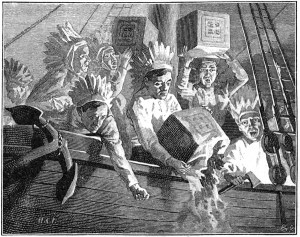
boston-tea-party-2Many details remain unknown about who exactly the “Mohawks” were that marched on Griffin’s Wharf that night. The men used lamp soot and red ochre to disguise their faces and carried a wide assortment of weapons. As they made their way to the wharf, they yelled and “whooped” as Indians in a war party. If they had coordinated the timing with leaders in the Old South Meetinghouse, it is still unknown. The identities of most of these men either were never recorded or are lost to history; that is how tight their veil of secrecy was coupled with their sophisticated organization.  As they made their way to the ships, the Whig leaders inside the Old South Meetinghouse stayed behind and were never directly part of what happened next.

The men, with a crowd behind them, approached the wharf. There they divided into three different groups, one for each of the ships, Dartmouth, Beaver and Eleanor. Being a port city, most of the men knew where to find the cargo they were looking for and how to operate on a ship. Respectively, most of the other cargo and private property on the ships were not touched.  They were only after the tea.  Hauling the chests to the deck, they were broken open and dumped into Boston Harbor. Some of the men watched to make sure no one was trying to steal any of the tea that they were dumping. The group of approximately 150 men worked quickly as the crowd of spectators grew.

The American Revolution did not just “happen.” It was the culmination of various events and acts that individually did not guarantee separation. As a collective, one can retroactively see how the accumulation of these events led to the inevitable. The Boston Tea Party was one of these events. This time it was different; this time Great Britain would respond in a way it never had before. The Tea Party gave the tinder box of revolution in America more fuel and many believed a small incident would cause a spark leading to open war between colonies and mother country. The spark would come on April 19, 1775 in the Massachusetts countryside.

Stepping Onto Long Wharf and Into History: The Day the British Came To Boston

Emerging Revolutionary War is honored to welcome guest historian Katie Turner Getty. A short biography is at the bottom of the post. 

In terms of historical significance, few American cities rival Boston, where shades and shadows of the Revolution can be found around every corner. By walking the city’s famous Freedom Trail, one can follow in the literal footsteps of the inhabitants who left such an indelible mark on the city. Indeed, many heroes of revolutionary Boston—Revere, Adams, Otis—lie in their eternal repose in burying grounds mere steps from busy thoroughfares.

The presence of those revolutionaries still looms large in Boston and many of their old stomping grounds still stand. Several buildings located on the Freedom Trail played unforgettable parts in the revolution. From the fiery speeches at Old South Meeting House on the eve of the tea party to the blood shed by those massacred outside the Old State House*, these sites are popular and are frequently visited.

But there is one site not located on the Freedom Trail that is yet imbued with great historical import. Indeed, it is the site of the 1768 arrival of British warships in Boston Harbor and the troops who first took those fateful steps into Boston for the purposes of occupying the city.

katieturnergettyphoto1
East-facing view of Long Wharf and John Hancock’s office and counting house, built in 1763, and now the Chart House restaurant.

The name of this site, so often overlooked, is Long Wharf.

Long Wharf has stretched into the Atlantic from Boston for 300 years, serving as the world’s great doorway to the city. It was the longest wharf in Boston, extending 1,586 feet into the deep water of the harbor allowing up to 50 ships to dock at one time[1]. It would have been a place of great bustle—the loading and unloading of cargo by longshoremen, transporting of such cargo to the busy warehouses and shops that lined the wharf, and then the purchase of such goods by local people.

katieturnergettyphoto2
West-facing view toward Boston, from the end of Long Wharf. The Town House (now known as the Old State House), built in 1713, is in the distance.

On Friday, September 30, the Beaver, the Senegal, the Martin, the Glasgow, the Mermaid, the Romney**, the Launceston, and the Bonetta anchored in the harbor. On board the ships were “the 14th and 29th Regiments, a detachment from the 59th regiment, and an artillery train”.[2]  The next day, Bostonians warily watched as “the war ships maneuvered closer to the town and ranged themselves as if for a siege.”[3] Then, carried off the warships by small boats, British troops stepped onto Long Wharf and into American history.

These ships and troops had arrived in the port of Boston as a response to colonial opposition to the Townshend Acts which were enacted by Parliament in 1767 in an effort to enforce their sovereignty over the colonies and raise revenue. The Townshend Acts imposed a tax on imports such as tea, glass, paper, and paints, as well as instituted a Customs board to help enforce British trade regulations and deter smuggling activity. Many Bostonians were opposed to the Townshend Acts and protested by gathering in mobs and harassing officials.

katieturnergettyphoto3
View of the Atlantic Ocean from the very end of Long Wharf.

Paul Revere immortalized the landing of the troops in an engraving entitled “A View Of Part of the Town of Boston In New England And Brittish [sic] Ships of War Landing Their Troops! 1768”. The image depicts the eight British ships of war arrived in the harbor, with smaller boats carrying red-coated soldiers to Long Wharf. Some troops are already amassed on the wharf, gathering into formation.

katieturnergettypaulrevereengraving
“A View of Part of the Town of Boston In New England And Brittish [sic] Ships of War Landing Their Troops! 1768” (courtesy of American Antiquarian Society http://www.americanantiquarian.org/Inventories/Revere/b2.htm )
Revere’s engraving also shows many buildings running along the north side of Long Wharf in an uninterrupted line toward the town. They were warehouses, counting houses, shops, and dwellings. One of these buildings was John Hancock’s Counting House, which still stands on Long Wharf today. Currently incarnated as a restaurant called the Chart House, it is the oldest extant building on Long Wharf, built in 1763. John Hancock’s original wall safe is actually still set in the red brick wall of the second floor dining room. The safe is not off-limits; visitors may freely open and close the safe’s inner and outer doors or even run a hand over the smooth metal.

katieturnergettyphoto4
John Hancock’s original safe, still fixed in the wall of his Counting House.

When standing at the wall safe, take a few steps to the right and look out the front windows of the building. Look down to the ground level to see the path of the troops as they passed right by Hancock’s Counting House, “with insolent parade, drums beating, fifes playing, and colours flying, up King Street” as they headed down the wharf and into the town. The soldiers were marching to the Town House, at the base of King Street. And beyond that, to Boston Common.

katieturnergettyphoto5
View out a second floor window of Hancock’s Counting House, a few steps from the wall safe. The viewer is looking down at Long Wharf where the British troops marched past on October 1, 1768.

Long Wharf at the time (as it is today) was really just an extension of King Street, which ran all the way from the Town House (later to become the site of the Boston Massacre), down to the shoreline, then continued along in the form of a wharf, out into the harbor. After the Revolution, King Street was (perhaps appropriately) renamed State Street and is known by that decidedly more American moniker today.

The soldiers’ route may be traced today by any perambulating history enthusiast. Walk out past Hancock’s Counting House, to the terminus of Long Wharf and stand where the British soldiers disembarked. As you gaze out across the cold gray Atlantic, feel the stiff sea breeze rolling in off the water just as they did. Then turn your gaze away from the Atlantic and look back toward the city. The view is the same as in 1768—the Town House will be in your direct line of sight. As the soldiers marched down the wharf in a straight line, they too would have seen the Town House quite clearly.

A pamphlet published by the Boston Redevelopment Authority in the 1980s reveals that although the wooden timbers of Long Wharf are experiencing decay, the 17th and 18th century granite bulkheads beneath the wharf are still intact.[4] It is a thrill for any revolutionary history enthusiast to walk out to the end of Long Wharf, knowing that deep beneath his or her feet are the very same granite blocks, impervious to time and history, that bore silent witness to the arrival of the British soldiers who stepped onto Long Wharf and into history when they came to occupy Boston.

*The building known today as the Old State House was known in the 1770s as the Town House.

**The Romney actually arrived in Boston Harbor in May 1768 to help enforce customs and discourage the flouting of trade regulations, attempting to seize John Hancock’s ship, Liberty.
*Katie Turner Getty is a lawyer, history enthusiast, and lifelong resident of Boston. She holds an A.A. from Bunker Hill Community College in Charlestown, Massachusetts, a B.A. in History from Wellesley College, and a J.D. from New England Law Boston. She can often be found exploring historic sites both on and off the Freedom Trail.


Sources:

[1]  National Park Service, “Long Wharf and Custom House Block,” Maritime History of Massachusetts, accessed October 28, 2016, http:// https://www.nps.gov/nr/travel/maritime/lon.htm%20

[2] Paul Revere, A View of Part of the Town of Boston in New England and Brittish [sic] Ships Landing Their Troops! 1768, circa 1770, engraving, 26 x 40.5 cm, American Antiquarian Society, Worcester, Massachusetts http://www.americanantiquarian.org/Inventories/Revere/b2f1.jpg

[3] Richard Archer,  As If An Enemy’s Country (Oxford: Oxford University Press 2010), xiv.

[4] Boston Public Library, “Long Wharf”, Sasaki Associates, Boston Redevelopment Authority, 1980, accessed October 24, 2016  https://archive.org/details/longwharf00sasa

The Revolutionary Beginnings of the Headless Horseman

October of 1776 was a scary time during the Revolutionary War.  George Washington’s army had suffered major defeats in August and lost the city of New York to the British Army.  By October many of Washington’s men had fallen back towards White Plains, New York where they prepared to defend themselves.  Morale was plummeting among the Continental Army and it seemed the Americans would lose the entire war before the end of the year.

This painting portrays the Headless Horseman, a decapitated Hessian trooper, chasing Ichabod Crane, a scene from Washington Irving's short story, "The Legend of Sleepy Hollow"
This painting, by John Quidor (1858), portrays the Headless Horseman, a decapitated Hessian trooper, chasing Ichabod Crane, a scene from Washington Irving’s short story, “The Legend of Sleepy Hollow.”

It was around this time that some believe the story of the Headless Horseman had its origins.  The Headless Horseman is a legendary ghost who first made his appearance in Washington Irving’s classic “The Legend of Sleepy Hollow,” which was originally published in 1820.  The story is set in the early years of the republic in a small town on the Hudson River.

While this is a fictional story, it has some basis in fact.  The village of Sleepy Hollow is a real place in Westchester County in New York, less than ten miles from White Plains, New York.  The ghost known as the Headless Horseman that haunted this village is referred to by Irving in the story as “the ghost of a Hessian trooper, whose head had been carried away by a cannonball, in some nameless battle during the Revolutionary War.”

This is the cemetery around the Dutch Church in Sleepy Hollow, NY where the grave of the Headless Horseman was supposedly buried.
This is the cemetery around the Dutch Church in Sleepy Hollow, NY where the grave of the Headless Horseman was supposedly located. (Author’s photo)

A Hessian soldier made a natural choice for this fearsome ghost.  Hessians were greatly feared by Americans during the Revolutionary War.  These German soldiers were sent by the thousands to America to reinforce the British.  Hessians got their name as many of these soldiers were from Hesse-Kassel in Germany.  These foreign speaking mercenaries were viewed as bloodthirsty killers and easily vilified.  They were renowned as fearsome fighters and there were stories that they showed no quarter to retreating American troops at the Battle of Long Island, including nailing American riflemen to trees with their bayonets.  However, some of these Hessian soldiers were probably misunderstood.  Many of them had been pressed into service and were forced to fight for their princes.  Many Hessians even preferred life in America and thousands decided to desert and settle in America at the end of the war rather than return to Germany.

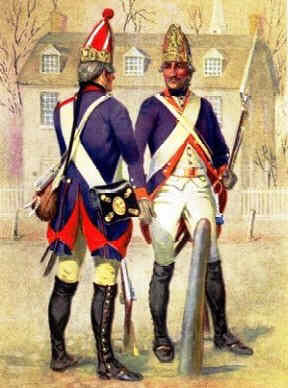
Hessian soldiers as they would have appeared in 1776.

The Hessian that provided the inspiration for the Headless Horseman may have been killed during the Battle of White Plains on October 28, 1776.  Washington Irving even mentions this particular battle in his tale when he recounts a small anecdote of an “old gentleman . . .  who, in the battle of Whiteplains, being an excellent master of defence, parried a musket ball with a small sword.”  During this battle Hessian troops played a large role.

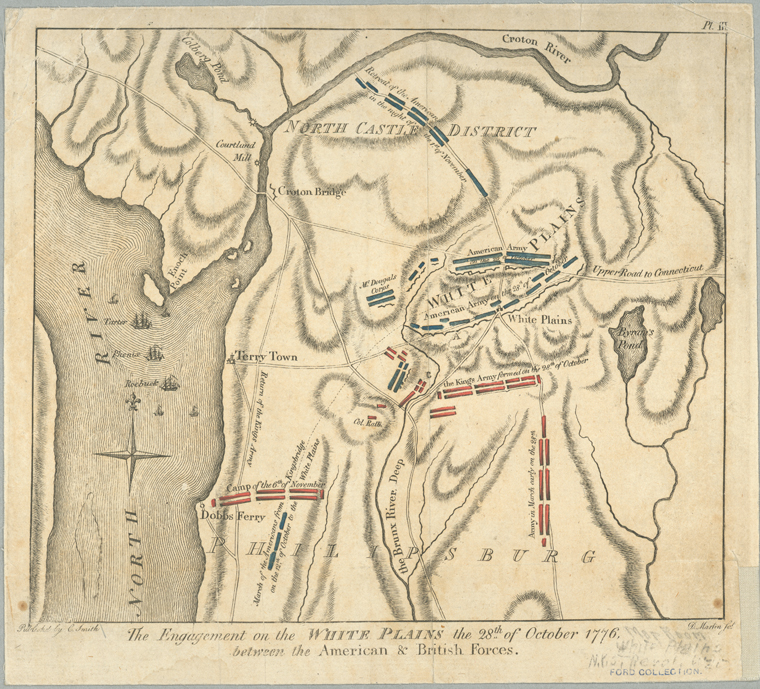
Some of these Hessian troops, commanded by Colonel Johann Rall, led a flanking assault on the American troops and pushed the entire American force back.  More than 400 British, Hessian, and American soldiers were dead or wounded at the end of the day and although the Americans fought bravely, Hessian and British troops commanded the battlefield.

white_plains_battle_plans
This 18th century map of the Battle of White Plains shows the disposition of British and American troops. On the British left flank you can make out “Col. Rall” and his Hessians.  On the left side of the map you see the North River (Hudson River) and can see Terry Town (modern day Tarrytown). Sleepy Hollow is located just north of this town.

Perhaps the ghost of the Headless Horseman was the spirit of one of the many Hessian soldiers killed during the Battle of White Plains.  Another possibility is one of the Hessians killed in the skirmishing that occurred in the days that followed.  Major General William Heath of the American army remembered a particular skirmish that occurred a few days later on November 1, 1776 when “a shot from the American cannon at this place took off the head of a Hessian artilleryman. They also left one of the artillery horses dead on the field.”

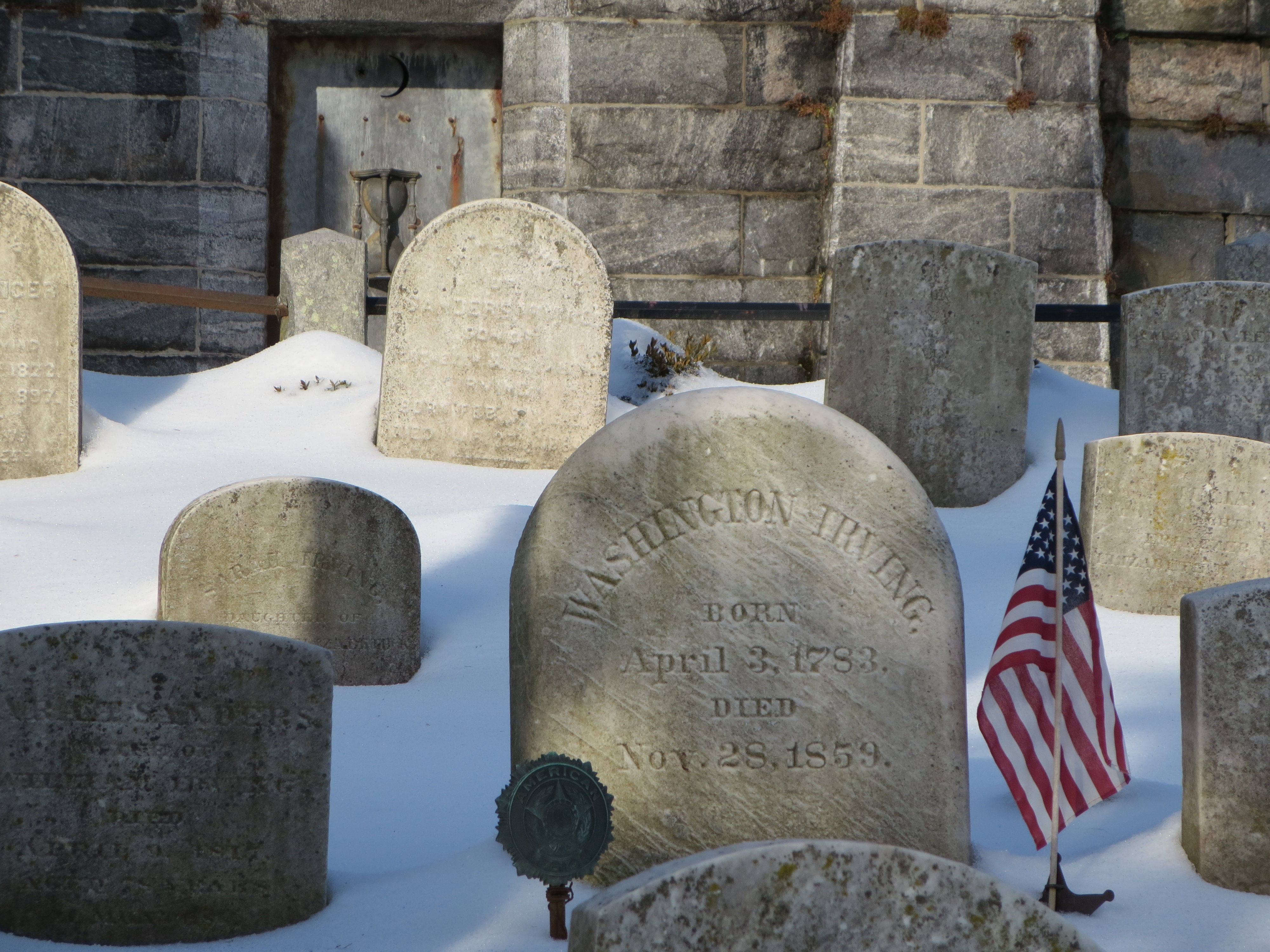
The grave of Washington Irving, most famous for his stories about Sleepy Hollow and Rip Van Winkle, he was actually very much fascinated with the Revolutionary War and later wrote a large historic biography of George Washington. (Author's photo)
The grave of Washington Irving who became famous for his stories about Sleepy Hollow and Rip Van Winkle.  Irving was actually very interested in Revolutionary War history and later wrote a large historic biography of George Washington. (Author’s photo)

Regardless of the true origins of this ghost, the Hessians’ victory at White Plains was short lived.  Colonel Rall and his brigade of Hessians would be surprised and captured by George Washington’s men at the Battle of Trenton on December 26, 1776, which would prove to be a major turning point in the Revolutionary War.

Christopher Walken famously played the Hessian who became the Headless Horseman in Tim Burton's Sleepy Hollow movie. In this retelling of the tale, the Hessian was killed in a skirmish in the winter of 1779.
Christopher Walken famously played the Hessian who became the Headless Horseman in Tim Burton’s Sleepy Hollow movie. In this retelling of the tale, the Hessian was killed in a skirmish in the winter of 1779.  Although there is no historical evidence that supports his fanciful outfit, weaponry or filed down teeth.

While the Battle of White Plains has been all but forgotten, the story of the Headless Horseman has become a touchstone which still connects us with this battle and the Revolutionary War in general.  And just like we like to find where these battles took place and walk the hallowed ground, so too does the Headless Horseman.  Irving writes that while the body of the Hessian lies “buried in the churchyard, the ghost rides forth to the scene of battle in nightly quest of his head.”  I urge you to follow in his footsteps and check out Battle Hill Park next time you are in White Plains, New York and the historic environs of Sleepy Hollow nearby.

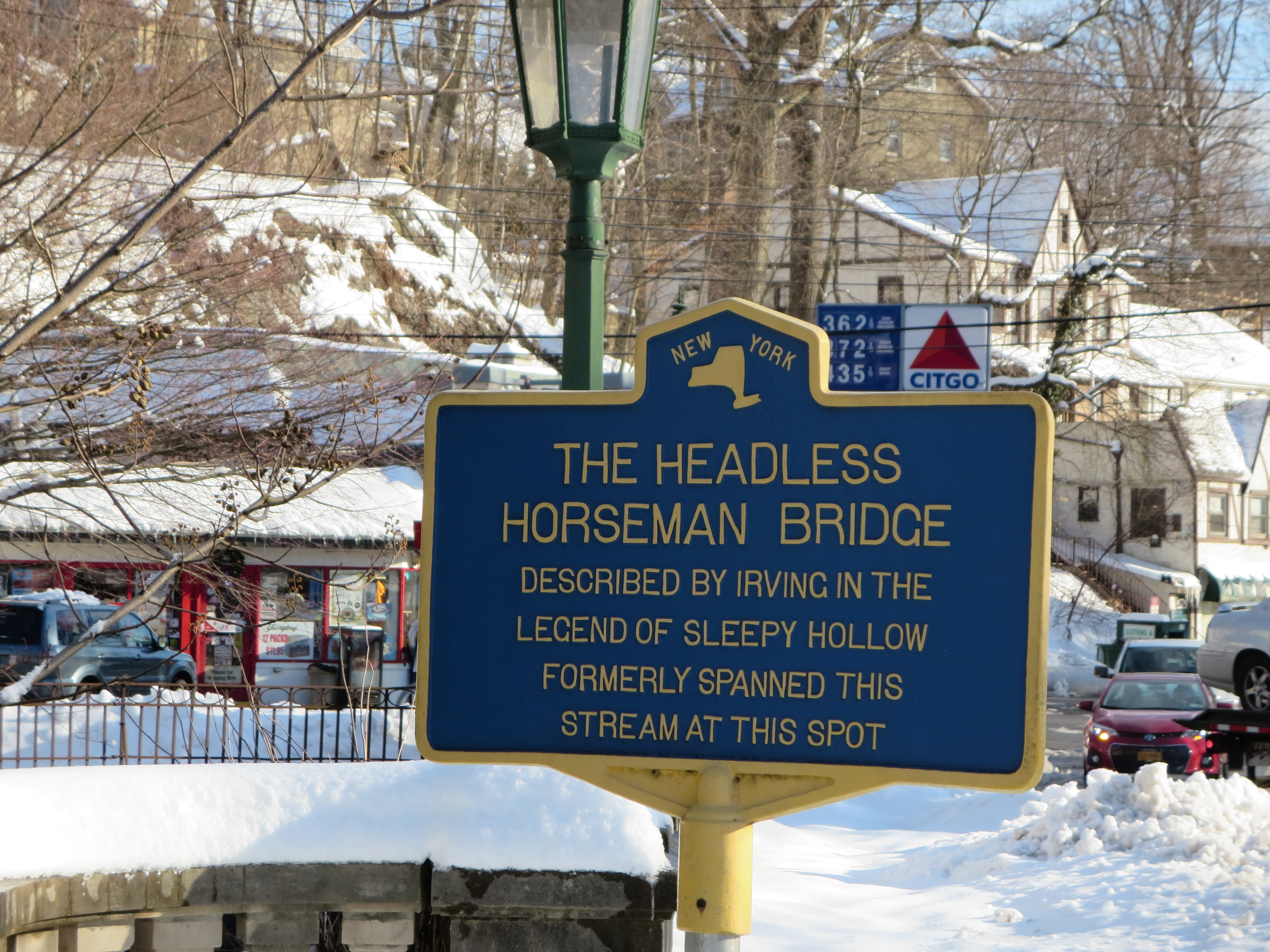
One of the many historic sites in Sleepy Hollow you can visit still today. (Author's photo)
One of the many historic sites in Sleepy Hollow you can visit still today. (Author’s photo)

Surrender at Yorktown

On this date, in 1781, the British army marched out of their entrenchments at Yorktown and surrendered to General George Washington and the combined Continental and French armies.

img_5983
Modern view of the “Surrender at Yorktown” site (P. Greenwalt)

Although the victory did not conclusively end the war, the victory prompted British Prime Minister, Lord Frederick North, to exclaim,

“Oh, God, it is all over!”

Approximately two years later, with the signing of the Treaty of Paris on September 3, 1783, the American Revolutionary War was truly over.

What is not truly over is the efforts to preserve, interpret, and educate the current and future generations about the importance of Yorktown and the American Revolution. In the spring, the new American Revolution Museum of Yorktown will open its doors, updating the Victory Center at Yorktown Museum.

From the Jamestown-Yorktown Foundation website, the museum’s goals are to;

“Through comprehensive, immersive indoor exhibits and outdoor living history, the American Revolution Museum at Yorktown offers a truly national perspective, conveying a sense of the transformational nature and epic scale of the Revolution and the richness and complexity of the country’s Revolutionary heritage.”

For more information about the museum, what it entails, and the opening date, click here.


Campaign 1776 Updates

Our friends at Campaign 1776, an initiative of the Civil War Trust,  have passed along a few important updates from their very busy September.

campaign-1776-logo-220First, another installment of their very popular “In4” video series sheds light on the Battle of Brandywine, fought in southeastern Pennsylvania on September 11, 1777. The video is narrated by Thomas McGuire, historian and author. Check out the video here.

Switching gears to the Southern Theater, Campaign 1776 has kicked off an initiative to save 1,037 acres at six sites in South Carolina. Those sites include land on Port Royal Island, Fort Fair Lawn, Colleton Castle, Lewisfield Plantation, Hanging Rock, and Waxhaws.

This appeal is the “first of its kind”, according to Civil War Trust Communication Manager Meg Martin, “to save land at these sites.” Furthermore, some of these sites were pivotal to the eventual outcome of the American Revolution, as some historians believe that the war was essentially won in the Southern Theater.

Learn more about the Campaign’s involvement here. But, feel free to leave your opinion on whether you agree that the American Revolution was won in the South or not in the comments below.


*Thank you to Meg Martin for her contributions to this post.*

“A Very Handsom Retreet”: Lt. Colonel Nathan Whiting and the Fighting Retreat that Decided the Battle of Lake George

When analyzing the key actions of a military engagement in order to pinpoint a decisive moment or turning point, one does not usually come across a retreat and/or rout that actually attributed to the success of an army. However, during the late morning of September 8, 1755, roughly three miles south of Lake George in New York’s Adirondack Mountains, a contingent of men from Connecticut and Massachusetts, and their Mohawk allies conducted quite possibly the first ever organized fighting retreat in American military history – one that would turn the tide of battle and save their army from potential destruction. It is easy for a maneuver like this to be overlooked, but without the crucial time bought for William Johnson’s provincial army at its encampment along the southern shore of the lake by Lt. Colonel Nathan Whiting’s courageous New Englanders, Baron de Dieskau’s French army may well have emerged victorious during the Battle of Lake George and subsequently pushed their way to Albany’s doorstep.

Around eight o’clock in the morning, September 8, 1755, a column of men 1,200 strong was marched out of William Johnson’s camp at the southern end of Lake George. The column’s destination was Fort Lyman, roughly fourteen miles to the south located beside the Hudson River (present-day Fort Edward, NY). There, intelligence gathered by Johnson’s army had placed the 1,500 strong French force led by Jean-Armand, Baron de Dieskau, which was believed to be preparing an assault against the 500 man garrison of New Hampshire and New York provincials.

The contingent of reinforcements dispatched from the English camp was under the overall command of Colonel Ephraim Williams, 3rd Massachusetts Provincial Regiment, and was comprised of his own regiment, 200 Mohawk Indians, and another 500 men of the 2nd Connecticut Provincial Regiment led by Lt. Colonel Nathan Whiting. The column marched south down the military road with the Mohawk at its head, followed by the Massachusetts men, and Whiting’s regiment taking up the rear.

Nathan Whiting, born in 1724 and a resident of Windham, was 31-years-old in 1755 and one of William Johnson’s youngest field officers. He was a graduate of Yale and a veteran of the Louisbourg expedition during King George’s War – service which earned him a lieutenant’s commission in His Majesty’s Forces. When hostilities between England and France erupted in 1754 he was commissioned as the 2nd Connecticut Provincial Regiment’s lieutenant colonel and was sent to Albany to serve as part of the Crown Point Expedition, an offensive designed to oust the French from the Lake Champlain-Lake George-Hudson River corridor. The regiment’s colonel, Elizur Goodrich, was ill and bedridden during the Battle of Lake George, so Whiting served as the unit’s field commander during his absence. Whiting was a loyal officer and earnestly dedicated to the cause in which he was fighting for. Before reaching the southern shore of the lake on August 28, he penned a heartfelt letter to his wife that epitomized his character: “… [P]ray make your Self as easy as possible[.] I know your D[aily] prayers are for my preservation[.] Let it be an article of them that it not be obtained by any unworthy means, but in the prosecution of the Duty I owe at this time to my Self, my Country & my God.”[1]

About two hours or so and three miles into the march to Fort Lyman, the forward ranks of Ephraim Williams’s column of reinforcements were ambushed by Dieskau’s native allies, Canadian militia, and regular grenadiers of the Regiments of Languedoc and La Reine. The French outside of Fort Lyman had earlier uncovered dispatches from a dead courier that was sent to inform the English outpost that reinforcements were going to be sent from the lake encampment to assist it in case of an attack. Using this intelligence, Dieskau marched his army up the military road towards Lake George and prepared an ambush to surprise the oncoming party of reinforcements. Although the ambuscade was initiated prematurely before the entire column could march into Dieskau’s hook-like formation, it still succeeded in throwing the English force into confusion and sent it scurrying back up the road to Lake George. Both Ephraim Williams and Chief Hendrick (commanding the Mohawk contingent) were killed during the confrontation and all order was lost, leaving Whiting, who was now the highest ranking officer on the field, to try to prevent a disaster.

008
The Bloody Morning Scout, 10:00 a.m. Map by Nicholas Chavez.

The 2nd Connecticut was spared from being involved in the ambush because of their distance to the rear of the column. However, they were met with the sights and sounds of the maelstrom unfolding ahead of them as panic-stricken men streamed through their ranks along the military road. Knowing that an all-out rout would spell disaster for Johnson and the rest of the army at the lake – which was surely Dieskau’s next target – Whiting ordered his Connecticut men to take to the woods surrounding the road and use every bit of cover possible to hold back the onrushing enemy. Rallying a handful of Bay Staters and Mohawks, they too rejoined the fighting. If Whiting could not stand and fight, he was going to run and fight in order to buy time for the rest of the army to prepare to meet the inevitable assault heading its way. With tremendous tenacity, the brave band of New Englanders and their native allies returned fire at every opportunity. They loaded, discharged their firelocks, and then ran to the next available form of concealment, repeating the process again and again. Their resistance forced Dieskau to slow his pursuit and even gave his Indians the chance to break ranks and leave the fight or return to the morning’s engagement site to plunder.

016b
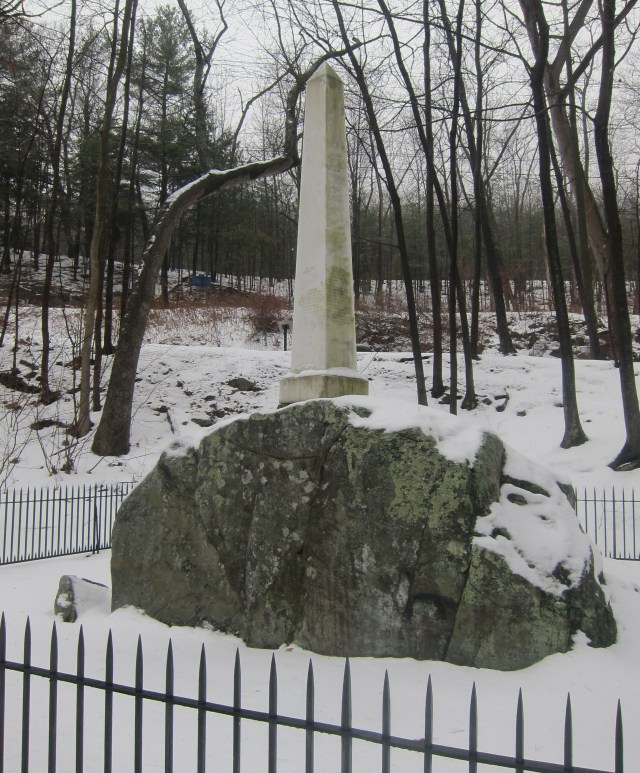
Obelisk dedicated to Col. Ephraim Williams near the spot of his death during the Bloody Morning Scout. Author’s photo.

Whiting’s fighting retreat was achieving its intended goals. Back at the Lake George encampment the fighting could clearly be heard inching closer and closer. Having the necessary time needed to prepare a defensive position, Johnson ordered his men to throw up a makeshift breastwork of logs and whatever else could be found. Artillery was planted aiming down the military road and a body of men from Lt. Colonel Edward Cole’s 1st Rhode Island Provincial Regiment was ordered forward to aid Whiting. The added strength brought Dieskau’s army to a near halt. For well over an hour the men of Whiting’s fighting retreat fought desperately against their relentless foe, refusing stubbornly to give up every inch of ground over the three miles from the ambush site to the lakeshore encampment. In the words of Lt. Colonel Seth Pomeroy of the 3rd Massachusetts, who was fortunate enough to have been ordered to remain behind in camp, Whiting’s men made a “very handsom retreet.” [2]

It was nearing noon when, in Pomeroy’s words, the rearguard, “Came within about ¾ of a mile of our Camp there was ye Last Fire our men gave our enemies which kill’d grate numbers of them [as they were] Sean to Drop as Pigons….”[3] Emerging from the wood line into the clearing made by Johnson’s camp, Whiting and his men caught the first glance of what their courageous actions had accomplished that morning. There in front of them the entire army waited to meet the oncoming enemy behind a long line of newly built breastworks.

For four hours Dieskau attempted to break the English lines, not once even coming close to reaching their defenses.  By nightfall the French army was in full retreat (without its commander, who was left behind on the field wounded) back to Carillon to the north, and William Johnson and his army could finally declare the Battle of Lake George a victory for His Majesty King George II. The southern shore of the lake was still in British hands, and the road south to Albany was again secure. Plans were made to build a large permanent fortification at the site of Johnson’s encampment, and by the end of the month construction of what would come to be christened Fort William Henry began.

Despite the tremendous leadership and collective effort of many officers during the battle, Johnson took all the credit for himself – even though he was wounded early in the fighting and had missed most of it. His second-in-command, Major General Phineas Lyman of Connecticut, who had commanded the army during the fighting after Johnson’s wounding, was not mentioned in the general’s report to the royal governors the following day. Also omitted from this were Nathan Whiting and his men who desperately fought to buy time for the army to prepare the defenses that proved so crucial to deciding the outcome of the battle. It is impossible that Johnson simply did not know what had transpired in the forests south of Lake George that morning – he would have clearly heard the sound of musket fire slowly progressing towards his camp. He mentioned in his report hearing the, “… heavy firing, and all the Marks of a Warm Engagement….”[4] His failure to include the service of Lyman and Whiting in his recollections was nothing more than a want of glory and a personal vendetta that he seemed to hold against Connecticut’s officers. For his victory at the Battle of Lake George, Johnson was later knighted – an honor that would have been better bestowed upon others.

An already underappreciated event in America’s colonial history, the English victory at the Battle of Lake George halted Dieskau’s offensive into New York’s interior and quite possibly saved Albany and everything north of it from falling into the hands of France and being cut off from the rest of the colonies. In my opinion, had the battle been lost by the English its consequences would have been far greater than Braddock’s Defeat along the Monongahela. Not only was the Ohio River Valley already lost that summer, but if the British were also ousted from Lake George then the major water “highway” north into Canada would have been lost as well. This would have given France a direct route south into New York’s interior and even an avenue of approach towards New York City via the Hudson River. Many more would have been in danger following that summer than just the frontier settlers of Maryland, Pennsylvania, and Virginia. So if these observations are at least in some part accurate, then the significance of the English victory along the southern shore of Lake George cannot be understated. If this truly was one of the more strategically significant battles of the French and Indian War, then Nathan Whiting’s fighting retreat made the victory possible. It was the decisive action of the Battle of Lake George and quite possibly the first ever successfully organized fighting retreat in American Military History.

[1] Nathan Whiting, “The Letters of Colonel Nathan Whiting,” in The Papers of the New Haven Colony Historical Society, vol. 6 (New Haven, CT: New Haven Colony Historical Society, 1900), 137.

[2] Seth Pomeroy, The Journals and Papers of Seth Pomeroy: Sometime General in the Colonial Service (New York: Society of Colonial Wars in the State of New York, 1926), 114.

[3] Ibid.

[4] Milton W. Hamilton, “Battle Report: General William Johnson’s Letter to the Governors, Lake George, September 9-10, 1755,” in Proceedings of the American Antiquarian Society, vol. 74 (Worcester, MA: Published by the Society, 1965), 22.

North Jersey American Revolution Round Table

Two of the most significant battles of the war happened in the state of New Jersey; Trenton and Princeton. The harshest winter of the war for the Continental Army was at Morristown, New Jersey. Maybe it is only fitting that the largest American Revolution Round Table is also located in the Garden State.

NJARRT
North Jersey American Revolution Round Table

The North Jersey American Revolution Round Table is now on its ninth year as an organization and according to Secretary Rich Rosenthal, they are known for their “caliber of speakers and membership participation.”

Meetings are held the second Thursday of every month at the Washington’s Headquarters Museum Great Hall. All facets of the American Revolutionary War and era are discussed with, of course, “special emphasis” on New Jersey and Morristown’s role in the history of the United States.

Guests are certainly welcome. “We meet at a National Park facility [Morristown National Historical Park]–there is no admission!”

For more information, consult the following website by clicking here. An email newsletter is also available to keep up-to-date on events of the non-profit round table.


A Quick Trip to Fort Ticonderoga

Emerging Revolutionary War is honored to welcome guest historian David A. Powell to the blog. A biography of David is at the bottom of this post. 

The Hudson Valley in upstate New York is one of my favorite historical places – which might come as a surprise to some, given that my usual historical beat is the 1861-1865 time-frame. There are a handful of Civil War related sites along the Hudson, but not many.

But for two centuries before our war between the states, the region was the pathway for commerce, settlement, and conflict. The banks of the Hudson, Lakes George and Champlain, and the St. Lawrence are all dotted with crucial reminders of a violent historical past.

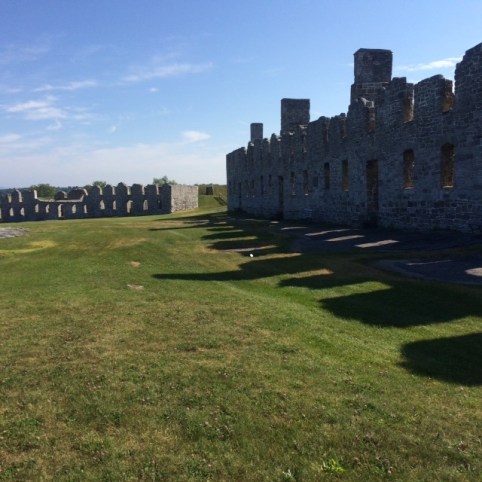
Ruins Crown Point
Ruins of Crown Point

I’ve been to most of these sites; West Point, Bennington and Saratoga battlefields, the site of Fort William Henry, Crown Point, and plenty of other locations. One of them, however, fixes my attention beyond all others:

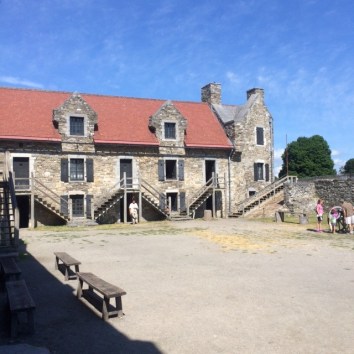
Fort Interior
Interior of Fort Ticonderoga

Fort Ticonderoga.

The fort occupies a strategic place on Lake Champlain, were a land portage connects Champlain to Lake George, and ultimately, the Hudson River.

<Lake Champlain from Fort, looking south>

Originally called Carrillon by the French, who built it in 1755; the fort changed hands several times during the ensuing 25 years. It was unsuccessfully attacked by the British in 1758, and finally captured the next year, part of the British “Annus Mirabilis,” that string of decisive triumphs over the French that reached their crescendo with Wolfe’s victory at Quebec. Two decades later, it figured in the American Revolution; it was wrested from British control by Ethan Allen and Benedict Arnold in 1775. Its heavy artillery was sledged across many miles of Wilderness snow and ice to reinforce the Rebel army besieging Boston by Henry Knox, which forced the British to abandon that city. In 1776 Ticonderoga was a bulwark of the Patriot defenses on Lake Champlain. In 1777, it was easily re-captured by the British under Burgoyne, but returned to American control after Burgoyne’s disasters of Bennington and Saratoga.

Ticonderoga is fully restored now, owned and maintained by a private foundation that has done an outstanding job of presenting and preserving the Fort’s history. The town and the fort grounds are also dotted with interesting monuments, many erected by British regiments, mainly placed to honor their troops who fought in the Fort’s bloodiest single battle, that of 1758.

British General James Abercrombie led 17,000 troops – colonials and British regulars – against a much smaller garrison of between 4,000 and 5,000 French, Canadian Militia, and Indian Allies. The French, under the Marquis de Montcalm, defended an entrenched line outside of the fort walls, which Abercrombie obligingly assaulted. The British lost 2,000 men, and Abercrombie retreated.

My favorite monument at Ticonderoga is actually paired with another monument erected by the American Colonists in Westminster Abbey (left to right in picture below). They both commemorate the death of Lord George Howe, a Brigadier General in Abercrombie’s army (and elder brother to the Howes of Revolutionary War fame) who embraced irregular warfare.


Go spend an afternoon at Ticonderoga. You won’t be disappointed.


*David A. Powell is a graduate of the Virginia Military Institute (1983) with a B.A. in history. He has published numerous articles in various magazines, and more than fifteen historical simulations of different battles.

For the past decade, David’s focus has been on the epic battle of Chickamauga, and he is nationally recognized for his tours of that important battlefield. The result of that study was his first published book, The Maps of Chickamauga (Savas Beatie, 2009).

His latest book is Failure In The Saddle: Nathan Bedford Forrest, Joe Wheeler, and the Confederate Cavalry In the Chickamauga Campaign (Savas Beatie, 2011). He is currently working on a full length monograph of the battle of Chickamauga. The first volume of that work, entitled The Chickamauga Campaign: A Mad Irregular Battle, is scheduled for a 2014 release.

David and his wife Anne live and work in the northwest suburbs of Chicago, Illinois. He is Vice President of Airsped, Inc., a specialized delivery firm.

Union Jack o’er the Capitol: A Burning of Washington Walking Tour

Emerging Revolutionary War is honored to welcome guest historian Zach Whitlow. Zach’s biography is at the bottom of this post. 

August marks the 202nd anniversary of the Burning of Washington. On the heels of their astounding victory at Bladensburg, a British incursionary force under Major General Robert Ross and Rear Admiral George Cockburn occupied the American capital for about 24 hours on August 24th & 25th, 1814. Besides a small ambush at the Sewall House on Capitol Hill, in which two corporals and General Ross’ horse was killed, the British encountered no resistance in the city whatsoever. The Union Jack was triumphantly raised: Washington had fallen. Soon it would burn.

The burned out shell of the White House following the British occupation of Washington. (The President's House, by George Munger, 1814-1815)
The burned out shell of the White House following the British occupation of Washington. (The President’s House, by George Munger, 1814-1815)

What followed were events that literally burned themselves into the American psyche. To remember this bleak moment in history, rangers from the National Mall & Memorial Parks are leading a series of walking tours in the month of August. Beginning at the newly designated Belmont-Paul Women’s Equality National Monument (the site of the ambush), visitors walk a total of 2.5 miles and retrace the British advance down Pennsylvania Avenue. Through the program, the rangers will sift through the modern paved environment and tell the stories of long gone places, such as the newspaper offices of the National Intelligencer and Barbara Suter’s tavern.  The tour will also feature some of the surviving remnants of that time, such as the Octagon Museum.

The walking tour begins at Belmont-Paul Women’s Equality National Monument (144 Constitution Ave NE, Washington, DC 20002) every Saturday in August at 3:00 pm. There will also be programs on Wednesday, August 24th and Thursday, August 25th at 3:00 pm. Please bring comfortable shoes and plenty of drinking water.


*Zach Whitlow has an M.A. in Museum Studies from the George Washington University, a B.A. in History from California State University, Long Beach, and three A.A. degrees from Fullerton College. A lifelong historian, he currently works for the National Park Service at the National Mall & Memorial Parks in Washington, DC and the Office of Historic Alexandria in Alexandria, VA. Prior to this, Zach worked at the National Archives, George Washington’s Mount Vernon, and the Queen Mary in Long Beach, CA. He currently lives in Alexandria, VA with his girlfriend Teresa and their two cats, Max and Lizzie.