Emerging Revolutionary War is open to submissions from our readership. Guest submissions can also lead to membership. Articles of varied length and photo essays are welcome. Please be advised that we do not pay for any article submissions. Emerging Revolutionary War is 100% non-profit. We do offer to promote you and your work to the best of our ability, while offering an outlet to explore new ideas and improve as a writer/historian.
We are looking to establish long-term relationships with writers who conduct excellent research and provide a fresh look at an old subject. Any articles that the author submits should offer a new interpretation of or newly discovered information on significant events.
Guest submissions are subjected to a blind peer review process. Members of our editorial board, whose identities are kept anonymous, read and comment on posts. However, they do not necessarily offer a simple up-or-down judgment. In keeping with our mission to provide a platform for emerging voices, our board sees its role as a developmental entity. The board’s general approach is to try and find a way their way to “yes.” This often involves several rounds of revisions based on feedback provided by the board. While there is no guarantee of publication, if an author is willing to put in the time and make a good-faith effort at incorporating feedback, the board is willing to continue helping authors develop pieces.
Word count should be in the 800-1500 range for consideration. Please submit guest posts as Word Document attachments by email to emergingrevolutionarywar@gmail.com with “Guest Post Submission” in the subject line.
Authors will receive an e-mail acknowledgment when their submission has been received. The review process may take up to two/three weeks. Once the process is complete, an editor will contact the author to report the outcome. Just because you submit an article does not mean we will post the article. If your writing is accepted for publication, you will be asked to sign a form stating that the article is your own work and allowing Emerging Revolutionary War to retain first digital rights.
To be considered for authorship, please keep in mind the following guidelines:
Any and all topics on the broadly-defined Revolutionary War era are welcomed (French and Indian War, colonial era, American Revolution, War of 1812).
If submitting a proposal, be specific about what your article will focus on. Include an outline of the story idea and a professional biography.
Any first-time article should be no more than 1,500 words.
All works must contain footnotes or endnotes in either Chicago or MLA format or a section citing works referenced.
All work must be original by the submitting author.
Articles should not be of a general nature but should be written to be enjoyed by a general audience.
Articles should have strong leads. The first few paragraphs must capture readers, hold on to them, and then propel them into a story.
Article submissions must contain an author’s brief professional biography.
Submissions are subject to modification and editorial board review, with the editors having final approval.
Previously published work may be considered as long as the author owns the copyright. Previously published submissions must be identified as such at the time of submission.
We request authors send at least one image for use in the article, whether taken themselves, within public domain, or from elsewhere with clear publication permission. Any photos or photo essays should set the scene, showing specific items of interest as they relate to your narrative. They must come with captions and photo credits.
Please submit all articles in a titled Word or Google Docs document (not PDF). Be sure to put the author’s name at the beginning of the piece.
If you have a passion and love for early American history and an interest in research and writing, we love the opportunity for ERW to help you share that passion!
In an age where the names of Franklin, Jefferson, and Washington are household, the names of Wilkinson, Kemper, and Bowles seem to be consigned to the fringes of histories of the early American republic. With the formation of the fledgling United States of America, both the honorable and not-so-honorable helped shape the direction of expansion, and diplomacy, and reinforce societal values of the 18th and early 19th centuries. This collection of essays is akin to watching a true crime television documentary.
With a collection of essays, editors David Head and Timothy C. Hemmis, historians, and biographers provide snippets into the lives of these scoundrels of the early Republic. A few of the names are well known, including Benedict Arnold and Aaron Burr, a few will conjure up memories from the fringes of other histories, such as James Wilkinson, whereas others have escaped the main avenues of historical exploration. Throughout the various essays, “this collection seeks to reexamine the Founding generation” to “replace the hagiography of the Founding Fathers with something more realistic” (pg. xx).
First, an examination of the word “scoundrel” is needed. According to usage at the time and the 1755 dictionary of Samuel Johnson’s authoring, that word meant “a mean rascal; a low petty villain” (pg. xiii). Through 12 individuals, the various authors explain how each earned the moniker “scoundrel” and how that affected the development of the United States. Especially interesting was the role of various individuals in Western expansion and the domino effect on international diplomacy. Individuals such as Aaron Burr and James Wilkinson are better known but Philip Nolan and Thomas Green are not so much.
Others, such as Benedict Arnold and Charles Lee get a fresh look from two great Revolutionary-era historians, James Kirby Martin and Mark Edward Lender. Included in those discussed, William Augustus Bowles and Diego de Gardeoqui show how international actors played prominent roles in providing heartburn to the national government. One theme, the west and south of the original thirteen states provided the arena for scheming, opportunity, and risk.
In conclusion, the editors examine three main reasons a study like this is important, that the “unintended result of the American Revolution” was “many men decided they had their own ideas about what was important” (pg. 266). Secondly, the “vital importance of the American West as a zone of territorial expansion, economic opportunity, and foreign intrigue” and lastly simply “early America was…a time and place for scoundrels…” (pgs. 267-268).
Overall this essay-comprised book is a fun, fresh read that looks at those scoundrels that sought an opportunity to change the landscape of the early American republic and potentially change the course of United States history. Who does not like to read about plots, scheming, and resultant escapades?
Welcome to the first “Rev War Revelry” of 2024! To kick off the new year, Emerging Revolutionary War is joined by Tom Hand, author, historian, and founder of Americana Corner. However, in the later stages of 20234, Tom added published book author to his lengthy list of accomplishments. His book, American Triumph is now available via his website.
The book, “masterly blends the personal experiences and historic milestones” of three luminaries of the early Republic, Benjamin Franklin, George Washington, and John Adams. The book, with a plethora of graphics, sidebars, and informational tidbits aims to provide a “captivating collection of stories” for the “everyday American.”
We look forward to a lively and friendly discussion with Tom. Hope you can tune in, to Emerging Revolutionary War’s Facebook page at 7 p.m. EDT this Sunday, January 7th.
Located in rural south-central Pennsylvania, the Conococheague Institute is preserving regional history of the colonial and early national periods. Their website describes themselves as a “hands on regional learning center.” The historic site features year-round special events such as weapons demonstrations, brewing, spinning, cooking, sewing, medicine and more.
Since our next scheduled Rev War Revelry will land on Christmas Eve (Dec 24th) we have decided to give the team the night off. Plus, we are still recovering from a GREAT trip to Boston covering all the great events around the Boston Tea Party 250th (be sure to stay tuned, we will be placing all our live videos in a playlight on our You Tube page). In lieu of not having a Rev War Revelry on Dec 24th, please commemorate the Christmas holiday by watching our “The Crossing Watch Party” from two years ago. ERW historians provide historic commentary and critique of this popular movie that depicts the events on December 25-26, 1776 of Washington crossing the Deleware and the Battle of Trenton.
We hope everyone enjoys their Christmas and New Years and hope Santa brings you a great history book (we have some recommendations at: https://www.savasbeatie.com/american-revolution/ ). We will see you again live on Sunday, January 7th as we welcome our good friend Tom Hand, founder of Americana Corner, as he talks about his new book. Cheers!
With three ships sitting at Griffins Wharf in Boston Harbor laden with tea, the Sons of Liberty were quickly running out of time on December 16, 1773. At the stroke of midnight, twenty days would have past since the first ship arrived in the harbor. At that time, customs officials would seize the cargo, the tax would be paid, and the British government would have been successful in forcing the colonists to pay a tax they did not consent to. The British would have demonstrated their power over the colonists. The colonists’ rights as Englishmen were at stake. Whereas the tea cosignees had resigned in New York and Philadelphia, the ones in Boston refused to resign and the Governor was refusing to allow the ships to leave the harbor.
On December 16, the leaders of Boston held a meeting they referred to as the “Body of the People.” Because of the large amount of interest in the issue, more than 5,000 people attended this meeting at the Old South Meeting House in Boston (the largest venue in the city). At the meeting was William Rotch, the owner of the ship Dartmouth which was the first ship to enter the harbor and would be the first to be seized by the customs officials on December 17. Rotch wanted to protect his property and see if the Governor would allow him to sail out of the harbor. The meeting recessed to let him go to the Governor outside of Boston and request the ability to leave the Harbor. Governor Hutchinson said he could not allow the Dartmouth to leave. After the meeting had reconvened in the Old South Meeting House, Rotch returned to Boston at about 6 p.m. and told the crowd that the Governor would not let the tea return. This news was responded to with loud cries and shouting.
At that moment, Samuel Adams declared “This meeting can do nothing further to save the country.” After saying this, people heard Indian war whoops coming from the crowd and outside the building. Another person declared “Boston Harbor a teapot this night!” The people then began exiting the building and heading down to Griffins Wharf a few blocks away. Down at the wharf, men (some disguised as Mohawk Indians) began boarding the three ships. Approximately one hundred men boarded the ships and quickly got to work pulling up the large tea chests to the decks and dumping the tea into the cold water below. Crowds gathered and watched the men work for nearly two hours as they methodically worked to destroy all the tea on board the ships.
The men were careful to not destroy any other property except the tea. They also refused to steal any of the tea, punishing anyone who made an attempt. It was low tide and the tea started to pile up out of the water and needed to be mashed down into the water and mud.
British regulars were stationed at nearby Castle William, but they were not called down to the ships out of fear of insitigating a similar event as the Boston Massacre that occurred three years earlier. The British navy, posted in the harbor also made no attempt to stop the destruction. Some Royal Navy sailors watched the events on Griffins Wharf with some trepidation.
Once all 342 chests of tea had been tossed overboard, the destroyers left and the crowd dispersed. In all, they had destroyed 46 tons of tea on the ships.
The event would have major repurcussions as the British determined to repsond to the event with brute force and would ultimately result in the Revolutionary War less than two years later. John Adams wrote: “This Destruction of the Tea is so bold, so daring, so firm, intrepid and inflexible, and it must have so important Consequences, and so lasting, that I cant but consider it as an Epocha in History.”
Learn more about the events happening to commemorate the 250th anniversary of the Boston Tea Party by visiting https://www.december16.org/.
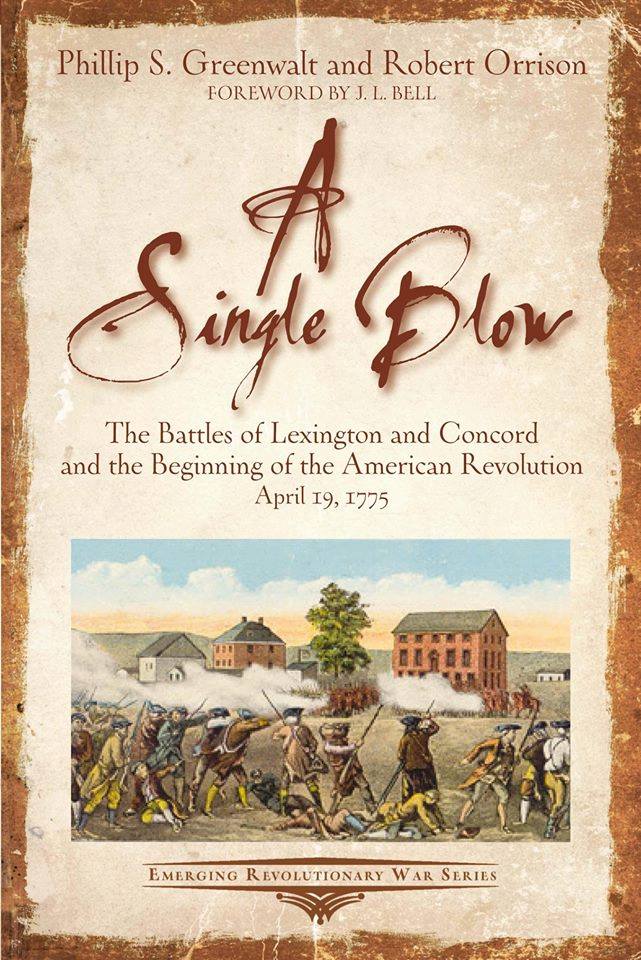
You can learn more about Boston in the Revolutionary War by reading Rob Orrison and Phill Greenwalt’s book A Single Blow, part of the Emerging Revolutionary War book series.
Join us via our Facebook page (https://www.facebook.com/emergingrevwar ) starting next Thursday, December 14th as ERW travels to Boston for the Boston Tea Party 250th commemoration. We will be posting videos from historic sites throughout Boston focusing on the events around December 16, 1773. We will interview historians, authors and museum professionals from all over Boston. We will also bring you live to the “destruction of the tea” reenactment on Saturday and of course visits to surprise historic sites all over Boston…and maybe a few pubs along the way!
If you miss one of our live videos, don’t worry…we will post all our content to our You Tube channel as well (https://www.youtube.com/@emergingrevolutionarywar8217 ). If you happen to be in Boston, be sure to send us a message and we would love to have you join in on the fun. The Boston Tea Party is one of the most important events in the history of our nation and the beginning of the push to revolution. ERW will be your home for all events with the 250th of the American Revolution!
For more on the events in Boston from 1773 – 1775, be sure to get a copy of “A Single Blow: The Battle of Lexington and Concord and the Beginning of the American Revolution”
Join us this Sunday evening at 7:00 p.m. on our Facebook page for an author interview with Jack Kelly to discuss his new book, God Save Benedict Arnold: The True Story of America’s Most Hated Man.
Benedict Arnold committed treason― for more than two centuries, that’s all that most Americans have known about him.
Yet Arnold was much more than a turncoat―his achievements during the early years of the Revolutionary War defined him as the most successful soldier of the era. GOD SAVE BENEDICT ARNOLD tells the gripping story of Arnold’s rush of audacious feats―his capture of Fort Ticonderoga, his Maine mountain expedition to attack Quebec, the famous artillery brawl at Valcour Island, the turning-point battle at Saratoga―that laid the groundwork for our independence.
Arnold was a superb leader, a brilliant tactician, a supremely courageous military officer. He was also imperfect, disloyal, villainous. One of the most paradoxical characters in American history, and one of the most interesting. GOD SAVE BENEDICT ARNOLD does not exonerate him for his treason―the stain on his character is permanent. But Kelly’s insightful exploration of Arnold’s career as a warrior shines a new light on this gutsy, fearless, and enigmatic figure. In the process, the book offers a fresh perspective on the reasons for Arnold’s momentous change of heart.
As we move towards to the 250th anniversary of the Boston Tea Party, we at ERW have gotten a lot of questions with a central theme…” why was it tea that led to revolution?” Was tea so central to colonial life that it was worth risking war or was it something else? The answer is somewhere in the middle and as with most history, there is nuance to the story (and yes, tea WAS a big part of everyday live in British America).
On May 10, 1773, Parliament passed the Tea Act, this act was a way for the British government to help bail out a major corporation, the British East India Company. The British East India Company was one of the largest global companies and faced immense debt and financial trouble. Furthering their troubles, they held a large amount of tea stored in warehouses in London. The British East India Company sought a way to offload this tea, which was considered some of the best tea in the world. The company’s success was directly tied to Great Britain’s international strategy, as the company spread British influence across the globe especially in India where they basically managed the British colony. The Tea Act reduced the cost on the tea (cutting out the “middleman” in Great Britain), and now the colonists could buy the tea directly from the British East India Company.
The British colonies in North America consumed on average of 1.2 million pounds of black tea annually. In 1773, about 1/3 of the population drank tea at least twice a day. It was a common luxury among most middle- and upper-class colonists. They preferred black tea but also drank green tea. Black tea varieties included Bohea, Congou and Souchong and common green tea varieties included Singlo and Hyson. All the tea that the British East India Company sold was grown and imported from China. Tea from China was preferred by most for better flavor, but it tended to be more expensive. The North American colonies consumed a lot of smuggled tea from the Dutch, the quality of the tea was not the same but much cheaper. A large market grew for smuggled tea with most British port officials looking the other way. All of this changed when the Tea Act was passed.
Nineteenthcentury lithograph depicting a tea plantation in Qing China
Many in Parliament believed the colonists would have little opposition to this new act. They could now purchase their preferred tea for a cheaper price than the smuggled tea from the Netherlands. Unfortunately for Royal leaders, this was not the case. As word reached the colonies Whig leaders such as Samuel Adams called it nothing more than a British authorized monopoly of the tea market, cutting into the pockets of colonial merchants (though their tea smuggling business was illegal to begin with). The Tea Act also highlighted a British policy that the colonists opposed for many years, the Townshend Acts. The Townshend Acts imposed duties on imported lead, glass, paper, paint, and tea. This “tax” was payable at ports and funded the salaries of colonial judges, governors, and other government officials. This angered many colonial leaders for two reasons. First, it levied another tax on the colonists without having their own representation in Parliament. Secondly, it made the government officials more beholden to the British government (and the tax) than the colonial governments.
Whig groups like the Sons of Liberty used local taverns as places for their meetings. The most famous being the Green Dragon Tavern in Boston. It no longer stands today.
As the news of the Tea Act reached the colonies, the reaction was mixed. Whig leaders in major cities such as Charleston, New York, Philadelphia and Boston saw it as a way to reinvigorate their cause of opposing British rule. Recently things were mostly quiet with little interest by the public for protest. But now the Whig spin machine went into full affect. The Tea Act was a direct affront to colonial self-rule and economic interest. The taxes paid for the tea went to British officials in the colonies and the cheaper priced (and better quality) tea would put many American merchants out of business. Whigs were able to control the message that the Tea Act was just another way for Parliament to make money off the colonists, who did not have representation in Parliament.
As part of the Tea Act, consignees were appointed to oversee the sale of tea and the collection of the taxes on behalf of the British East India Company. As the tea began to arrive in colonial ports, public pressure was put on consignees to resign. This pressure was successful in New York, Philadelphia and in Charleston. Each of these cities were able to either stop the tea from being offloaded or, as in the case of Charleston, they confiscated the tea and didn’t allow any duties to be paid on it. All of these were direct affronts to the law but the events in Boston proved to be the most dramatic.
Ca, 1780 view of Charleston Harbor, and the Exchange Building where the confiscated tea was locked away by Whig leaders.
Unlike in other port cities, the consignees in Boston refused to resign. Richard Clarke, leading merchant in Boston and one of consignees faced a mob at his warehouse trying to pressure him and the other consignees to resign. Encouraged by the Massachusetts Governor Thomas Hutchinson (who had two sons serving as tea consignees) to stand their ground, the consignees refused to resign. Soon news arrived that the first ship carrying the tea, the Dartmouth, was arriving in Boston soon.
Hosting several town meetings, some hosting thousands of people, Whig leaders such as Samuel Adams, Dr. Joseph Warren and John Hancock were able to organize a strong opposition to the tea. Of course, Boston was already a tinderbox due to the “Boston Massacre” in 1770 and the large contingent of British regular troops stationed in Boston. Bostonians were reminded daily of Royal influence. The Whigs protested to the Governor to order the ships to return to England, but Hutchinson refused to do so and claimed he didn’t have that authority. Many historians believed Hutchinson, who recently had resigned as Governor and was awaiting his replacement, had grown tired and frustrated with the likes of the Whigs and Sons of Liberty in Boston and was trying to press the issue.
On November 28, the Dartmouth arrived in Boston Harbor. Captain James Hall was turned away at the first wharf he sailed too and was redirected to Griffins Wharf. Everyone knew that once a ship entered the harbor, the captain had twenty days to unload the cargo and pay the custom duties. Soon two more ships arrived at Griffins Wharf with more tea. With the Governor refusing to allow the ships to leave the harbor and local patrols watching the ships to make sure the tea was not offloaded, the stage was set for December 16th, the last day the ship’s captains had to unload their cargo.
This article by ERW’s William Griffith first appeared on the American Battlefield Trust’s websiteon January 4, 2021.The original link can be found here.
The French and Indian War was in its fifth full year, and the tables had turned in Britain’s favor. As the larger conflict, the Seven Years’ War, raged throughout the globe, in North America, the British were one swift strike away from conquering the continent. The French in the Ohio River Valley, Great Lakes region, and Upstate New York had been thrown back on their heels and sent scurrying north into Canada leaving the road open for a British thrust against Montreal and Quebec. For the summer of 1759, the latter city, the capital of New France, would be placed in the crosshairs by an army commanded by Major General James Wolfe. If Quebec, situated along the most important water highway in Canada, the Saint Lawrence River, should fall, the French in North America would be squeezed into the region around Montreal. Pending any catastrophic failures by Britain’s army and navy and their allies elsewhere in the world, it would only be a matter of time than before New France was conquered.
James Wolfe and His Army
Thirty-two year old James Wolfe had served in the British Army for almost eighteen years when he was given command of the roughly 9,000-man force that was tasked with defeating the French in and around Quebec City in 1759. He was hard-nosed and did not always get along with his subordinate generals, Robert Monckton, George Townshend, and James Murray. The previous year he had been a brigadier general under Jeffry Amherst during the successful siege and capture of the fortress city of Louisbourg in Nova Scotia, and afterward led a campaign of destruction against the fishing villages of the Gulf of Saint Lawrence. He then returned to England and secured a major generalship and command of the Quebec expedition. He arrived in Halifax in April 1759 and began training his force and preparing plans for his campaign.
Wolfe’s army was composed predominantly of professional British soldiers. Several hundred North American ranger units also complimented his force, which he described as, “… the worst soldiers in the universe.” He did not have much respect for colonial troops. On June 26, Wolfe’s men began landing at Ile d’Orleans in the middle of the Saint Lawrence River just to the east of Quebec City. Across the river, the French commander, the Marquis de Montcalm, prepared to oppose them.
The Marquis de Montcalm and Quebec’s Defenders
Louis-Joseph, Marquis de Montcalm, had been in command of France’s regular troops in North America since 1756. During that time he had put together an impressive string of victories at places like Fort Oswego, Fort William Henry, and Fort Carillon. As the attack on Quebec loomed, he was given command of all military forces on the continent, including the Canadian militia and marines. The previous harvest had not been good in Canada, and his army and the civilians in the city were on short rations, but relief came during the spring of 1759 when ships arrived carrying food and supplies. With this, Montcalm was determined to hold onto the city at all costs. He dug trenches outside the city and along the Saint Lawrence’s northern shoreline extending for nearly ten miles, welcoming a frontal assault from Wolfe. His army, consisting of over 3,500 French regular troops, included thousands more Native American allies and Canadian militiamen who were not accustomed to fighting in open fields against professional enemy soldiers. This important disadvantage would play a large part in Montcalm’s ultimate defeat.
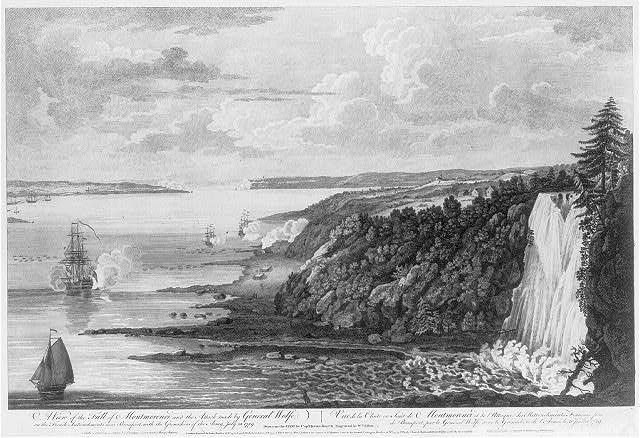
An engraving of General James Wolfe’s failed attack on the Montmorency River, July 31, 1859. Library of Congress
The Campaign
When General Wolfe’s army began landing at Ile d’Orleans and subsequently Point Levis (directly across the river from the city) to the east of Quebec, he had initially hoped to force a landing on the northern shore just a few miles downstream at Beauport. However, he quickly discovered that Montcalm had heavily fortified the landing site, throwing a monkey wrench into his plans. This did not deter Wolfe, however, and by July 12, he had placed ten mortars and cannon at Point Levis and began bombarding the city itself. More guns were brought up and the bombardment continued for weeks in an effort to demoralize those within Quebec City.
The best chance to defeat Montcalm was to force him out of his defenses and into an open field battle. Wolfe understood that his vigorously trained and superior disciplined regular troops would have the upper hand against lesser-numbered French regulars and their militia. His first attempt to accomplish this occurred on July 31, when he landed a force of grenadiers, light infantry, and rangers near Montmorency Falls further downstream from Beauport hoping to ford the Montmorency River and reach a position in the rear of the French lines. It failed miserably. Montcalm guessed correctly that an attack was coming from that direction and rushed men there to meet the enemy. The river’s tide prevented Wolfe from getting all of his troops in position on time and frontal assaults launched from the beach were beaten back with heavy losses. The British retreated, leaving behind 443 men killed and wounded. The first attempt to force a landing on the Quebec side of the river had failed, but it would not be the last. Wolfe turned his attention further upriver, where he hoped his prospects for victory would be more fruitful.
The Plains of Abraham
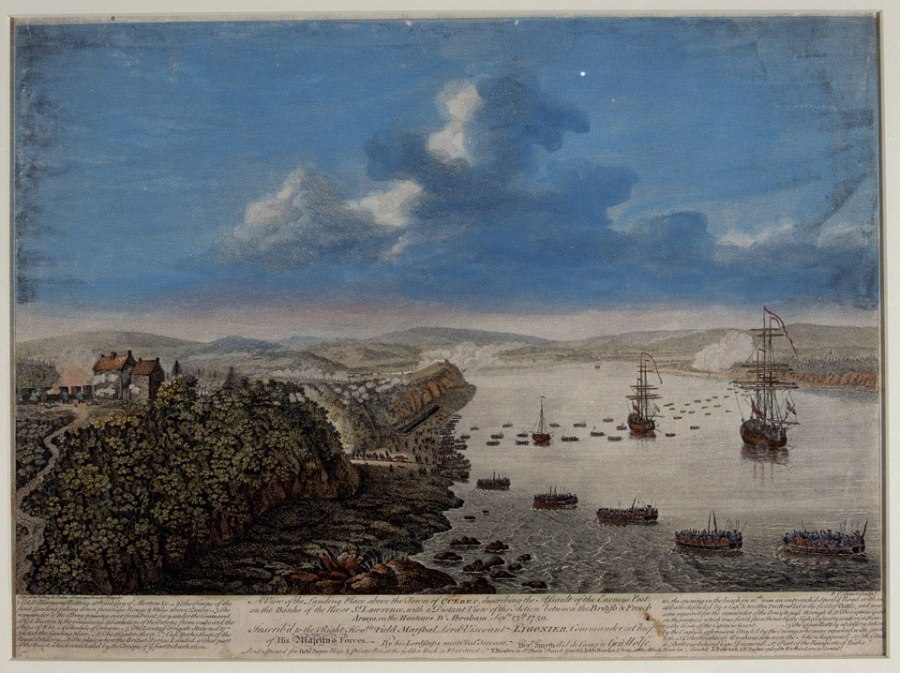
As the weeks passed following the debacle at Montmorency, the British probed the northern shore west of Quebec for a secure landing spot. During this time, Wolfe grew sick with a severe fever and kidney stones and believed his days were numbered. He recovered enough, however, to begin moving his army upriver about eight miles from the city not far across from Cap Rouge. It was decided that the landing would be made at Anse au Foulon, where a narrow gap and trail led to the top of the cliffs just two miles west of the city.
At four in the morning, September 13, Lieutenant Colonel William Howe (who would serve as the commander of the British Army in America during the Revolutionary War) came ashore with the light infantry and surprised and overwhelmed the enemy outpost above the landing site. The conditions for rowing the army into position that early morning had been perfect for Wolfe. Montcalm was caught off guard.
After securing the landing zone, Wolfe began moving his attack force of roughly 4,400 regulars onto the Plains of Abraham, an open field about a mile wide and a half a mile long in front of the city’s western defenses. Responding to the threat as quickly as could be done, Montcalm rushed some 1,900 French regulars and 1,500 militiamen and Native Americans to meet the British line. This was the open field fight that Wolfe had been yearning for ever since the campaign began.
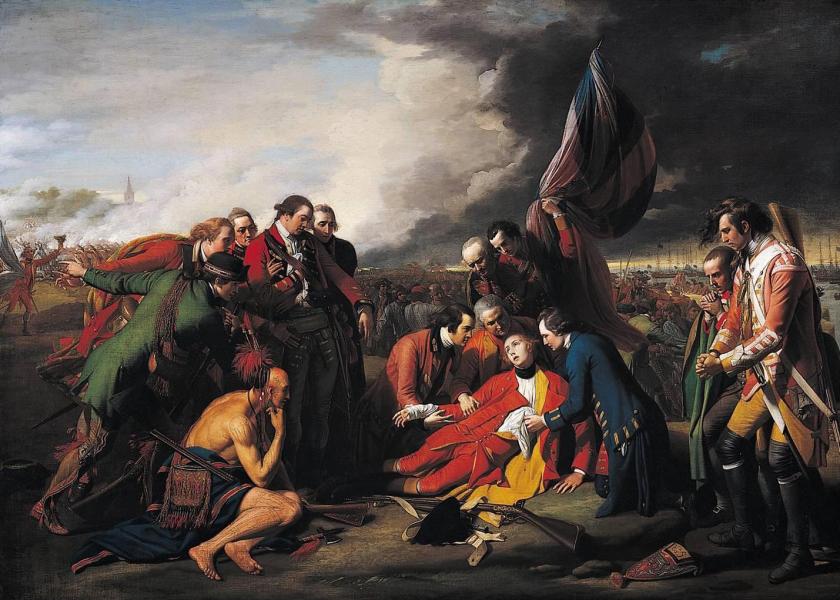
Benjamin West’s depiction of the death of British General James Wolfe during the Battle of Quebec, painted in 1770. Wikimedia Commons
As the French commander formed his men up in a line of battle, the British waited patiently across the field to receive their attack. Montcalm ordered his troops forward, and almost immediately his militiamen’s lack of experience and training in open combat became apparent as their formations wavered and some failed to advance close enough to the enemy line to fire effectively. One British participant described what happened next:
The French Line began … advancing briskly and for some little time in good order, [but] a part of their Line began to fire too soon, which immediately catched throughout the whole, then they began to waver but kept advancing with a scattering Fire.—When they had got within about a hundred yards of us our Line moved up regularly with a steady Fire, and when within twenty or thrity yards of closing gave a general [fire]; upon which a total [rout] of the Enemy immediately ensued.
The battle was over in just fifteen minutes as the British swept forward, claiming the field and capturing hundreds of prisoners. Both sides each lost over 600 men killed and wounded, including both respective commanders. Wolfe was mortally wounded and died a hero on the field. Montcalm, too, was hit by grapeshot in the abdomen and died the next morning. Five days later, Quebec surrendered. The French retreated further downstream to Montreal, attacked and failed to retake Quebec the next spring, and surrendered in whole on September 8, 1760, effectively ending all major military operations in North America during the French and Indian War. The battle for the continent between Britain and France was over.








 Emerging Revolutionary War Era