As soon as one reads the title of this post, I am willing to bet a handful of names pop into your mind. This initial thought is most likely followed by a quick passing of puzzlement that the “Father of Modern Military History” would most likely been after the era of the American Revolution. More closely connected with the French Revolution or Prussia or even later after the unification of Germany in the 19th century.
None of those thoughts land on what European historians contend is the “Father of Modern Military History.” Bear with me a moment though before you click off this post. Have you ever browsed the aisles of Barnes and Noble? Of course you have, history enthusiasts tend to be book enthusiasts. A few weeks back that is what I was doing over my weekend. I strayed too far, however, and left the “United States History” section and ventured into the “World History” section. Ever done that?
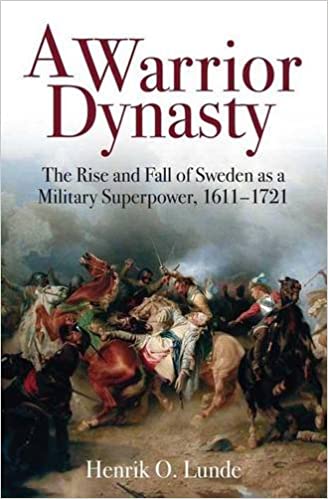
That is when this book caught my eye, “A Warrior Dynasty, The Rise and Fall of Sweden as a Military Superpower, 1611-1721.” I can safely say, I knew exactly nada about Sweden and their era of being a “military superpower.” So, I figured I would take the plunge. One more book in the personal library cannot hurt right?
After an introduction outlining the need for a book of this history in English and a brief overview of Sweden up to the 17th century, the author, who happens to reside in Southwest Florida now, introduced me to the monarch of Sweden. In addition to being the king, he was the greatest military mind in Europe during this time frame of the Thirty Years War.
Gustav II Adolf or his Latinized name, Gustavus Adolphus. He served as King of Sweden from 1611 to 1632, when he was killed in action and was the primary reason that Sweden rose to such military prominence during this time frame. After his premature death he was posthumously given the title Gustav Adolfden store which translated means Gustavus Adolphus the Great by the Riksdag, the Swedish Parliament.
Besides the other title he earned posthumously, “Father of Modern Military History.” Why is he deserving of this title? Let’s examine.
Emerging Revolutionary War welcomes guest historian Andrew Waters
Appearing this month at the Journal of the American Revolution (JAR) is an article I wrote on William “Bloody Bill” Cunningham and his infamous raid known as the “Bloody Scout.” The article attempts to provide a single-source narrative of the Bloody Scout and some of the contexts for it, although it is based on a previous article I wrote (though never published) that attempted to explore more deeply its sociological implications.
Anyone who comes to western South Carolina and has any interest in the American Revolution will soon encounter Bloody Bill. As I attempted to explain over at JAR, “without veering too deeply into sociological speculations, I can only say that his (Cunningham’s) presence is still palpable here, embedded in the cultural DNA. Though he may be only a curiosity in other parts of the United States, if he is known at all, in the South Carolina Upstate, it seems there will always be Bloody Bill.”
On both banks of the Hudson River, in 1776, sat two forts the patriots hoped would stop any British excursions up the waterway. Named for the top two military leaders of the Continental army–George Washington and Charles Lee–the fortifications both fell to the British by late November of that same year.
Join Emerging Revolutionary War this Sunday, at 7 p.m. EDT on our Facebook page as the forts become the focal point for this week’s “Rev War Revelry.” Joining ERW will be Charlie Dewey who will help break down and discuss the implications of these actions in November 1776.
Dewey, an officer in the New York Army National Guard and a graduate of the Virginia Military Institute has been a museum educator and special events coordinator for Fort Lee Historic Park since May 2018. He has been publishedin the Journal of the American Revolution along with being the author of various other scholarly articles on the Revolutionary time period.
Fort Washington, the last toehold of the Americans on Manhattan Island that fell and Fort Lee, the beginning of the long trek by Washington’s army across New Jersey late in 1776 have a unique part in American Revolutionary history. We look forward to you joining us this Sunday for this historian happy hour.
As July 4th approaches, many of us turn our thoughts to the Declaration of Independence and the early years of the Revolution. I do too, but I also recall another July 4th, the one in 1754 when a Virginia militia officer named George Washington surrendered the crudely built Fort Necessity to the French. The battle touched off the French and Indian War.
General George Washington looks back at us from marble statues or stiff paintings with a grim-faced and determined look. Known for his dignity, resolve, and sound leadership, he seems cold and reserved. Yet he was also quite sentimental. In the midst of a grueling campaign, with a massive British invasion force set to descend on him at New York City in July, 1776, Washington paused to pen these words: “I did not let the Anniversary of the 3rd or 9th of this Inst pas[s] of[f] without a grateful remembrance of the escape we had at the Meadows and on the Banks of the Monogahela. [T]he same Providence that protected us upon those occasions will, I hope, continue his Mercies, and make us happy instruments in restoring Peace & liberty to this once favour’d, but now distressed Country”.
Washington was writing to General Adam Stephens, his subordinate in the French and Indian War twenty years earlier, who now commanded a division in the Continental Army. These lines give us a unique insight into the mind of the Revolution’s commanding general.
The French and Indian War years were Washington’s formative years as a military officer. He learned the art of war on the Pennsylvania, Virginia, and Maryland frontier: tackling supply and logistical challenges, dealing with recruitment and discipline, and working patiently-though not always successfully- with elected officials.
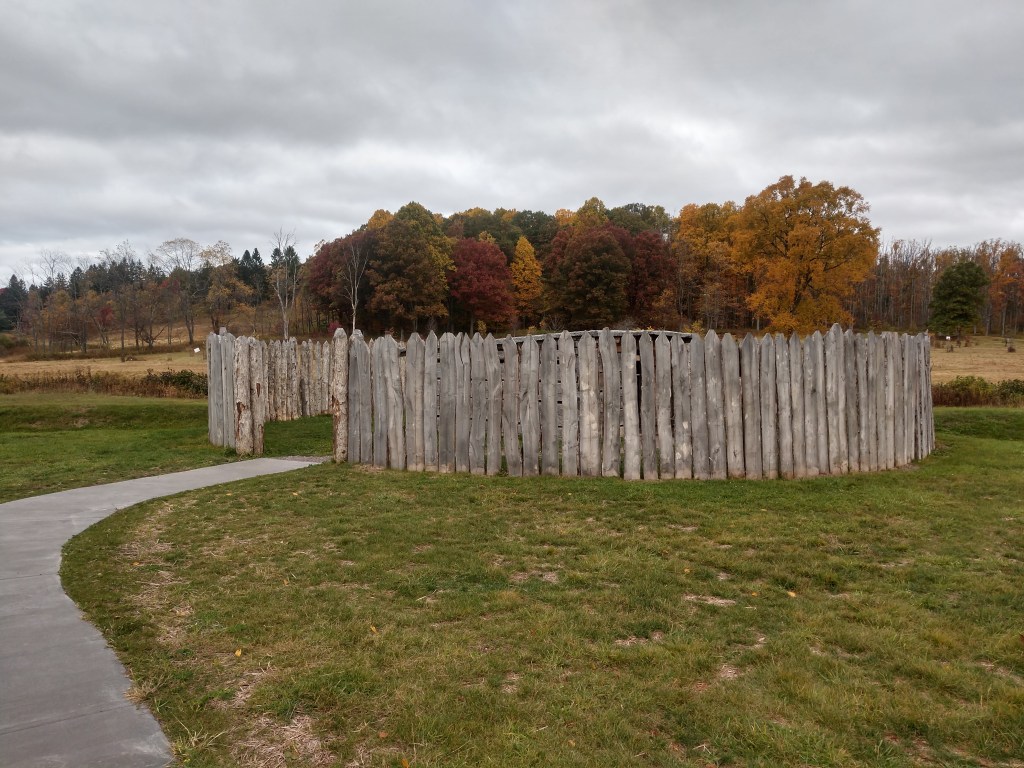
Fort Necessity. Author photo.
He lost his first major battle (Fort Necessity) to the French, fighting with the British. He won his last major battle (Yorktown) against the British, with the help of the French. The irony is deeper, for the surrender at Fort Necessity (the only time Washington ever surrendered), was July 4, 1754. Twenty years later, when celebrating American independence, he no doubt reflected on the juxtaposition.
The two battles Washington reflected upon, Fort Necessity (the Meadows) and Braddock’s Defeat (the Monongahela) were both defeats- disasters, really. Yet the experiences were powerful for the young Virginian; Braddock’s Campaign especially.
British troops and colonial forces were attempting to remove the French from western Pennsylvania and the Ohio country. The first few campaigns ended in failure, but Washington was able to participate in the final victorious effort in 1758.
Washington saw good and poor leadership, good and poor discipline, and good and poor coordination. When making decisions on conducting the war and running the army twenty years later, his decisions were informed by his earlier experiences.
He wrote of these experiences again later, and their impact on him was clearly profound. Washington also kept the sash and pistols that Braddock had given him before he died. These treasures reside in the collection at Mount Vernon today.
So strong were the memories of his youth in the woods of the frontier, that he even purchased the very land on which the battle of Fort Necessity was fought (How many Generals in American history can claim that?). In 1784 he visited the area, bought lands, and tried to find Braddock’s Grave. Washington wrote that he was “desirous of erecting a monument over it.” Unable to find the grave, Washington satisfied himself with viewing places where he learned the art of war three decades earlier.
A swivel gun at Fort Necessity. Author photo.
Washington himself was one of the new nation’s first battlefield tourists. He enjoyed visiting battlefields and retracing the movements of the armies. During his Presidency, he visited many Revolutionary battle sites, including some where he commanded. One has to wonder what ran through his mind as he re-examined the ground as a seasoned veteran and commander, without the urgency and chaos of battle unfolding around him.
Most of us have had close calls: an accident, medical emergency, or in military service. These events are life- changing. Reading Washington’s reflections allows us to better know the person, and understand his complex personality.
Being sentimental as he was, we might also wonder, what might Washington have thought of those battle sites today. Many are preserved as historic sites, though a good many have been lost to development. Hopefully he would applaud our current efforts at preservation, scholarship, and interpretation.
While delegates to the Second Continental Congress debated the matter of Independence in 1776, the British brought the war to Charleston, South Carolina. Defense of the city focused on Fort Sullivan, on Sullivan’s Island at the northern mouth of Charleston Harbor. Major General Henry Clinton, commanding an Army expedition against the Americans, was determined to exploit the fort’s vulnerabilities. He ultimately failed, but his effort, or lack thereof, prompted a British newspaper to craft a little ditty taunting the poor general.
In June 1778, the Continental army marched out of their winter encampment in Valley Forge, Pennsylvania and headed toward New Jersey in pursuit of the retreating British army. The past six months, from December 1777 to June 1778, ushered in a period of suffering, renewal, and change.
Valley Forge is imprinted into the psyche of Americans as the the toughest winter of the entire American Revolution. In fairness, it was one of many tough winters that the Continental army survived. However, the reasons why this winter stands out will be part of the discussion of this Sunday evening’s “Rev War Revelry” which can be found on Emerging Revolutionary War’s Facebook page at 7 pm. EDT.
This week’s historian happy hour includes a discussion with Philip S. Greenwalt author of the recently released Emerging Revolutionary War Series title, The Winter that Won the War. This is the fourth volume in the series, with previous ones covering Lexington and Concord, Trenton and Princeton, and Monmouth.
Greenwalt will discuss how the Valley Forge winter was the intersection of various issues and how the decisions made and the determination of survival by the army made this the winter that won the war.
Tune in as well to hear how you can purchase a copy of this book to take with you as you plan that summer trip to Valley Forge and the Philadelphia area!
Emerging Revolutionary War welcomes back guest historian Karl G. Elsea
When visiting Revolutionary War battlefields there are often replica field guns (sometimes with original barrels) on the grounds. What is often not shown is the equipment needed for the gun to get to the field. That movement required horse(s) and harness and a limber. An earlier article provided information on Patriot limbers. This article concerns the horse harness.
NPS Yorktown, Author’s photo. Original 4-pounder barrel on reproduction carriage
There are inventories and paintings that show British harness used during the war. Muller’s A Treatise of Artillery shows the horse harness hook-ups on British limbers for medium and heavy artillery, and it is somewhat unique. The British hook-up appears more restrictive as to horse size. The cart-saddle used by the British was ubiquitous. It seems reasonable that the Patriots would have used the same harness with the exception of the specialized hook-up hardware on the limber. The following part of a Philipp Loutherbourg painting of Warley Camp detailing a review in 1778 clearly shows the cart-saddle with chain on the thill horse and the rest of the British harness.
On this date, in 1778, the Continental army, under the command of General George Washington broke winter camp and began the spring campaign. Their objective was to catch the British army, under Sir Henry Clinton, retreating across New Jersey to the safety of New York City.
Nine days later, in the last major action in the northern theater, Washington’s forces would engage their adversary in the Battle of Monmouth. The army that fought this engagement in one of the hottest recorded days of any battle in American history, was a much improved military organization. Not perfect but much improved from the force that marched into Valley Forge six months prior.
During that half-year, from December 19 to June 19, the army saw an improved quartermaster department, the formation of a military handbook and tactical training, and the news that a powerful European nation had agreed to become allies in the quest for American independence.
Much is made of turning points or the critical importance of an event so I do not want to retread that argument here. However, what happened at Valley Forge was significant in the path to eventual American victory and the formation of the United States of America.
There is an old saying that even the greatest fiction writers cannot envision a story that is unbelievable as actual events can be. Or to sum it up more succinctly, a coincidence. After delays due to the pandemic, the latest volume of the Emerging Revolutionary War Series was released, in time for the 243rd anniversary of the end of the winter cantonment at Valley Forge.
The book is authored by yours truly and can be found via the publisher’s website by clicking here or through your favorite bookseller or by emailing Emerging Revolutionary War.
Then follow in the footsteps of Washington’s forces to Monmouth.
In December 1776, the American Cause for independence was at an all-time low. After losing New York to the British, General George Washington’s Continental army limped into eastern Pennsylvania broken and on the verge of defeat. Against all odds, Washington chose to attack the garrison at Trenton on December 26. The crossing of the Delaware River and victory that followed are widely recognized as having saved the American Revolution. What is less known are the events that occurred in Burlington County, New Jersey that affected this battle.
Between December 21-23, 1776, Hessian detachments under the command of Colonel Carl von Donop were busy prodding the countryside south of Bordentown. American Colonel Samuel Griffin, with a force of 600 mixed units (more than half no older than 15 years old), established a foothold at Mount Holly. Two days of harassment at Petticoat Bridge (Mansfield Township) convinced von Donop that rumors of an American force of 3,000 at Mount Holly were true. On his own authority, the Hessian colonel moved his force of 2,400 on the morning of December 23. What transpired were a series of firefights at Petticoat Bridge, the Mount (along Woodlane Road) and finally at Iron Works Hill on the southside of the Rancocas Creek. The American forces retreated to Moorestown, leaving Mount Holly fully occupied by the Hessian forces. Instead of returning to Bordentown, von Donop stayed. Why? Our answer comes in the journals of Burlington resident Margaret Hill Morris and Hessian Jager Captain Johann Ewald. Both write of a “beautiful young widow” who kept von Donop occupied for three days. The Hessians remained at Mount Holly, more than a day’s march from Trenton. On December 26, a bugler rode into town delivering the news of Washington’s victory. Had Colonel von Donop remained or returned to Bordentown prior to the attack, he would have been readily available to reinforce Colonel Johann Rall at Trenton, likely changing the outcome of the battle.
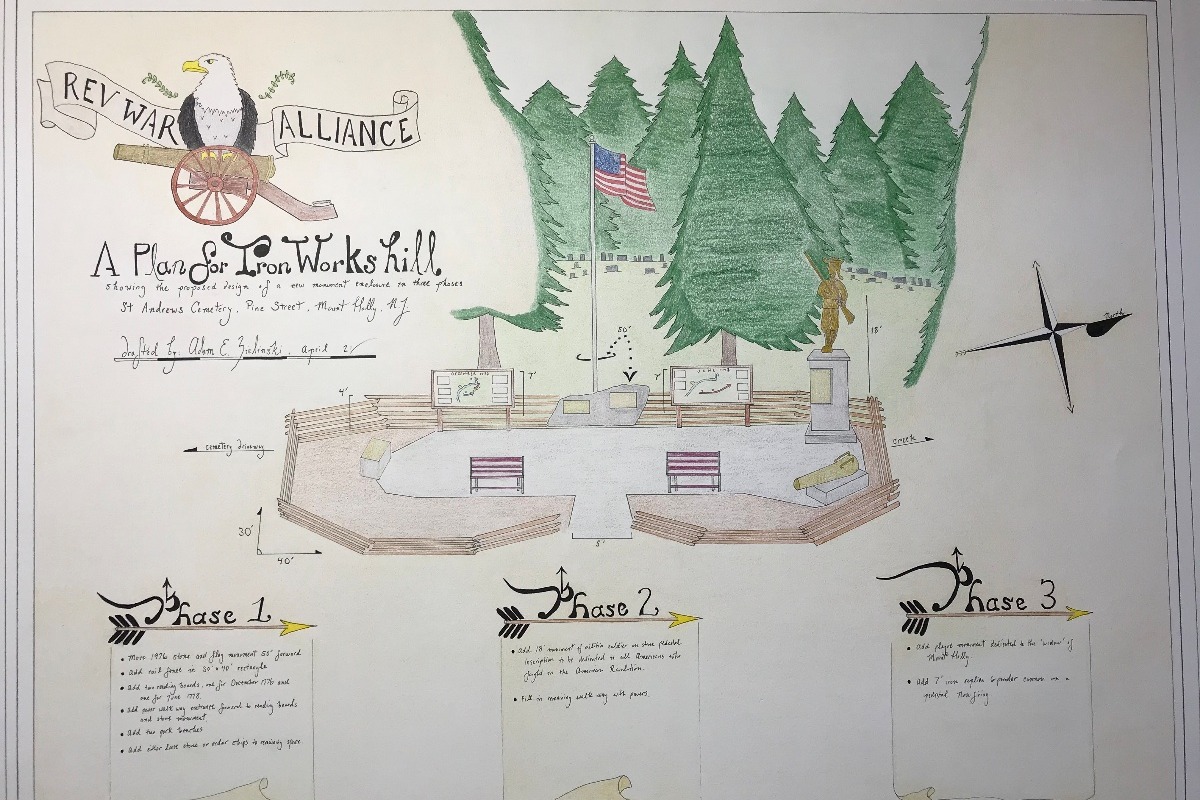
In 1976, a stone monument was erected at St. Andrew’s Cemetery on Pine Street in Mount Holly to honor the events that took place in December 1776. While this monument has served its purpose, we, the Rev War Alliance of Burlington County, feel the time has come to enhance the visitor experience with a new monument project. To coincide with the coming 250th of American Independence, we have received permission to add/build to the existing monument along Pine Street.
The provided sketch/plan is broken down into three phases with Phase 1 being the purpose of this fundraiser.
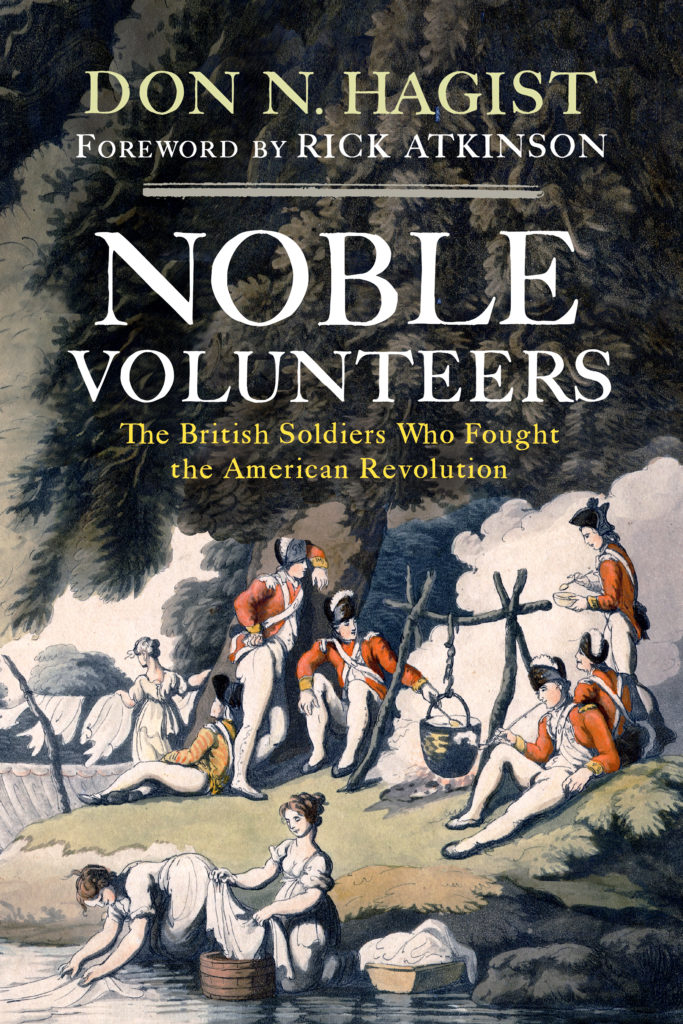
Don Hagist is one of our foremost American authorities on the common British soldier during the American Revolution. His latest book, Noble Volunteers: The British Soldiers Who Fought the American Revolution, is an institutional portrait of the British army that fought the American Revolution. Hagist has walked this ground before, most notably in British Soldiers, American War, which dedicated a chapter to a specific individual as a way of illustrating the experience of the common soldier. Noble Volunteers extrapolates on that, using soldier accounts, regimental paybooks, muster rolls, pension applications, and any other available material to give us an integrated picture of the entire army and how it functioned. It’s an extraordinarily valuable book.





 Emerging Revolutionary War Era