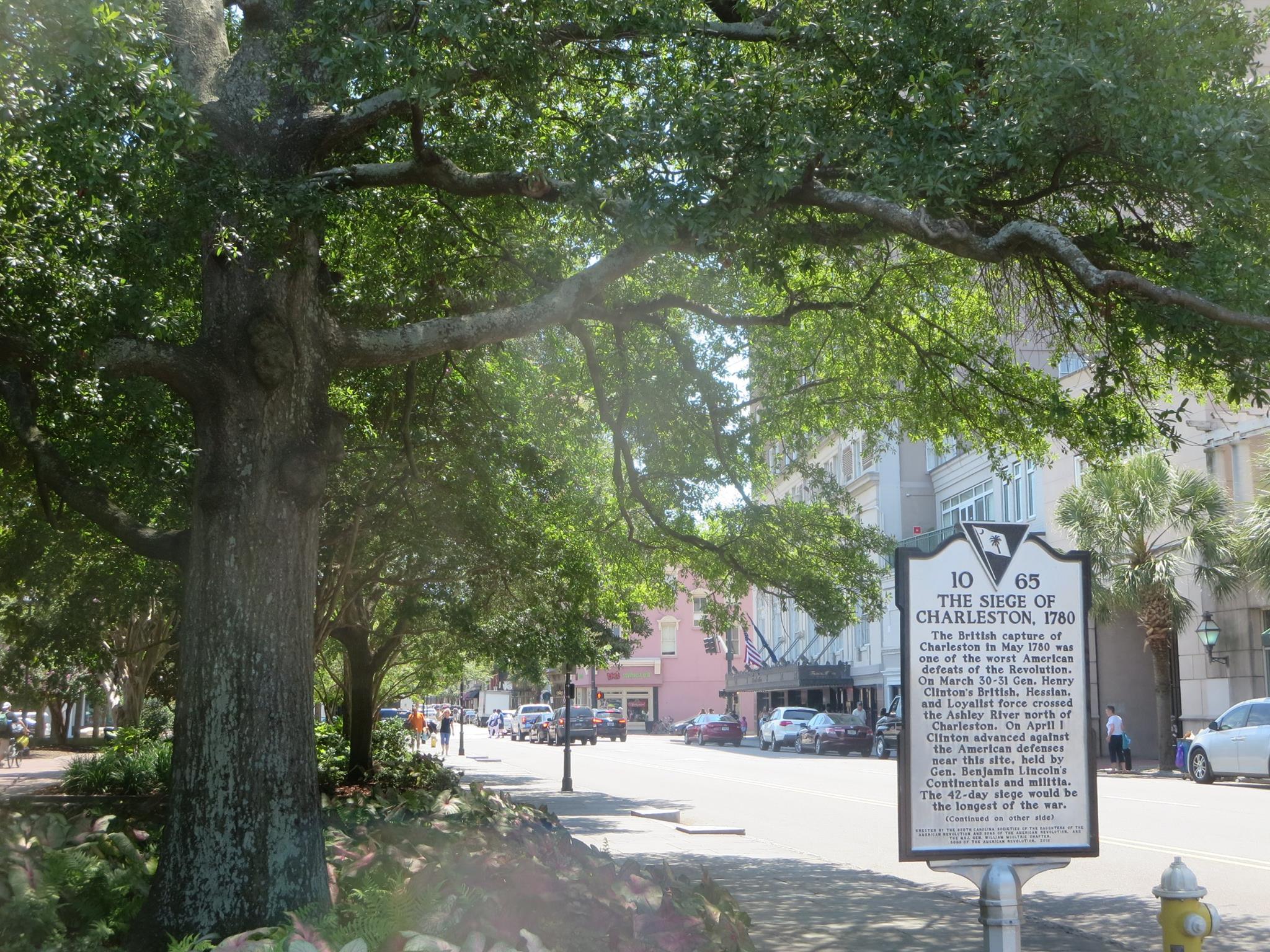
“The Severest Blow We Ever Received”: The Fall of Charleston, South Carolina, May 12, 1780

On May 12, 1780, around noon, the Southern Continental Army formed up in the tabby Hornwork (near present-day Marion Square), marched out of the fortifications and laid down their weapons between their main defensive line and the Hornwork. Their flags were cased and they were forced to play a Turkish march on their drums. This was humiliating to the Patriot defenders. British and Hessian grenadiers entered the Hornwork and the British flag was raised over the American fortifications. Charleston, South Carolina had officially fallen.

Today a state historic marker marks the location of where the Americans surrendered.

During the surrender ceremony, the British Army lined up to watch the American Continentals surrender their arms. They were amazed to see the wretched condition of the American soldiers. They noted their clothes were ragged and torn and many had no shoes. Despite this, they were extremely disciplined and professional. One British officer noted that it was “admirable that these people still fight for the chimerical freedom of America with such ardor.” Many Continental soldiers were too sick to march out and lay down their arms. Seeing how small a force was surrendering, some of the British were amazed that so few had “made a gallant defense.”

Over the course of the 42 day siege leading up to the surrender, the Americans had lost 89 men killed and 138 wounded.  The British had lost 99 killed and 217 wounded.  The British were successful in capturing the city, but more importantly than the city, the British had captured the entire Southern Continental Army: 5,618 men, 400 cannon, 15 stands of flags, and 5,000 muskets.  Of the men captured 3,465 were hardened Continental veterans who were irreplaceable to Americans.  In one swoop, the Continental lines of Virginia, North Carolina, and South Carolina ceased to exist.

Among the prisoners were three signers of the Declaration of Independence: Arthur Middleton, Edward Rutledge and Thomas Heyward.  This was the largest defeat the American cause would suffer in the Revolutionary War.  The next time America surrendered a larger force to a foreign enemy was at the surrender of Bataan in World War II.

In Philadelphia, John Adams wrote simply that “This is the severest blow we ever received.”

Over the following two years, a bloody civil war erupted throughout the backcountry of South Carolina.  As British General Lord Cornwallis marched into the wilderness to subdue the Patriots in the interior of the state, he met initial success, but eventual failure, and ultimately total defeat at Yorktown, Virginia in October of 1781.

The road to Yorktown began at Charleston on May 12, 1780.

“This Sudden Expedition”: The Capture of Fort Ticonderoga – 246 Years Later

On this date in 1775, an early victory was secured for the American cause along the western shore of Lake Champlain in New York. Led by Colonel Benedict Arnold and Ethan Allen, over eighty men surprised and overwhelmed Fort Ticonderoga’s garrison, capturing the strategic stronghold and much needed supplies and cannon for the Americans. On May 22, the Pennsylvania Packet reported on the news received from the north:

On Wednesday evening last arrived here, John Brown, Esq; from Ticonderoga, express to the General Congress, from whom we learn, that on the beginning of this instant, a company of about fifty men, from Connecticut, and the western part of Massachusetts, and joined by upwards of one hundred from Bennington, in New-York government, and the adjacent towns, proceeded to the eastern side of Lake Champlain, and on the night before the 11th current, crossed the Lake, with 85 men, (not being able to obtain craft to transport the rest,) and about daybreak invested the fort, whose gate, contrary to expectation, they found shut, but the wicker open, through which, with the Indian war whoop, all that could, entered one by one, others scaling the wall on both sides of the gate, and instantly secured and disarmed the sentries, and pressed into the parade, where they formed the hollow square;  but immediately quitting that order, they rushed into the several barracks on three sides of the fort, and seized on the garrison [commanded by Captain William Delaplace], consisting of two officers, and upwards of forty privates, whom they brought out, disarmed, put under guard, and have since sent prisoners to Hartford, in Connecticut. All this was performed in about ten minutes, without the loss of a life, or a drop of blood on our side, and but very little on that of the King’s troops.

In the fort were found about thirty barrels of flour, a few barrels of pork, seventy odd chests of leaden ball, computed at three hundred tons, about ten barrels of powder in bad condition, near two hundred pieces of ordnances of all sizes, from eighteen pounders downwards, at Ticonderoga and Crown Point, which last place, being held only by a corporal and eight men, falls of course into our hands.

By this sudden expedition, planned by some principal persons in the four neighboring colonies, that important pass is now in the hands of the Americans, where we trust the wisdom of the Grand Continental Congress, will take effectual measures to secure it….

The story of the capture of Fort Ticonderoga is as confusing as it is epic. Arnold, a Connecticut man, held a colonel’s commission to take the fort from the Massachusetts Committee of Safety, but he rode ahead to be part of the action without the men he was ordered to raise for the expedition; and Ethan Allen and his Green Mountain Boys of the Hampshire Grants were anti-New York and in search of their own glory after being asked to join a separately organized assault on the fort by Colonel Edward Mott sanctioned by Connecticut.

Ethan Allen demands the surrender of Fort Ticonderoga in this dramatized illustration. NYPL

The irony of all of this is that each plan formulated by those involved was done entirely without the advice or consent of New York, the very colony whose boundaries the fort was within. This occurred all during the commencement of the Second Continental Congress when New York was still weary of escalating hostilities with the King. Regardless of the awkward and unconcerted circumstances, it is undeniable that the fort’s capture helped secure victory for the Americans during the siege of Boston when fifty-eight pieces of ordnance were transported to assist General Washington in driving the British out of the city. Whether or not Allen heroically demanded Capt. Delaplace to surrender, “In the name of the Great Jehovah and the Continental Congress!” as is remembered (he almost definitely did not), is an entirely different question.

Hindsight is 2020 (or 2021)

Emerging Revolutionary War welcomes guest historian Liz Williams, from Historic Alexandria, the host of the second annual symposium

When we planned our 2nd Annual Revolutionary War Symposium for 2020, our theme came easily – Hindsight is 2020. Little did we know that our cheeky title would take on a different meaning as we had to navigate a global pandemic. But I am excited that we can still offer our symposium (yes 6 months later) and virtual!  In this format, we can zoom our experts to computers and smartphones across the country. And this year we have a great variety of topics – from Drunken Hessians to African American Continentals. Learn about Loyalists, battles in the Southern Theatre, and along a creek in southeastern Pennsylvania.

As we move toward the 250th anniversary of the nation, it is critical for us all to look with fresh eyes at our founding. At Gadsby’s Tavern Museum, we engage with the complexity and challenges of early America, many of which were rooted in what transpired before and during the Revolutionary War. By understanding our past, we can continue the work of creating a better United States for all.

The Symposium costs $40 per person, $20 OHA Members & Students and reservations can be made at AlexandriaVa.gov/Shop. Looking forward to seeing everyone on May 22!

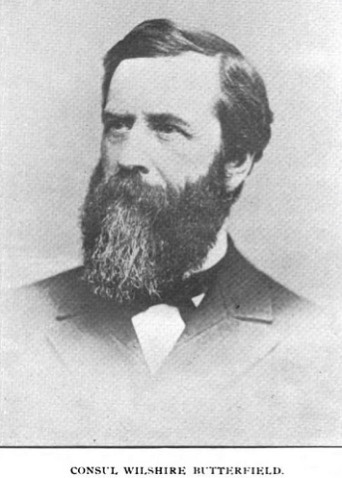
Historians from the Past: C.W. Butterfield (1824-1899)

Butterfield from his book on George Rogers Clark

Early histories of the American Revolution in the west relied on oral tradition, local lore, legend, and even a bit of inventive myth-making as a young United States spread beyond the Appalachians and sought to develop its own, new identity.  Considerable effort, but not always the most rigorous methodology, often went into combining these sources into a narrative and telling an integrated story of how events in Boston, New York, Philadelphia, Charleston or London eventually affected communities “over the mountains.”   The first historians overlapped with the Revolutionary generation.   Often, the writers were children in the early 1800s and heard stories from veterans and settlers themselves (or their relations, descendants, and neighbors) in their old age.   

            A second generation came along in the mid-19th century.   The most notable was Lyman Draper.   He set out to write the definitive history of the war on the frontier, but ended up amassing the definitive archive.  While working on his never-published history, Draper crossed paths with Consul Wilshire Butterfield, who had moved to Madison, Wisconsin in part because of Draper’s success building libraries in the city and state.   Like many of his contemporaries, including Draper, Butterfield did not start as a professional historian.  Born in Oswego, NY, he moved with his family as a boy to Seneca County, Ohio in 1834, briefly attended school in Albany, and then took a brief tour of Europe in 1846.  The following year, he wrote a history of Seneca County, which was published in 1848, the same year he was elected the county’s Superintendent of Schools.  The job didn’t last long as he set out for California during the Gold Rush.  Rather than becoming a “Forty-Niner” he ran for Superintendent of State Schools, but narrowly lost.   Then it was back to Ohio, where he studied law, served briefly as Secretary of a Railway Company, and eventually opened a legal practice in Bucyrus, Ohio.   Along the way, Butterfield, who lacked much in the way of formal education but was clearly adept at learning, took the time to publish a book on punctuation.  Then, in 1873, the Cincinnati publisher Robert Clarke & Company issued Butterfield’s An Historical Account of the Expedition Against Sandusky Under Col. William Crawford, in 1872.   (The campaign’s climatic battle took place about 20 miles from Butterfield’s law practice.)  The book was a hit and the transplanted Ohio lawyer changed careers. 

Continue reading “Historians from the Past: C.W. Butterfield (1824-1899)”

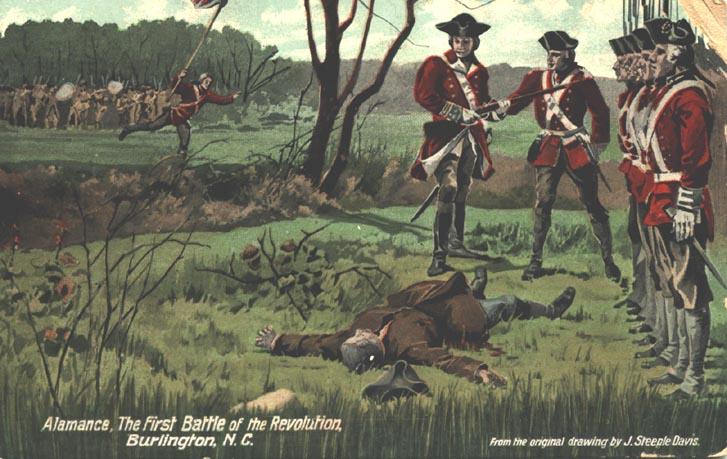
“Rev War Revelry”: The Battle of Alamance

The month of May will mark the 250th anniversary of a little known event that occurred in the North Carolina piedmont called the Battle of Alamance. This battle was the result of an uprising of western North Carolinians who were opposed to the corruption in the colonial government and called themselves “Regulators.” The North Carolina colonial militia under the command of Royal Governor William Tryon marched from the east to quell the rebellion. The two North Carolina forces met at Alamance in May of 1771.

Emerging Revolutionary War welcomes Jeremiah DeGennaro, Historic Site Manager of Alamance Battleground to the “Rev War Revelry” historian happy hour. We will discuss the history of the Battle of Alamance, from what unfolded in North Carolina in 1771 to how this engagement has been remembered. Most recently, the battle was featured in an episode of the TV show, “Outlander.”

Some have suggested that this engagement was the “First Battle of the American Revolution.” But was it? Tune in on May 2 at 7 p.m. ET on the Emerging Revolutionary War’s Facebook page to hear the discussion on this and other questions. If you can’t make it on Sunday night, remember you can watch it later (and all our past “Rev War Revelry’s”) on our YouTube page.

North Carolina’s Response to the 1775 Battle of Lexington and Concord

Emerging Revolutionary War welcomes guest historian Travis Copeland

Rumors roared throughout the Colonies in the Spring of 1775. From Watertown, Massachusetts with an earnest pen, a letter was taken down at 10am on Wednesday Morning, April 19, 1775. Reports had been sent to New London, Rhode Island, and we’re beginning to extend south to the Carolinas. There were reports that, “action had happened between the King’s Troops and the inhabitants of Boston.” The shot fired in Lexington, Massachusetts on April 19 was “heard around the world,” and North Carolina would be no exception. The above, brief sentence recount of the battle was enclosed with the expanded statement,

To All Friends of American Liberty let it be known,

That this morning before break of day a [British] Brigade consisting of about one thousand or twelve hundred men landed at Phipp’s farm in Cambridge, and marched to Lexington, [Massachusetts] where they found a Company of our Colony Militia in arms upon whom they fired without any provocation and killed six men and wounded four others. By an Express from Boston we find that other Brigades are upon their march from Boston supposed to be about one thousand…I have spoken with several who have seen the dead and wounded.[1]

In the age of foot-speed news, a letter penned on April 19 could take weeks to reach the inhabitants of North Carolina. From the Massachusetts committee of safety, the letter was dispatched with earnest haste to Worcester and then beyond the Massachusetts borders. Connecticut, New York, and British Canada were given a recount of the events by April 25, although news by mouth spread as rapid as fire.[2] In the last week of April, no news had yet reached deep South. New Jersey and Maryland were informed by pen just before April became May, but the southern colonist was still much in the dark. Finally, on Friday, April 28th at 8pm colonists from Alexandria, Virginia sent the statement and letter to Fredericksburg and from there to Surry County, Chowan, and Onslow, North Carolina. A flurry of exchange between Virginia and North Carolina created a clamor. War! 

Each county repeated to the next, “disperse the material passages through all your parts.”[3] On May 3, Edenton and Chowan passed-on the news of the clash with his Majesty’s troops.[4] The delegates at Craven County received the news on May 6th. It was ordered that they, “in haste have sent to request you will pursue the enclosed papers and you will do by opening the packet herewith sent the moment it comes your house.”[5] No more important news than the coming of the Revolution, although unknown in the fullest sense, could create such an exasperated command. Yet, the Bath delegates were not done with their orders. They further demanded that Craven county, “get three or four of your Committee to write a line and send the whole enclosed to the next Southward Committee with the utmost dispatch.”[6]

The clamor of excitement came from a colony that was thought to be deeply sympathetic to the British. Regards for the crown were certainly present in the Southern colonies, but the circular letter’s earnest nature displays the patriotic fervor that ran through the colonists. Finally, the letter was directed to Abner Nash, who represented the provision rebel government in North Carolina. As the news reached the upper echelons of society, directions were given to extend the news to anyone using a horse or bearer.[7] Cornelius Harnett, prominent Patriot politician in Wilmington, directed those who would receive the letter to, “for God’s sake send the man on without the least delay and write…to forward it by night and day.”[8] Others shared Harnett’s tone, writing, “Pray don’t neglect a moment in forwarding” and “I cannot avoid writing to you to beg you to forward the Paper containing such important news and pray order the express you send to ride night and day.”[9] Finally, directions were given to move the letter to South Carolina, “to be forwarded to Charlestown.”[10]

Several weeks after the initial fury of letter exchange, another letter was written from Lieutenant Governor Bull of South Carolina to the Earl of Dartmouth. The provisional governor allied with the Crown reflected on the disposition of the Carolinas. Despite the growing desire to show British force against the rebellious colonists, Lt. Gov. Bull stated plainly that, “The account of the Skirmish or Engagement between the King’s Troops and the Provincials of Massachusetts near Lexington on the 19th of last month, seems to produce effects here [the Carolinas] very different from intimidation.”[11] The southern colonist of North and South Carolina would not be thrown back or made afraid by the acts of British commanders and their regulars in the North.

The Continental Congress would not be intimated. It’s North Carolina representatives William Hooper, Joseph Hewes, and Richard Casewell issued a circular letter which shared the tone of Lt. Gov. Bull’s correspondence. They stated plain, with the April 19, 1775 battles of Lexington and Concord in mind, 

Heaven seems to have assumed the protection of the injured insulted Colonists and signally to have appeared in their Favour: when in the last Battle at Lexington six hundred raw, undisciplined Provincials defeated eighteen Hundred regular Troops and pursued them into their Camp…It becomes the duty of us in whom you have deposited the most sacred trusts to warn you of your danger and of the most effectual means to ward it off. It is the Right of every English Subject to be prepared with Weapons for his defense. We conjure you by the Ties of Religion Virtue and Love of your Country to follow the Example of your sister Colonies and to form yourselves into a Militia. The Election of the officers and the Arrangement of the men must depend upon yourselves. Study the Art of Military with the utmost attention, view it as the Science upon which your future security depends.[12]

The colony of North Carolina and its leadership was moved by the initial recount of battle and the circular letter’s news of Massachusetts. The waters of Revolution were rising and the Patriot leaders were beginning to call for more than just a uniform exchange of words. They desired for the state to take its formidable place in as rebels in the South. Further, the flurry of response to the Lexington engagement shows the prominent place of North Carolina in the revolution from the earliest days. Leaders in the South did not wait until the war moved South in 1779, 1780, and 1781 to throw their pens, support, and persons behind the cause of Gen. Washington, the Continental Congress, and the New England colonies. North Carolina was revolutionary from the start.

Sources:

[1] “Letters Concerning the News of the Battle of Lexington in Massachusetts, April 20 – May 9, 1775,” Colonial and State Records of North Carolina, vol. 9, p. 1234.

[2] “Letters Concerning the News of the Battle of Lexington in Massachusetts, April 20 – May 9, 1775,” Colonial and State Records of North Carolina, Documenting the American South, https://docsouth.unc.edu/csr/index.php/document/csr09-0412. vol. 9, p. 1230-31.

[3] “Letters Concerning the News of the Battle of Lexington in Massachusetts, April 20 – May 9, 1775,” Colonial and State Records of North Carolina, vol. 9, p. 1236.

[4] “Letters Concerning the News of the Battle of Lexington in Massachusetts, April 20 – May 9, 1775,” Colonial and State Records of North Carolina,. 9, p. 1237.

[5] “Letters Concerning the News of the Battle of Lexington in Massachusetts, April 20 – May 9, 1775,” Colonial and State Records of North Carolina, vol. 9, p. 1237.

[6] “Letters Concerning the News of the Battle of Lexington in Massachusetts, April 20 – May 9, 1775,” Colonial and State Records of North Carolina, vol. 9, p. 1237.

[7] “Letters Concerning the News of the Battle of Lexington in Massachusetts, April 20 – May 9, 1775,” Colonial and State Records of North Carolina, vol. 9, p. 1238.

[8] “Letters Concerning the News of the Battle of Lexington in Massachusetts, April 20 – May 9, 1775,” Colonial and State Records of North Carolina, vol. 9, p. 1238.

[9] “Letters Concerning the News of the Battle of Lexington in Massachusetts, April 20 – May 9, 1775,” Colonial and State Records of North Carolina, vol. 9, p. 1238.

[10] “Letters Concerning the News of the Battle of Lexington in Massachusetts, April 20 – May 9, 1775,” Colonial and State Records of North Carolina, vol. 9, p. 1239.

[11] “Letter from William Bull to William Legge, Earl of Darmouth, May 15, 1775,” Colonial and State Records of North Carolina, Documenting the American South, https://docsouth.unc.edu/csr/index.php/document/csr09-0426. vol. 9, p. 1258-1260.

[12] “Letter from William Hooper, Joseph Hewes, and Richard Casewell to the Inhabitants of North Carolina, June 19, 1775,” Colonial and State Records of North Carolina, Documenting the American South, https://docsouth.unc.edu/csr/index.php/document/csr10-0011. vol. 10, p. 20-23.

Travis Copeland is a North Carolina native with a love for early American history. He holds a B.A in History and Humanities and is studying for a postgraduate history degree. His research interests include North Carolina history and the early southern United States from the Revolutionary War to the Civil War with a particular interest in military conflict, political-social integration, and local history. When not researching and writing, he enjoys teaching, the outdoors, gardening, and good food and beer. Travis lives and teaches in North Carolina.


The Forgotten Woman of Valley Forge from America’s Forgotten Ally

During the winter encampment at Valley Forge, as thousands of men huddled around drafty wooden cabins, with dwindling supplies, and battled boredom and disease, a relief effort was organized hundreds of miles away.

George Washington, ensconced at the Potts House in the heart of the Valley Forge encampment, was very aware of the dire straights that his forces were exposed to. Throughout the winter he sent missives, directly and through intermediaries, discreetly asking for more aid, for supplies, for changes to military bureaucracy. He even consented to a delegation of congressmen to visit Valley Forge and see first-hand the situation in the winter of 1777-1778.

In a proverbial sense, he did not leave any stone unturned to try and ease the plight of his forces or continue to stay abreast of British designs, less than twenty-miles away in Philadelphia, Pennsylvania.

After hearing of the contributions of the Oneidas and Tuscaroras at the Battle of Oriskany in New York, Washington sent a letter of invitation for the Native Americans to visit his army. Approximately 50 warriors along with supplies made the few hundred mile journey from upstate New York to eastern Pennsylvania. They left their villages on April 25 and arrived on May 15,1778 in Valley Forge. The leaders of the Oneida party dined with Washington. Five days later some of the warriors participated in the engagement at Barren Hill under the Marquis de Lafayette. Six of the warriors gave their life in service to their ally.

In 2007 historian Joseph T. Glatthaar published a book about the Oneidas and their contributions to the American victory in the war. The title, in part, is Forgotten Allies. A fitting testament to the service and sacrifice this tribe underwent in their partnership with the fledgling American nation.

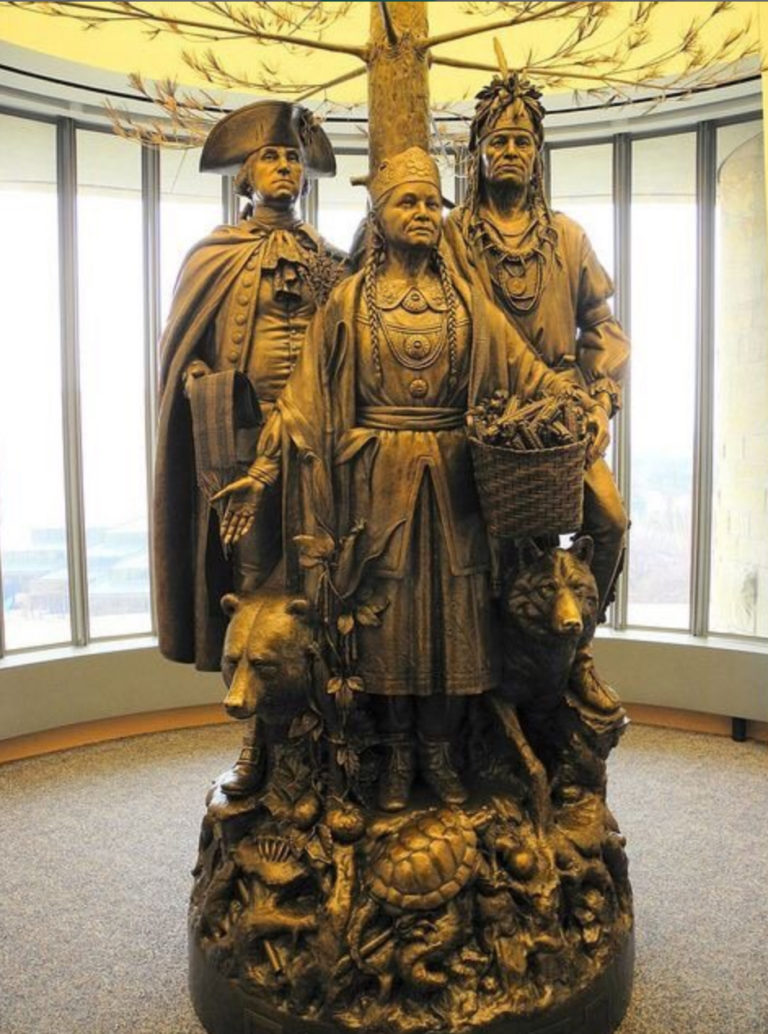
In 2004 a sculpture was completed of Polly Cooper, Chief Skenandoah, and George Washington
(courtesy of King of Prussia Historical Society)

If the Oneidas were the “forgotten allies” than in the winter encampment at Valley Forge there was a forgotten woman that tramped south with her fellow Oneidas. Her name was Polly Cooper.

Along with the warriors, whom Washington wanted to serve as scouts, the Oneidas brought much needed supplies, including bushels of white corn. While the leaders dined at the Potts House, Cooper established a de-facto cooking show. She handed out the white corn to the soldiers and taught them how to use husks to make soup and ground grain to make it palatable.

This much needed food sources, along with an improved supply chain under quartermaster Nathanael Greene rounded out the bleak winter with the glimmer of hope for better supplies in the upcoming campaign season.

The Oneida, including Polly Cooper for her services, refused any and all payment. Friends help friends in need is what the Oneida told Washington and his officers. However, a tradition exists in the history of the Oneida nation. That story, passed down orally from generation to generation, highlights that Marth Washington, in her gratitude for what Polly Cooper did for the rank-and-file of the Continental army, presented the Oneida heroine with a shawl and bonnet.

Another account reads that Cooper was gifted a black shawl that she saw for sale in a store window. The Continental Congress appropriated the money for the clothing item and gifted it as their thanks to her. This shawl is still in the ownership of her descendants and has been loaned to the Oneida cultural center from time to time.

The black shawl that Polly Cooper received for her services to the Continental Army at Valley Forge
(courtesy of the Oneida Indian Nation
http://www.oneidaindiannation.org)

“Rev War Revelry” Returns to Lexington with Alex Cain

Approximately one year ago, Emerging Revolutionary War began a historian happy hour virtual chat on Sunday evenings. The goal was to share our passion for history, connect with each other during the pandemic, and have an excuse to drink a beer. Pretty much what we would be doing if we could gather in person.

Fast forward one year and the “Rev War Revelry” that was created has now become a fixture of our Sunday evenings; well every other Sunday after 36-consecutive weeks from April 2020 to November 2020.

The brain trust at Emerging Revolutionary War convened to discuss what we should do for the one-year anniversary. One logical conclusion came up. A return to Massachusetts!

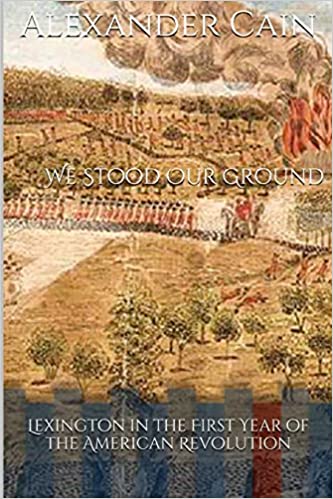
ERW welcomes guest historian Alex Cain, a Lexington historian and author, who will discuss what the Massachusetts town was like in 1775, the details of what happened on both April 18 and 19, 1775, and the misconceptions that sprung up from the beginning of the American Revolution. Of course, we welcome comments and questions through the hour.

Thank you for being part of the “Rev War Revelry” experience as we enter the second year of the historian happy hour. We look forward to seeing you on Sunday evening at 7pm EST on our Facebook page with your favorite beverage and question in hand.

The program can be accessed through Emerging Revolutionary War’s Facebook page. For those that cannot make the program when it is live, there will be a recording posted to our YouTube page within a few days following.

2021 Symposium Highlight: Michael Harris

Over the next few months, we will be highlighting the speakers and topics for our 2021 Symposium, Hindsight is 2020: Revisiting Misconceptions of the Revolution, taking place on May 22nd. Due to the COVID 19 pandemic, the Symposium will be virtual. Today we highlight historian and author Michael Harris, who will be covering the misconceptions around the role of John Sullivan at the Battle of Brandywine.

Michael C. Harris is a graduate of the University of Mary Washington and the American Military University. He has worked for the National Park Service in Fredericksburg, Virginia, Fort Mott State Park in New Jersey, and the Pennsylvania Historical and Museum Commission at Brandywine Battlefield. He has conducted tours and staff rides of many east coast battlefields. Michael is certified in secondary education and currently teaches in the Philadelphia region. He lives in Pennsylvania with his wife Michelle and son Nathanael.  He is the author of two books on the Philadelphia Campaign (Brandywine: A Military History of the Battle that Lost Philadelphia but Saved America, September 11, 1777 & Germantown:  A Military History of the Battle for Philadelphia, October 4, 1777) and is currently working on a third volume to cover the final months of the campaign. He will be presenting his talk “John Sullivan and the Battle of Brandywine” at the May symposium.


Do you believe the study of Loyalists in the American Revolution has been overlooked and why?

  I think at one time that was true, but over the last couple of decades historians have been digging deeper into the role the Loyalist population played in the Revolution and I feel that pattern of neglect has been corrected.  I think Loyalists were often overlooked because historians of the “Struggling to Overcome” theme of American Revolution historiography were more focused on the patriot struggle than the complicated role the non-patriot population played.

What first attracted you to the study of early American history? What keeps you involved in the study of this history? Do you find these things are the same or different?

 While I always had an interest in early American history, my professional career began as a Civil War historian at Fredericksburg Battlefield.  The shift to took place when I was hired to work at Daniel Boone’s birthplace and then later the Brandywine Battlefield.  While I currently teach at the high school level, my study of history continues due to my love of wanting to tell the military story of the Revolution and striving to dispel the many myths out there about the battles of the Philadelphia region.

What is the biggest myth about the role Loyalists played in the war, and how did it come about?

While this is not my area of expertise, I would say that there is some thought that thousands of Loyalists flocked to the British standard to help put down the rebellion.  At least that is what British leadership hoped would happen.  That myth, then and now, drove British decision making.  While a limited number of Loyalists did support the British cause militarily, it was never in the numbers believed now or in the numbers the British hoped for then.

Do you think there are common misconceptions of the era of the American Revolution among the American people? If so, what are they and have they ever affected your work?

I think a lot of us were taught bad history growing up.  You know, the George Washington chopped down a cherry tree stuff.  We grew up believing those things and trusting the “traditional” histories of the Revolution.  Then, you get a job at one of these sites, and you starting digging into the primary documents yourself.  All of sudden, you realize this was a lie and that was a myth.  That is when I realized I had to write the Brandywine book and that effort continued with my Germantown book.

Why do you think it is important for us to study the Revolutionary Era? 

There was a real struggle by the patriot population during the years of the American Revolution.  There is no denying that.  But that story cannot be told in a vacuum.  That story is interwoven with the story of the British Crown to put down the rebellion and the story of the Loyalist & Neutral populations of North America.  I don’t think that interconnected story has been told well and needs to continue to be explored.

Join us for our SECOND annual Emerging Revolutionary War Symposium, co-hosted by Gadsby’s Tavern Museum, speakers and topics include:


Michael Harris on Misconceptions of Battle of Brandywine
Vanessa Smiley on Myths of the Southern Campaigns
Travis Shaw on American Loyalists
John U Rees on African American Continental Soldiers
Mark Maloy on myths of the Battle of Trenton

Our registration fee is now only $40 per person and $20 for students. This will allow us to broaden our audience with the virtual program. We hope that 2022 will allow us to come together again in Alexandria for our third annual symposium. To register, visit: https://shop.alexandriava.gov/Events.aspx