While visiting home in New Jersey this past week I was able to travel to many different sites associated with the Monmouth Campaign of June 1778. One of those sites in particular was Coryell’s Ferry (or Landing), which straddled the Delaware River in present-day New Hope, Pennsylvania and Lambertville, New Jersey.
Ferry Landing Park in New Hope, PA. The site of Coryell’s Ferry.
France’s official entrance into the war on the Americans’ side in early 1778 forced the British to alter their overall military strategy. His Majesty’s Forces began withdrawing from the American interior and were consolidated along the coast between New York City and Newport, Rhode Island. From there, reinforcements were ordered to be dispatched to Florida and the Caribbean to counter France’s impending threat in that region. Philadelphia, which had been occupied since the previous September, was deemed unnecessary to hold any longer. By June 17, 1778, British Lt. Gen. Henry Clinton’s army of over 20,000 men had crossed the Delaware at Cooper’s Ferry (present-day Camden, New Jersey) and was marching northeast towards New York City.
Three days later the Continental Army was in full pursuit with Washington’s advanced column being led across the river by Maj. Gen. Charles Lee at Coryell’s Ferry (some thirty miles northeast of Philadelphia). By June 22, Washington and the last elements of his army were in New Jersey as well. What exactly was to happen next was not yet known. Clinton could either transport his army to New York City via South Amboy or from Sandy Hook. Until it could be discerned what the British general’s intentions were, Washington planned to “govern ourselves according to circumstances.” In six days the two armies would collide in desperate battle near the small village of Monmouth Court House.
Lambertville, NJ from the Pennsylvania side of the Delaware River. The Continental Army crossed here between June 20-22, 1778.
A few months ago, author Eileen Schnabel sent us her young adult novel, “One if by Land, Two if by Submarine” for a gander. Not being specialists in middle school fiction, we turned to an expert, my 13-year old daughter, Abigail, who is a voracious reader and read the novel over the holiday break. Here is her review:
Abigail Sterner, Book Review of Eileen Schnabel, One if by Land, Two if by Submarine, (Reston, VA: Curiosity Quills Press, 2018), Digital Edition.
One if by Land, Two if by Submarine, by Eileen Schnabel, is a perfect blend of historical and science fiction. The story centers around Kep, a 13-year-old boy who enjoys swimming. He and his genius, history-obsessed younger brother Max, go to a Revolutionary War reenactment camp for a competition with a grand prize of $200 dollars. It isn’t clear exactly what the competition involves, but it serves the purpose of bringing several main characters together into a team. The team starts out with Max and Kep. They are later joined by the daughter-of-a-Senator-turned-animal-rights-activist named Tella. The fourth and final member of the team is an aspiring actor named T.J. During the competition, the four discover that they must travel back in time to prevent someone from foiling the famous ride of Paul Revere. Thus, the kids have to save the American Revolution before it can even begin.
Francis Hopkinson, Signer of the Declaration and Satirical Lyricist
The Philadelphia Campaign did not end well for the Continental Army after three separate defeats at Brandywine, Paoli, and Germantown followed by the British occupation of the new nation’s capital. Among other things, however, it would produce an amusing little ditty commemorating an attack on the British on January 5, 1778 for American audiences eager to poke fun at the British.
When informed that the British had occupied his adopted hometown, Benjamin Franklin reportedly waved off his concern and replied, “No, Philadelphia has captured Howe.”[i] Franklin was more militarily astute than many politicians observing the war. When his army captured Continue reading “The Battle of the Kegs (January 5th, 1778)”→
The start of a new year seems to be coupled with new resolutions and fresh beginnings, naturally. If your list includes looking for that one book to start 2019 with or looking to dive into the American Revolutionary Era with a reading list or you were casting around to settle on a new interest to begin the year with, Emerging Revolutionary War has you covered!
With 2018 coming to a close, Emerging Revolutionary War asked its cadre of historians to share their answers to the following question;
“What was the one book that most influenced you and sparked your interest in this time period of history?”
Washington Crossing the Delaware, by Emanuel Gottlieb Leutze. Washington had crossed the Delaware River on the night of December 25 to attack Trenton. (The Metropolitan Museum of Art)
Early on the morning of December 26, 1776, George Washington and his 2,400 man army went running into the Hessian occupied village of Trenton, New Jersey. It was snowing hard that morning and the one American soldier recalled that “we advanced, and although there was not more than one bayonet to five men, orders were given to ‘Charge bayonets and rush on!’ And rush on we did.” Continue reading “Victory or Death”→
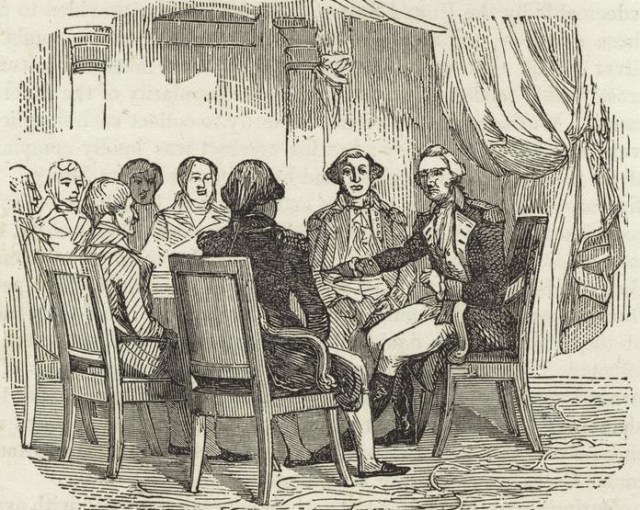
This drawing shows Washington holding a council of war in 1778. The scene would have been similar in the Merrick house on Christmas Eve, 1776. Washington always liked to consult his generals before making big decisions. However, on Christmas Eve of 1776, there were almost no options left. (NYPL)
There was perhaps no darker Christmas Eve in American history than in 1776. The cause of American liberty and independence was on the very verge of disintegration. General George Washington’s army (that had once had more than 20,000 soldiers) had melted to only about 3,000 fit for duty. Of those soldiers, many of their enlistments would expire the following week on January 1. The victorious British and Hessian soldiers had thrashed Washington’s army in nearly every engagement they fought. Just a week before Christmas, Washington wrote that he “tremble[d] for Philadelphia” and that he thought “the game was pretty near up.” The British were well known for their harsh treatment of rebels, and it was likely they would show no mercy to these colonial rebels. Gloom and dread filled the minds and hearts of the patriots. Writer Thomas Paine famously wrote that “these are the times that try men’s souls!” General Nathanael Greene was hopeful some event would change their fortunes when he wrote “I hope this is the dark part of the night, which is generally just before the day.”
General Nathanael Greene by Charles Willson Peale. The final council of war before the Battle of Trenton was held at his headquarters and Washington would personally lead Greene’s division at Trenton. (Wikimedia Commons)
On December 22, Washington’s aide, Colonel Joseph Reed wrote to Washington that “our affairs are now hasting fast to ruin if we do not retrieve them by some happy event. Delay is now equal to total defeat.” Washington had to act.
A plaque on the site of the Samuel Merrick house placed by the Daughters of the American Revolution denotes the structure’s historical significance. (Author Photo)
On the night before Christmas, Washington met with his generals in the home of Samuel Merrick in Bucks County, Pennsylvania, where General Nathanael Greene had made his headquarters. Here, Washington laid out his final dispositions for what would be one of the boldest missions of the entire war. The following night, his army would cross the Delaware River and march on Trenton, New Jersey and attack the 1,500 Hessian soldiers garrisoned there. What exactly was said in this meeting we do not know, but there must have been major objections to such a dangerous and desperate action. The demoralized army would have to cross an ice-choked river, march nine miles in a winter storm and defeat well-drilled and equipped German soldiers. However, as Washington had written the day before: “Necessity, dire necessity, will, nay, must, justify an attempt.” As Washington and his fellow generals left the Samuel Merrick house that Christmas Eve, they were given the password for this daring Christmas mission: “Victory or Death.”
The Samuel Merrick house as it looks in 2017. The stone part is the original building. Today it is a private residence. (Author Photo)
The events that would follow would prove to be the most crucial in the history of the United States. To learn more about these events and what must have been the gloomiest night before Christmas, as well as have a field guide to see where these sites are today, I hope you check out my new book about this campaign: “Victory or Death: The Battles of Trenton and Princeton.”
I am a frequent visitor to Oakwood Cemetery in Richmond, Virginia’s East End. The Cemetery, founded in 1854 with its first burials in 1856, is the resting place for about 17,000 Confederate soldiers. I recently made a startling discovery that connects this 19th Century landmark to the Revolution.
Buried in a family plot, not far from the massive Confederate section, is Richard Eubank. His stone reads, “Richard Eubank, 1758-1855, Coxswain of Boat That Took George Washington Across the Delaware – 1776, Rev War.” I was stunned to make such a discovery.
It cried out for more research for several reasons. First, Eubank died in 1855, but the cemetery wasn’t even in use until the next year, so there’s a story there. Secondly, how did this soldier, the man who guided Washington across the Delaware, come to be buried here, in Oakwood, one of the city’s lesser known cemeteries? Most Revolutionary ‘celebrities’ are found in either St John’s or Shockoe Cemeteries in Richmond. What could I find out about Eubank? The more I investigated, the stranger the story got.
(An occasional series highlighting British Lieutenant Governor Henry Hamilton’s march south from Detroit to recapture Vincennes (Indiana) on its 240th anniversary through the entries in Captain Norman MacLeod’s diary.)
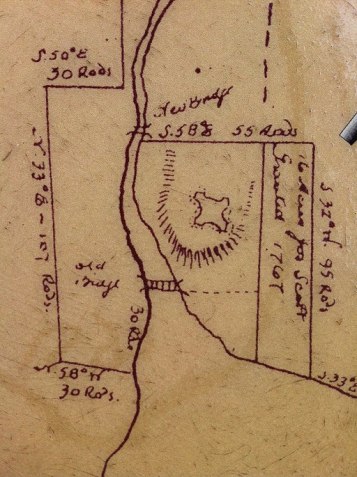
Fort Sackville Map Inset, Nova Scotia Archives and Records, (Wikimedia Commons)
As Lieutenant Governor Henry Hamilton’s army arrived on the lower Wabash, the river widened and deepened, enabling his much-fatigued army to spread out and make better progress to Vincennes and Fort Sackville. All along the way, the governor’s efforts to grow his army through the addition of Indian allies had largely succeeded, not only increasing his numbers but improving his intelligence about the American forces awaiting him. Those were paltry, indeed.
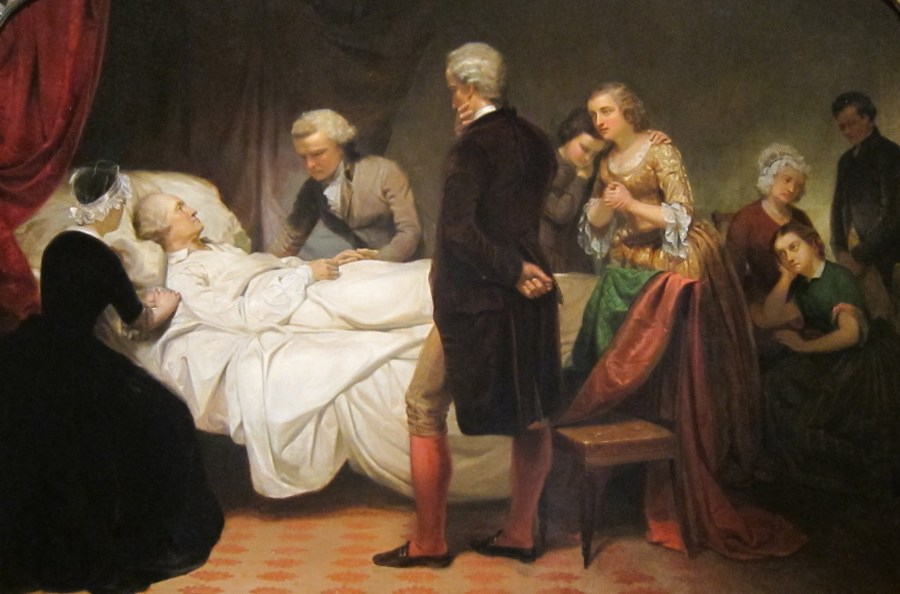
George Washington died on December 14, 1799. On December 12, 1799, the celebrated Revolutionary War general and former president rode around his beloved Virginia plantation, Mount Vernon. Despite the fact it was snowing and sleeting, Washington spent five hours in the winter weather. Washington had survived much worse winters before, and gave little thought to this particular storm, even as he sat for dinner that evening with snow still clinging to his hair. Later that night however, he began to show signs of a sore throat. The next day, he went out again in the miserable weather to mark some trees that needed to be cut down. On the night of December 13, the sore throat had gotten worse. He stayed up that night reading the newspaper with his wife, Martha, and his personal secretary, Tobias Lear. As he headed to bed, Lear suggested he take some medicine for his cold. Washington declined, saying he would “let it go as it came.”[1]
In this highly romanticized painting done in 1851, painter Junius Brutus Stearns depicts the final moments of Washington’s life. (Wikimedia Commons)
Around 3 or 4 in the morning, Washington awoke with a fever and his throat even more tender. Martha was worried and wanted to go alert Tobias Lear, but Washington was afraid the cold air would harm Martha and decided to wait until the enslaved handmaid Caroline came into the room to start a fire at 7 in the morning. At that time, Lear was alerted and he immediately called for doctors to come to Mount Vernon. Continue reading ““I die hard; but I am not afraid to go.” – George Washington’s Final Battle”→
Bob Drury and Tom Clavin have spent years writing books, both individually and as a team. Between the two of them, they have explored topics ranging from baseball and golf to the old west and America’s 20th century wars. With Valley Forge (Simon & Schuster, 2018), Clavin and Drury have turned to the American Revolution. The result is another successful collaboration. (I’m biased as I have enjoyed several of their earlier books.)
Valley Forge tackles the Philadelphia Campaign, the winter encampment at Valley Forge (and elsewhere in truth), and the Continental Army’s emergence as a quality army capable of fighting the British on their own terms, which it demonstrated at Monmouth. The focus is on Washington and the main army with him. The reader sees both of them grow as Washington defeats political attempts to undermine his leadership and struggles to hold the army together in the face of harsh conditions and insufficient support from the rebelling states, Continental Congress, and local farmers. Meanwhile, the Army develops into a core of hard-bitten professionals suitably trained in European methods specifically adjusted for their circumstances. After undergoing Steuben’s training program, it had the military skills needed to match its fighting spirit. By and large, it marked a turning point in the war. Thus, at the end, the authors argue, “For those who survived, not least their inspired and inspiring commander in chief, the hardships they overcame had not so much transformed their innate character as revealed it.”[i]Continue reading “Book Review: Bob Drury & Tom Clavin, Valley Forge, Kindle ed., (New York: Simon & Schuster, 2018).”→









 Emerging Revolutionary War Era