


Bob Drury and Tom Clavin have spent years writing books, both individually and as a team. Between the two of them, they have explored topics ranging from baseball and golf to the old west and America’s 20th century wars. With Valley Forge (Simon & Schuster, 2018), Clavin and Drury have turned to the American Revolution. The result is another successful collaboration. (I’m biased as I have enjoyed several of their earlier books.)
Valley Forge tackles the Philadelphia Campaign, the winter encampment at Valley Forge (and elsewhere in truth), and the Continental Army’s emergence as a quality army capable of fighting the British on their own terms, which it demonstrated at Monmouth. The focus is on Washington and the main army with him. The reader sees both of them grow as Washington defeats political attempts to undermine his leadership and struggles to hold the army together in the face of harsh conditions and insufficient support from the rebelling states, Continental Congress, and local farmers. Meanwhile, the Army develops into a core of hard-bitten professionals suitably trained in European methods specifically adjusted for their circumstances. After undergoing Steuben’s training program, it had the military skills needed to match its fighting spirit. By and large, it marked a turning point in the war. Thus, at the end, the authors argue, “For those who survived, not least their inspired and inspiring commander in chief, the hardships they overcame had not so much transformed their innate character as revealed it.”[i] Continue reading “Book Review: Bob Drury & Tom Clavin, Valley Forge, Kindle ed., (New York: Simon & Schuster, 2018).”

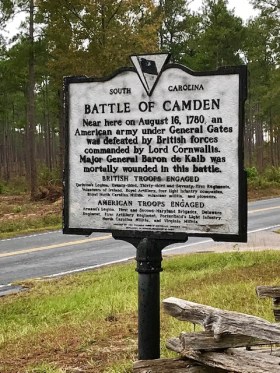 August 16, 1780 would prove to be a devastating day for the American Army in the south, known as the “Grand Army” by its commander, Maj. Gen. Horatio Gates, the Hero of Saratoga. The battle between this army and that of Lt. Gen. Charles, Earl Cornwallis, in the Pine Barrens near the South Carolina town of Camden, would end in the total rout of the Americans and the destruction of the reputation of its commander. It would also temporarily leave the southern colonies without a central army to oppose the British.


 Emerging Revolutionary War Era