My 4th of July in Quincy, Massachusetts: Where else would I be?

ERW is pleased to welcome back guest author Marianne Holdzkom.

July 4, 2026, was a big moment for the United States. This day marked the 250th anniversary of the adoption of the Declaration of Independence, what many call the birthday of the United States. As people were making plans, the question was always, “Where do you want to spend this important anniversary?” There were certainly many fantastic choices: New York City, Boston, Philadelphia, and Colonial Williamsburg, just to name a few.  Yet I have known for a number of years where I would be. It was a no-brainer. I would spend that day in Quincy, Massachusetts. There is no place else for me. Not only was this 4th the 250th birthday of the Declaration of Independence, but it also marked the 200th anniversary of the deaths of John Adams and Thomas Jefferson—fifty years to the day that the Declaration was adopted by the Continental Congress. It was that anniversary that drew me to Quincy. As a John Adams scholar, I was compelled to be in the town where he lived and where he died. I needed to pay my respects. While others were deciding what fireworks display to see, I was on a mission: Quincy or bust!

Even when Adams was serving abroad, his hometown was never far from his thoughts. “I know not the Reason but there is some Strange Attraction between the North Parish in Braintree [now Quincy] and my Heart,” he wrote to Abigail. “It is a remarkable Spot. It has vomited Forth more Fire than Mount Etna. It has produced three mortals, Hancock and two Adams’s, who have, with the best Intentions in the World, set the World in a blaze.”[1] He was writing from Paris at the time. Now, as the locals will tell you, Quincy is full of history that goes well beyond the Adamses. From the early years of the Massachusetts Bay colony, this region has been one of the historically richest areas of the country. Even in the early colonial period, the South Shore was the center of controversy with the antics of Thomas Morton and some of the Puritan disputes of the 17th century taking place here. The city also honors the history of the Quincy family for which the town was named. In addition, Quincy is the birthplace of both Dunkin’ Donuts and Howard Johnson. There is also a Quincy Quarry and Granite Workers Museum in the city.[2] There is no doubt that the city’s history is fascinating. Yet the attraction for many is always the remarkable Adams family.  In this Semiquincentennial year, when Americans are remembering their founding moment, many of us came to Quincy to honor John Adams.

My husband, Dr. Albert J. Churella, ever the good sport about my John Adams fandom, had secured hotel reservations for us in my home from home in Quincy.  The hotel is conveniently located across the street from the Quincy North T Station and makes it easy to get around Quincy on the Red Line.  On the evening of July 3, after settling into our hotel, we rode the two T stops to Quincy Center.  From here, it is a short walk to the Hancock-Adams Common, United First Parish Church, the Adams National Historical Park Visitors Center, and the Quincy Historical Society. As we strolled to dinner, I took the time to pose with the statues of John Adams and Abigail Adams on the Common. We also visited the new John Quincy Adams statue which I had never seen. This statue and the little park surrounding it are nice additions!
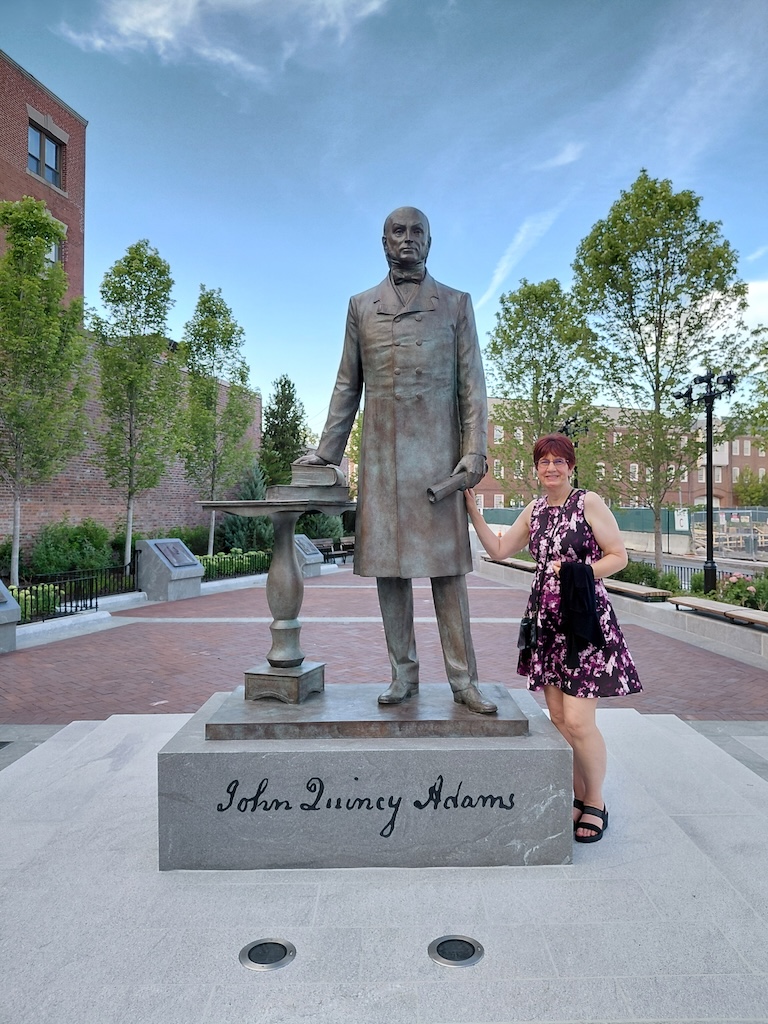
The author with Quincy’s new statue of John Quincy Adams

On the morning of July 4, the big day, we arrived early at the Adams National Historical Park. We knew the temperatures would soar, and the earlier we arrived the better chance we had of getting into the historic homes. Here, we met Mr. Scott McKinley, a fellow Adams family fan, and a talented voice actor as well as scholar. It was a delight to meet him and share part of the day with him. 

The author (right) with Scott McKinley at Peacefield

As the Visitors Center opened, we took our place in line with the other people who had decided to spend part of their day with the Adamses. We were fortunate to get a condensed tour of Peacefield in the morning as the temperatures in the house were becoming unbearable. Unfortunately, I could not see the one room that really mattered to me on that day.  Reportedly, John Adams died in his upstairs study, and we were not allowed to go there due to the heat. The best thing I could do was take a picture of the staircase.  However, according to our guide, one of the staff members at the park is doing some research into the exact place of John Adams’s death. He is not convinced that it happened in the study so stay tuned. I am still grateful that I was able to be in the house, however briefly.
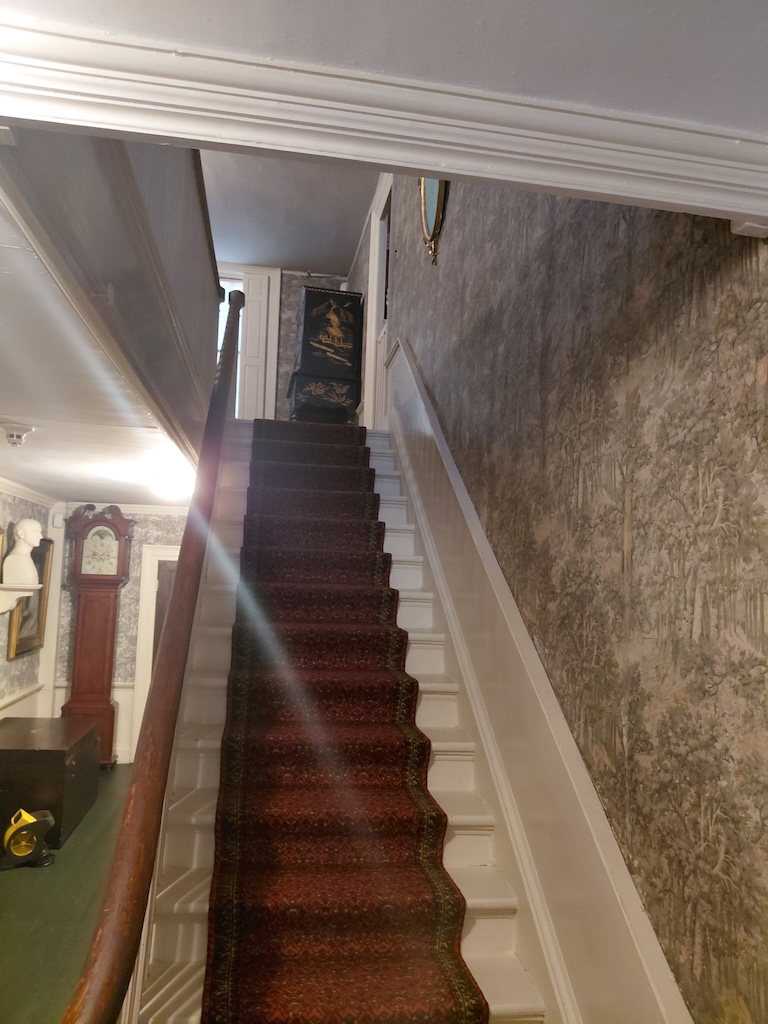
Staircase in Peacefield to the study

One of the special events the park planned for that day was a public reading of the Declaration of Independence. Hilary Miller, Chief of Interpretation at the park, arranged for volunteers from the audience to read portions of the Declaration.  Of course, all three of us in our party participated. It was a great way to remind ourselves of the power of those words.  While I was disappointed that there was no programming surrounding the death of John Adams on that day (that happened the following weekend), I was happy to be a part of this nod to the Declaration of Independence.

I had several nice moments that day at Adams.  I was happy to see, for example, that the park is still selling my book, Remembering John Adams: The Second President in History, Memory and Popular Culture. For an academic author, seeing one’s book on sale is always a win!  Yet the nicest gift of all that day came from Hilary Miller.  She remembered me from past visits and had something to share with me. Miller had requested a Cameo Video from William Daniels for her team as part of their July 4th celebration. She was kind enough to show it to me! The 99-year-old actor, John Adams to so many of us, recorded a wonderful tribute to the park and thanked them for all they are doing to preserve the legacy of John Adams and his family. I was touched that Hilary wanted to share that with me, knowing how much I would appreciate it.
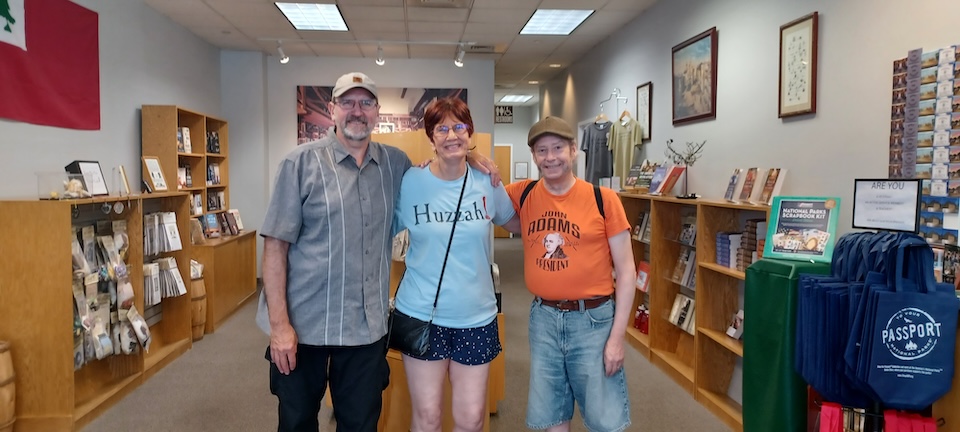
Albert Churella, the author, and Scott McKinley

Finally, that afternoon, we arrived at United First Parish Church, or The Church of the Presidents. The church was completed in 1828 and built in part from granite donated by John Adams.  He was a life-long member of the congregation here and wished to see a “Stone Temple” built to replace the wooden meeting house in his beloved town.  He, along with Abigail, John Quincy Adams, and Louisa Catherine Adams, are buried in the church’s crypt.  This is where I had to be, more than any other place that day.  As we met up with Bill Westland, the delightful church historian who has been a tremendous help to me in my research, I prepared myself for my visit to John Adams’s grave.  I knew that I would not have a moment alone there.  That just doesn’t happen although I have never requested it.  I was just hoping to be able to shut out everything else and pay my respects.  John Adams’s words were swirling around in my brain. “Posterity! You will never know, how much it cost the present Generation, to preserve your Freedom! I hope you will make a good Use of it. If you do not, I shall repent in Heaven, that I ever took half the Pains to preserve it.”[3]  “Yet through all the gloom, I can see the rays of Ravishing Light and Glory.”[4]  Meanwhile, my husband was taking pictures of me so that I could remember the moment.  This was my chance to pay my respects. He understood how important that was to me as did Scott.

As I was standing by John Adams’s tomb, another woman came up and said that she was there to pay her respects and thank him for his service.  I was touched by this and didn’t mind sharing the moment with her. Then I had to try and put into words what I was feeling.  I looked down at the tomb and asked Mr. Adams, “What do we do now?” The woman standing with me thought that was a very good question. I asked this question because I have been struggling to see those rays of ravishing light and glory lately. I love the optimism and hope in the statement, and I remind myself daily that if John Adams could say this given what he was up against then surely I can, too. Still, I needed his help that day. However, we did not get an answer to my question. Silence. 

When you spend as much time studying a historical figure as I have John Adams, you believe that you can know how they would respond to questions or statements in conversation. I know what I wanted to communicate, and I was only getting started. Next, I said to John, “I’ve done the best I can for you and your legacy. Thank you for everything.”  It was then that I could imagine a reply. “Thank you, Madam. And I have done the best I can for you.  For all of you! What do you do now, you ask?  That is up to you. I can do no more but to wish you well!”  Fair enough, President Adams. Message received. And thank you!
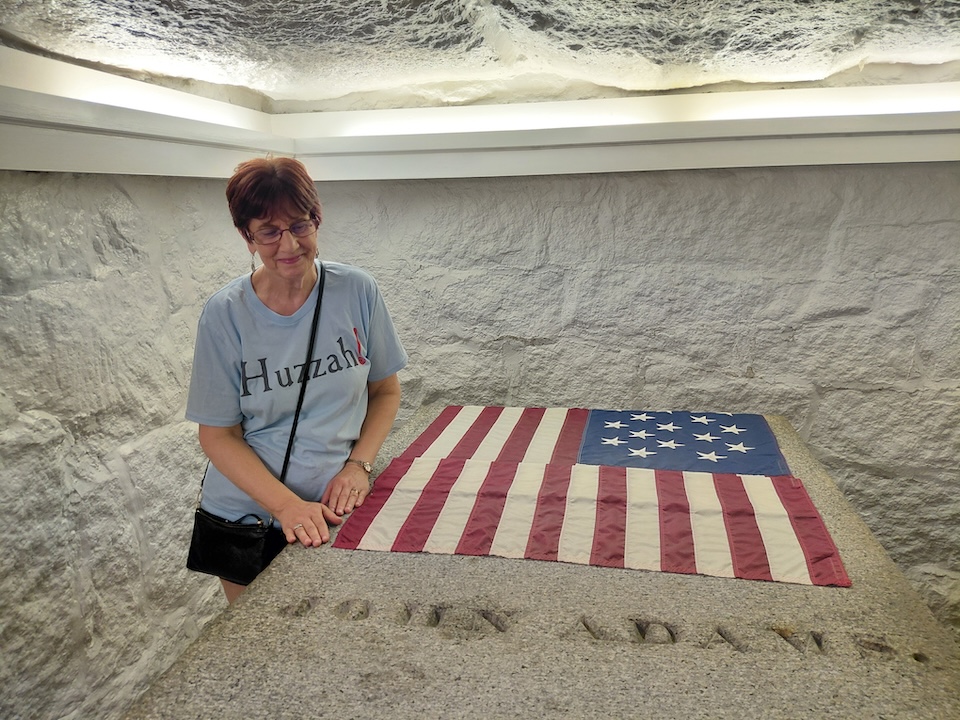
Communicating with John on July 4, 2026.

Marianne Holdzkom, Professor of History at Kennesaw State University, is the author of Remembering John Adams: The Second President in History, Memory and Popular Culture. She is also an Adams Memorial Foundation Scholar.

[1] John Adams to Abigail Adams, 15 August 1782, Adams Family Papers, An Electronic Archive, Massachusetts Historical Society, https://www.masshist.org/digitaladams/archive/doc?id=L17820815ja.

[2] For the early history of this region of Massachusetts, see Nina Sankovitch, American Rebels: How the Hancock, Adams and Quincy Families Fanned the Flames of Revolution (New York: St. Martin’s Press, 2020); For exhibits and resources concerning all aspects of Quincy history, visit the Quincy Historical Society and Museum, https://quincyhistory.org/; For more info on Quincy granite, see the Quincy Quarry and Granite Workers Museum, http://www.quincyquarrymuseum.org/

[3] John Adams to Abigail Adams, 26 April 1777, Adams Family Papers: An Electronic Archive, Massachuetts Historical Society, https://www.masshist.org/digitaladams/archive/doc?id=L17770426ja.

[4] John Adams to Abigail Adams, 3 July 1776, Adams Family Papers: An Electronic Archive, Massachusetts Historical Society, https://www.masshist.org/digitaladams/archive/doc?id=L17760703jasecond.
The Adams Book Club: The Unexpected Abigail Adams by John L. Smith, Jr.

Emerging Revolutionary War is pleased to partner with the Adams Memorial Foundation to share some reading about America’s “Founding Family.” The Foundation holds a monthly book club, hosted by Board President Jackie Cushman. Over the next few days, in special arrangement with the Adams Memorial Foundation, ERW will share links to the first few conversations from that book club.

We’ll kick things off with a conversation between Jackie and historian John L. Smith, Jr., about his book The Unexpected Abigail Adams: A Woman ‘Not Apt to be Intimidated’ (Westholme, 2024).

Continue reading “The Adams Book Club: The Unexpected Abigail Adams by John L. Smith, Jr.”

Maintaining the Chaos: The Complexities of Domestic Life for Loyalist and Patriot Women Amidst the American Revolution, 1752–1789

EDITOR’S NOTE: Emerging Revolutionary War has been pleased to co-sponsor a series of Monday-evening programs to commemorate the America 250th at St. Bonaventure University, where contributor Chris Mackowski teaches. In March, the line-up of programs featured a student research panel. We are pleased to present today the work of one of the “emerging scholars” from that panel, Kayla Krupski.

Kayla is a junior history major from Hamburg, NY, with a minor in classics. Her talk was titled “Maintaining the Chaos: The Complexities of Domestic Life for Loyalist and Patriot Women Amidst the American Revolution, 1752–1789.” We invited Kayla to share a synopsis of her research here.


The American Revolution is most often remembered through the voices of those who primarily wrote its history—men. Because women were not marching miles to face a redcoat with a musket, their courageousness was often overshadowed by active battle. However, women of the 18th century faced constant battles and fear within their domestic lives. Regardless of their allegiance, women embodied a quiet strength in maintaining their households.

Anna Rawle, a young loyalist woman living in Philadelphia, wrote in 1781, “It was the most alarming scene I ever remember.”[1] This quote comes shortly after the American victory at the Battle of Yorktown, when a Patriot mob harassed her home. These uneasy, fearful words that came from a young Loyalist woman reflected how her home, family, and life was threatened because of the Patriot victory.

The resilience and challenges of female roles during the Revolution showed how certain hardships did not solely lean toward one political side. Whether one was a Loyalist or a Patriot, it did not deem that one group of people were harassed more for their beliefs than others. Understanding this allows the unbiased mind to look past the political allegiances and recognize that, through their self-determination, women were not going to let the chaos of the war keep them from continuing to live their domestic lives.

By looking at three women of different ages and political and religious backgrounds, we can connect how the American Revolution affected all women who shared the common emotion of fear. Sally Wister, Anna Rawle, and Abigail Adams had a swift transition from calmness to chaos in their daily lives.

Continue reading “Maintaining the Chaos: The Complexities of Domestic Life for Loyalist and Patriot Women Amidst the American Revolution, 1752–1789”

“…you express a Desire to become acquainted with our American Ladies.”

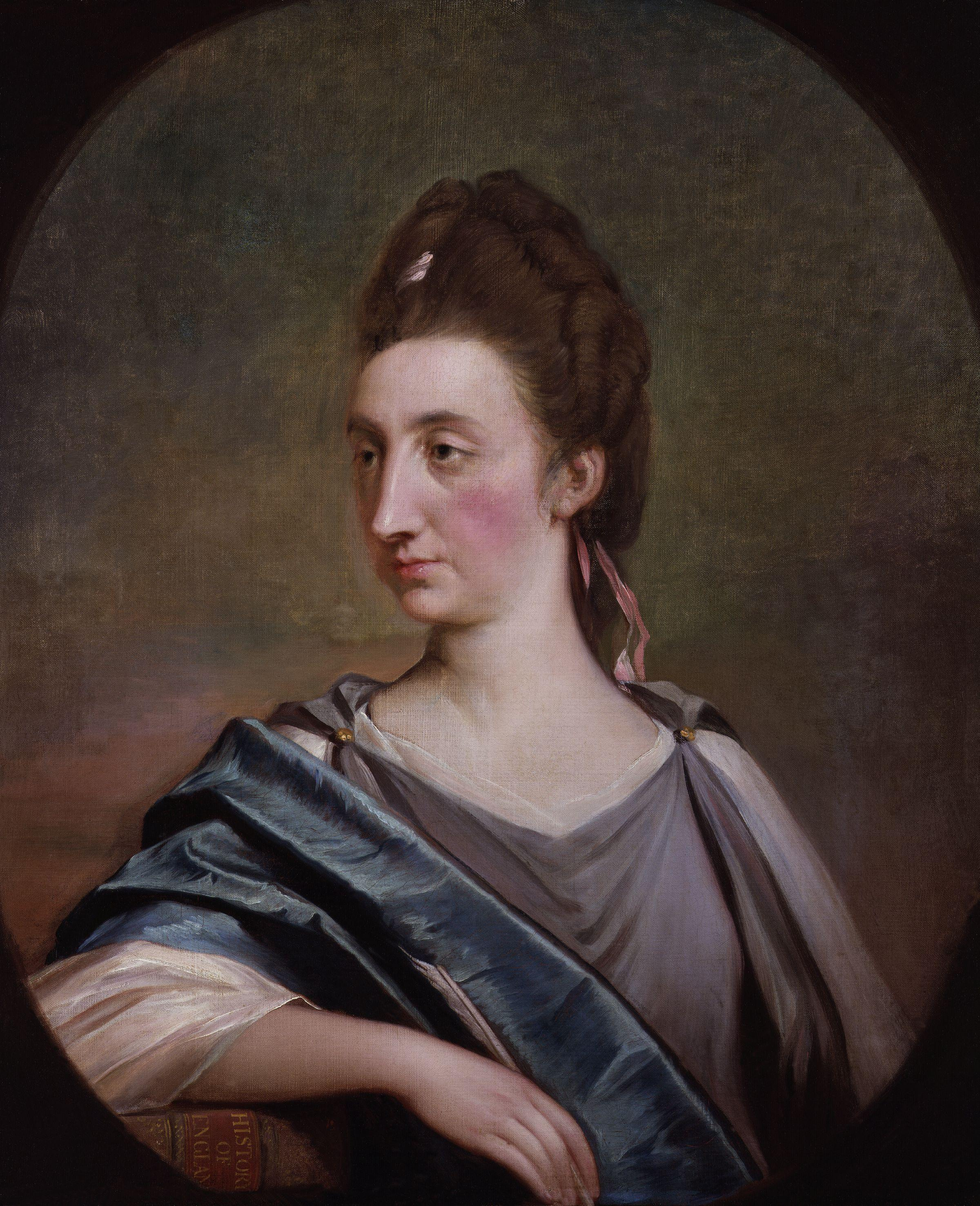
For good reason, much has been done, discussed, developed, and disseminated regarding the voluminous correspondence between Abigail and John Adams. Yet, her spouse was not the only recipient of the wisdom and insight that Abigail possessed. She also became friends with and communicated with Catherine Sawbridge Macaulay Graham in England.

Catharine Sawbridge Macaulay Graham

Graham was a prominent English historian and writer, “at the forefront of radical transatlantic politics in the eighteenth century.” She was a prolific pamphleteer and considered one of England’s first major historians. She was a supporter of and wrote extensively on the American and French Revolutions. Through the cause of the former, she struck up a correspondence with Abigail Adams. Below is a letter from Abigail to Catherine in 1774 that highlights the current events in Massachusetts and also how close the two ladies on either side of the Atlantic Ocean had become in their letter writing. It is truly a remarkable letter that provides emotion and description of a friendship and life in Massachusetts on the cusp of revolution.

Madam

In the last Letter which Mr. Adams had the honour to receive from you, you express a Desire to become acquainted with our American Ladies.1 To them Mrs. Macaulay is sufficiently distinguished by her superior abilities, and altho she who is now ventureing to address her cannot lay claim to eaquil accomplishments with the Lady before introduced,2 yet she flatters herself she is no ways deficient in her esteem for a Lady who so warmly interests herself in the cause of America—a Cause madam which is now become so serious to every American that we consider it as a struggle from which we shall obtain a release from our present bondage by an ample redress of our Grieveances—or a redress by the Sword. The only alternative which every american thinks of is Liberty or Death.

“Tender plants must bend, but when a Goverment is grown to strength like some old oak rough with its armed bark it yealds not to the tug, but only nods and turns to sullen state.”

Should I attempt to discribe to you the complicated misiries and distresses brought upon us by the late inhumane acts of the British parliment my pen would faill me. Suffice it to say, that we are invaded with fleets and Armies, our commerce not only obstructed, but totally ruined, the courts of Justice shut, many driven out from the Metropolis, thousands reduced to want, or dependant upon the charity of their neighbours for a daily supply of food, all the Horrours of a civil war threatning us on one hand, and the chains of Slavery ready forged for us on the other. We Blush when we recollect from whence these woes arise, and must forever execrate the infamous memory of those Men whether they are Americans or Brittons, whose contagious Ambition first opened the pandoraen Box, and wantonly and cruelly scatterd the fatal ingrediants—first taught us filled with grief and anxiety to inquire

Are these thy deeds o Britton? this the praise

That points the growing Lusture of thy Name

These glorious works that in thy [better?] Days

fild the bright period of thine early fame

To rise in ravage and with arm prophane

From freedoms shrine each sacred Gift to rend

and mark the closing annals of thy reign

With every foe subdued, and every Friend.

You will think Madam perhaps from the account I have given you, that we are in great confusion and disorder—but it is far otherways. Tho there are but few who are unfealing or insensible to the general calimity, by far the greater part support it with that firmness, that fortitude, that undaunted resolution which ever attends those who are conscious that they are the injured not the injurer, and that they are engaged in a righteous cause in which they fear not to “bare their bold Breasts and pour their generous Blood.” Altho by the obstruction of publick justice, each individual is left at a loose, to do that which is right in his own Eyes, yet each one strives to shew his neighbour that the restraints of Honour and of conscience are more powerful motives, than the judiciary proceedings of the Law. Notwithstanding the inveterate Malice of our Enimies who are continually representing us, as in a state of anarchy and confusion, torn up with intestine broils, and guilty of continual riots and outrage, yet this people never saw a time of greater peace and harmony among themselves, every one uniting in the common cause, and strengthning each other with inconceivable constancy and sumpathetick ardor.

I mean always to Except those whose venal Souls barter freedom for Gold, and would sell their Country, nay gladly see an innocent land deluged with Blood, if they could riot upon its Spoils, which heaven Avert!—Tis with anxious Hearts and eager expectations that we are now waiting for the result of the united Supplications of America. Yet having so often experienced their Enefficacy we have little reason to hope. We think we have more to expect from the firm and religious observance of the association which accompanied them3—for tho it was formerly the pride and ambition of American[s] to indulge in the fashions and Manufactures of Great Brittain now she threatens us with her chains we will scorn to wear her livery, and shall think ourselves more decently attired in the coarse and plain vestures of our own Manufactury than in all the gaudy trapings that adorn the slave.—Yet connected as we are by Blood, by commerce, by one common language, by one common religion as protestants, and as good and loyal subjects of the same king, we earnestly wish that the three fold cord of Duty, interest and filial affection may not be snapped assunder. Tis like the Gordean knot. It never can be untied, but the sword may cut it, and America if she falls to use the words of the revered and ever honourd Mr. Pitt, will fall like a strong Man, will embrace the pillars of State and pull down the constitution along with her.

I must intreet your pardon Madam for Detaining you so long from the important Services in which you are engaged, but having taken up my pen I could not refrain giving utterance to some of those Emotions which have agitated my Bosom and are the cause of many anxious hours to her who begs leave to subscribe herself Dear Madam your great admirer & humble Servant,

Abigail Adams

________________________________________________________________________________________________________________

Sources:
“Abigail Adams to Catherine Sawbridge Macaulay Graham”

https://founders.archives.gov/documents/Adams/04-01-02-0119

“Catherine Sawbridge Macaulay Graham”

https://www.mountvernon.org/library/digitalhistory/digital-encyclopedia/article/catharine-sawbridge-macaulay-graham-1731-1791

Book Review: “Making the Presidency: John Adams and the Precedents That Forged the Republic” by Lindsey Chervinsky

Emerging Revolutionary War welcomes guest historian and reviewer Al Dickenson

No president has an easy job. But imagine holding the position of president immediately after undoubtedly the best president the United States has ever had.

That was John Adams’ conundrum. Additionally, it is the subject of renowned historian Lindsey Chervinsky’s new book, Making the Presidency: John Adams and the Precedents That Forged the Republic. Initially released last year, in the midst of a politically fraught election season, Chervinsky places the modern world into a context we should all understand better: the history of the 1790s.

After a brief introduction regarding the Revolutionary War, the early republic, and George Washington’s presidency, readers are thrown into John Adams’ presidency. Federalists opposing Democratic-Republicans (commonly referred to as simply “Republicans” in Chervinsky’s text, as they referred to themselves), the Americans opposing the French, the North opposing the South, Federalists opposing Federalists: it seemed there could be no peace in the nation so split apart. Yet the nation stood for another 220 years. Why is that?

Chervinsky argues that the reason we are a nation today relies on how John Adams served his presidency, specifically the power sharing he enacted in his cabinet amongst Republicans (like Vice President Thomas Jefferson), Federalists (like Secretary of State Timothy Pickering), and Archfederalists (like Secretary of War James McHenry), the successful navigation of foreign affairs (see the ongoing French Revolution, specifically the XYZ Affair), and the peaceful transfer of power.

The final focus of Chervinsky’s book, Adams’ loss in the 1800 election, perhaps offers the most original outlook on Adams’ presidency. Being the loser of the election, and being the first incumbent president to lose an election, historians have often treated Jefferson a little kindlier than Adams. Where Chervinsky’s work shines, however, is in showing how these great, powerful men, the leaders of their respective parties, differed in how they saw power, and in how they wielded it.

Little scholarship focuses on Jefferson’s machinations to gain the presidency. Rarely researched are his Virginia and Kentucky Resolutions, which called for nullifying federal law, even though these ideas were eventually adapted into various Confederate causes and mentalities in the following decades. Nor are the essentially political and emotional blackmail Jefferson laid on Federalist members of Congress who refused to vote for him over Aaron Burr. Jefferson threatened the members of Congress with, in essence, secession of Republican states if they did not pick a president soon, given that this was the only election in American history where the House of Representatives made the presidential selection. The dirty tricks of politics manifested themselves in this election, including smear campaigns against Adams and unfounded warnings that the Federalist Party would forego the will of the people and simply appoint a new, Federalist president.

Compare this to John Adams, who, while certainly desirous of a second term, largely laid low during the turmoil occurring on the other side of the Capitol. When presented with suggestions to keep himself as president, he refused. When asked to annul the election, Adams refused. When asked to stand for himself and campaign in the final months of the election season, and during the contingent election in the House between Jefferson and Burr, Adams refused and stayed silent. He did not cling to power, nor did he view his opinion better than that of the American people who voted for a Republican and the House members who would choose the next presidency. Though he was a lame duck president in every sense of the word, he held true to his convictions of propriety in politics, though privately he fumed.

In this way, though history often sheds more light on the winner, makes historians wonder what other ways “losers” of an election may have impacted our politics and history. An interesting study question for any intrigued historian, but one that Chervinsky shows is vital to understanding American history and modern politics alike.

A “Passion for Superiority,” The Continental Army Officer Corps, and Middle School “Mean Girls”

John Adams woke on the morning of May 21, 1777, feeling light of heart. A spell of bad weather had finally broken, and the bright spring dawn cheered his spirits. He took a few minutes before beginning his day to pen a letter to his “Dearest Friend,” his wife, Abigail.[1]

“The Charms of the Morning at this Hour, are irresistible,” he told her. “The Streakes of Glory dawning in the East: the freshness and Purity in the Air, the bright blue of the sky, the sweet Warblings of a great Variety of Birds intermingling with the martial Clarions of an hundred Cocks now within my Hearing, all conspire to chear the Spirits.” Adams’s letters are filled with such descriptions, which are one of the many reasons they’re a delight to read. But then he got down to business.

As the Second Continental Congress’s de facto Secretary of War, he had spent the previous evening, May 21, at the War Department meeting with General Benedict Arnold. Arnold had been embroiled in controversy with several lower-level officers, one of whom claimed “Money is this man’s God, and to get enough of it he would sacrifice his country.” (The charge was untrue at the time but proved ironically prophetic.)

Adams told Abigail that he’d heard Arnold “fought like Julius Caesar” and came to believe Arnold’s side of the tale. “He has been basely slandered and libeled,” Adams concluded.

His political perch gave Adams a view of the Continental Army that might surprise us today. In his usual candor, he told Abigail:

“I am wearied to Death with the Wrangles between military officers, high and low. They Quarrell like Cats and Dogs. They worry one another like Mastiffs. Scrambling for Rank and Pay like Apes for Nutts.”

As he continued, he made an observation that touched close to home. Adams was notoriously vain—a vice he recognized and continually struggled with—so he was deeply familiar with the human tendency to compare oneself with one’s peers. Particularly early in his legal career, Adams measured himself against other young lawyers and pined for the chance to distinguish himself. It was, he said to Abigail, a “Passion for Superiority”:

“I believe there is no one Principle, which predominates in human Nature so much in every stage of Life, from the Cradle to the Grave, in Males and females, old and young, black and white, rich and poor, high and low, as this Passion for Superiority …. Every human Being compares itself in its own Imagination, with every other round about it, and will find some Superiority over every other real or imaginary, or it will die of Grief and Vexation[. . . .] I never saw it operate with such Keenness, Ferocity and Fury, as among military Officers. They will go terrible Lengths, in their Emulations, their Envy and Revenge, in Consequence of it.”

Adams had seen that sort of cattiness “among Boys and Girls at school, among Lads at Colledge, among Practicers at the Bar, among the Clergy in their Associations, among Clubbs of Friends, among the People in Town Meetings, among the Members of an House of Reps. [Representatives], among the Grave Councillors, on the more solemn Bench of justice, and in that awfully August Body the Congress, and on many of its Committees — and among Ladies every Where. . . . .” No where was it worse than among the “Mean Girls” of the army’s officer corps.

“So much for Philosophy,” Adams decided, and then inquired about his children and Abigail’s asparagus. Then he concluded with a note that resonates with all of us here at Emerging Revolutionary War:

“I would give Three Guineas for a Barrell of your Cyder — not one drop is to be had here for Gold. And wine is not to be had under Six or Eight Dollars a Gallon and that very bad. I would give a Guinea for a Barrell of your Beer. The small beer here is wretchedly bad. In short I can get nothing that I can drink, and I believe I shall be sick from this Cause alone. Rum at forty shillings a Gallon and bad Water, will never do, in this hot Climate in summer where Acid Liquors are necessary against Putrefaction.”

Cheers!


[1] All quotes from: Letter from John Adams to Abigail Adams, 22 May 1777 [electronic edition]. Adams Family Papers: An Electronic Archive. Massachusetts Historical Society. http://www.masshist.org/digitaladams/

Review: American Rebels, How the Hancock, Adams, and Quincy Families Fanned the Flames of Revolution

Two of the above three last names are very familiar to even casual observers of American history. John Hancock, whose signature is readily apparent at the bottom of the Declaration of Independence, where it was joined by John Adams and Samuel Adams. Yet, that last name in the title, Quincy, may not be as obvious as should be at first glance.

What is remarkable about these last names? Besides, the simple fact that members with those three surnames played a major role in the road to revolution and surprisingly on both sides of the chasm of loyalties? All could trace their roots to a small town in Massachusetts; Braintree.

“The covenant of liberty that they shared would be sharpened by ambition and envy, polished through friendships and love, and fought for in a revolution fomented by these children of Braintree” (pg. 8).

In that town, from its first inhabiting European settlers, the spirit of questioning accepted decrees took root, matured, and blossomed. And until now, the intertwining vines of those family trees had not been put under the microscope of historic observation until the publication this year of American Rebels, How the Hancock, Adams,and Quincy Families Fanned the Flames of Revolution. Penned by Nina Sankovitch an Illinois native, author of several nonfiction works, and resident of New England, she effortlessly weaves the stories of these families into part biography, part family history, and part United States history. All parts equally important and very well written.

“Even as the fortunes of these children of Braintree diverged, their futures would bring them together again. A shared promise connected them, fostered by the history, the land, and the people of Braintree…” (pg. 8)

One of the highlights in the book is the emergence of the Quincy family into a popular history such as this. One of the unsung heroes of the road to revolution was Josiah Quincy Jr.

“As Reverend Hancock preached, the “solemn covenant….of their Liberty” was not obtained through faith alone but could only be realized through hard work performed by a community together. And this sacred covenant would be protected against any and all usurpers who attempted to take their liberty away.” (pg. 15).

Furthermore, Sankovitch brings to the forefront the role of women in the various families and their impact on the time. The best known is Abigail Adams who is the confidant and intellectual equal of her husband, John. Another is the aunt of John Hancock, Lydia, who constantly watches out for John’s place in society. She is the driving force that will bring to fruition the connection between the Quincy and Hancock families. Or Abigail Quincy, who had married Josiah Quincy, Jr., would never remarry but dedicated the rest of her days to raising their son and preserving his memory and contributions to the cause of America. The anguish of losing her beloved is quite evident:

“I have been told that time would wear out the greatest sorrow, but mine I find is still increasing. When it will have reached its summit, I know not.” (pg. 348).

Highlighted by the quote above, the author brings these historic personas and people to life, capturing the heartache, familial turmoil, ambition, and connections. Just as these families bred revolutionaries, there were sons that stayed loyal to the British crown, including a brother and brother-in-law of Josiah Quincy.

From weaving the families together, to connecting the threads of the evolution of political thought, and showing the personal strains of what the road to revolution looked like, Sankovitch has compiled an easily readable, insightful look into the 18th century world.

Enjoy!

*Book Information*

Publisher: St. Martin’s Press (March 2020)

Pages: 416

ERW Book Review: Washington’s End: The Final Years and Forgotten Struggle by Jonathan Horn

George Washington retired from public life at the end of his second presidential term on March 4, 1797. Twenty months and ten days later he died on December 14, 1799. In between Washington was also the first in the United States to be a former president, first to deal with securing his legacy as both a military hero and political figure, and having to see the country he sacrificed so much to create, lurch forward without him having an active part in it.

Until now, these years have been either excluded, glossed over, or an anti-climatic ending to a Washington biography. Until now. Joseph Horn, a former presidential speechwriter and the author of The Man Who Would Not Be Washington lends his talent to a new biography of Washington, examining those last few years in-depth.

The author has a valid point when he argues that, “for too long, the story of Washington’s last years has been squeezed into the margins of manuscripts, if included at all” (pg. 14). Channeling the method of famed Washington biographer Douglas Southall Freeman, Horn writes this biography in the “fog of war” style that affords the reader the opportunity to read the history “through the eyes of those who made it rather than through the hindsight of historians” (pg. 14).

Continue reading “ERW Book Review: Washington’s End: The Final Years and Forgotten Struggle by Jonathan Horn”

Review: Founding Martyr, The Life and Death of Dr. Joseph Warren, the American Revolution’s Lost Hero by Christian Di Spigna

ERW Book Reviews (1)

Doctor. Major General. President of the Provincial Congress. Author of political tracts. A true patriot. Forgotten.

41mPwaMUWfL._SX336_BO1,204,203,200_All these words, plus many more, are titles that depict the life of Dr. Joseph Warren. However, the last term is most synonymous with the Massachusetts doctor who fell in the Battle of Bunker Hill on June 17, 1775 in the early stages of the American Revolutionary War. That last word, forgotten, is exactly what author and historian Christian Di Spigna is hoping to expunge with his new biography, Founding Martyr. 

Di Spigna, an early American history expert and Colonial Williamsburg volunteer, focuses his account of Dr. Warren on not the events immediately surrounding his death at Bunker Hill and subsequent martyrdom but “to fill in the more obscure parts of Warren’s life” which will lead to understanding more of the “key period in the formation of his character, his special networks, and ultimately his medical and political careers” (pg. 7). Continue reading “Review: Founding Martyr, The Life and Death of Dr. Joseph Warren, the American Revolution’s Lost Hero by Christian Di Spigna”

A Woman’s Place –Women’s Contribution in the Revolutionary War

Emerging Revolutionary War is honored to welcome historian Malanna Henderson to the blog. A biography of Mrs. Henderson is at the bottom of this post. 

Historical records are generally written by men about men.

When most of us think about the role women played in the Revolutionary War, Betsy Ross comes to mind.  Why did early historians choose to recognize the contributions of Betsy Ross instead of others? We all know the answer to that question. Her contribution was sewing the American flag. Sewing, a traditional “female” occupation, was elevated to heroic heights by the legacy of Ross. Most historians today don’t name Betsy Ross as the designer of the first American flag, but that’s another story.

Women whose contributions didn’t fall neatly into categories that weren’t exclusively defined as “feminine” were intentionally excluded; and yet, without their contributions, big and small during the years that the war ensued, the war could have raged on longer or dare I say, we might be flying the Union Jack instead of the Stars and Stripes.

Heroism has many forms.

On the home front women maintained the farms, took care of livestock and fed, clothed and educated their children while their husbands took up arms against the British. That was how most women supported the war effort. However, as in the Civil War women were camp followers, accompanying their husbands and sons to the battlefield. For these women, the army could supply food and protection since they could no longer support themselves after their men left for war. In the military camps, women nursed the sick and wounded, laundered and mended uniforms and cooked meals. At some time in the war, women were paid for providing these services.

Then there were women who chose to pursue more daring endeavors, like spying or binding their breast, cutting their hair and donning men’s clothing to enlist in the war under an alias.

deborah-sampson
Deborah Sampson (courtesy of Fold3 by Ancestry.com)

One in particular, Deborah Sampson answered the call to freedom by enlisting in the in the 4th Massachusetts Regiment, under the alias Robert Shurtliff. Continue reading “A Woman’s Place –Women’s Contribution in the Revolutionary War”