The Attack and Defense of the Chew House: British Professionalism at Germantown

Emerging Revolutionary War welcomes back guest historian Ben Powers. Bio follows the article.
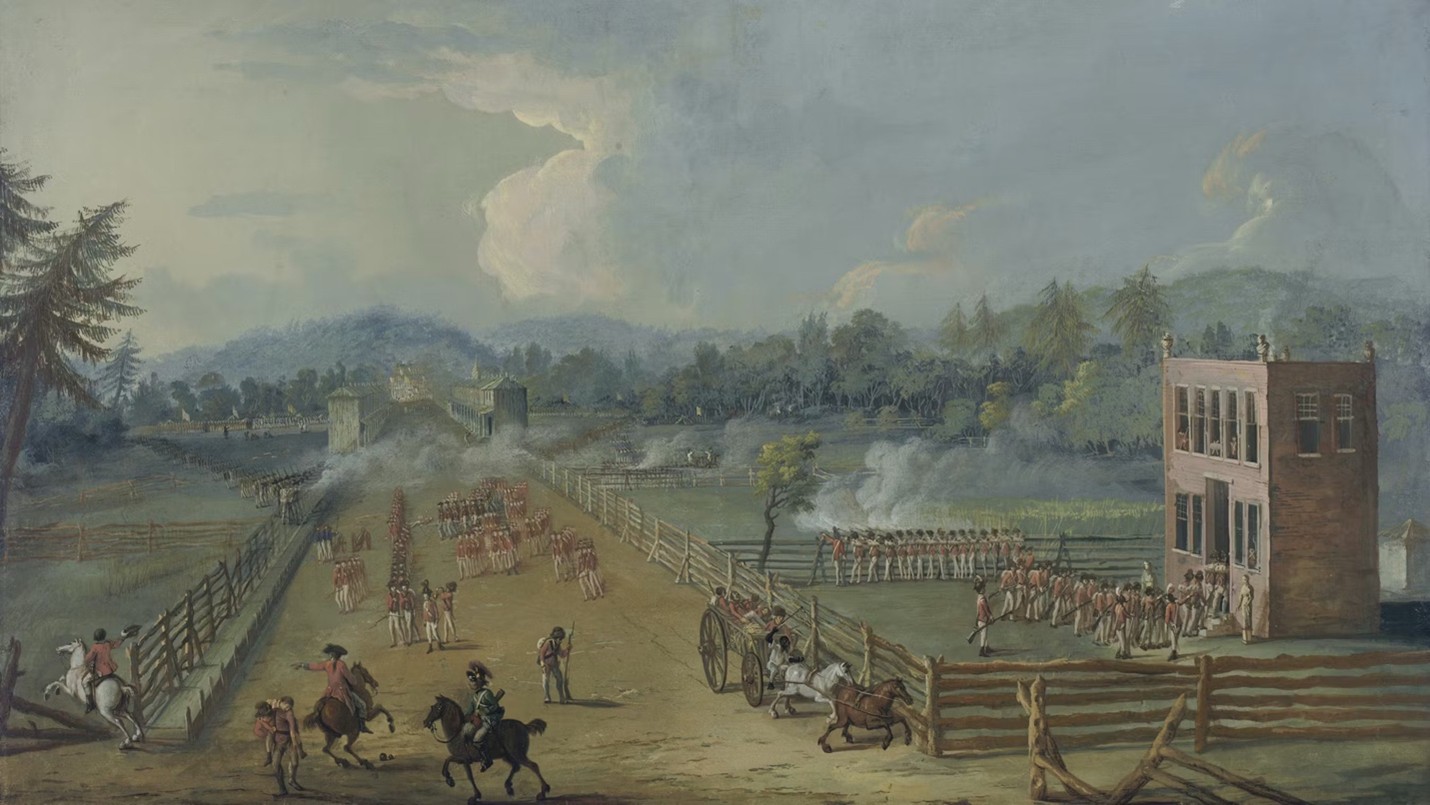
Battle of Germantown
Painted by Xavier della Gatta, 1782
https://www.amrevmuseum.org/collection/battle-of-germantown

     Was the Battle of Germantown an American failure or a British success? Did the Continental Army lose due to an overly complicated plan, environmental factors such as fog, and poorly applied military judgment, or was the British Army’s resistance a decisive factor? The defense of the Chew House demonstrates that the British were professional, tenacious, and courageous, rather than the fortunate recipients of the fruits of an American blunder. Led by Lieutenant Colonel Thomas Musgrave, the men of the 40th Regiment of Foot established a strongpoint that disrupted American momentum and derailed the attack. Musgrave and the 40th Regiment of Foot transformed the Chew House into an obstacle that delayed the American advance long enough for British forces to reform and counterattack. This episode reveals the significance of British leadership and discipline under severe conditions, thereby reframing the context of the Battle of Germantown.¹

     Germantown occurred at a time when the Continental Army was undergoing a transformation from an amateur to a professional military. American officers engaged in self-directed study of “books upon martial science” and were known to carry such texts among their baggage and haversacks when on campaign.² In this manner, Continental officers sought to emulate their European counterparts.³ One officer known to have made a detailed study of the art and science of war was Washington’s Chief of Artillery, Henry Knox.⁴ At the time of Germantown, the officers of the Continental Army had been at war for over two years and had learned many practical lessons; however, many officers, including Washington, continued to hold Knox’s auto-didactic military education in high esteem. The gap between knowing theory and its practical application would become apparent, to the detriment of the Continentals, at Germantown.

     In contrast, the British Army officer corps had been fully engaged in a minor military enlightenment through the latter half of the eighteenth century. While British officers engaged in self-study programs similar to Knox’s, they could more readily share the results of their study within an established army, comparing and contrasting ideas and adopting best practices.⁵ The British Army was able to synthesize the best practices from both theory and combat experience into regulations that informed the training and operational deployment of all its formations.⁶

     Early interpretations of the battle frequently emphasized confusion and poor execution, particularly the American decision to attack the Chew House. Yet the battle was “very much more than a contest… for the possession of a country house.” More recent scholarship describes the plan for the attack on Germantown as a sophisticated maneuvering scheme that nearly succeeded. Its subsequent failure owes more to British action than American incompetence.

Continue reading “The Attack and Defense of the Chew House: British Professionalism at Germantown”
Announcing our 2025 ERW Bus Tour…. Philadelphia Campaign of 1777 with Michael Harris!

We are excited to announced our FIFTH annual ERW bus tour will be on November 7-9, 2025 and will cover the 1777 Philadelphia Campaign.

Author and historian Michael Harris will join us as we cover the fall of 1777 campaign. The British Army under Gen. William Howe made a concerted effort to take the American capital of Philadelphia. George Washington and the Continental Army fought major actions at Brandywine and Germantown in an effort to hold and take back the city. The tour will cover sites associated with the Philadelphia Campaign, such as Brandywine, Germantown, Paoli and others.

Tickets are $250 per person and will include Friday night lecture at the host hotel, all day bus tour on Saturday and half day bus tour on Sunday. A lunch is included for Saturday.

Our host hotel is the Holiday Inn Express and Suites – King of Prussia. Lodging is NOT included in the registration fee. A room bloc has been established under the name of “Emerging Revolutionary War.” A link will be provided in the future for hotel lodging.

Join us for our FIFTH annual tour as we take on the beginning of the American Revolution just a few months before the 250th anniversary. Learn about the dramatic events that led to some of the bloodiest days in the American Revolution. There is no better way to experience history than to stand in the footsteps of where it happened!

To register, visit: https://www.eventbrite.com/e/battles-for-the-capital-1777-philadelphia-campaign-bus-tour-tickets-1048228358237?aff=oddtdtcreator

For more questions, please email emergingrevolutionarywar@gmail.com.

“Rev War Revelry” The Importance of Germantown

On October 4, 1777, General George Washington’s Continental Army struck the British outpost at Germantown, Pennsylvania. Less than a month after the Battle of Brandywine and approximately a week after the loss of their capital, Philadelphia.

Initially successful, Washington’s forces got bogged down by fog and British holdouts in a stone structure called Cliveden. What started so promising did end in a tactical defeat for the Americans. Yet, coming days before the climatic battle in New York, dubbed Saratoga collectively, the cause of American independence was buoyed.

Although outshone in the annals of history by Saratoga, the setback at Germantown proved decisive in the French court, especially with the French foreign minister, who saw that the simple fact that Washington could regroup following Brandywine and come within some bad luck and fog of defeating the British was testament to resolve of the American effort for independence.

To cut through the fog and discuss the campaign, engagement, and repercussions of the Battle of Germantown, Emerging Revolutionary War invites back historian and author Michael C. Harris this Sunday for the next installment of “Rev War Revelry” at 7pm EST on our Facebook page.

He will join a duo of ERW historians. In addition, his publication, Germantown: A Military History of the Battle of Philadelphia, October 4, 1777, is now available through the publisher, Savas Beatie, LLC. Click here to order.

We look forward to hearing your comments, questions, and/or opinions this Sunday. So, set a side an hour-ish–as you know historians can get to talking and lose track of time easily, especially when books are also involved–for this historian happy hour.

Women’s History Month: The Story of Anna Maria Lane

Emerging Revolutionary War welcomes guest historian Paige Backus. 

image2
Aron, Paul. “Fighting as a Common Soldier”. Colonial Williamsburg: Trends and Traditions (Spring 2017). Accessed March 12, 2019. Click here for URL.

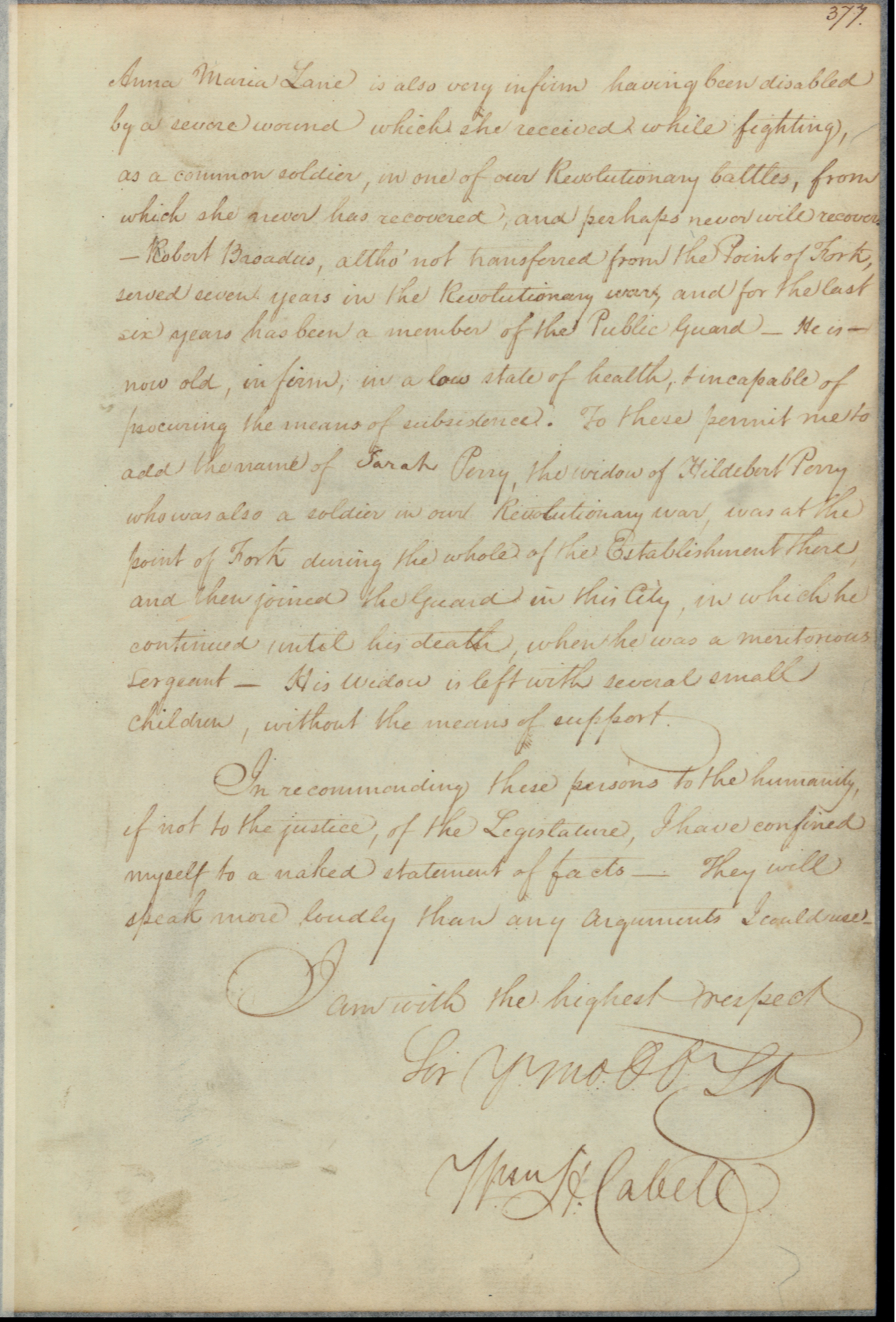
Women’s History Month is dedicated to celebrating extraordinary women and encouraging the women of today to be the same.  Throughout American history, there are multitudes of women who certainly were put into extraordinary situations and rose to the challenge to make their place in history. Throughout the American Revolution, women were generally not allowed to serve in the armies so they accompanied their husbands to war as camp followers assisting with the cooking, cleaning, nursing and other domestic tasks needed by the army. This is no small feat considering that women were exposed to the hardships and challenges of war, working without the modern technology we take for granted today, and doing it all in skirts. However, one woman named Anna Maria Lane not only followed her husband into war, but she joined him in battle becoming the only known woman in Virginia to serve as a soldier during the American Revolution. Continue reading “Women’s History Month: The Story of Anna Maria Lane”