Emerging Revolutionary War is pleased to share the following information from our friends at Campaign 1776 managed by the Civil War Trust.
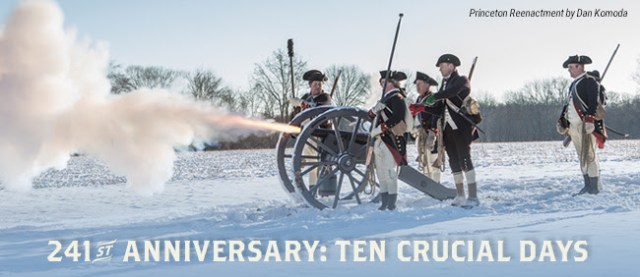
“As many of you may know, this winter marks the 241st anniversary of the American victories at the battles of Trenton and Princeton. The Continental Army’s triumphs in the Ten Crucial Days campaign proved instrumental to rekindling Patriot morale and keeping the cause for American independence alive in the wake of early defeats.Continue reading “From Campaign 1776: Ten Crucial Days”→
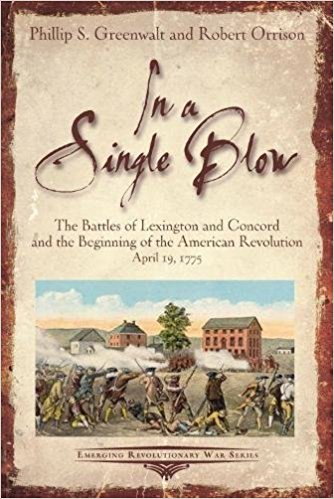
This summer Emerging Revolutionary War will launch its namesake book-series, the Emerging Revolutionary War Series published by Savas Beatie LLC, a military history book publishing company based in California.
The initial two volumes of the series will discuss the Battles of Lexington and Concord, the opening salvos of the American Revolution and also the Battles of Trenton and Princeton, two engagements that kept the cause of American independence alive in the bleak winter of 1776-1777.
Look for the the first two books in stores and online this summer. For a preview, courtesy of Amazon, click here for In a Single Blow. For Victory or Death, click here.
The financier. Those two words explain the importance of Robert Morris, the Liverpool, England born Pennsylvanian transplant. As George Washington engineered the pivotal campaign that culminated in the actions at Trenton on Christmas Day 1776 and Princeton in early January, Robert Morris was the man who made it happen.
Born on January 20, 1734, Morris was a 13-year old lad when he sailed for the British North American colonies. He was headed to Oxford, Maryland where his father had emigrated prior to. While living on his father’s tobacco-growing plantation, Morris was afforded the opportunity to have a tutor and showed his mental prowess, advancing rapidly in his studies.
Outgrowing his tutor, Morris was sent to a family friend in Philadelphia where it was arranged the young man would become an apprentice in the shipping and banking of future Philadelphia mayor Charles Willing. When Willing died in 1754, Morris was made partner. He was only 24 years old at the time.
After the establishment of Willing, Morris, and Company on May 1, 1757, Morris was set about establishing himself firmly in the upper society of Philadelphia, the largest city in the 13 British colonies. Yet, it was not until he was 35 years old in 1759 when he wed Mary White, who hailed from a prominent Maryland family. In time, the family grew to include five sons and two daughters. That same year, Morris and his partner Thomas Willing organized the first non-importation agreement in which the slave trade was ended for good in the Philadelphia region.
Robert Morris (courtesy of our friends at The Society of the Descendants of the Signers of the Declaration of Independence, http://www.dsdi1776.com)
Even before his marriage, Morris was active in politics. In 1765 he had served on a committee comprised of local merchants. Formed in protest to the Stamp Act, Morris was chosen to mediate a mass town meeting of protesters. Even though he personally felt the new acts were unconstitutional, Morris was remained steadfastly loyal to Great Britain. Continue reading “Six Signing Signers”→
I grew up in a suburb of Reading, Pennsylvania. Reading is the county seat of Berks County, and is located about sixty miles northwest of Philadelphia. Reading is an old town; Richard and Thomas Penn, the sons of William Penn, founded the town in 1743. It is situated on the banks of the Schuylkill River, and has always been an important logistics center as a result. German immigrants settled much of Berks County, and many in the area spoke the language. Today, Reading remains the gateway to the so-called Pennsylvania Dutch region.
There’s a part of the east side of the city, situated at the base of Mt. Penn, the dominating high ground that overlooks the city, called Hessian Camp. This is what a local newspaper writer said about that part of town a few years ago: “Reading’s Hessian Camp section is arguably the city’s finest neighborhood. Mansions line the curvy, hilly streets…The neighborhood, tucked into the side of Mount Penn, is hidden from the hustle and bustle of the downtown.” My mother’s favorite aunt and uncle lived in Hessian Camp.
Historical marker for the “Hessian Camp”
A historical marker erected by the Commonwealth of Pennsylvania in Hessian Camp stands out. As a child, I thought it an odd name, so I started asking questions. I eventually learned that it was the site of a Hessian prisoner of war camp during the Revolutionary War. That satisfied my youthful curiosity, but as an adult who has traveled back to Reading regularly since moving away in 1983, I retained my interest in it and remained curious about it. Consequently, I decided to tackle it and see what I could learn of it. Eventually, the story took shape.
After George Washington crossed the Delaware River and surprised Hessian mercenaries at the Battle of Trenton, the Hessian prisoners of war were take inland for detention. Due to the heavy German presence in Reading, it was a perfect place to house these men because so many of the locals spoke the language and could converse with these men. They also hoped that the Hessians would desert and take up residence—and perhaps their loyalty—with the Patriot cause. Further, as a result of Reading’s location, it would require a determined campaign to free the prisoners of war.
The initial prisoners of war were housed in a temporary prison along the banks of the Schuylkill River. They spent a cold, rough winter, and many died of disease and/or cold. After the Battle of Saratoga, when it became obvious that more Hessian prisoners of war would be heading to Reading for detention, the local citizenry demanded that the POW’s be moved to a more remote location. The original campsite was about 12 acres in size, and housed about 1,000 detainees—about the same as the permanent population of Reading. There was plenty of fresh water from a spring and plenty of lumber to construct huts, so the site was chosen.
There are two surviving accounts from German POW’s housed in Reading. Johann Bense, from the Duchy of Brunswick, arrived in Reading on June 16, 1781:
On the bank of the Schuylkill, we had been camping on a meadow in the open air for 8 weeks and were plagued by the great heat during the day and by rain and cold during the night. On August 9, we marched from the Schuylkill via Reading onto a high, rocky mountain.
We were supposed to build barracks there. But because we did not want to agree to that right away, but rather made ourselves straw huts, we were treated very severely. A sharp command from the corporal forced us to build the barracks and it was our good fortune because all our straw huts were consumed by fire on October 21, 1781.
Therefore, those who had not yet completed their barracks, had to do more now to get them ready. Through that, the men got some freedom to go into the country and work and so they kept their supplies. They are read out twice a month [report for roll call twice a month].
On April 26, 1782, we received money, linen trousers, shirts, and 1 pair of shoes from Lieutenant du Roi [of the Regiment Prinz Friederich]. Now, our situation was pretty good.
It did not last long, however, that they locked us up and all who were in the country and worked there, had to come in [to the city].
In the month of July, they read us an order from Congress. Any one of us wanting to be free, and that immediately, should give 80 silver talers [one British pound was worth 5 5/6 talers] as ransom and if he did not have that much money, a citizen should pay it for him with whom he should work in bondage for 3 years.
But if we wished to enter service with them [in the American army], each would get 8 silver talers as gratuity and after the end of the war, he would be given 100 acres of land. This now was voluntary, to be sure, but because our men did not want to agree to that, we were treated very harshly.
Since a few of us deserted, 356 men [of ours] were suddenly taken to the Reading jail and because there was not enough room, they had to lie in the court yard in the rain and the cold. They had to buy wood and water.
Two hundred of our men were sent to the prison in Lancaster; the artisans were also taken there. Afterwards another 100 men were taken into prison, among them was myself. Because a few non-commissioned officers deserted, 42 sergeants and non-commissioned officers were also taken to jail. These had to lie in the cellar and below in the dungeon [at Lancaster]. Many of our men who could not stand it entered [American] service or sold themselves as indentured slaves for 3 years. The rest, who had been prisoners since September 11, were let out on December 16 but each had to give 1 taler.
The non-commissioned officers were let out after 17 days but because some deserted right away again, those having been in jail before were quickly taken back to prison and had to remain there up to the exchange.
Some of our men took up service on a pirate ship which was captured immediately at its departure from Philadelphia, and taken to New York. In the last year of our captivity, we thus were the most wretched and most miserable men. None of us could go out and none of the inhabitants were allowed to see us…
On February 13, we had our first news of peace [from a Hessian Quartermaster]. We continued being in doubt until finally in March a French ship arrived in Philadelphia with the same message. It was made known to us at the barracks on the 26th that there was peace with France, Spain, Holland, and England and now we were daily hoping for our release. . . On April 16 in the afternoon, the non-commissioned officers came out of the city jail and [returned] to the barracks.
On April 21, which was also the second day of Easter, at 12 Noon, 13 cannon shots were fired for the 13 free colonies. The whole city was illuminated in the evening and fires were made on April 24. In the morning the English Commissary Maclean came to give us each a blanket. Other staff officers came and we prisoners found out we would march to New York.
Bense departed Reading on May 3, 1783, and by May 10, had arrived in New York City. He eventually returned home to the Duchy of Brunswick,
The second account comes from a letter by Sgt.-Maj. Samuel Vaupel, who served in the Leib Company, Erbprinz Regiment of Hessen-Hanau. He reported to his commanding officer, Lt. Col. Lentz, in New York:
Your Excellency, I have a report to humbly send you, also a resolution from the Board of War of Congress and the address of Captain Thomas Bowen. From these, your Excellency will see in what a depressing situation we are in….We were told everyone must choose to either buy himself free or join the American service. The king would not help us, and our prince did not want us… Nobody [from the ranks] responded to this reading and speech. It was immediately ordered that now nobody could leave camp and the proclamation read three times daily. But our people pretty much stuck together.
On August 7, 1782, we were visited by Major-General [Benjamin] Lincoln and Brigadier-General [Moses] Hazen from Lancaster. The Corps had to form up and we were reviewed but they didn’t speak. They rode our regimental street and around the barracks, then went on to Reading.
On the morning of the 10th instant, Brigadier-General Hazen returned with a German Captain [Anthony] Selin from his regiment. The troops had to turn out again and form a circle. The General spoke, which was translated by the above mentioned captain. We should choose to either make ourselves free by paying 80 Dollars or join the American army; the King of England did not care enough about us to exchange us or pay for our provisions; they cannot provide for us any longer when they have problems feeding their own men; and if we continue refusing to make our decision, serious measures will be taken.
After the speech we NCOs said that we could not agree to these conditions, and asked if he would allow two NCOs from our Corps to go to New York to report these conditions to our commanding officer. If he says all hope is gone and doesn’t need us any longer, then every man can do as he wishes. The general’s answer was: He wanted to report it to Congress, but we have not heard anything as of now and don’t expect to.
The above mentioned Captain Selin is Swiss-born and cannot be described badly enough; he was introduced to us as our commander. The new captain called together all the NCOs and gave orders that nobody will dare go 10 paces beyond the post without being termed a deserter and when the provost guard calls and they don’t stop, the guard should fire on them
The water is located just outside the post, but nobody may go for it alone. The NCO of the guard has to call for water and one of his armed guards goes along to the well. This captain has ordered the guard to allow nobody out of camp, not even a woman or child, without permission. [Some of for-hire soldiers were allowed to have wives and children with them.]
He also said he has forbidden the local residents into the camp. It is not permitted to openly bring us an apple. Since all this did not help, the above mentioned captain announced the NCOs were to blame for the lack of enlistments – that they discouraged the men from enlisting.
This lasted until September 7, when he unexpectedly came to the barracks at daybreak and gave the order to march; our people were to go to the mountain with sack and pack. We all packed our things and when we were formed up on the barracks mountain, the captain went from right to left without saying anything. Finally, with the Brunswickers, he began pulling young people from the ranks.
When he came to our regiment he only said the married men and NCOs should step forward. The remainder dressed ranks, were turned right and joined up with the Brunswickers to march to the jail in Reading.
There were 142 men of our regiments and 158 Brunswickers, 300 in all. They filled up the jail and the remainder had to camp in the jail yard. The first day these people had to pay 2 pence for a pail of water and also had to pay for firewood to cook with. They were in this jail through the 10th instant.
On the 11th instant 102 men from the regiment and 84 Brunswickers were taken to the jail in Lancaster.
On the 24th instant, 21 men from the regiment and 25 Brunswickers were again taken to the jail in Lancaster. There is now nobody from the regiment in the Reading jail except the baker Muller from the Lt. Colonel’s Company.
Private Wiskermann of the Leib Company was employed in Reading by a rich widow. On September 2, the captain had him brought in from the widow and asked him to enlist, buy himself free, or be sent to an underground prison or dungeon as the English call it. He decided he would rather be free and the above mentioned madam, named Mifflin, ransomed him.
Fourteen men from the regiment who were employed at an iron smelter, have returned to the barracks. On September 23, 10 of these men were taken to the Reading jail. The other 4 men remained sick in the barracks; the other 10 men were taken, with others, on September 24 to Lancaster. They also had to each pay the jail keeper in Reading 1/4 Dollar for the one night lodging.
Concerning us here in the barracks, we expect daily and hourly to go to the jail. Captain Selin indicated, when the others went to jail, that at the slightest incident or attempt at desertion, the others would also go into the jail. We have to hear daily from this captain how our tyrannical prince no longer needs us and that we will not get any more clothing or money from him. We collectively humbly beg your Excellency to have mercy on us and rescue us from this unhappy and depressing situation.
Should this be impossible, we beg you to have the grace to send us uniforms, blankets, and money. Otherwise it will be impossible to withstand the coming winter as our blankets are torn and so little firewood is issued that we can’t make the fires small enough. . . nobody is allowed out to gather firewood.
Sergeant-Major Vaupel ransomed himself on or about December 8, 1782. His fate is unknown. The fates of the poor German soldiers sent to fight in North America remains a fascinating mystery.
Other than large, handsome houses, there is nothing left of the Hessian campsite in Reading. The historical marker and the name of the neighborhood are the only reflection of the former occupants of the area. However, the presence of those prisoners of war was among the earliest things to draw my interest in the Revolutionary War.
A map showing the location of the Hessian POW camp in Reading, PA.
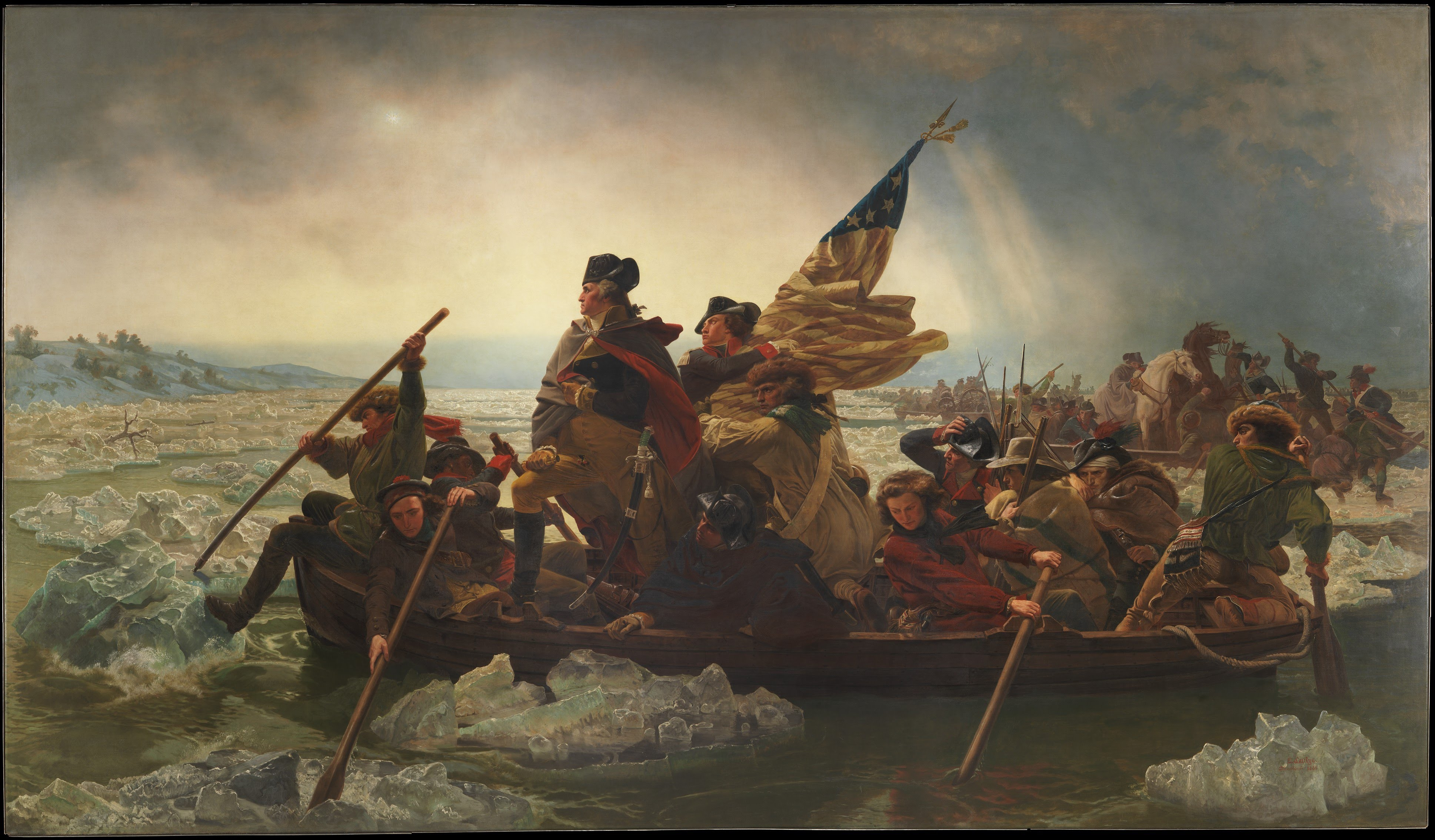
Washington Crossing the Delaware, by Emanuel Gottlieb Leutze The Metropolitan Museum of Art, http://www.metmuseum.org
One of the iconic images of the Revolutionary War is Emanuel Gottlieb Leutze’s 1851 painting, Washington Crossing the Delaware. It is the night of December 25, 1776. The Continental Army is being transported across the Delaware River to attack a Hessian garrison at Trenton, New Jersey, some nine miles to the south. In the foreground, anonymous men (and possibly one woman) of varying nationalities and races row an overloaded boat across the river, pushing great slabs of ice out of the way. Two of the boat’s occupants are not anonymous: General George Washington, standing resolutely near the bow, and young Lieutenant James Monroe, holding the stars and stripes.
Leutze’s painting is glorious–and wrong in almost every detail. The river resembles the Rhine more than the Delaware; the boat is too small and of inaccurate design; there is too much light for what was a night crossing; Washington did not cross standing up; the stars and stripes had not yet been adopted by the Continental Congress; and James Monroe was not holding the flag, not in the boat, and not even present with the army.
He was already across the river, and he was busy.
Washington’s plan for a surprise attack on Trenton was a risky attempt to reverse the sagging fortunes of the Patriot cause. During the summer of 1776 British forces, including Hessian mercenaries, had driven the Continental Army from New York across New Jersey and into Buck’s County, Pennsylvania. Expired enlistments and outright desertion had thinned the American ranks, and many of those who remained were despondent. Washington gambled that a successful attack against an isolated British outpost would boost the army’s morale and stiffen the resolve of Congress and the people.
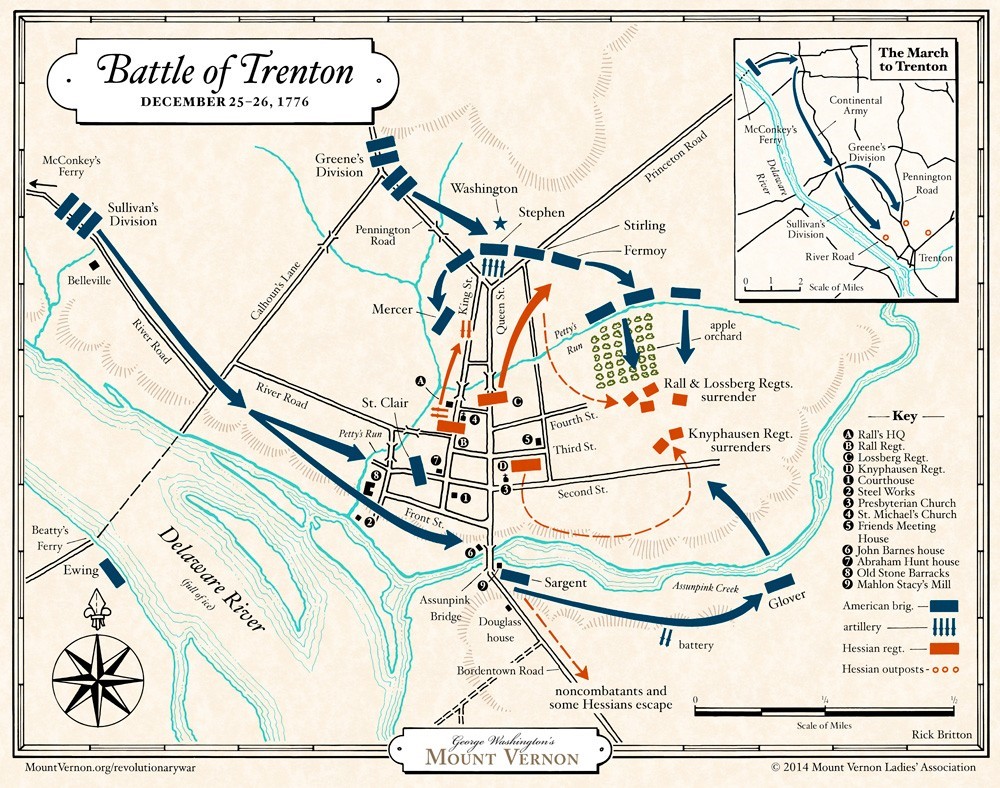
Three Hessian regiments, comprising about 1,400 men, were stationed at Trenton under the command of Colonel Johann Rall (also spelled Rahl). Washington planned to bring 2,400 Continental soldiers across the river overnight at McKonkey’s Ferry, march to Trenton, and attack before dawn. Two other elements of the army were part of the plan. A 1,900-man force under Colonel John Cadwalader would make a diversionary attack against British troops at Bordentown, New Jersey. General James Ewing would lead 700 men across the Delaware at Trenton Ferry, control the bridge over Assunpink Creek, and intercept any Hessian troops retreating from Trenton. Bad weather prevented both of these deployments, meaning that everything would depend on the main body’s effort. The army’s password for the evening was “Victory or Death.”
Washington’s plan included sending a small detachment of troops over the Delaware first to secure the army’s route of march. James Monroe was with this contingent. In his autobiography (written in the third person late in life and not completed before his death), Monroe described the mission:
The command of the vanguard, consisting of 50 men, was given to Captain William Washington, of the Third Virginia Regiment . . . Lieutenant Monroe promptly offered his services to act as a subaltern under him, which was promptly accepted. On the 25th of December, 1776, they passed the Delaware in front of the army, in the dusk of the evening, at [McKonkey’s] ferry, 10 miles above Trenton, and hastened to a point, about one and one-half miles from it, at which the road by which they descended intersected that which led from Trenton to Princeton, for the purpose, in obedience of orders, of cutting off all communication between them and from the country to Trenton.
Monroe noted that the night was “tempestuous,” and that snow was falling. While manning their post, the detachment was accosted by a local resident who thought the Continentals were British troops. Describing the incident many years later at a White House dinner during his presidency, Monroe recalled that the man, whose name was John Riker, was “determined in his manner and very profane.” Upon learning that the soldiers were Americans, he brought food from his house and said to Monroe, “I know something is to be done, and I am going with you. I am a doctor, and I may help some poor fellow.” Dr. Riker proved remarkably prescient.
Battle of Trenton map courtesy George Washington’s Mount Vernon
The main army’s river crossing and march to Trenton took longer than planned, meaning that the attack would occur well after sunup. Outside the town Washington divided his force, sending a division commanded by Major General Nathaniel Greene to attack from the north while the other, led by Major General John Sullivan, attacked from the south. At 8:00 AM the assault began, and here we return to Monroe’s account from his autobiography:
Captain Washington then moved forward with the vanguard in front, attacked the enemy’s picket, shot down the commanding officer, and drove it before him. A general alarm then took place among the troops in town. The drums were beat to arms, and two cannon were placed in the main street to bear on the head of our column as it entered. Captain Washington rushed forward, attacked, and put the troops around the cannon to flight, and took possession of them. Moving on afterwards, he received a severe wound and was taken from the field. The command then devolved upon Lieutenant Monroe, who attacked in like manner at the head of the corps, and was shot down by a musket ball which passed through his breast and shoulder. He was also carried from the field.
The Capture of the Hessians at Trenton December 26 1776, by John Trumbull (Yale University Art Gallery) (James Monroe lies wounded on the ground at left center)
Monroe was brought to the same room where William Washington lay, and their wounds were dressed by the army’s surgeon general and Dr. John Riker. Riker’s prediction of helping “some poor fellow” came true as he repaired a damaged artery in Monroe’s shoulder. What neither man realized at the time was that the intrepid physician had saved the life of a future president.
George Washington’s gamble in initiating the Battle of Trenton paid off. The victory was complete, and came at a surprisingly small cost in terms of American casualties. Two enlisted men froze to death during the nighttime march, and two were wounded in combat. The only losses among officers were the nonfatal wounds sustained by William Washington and James Monroe. Washington followed up his success at Trenton with another at Princeton on January 3, 1777, where the Continental Army proved that it could prevail over regular British troops.
The best commentary upon James Monroe’s performance at Trenton, and his Revolutionary War service generally, comes from no less an authority than George Washington. Writing to an acquaintance in 1779, Washington noted Monroe’s “zeal he discovered by entering the service at an early period, the character he supported in his regiment, and the manner in which he distinguished himself at Trenton, where he received a wound.” The general concluded that James Monroe had “in every instance maintained the reputation of a brave, active, and sensible officer.”
Scott H. Harris is the Executive Directors of the James Monroe Museum in Fredericksburg, Virginia. Harris became director of the James Monroe Museum and Memorial Library in July 2011, following ten years as director of the New Market Battlefield State Historical Park (administered by Virginia Military Institute). From 1988 to 2001, Scott was the first curator of the Manassas Museum and later director of historic resources for the City of Manassas, Virginia. Prior to his work in Manassas, he was a consulting historian with the Association for the Preservation of Virginia Antiquities in Richmond and an historical interpreter with the Colonial Williamsburg Foundation. He has been a board member of the New Market Area Chamber of Commerce, Prince William County/Manassas Convention and Visitors Bureau, Shenandoah Valley Travel Association, and Virginia Civil War Trails, Inc. He is a past president of the Virginia Association of Museums and serves as a peer reviewer for the Museum Assessment and Accreditation programs of the American Association of Museums.
Scott received his BA with honors in History and Historic Preservation from the University of Mary Washington in 1983. In 1988, he received an MA in History and Museum Administration from the College of William and Mary. Scott is also a graduate of the Seminar for Historical Administration, the nation’s oldest advanced museum professional development program.
Emerging Revolutionary War is honored to welcome guest historian Scott H. Harris, Director of the James Monroe Museum.
It is one of the great exploits of the American Revolution. On the night of December 25, 1776, General George Washington led the Continental Army across the icy Delaware River to attack a Hessian garrison at Trenton, New Jersey. Young Lieutenant James Monroe held the flag behind Washington as they were rowed across the freezing river (standing up).
Emanuel Gottlieb Leutze, Washington Crossing the Delaware. Oil on canvas, 1851. Only two figures in this fictitious image are identified—General George Washington and Lieutenant James Monroe (holding flag).






 Emerging Revolutionary War Era