Defending the New Nation: The Fredericksburg Gun Manufacturing Plant

Part Two by historian Malanna Henderson 

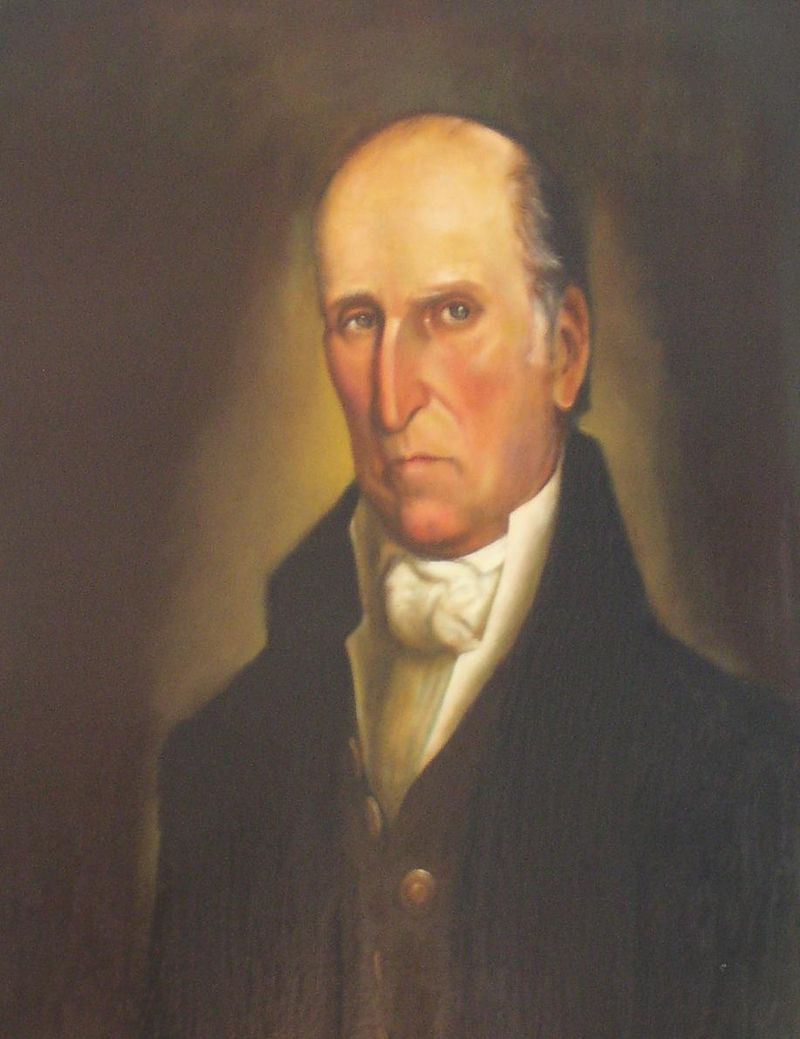
The financial direction of the gunnery was put into the hands of Fielding Lewis. Born into a wealthy family at Warner Hall in Gloucester County, Virginia in 1725, Fielding was the third son of John and Frances Lewis. Following his father’s footsteps, Fielding was a prosperous industrialist, running a fleet of ships to England and English ports, exporting tobacco and grain. In addition, he operated a store and served on numerous committees and local government associations that laid the groundwork for governing what would eventually become the United States of America. Fielding was addressed as Colonel Lewis, more often than not, reflecting his participation as a provider of provisions and raising the local Spotsylvania militia during the French and Indian War. Feats he was to repeat and go beyond during the Revolutionary War.

colonel-fielding-lewis
Colonel Fielding Lewis (Courtesy of The George Washington Foundation)

Often using his vast personal wealth, Lewis purchased schooners and sloops, outfitting them with artillery to patrol the Rappahannock River in an effort to protect civilian lives and property, and to stop British troops from seizing colonial weaponry.

In February 1776, Lewis purchased the schooner, Liberty, outfitting it with armory. Later, renamed Hornet, it sailed under the command of Richard Taylor of Caroline County. It carried a crew of twenty-one men. Lewis, then purchased a sloop named Defiance and placed it under the command of Captain Eliezer Callender. In April, Lewis purchased the pilot boat, Adventure, appointing Captain William Saunders at the helm.

Lewis commissioned ships to be built as well. The row galley was the most popular vessel used for defense of the river and harbor at the time. Although equipped with sails, the primary source of power was the oar. Larger row galleys measuring seventy feet long could carry a crew of fifty men. These galleys often-times carried two large eighteen pound cannons. Lewis commissioned another ship named Dragon and launched it in 1777; it was used primarily to patrol the Chesapeake Bay.

Free and enslaved blacks were often members of the crew. Around one-hundred and forty black men served with the Virginia fleet; one to ten on each of the seventy vessels. About ten served on the Dragon. Some of these men may well have been slaves belonging to Lewis or Dick. Only ten percent of black men who served in the navy were free, most were escaped slaves posing as free men, like Crispus Attucks, the first casualty of the Revolutionary War. To fulfill enlistment quotas, slaves served as substitutes for their masters. Unlike white men who served for a specific time, blacks were in it for the long haul; for only then could their service earn them the promise of freedom.

The first ship to engage in warfare was the Hornet, capturing four enemy merchantmen in the Rappahannock. Their ship, Speedwell, was taken into custody by the Virginia Navy and sent to the West Indies to bring back gunpowder. Fielding imported guns and ammunition for use in the colonies by the Rappahannock and the Patsey.

Lewis’s commitment to freeing the colonies from British rule was unrelenting. A wealthy man, he sacrificed nearly everything he possessed to see his dream of American independence from Britain rule become a reality. He sat on one local government committee after another. He bought ships and turned them into naval ships. He managed the financial direction of the gunnery, as well as procuring military materials. Col. Lewis appointed ship captains and he raised regiments, adding manpower to the Continental Army. During this time, Lewis didn’t neglect the on-going responsibilities he administered before the war. He presided over legal cases as the Justice of the Peace, provided religious leadership, administrative duties and support for the poor as a vestry member of St. George’s Anglican Church, and ran his plantation and mercantile business.

The Fifth Convention met in May of 1776 and authorized the Virginia Committee to reimburse Lewis 1,059 pounds to pay privateers who imported provisions. He was also reimbursed an additional 1,800 pounds in July. However by the end of the war Lewis was virtually bankrupt. He was owed a considerable amount of money but he never recouped all of the money he invested. By 1780, Lewis’ health had deteriorated to the extent that he was no longer able to manage the gunnery and the full responsibility fell on the shoulders of Charles Dick, who had used his personal credit to finance various tasks related to the success of the gunnery. The Convention was delinquent in its payments to Lewis, Dick and the sixty employees at the gunnery. Dick closed the factory for a time due to his inability to meet payroll. He wrote to Governor Thomas Jefferson his frustrations about the lack of funds:

I will do all in my Power to carry on the Work; but impossibiltys I cannot do … There must be proper stores laid in, Provisions, Walnut Plank for Gun-stocks, Iron, Steel are the principal articles, and these require even a good deal of Real money – And without which little or nothing can be done; I cannot speak plainer.”

The gunnery closed in 1783, the same year that the Treaty of Paris was signed establishing the independence of the United States of America. The manufacturing plant continued to operate, repairing muskets badly damaged after the war. Subsequently, once the gunnery ceased operations, the property and land was sold to trustees of the Fredericksburg Academy, whose president was James Mercer. The academy opened in 1786.

The last major battle of the Revolutionary War occurred at Yorktown. Major General Charles Cornwallis surrendered to General George Washington in October of 1781. By December, Fielding Lewis, at the age of fifty-six, had succumbed to his battle with (consumption) tuberculosis.  Charles Dick died a few years later in 1783. True patriots, Fielding Lewis and Charles Dick sacrificed their fortunes and health to free colonial America from British rule and were eye-witnesses to the birth of a new nation.

Today, at Historic Kenmore, in Fredericksburg, Virginia, stands the 18th-century plantation home built by Fielding Lewis and Betty Washington Lewis. The home, the pre-Revolutionary colonial kitchen and the Crownsinshield Gallery are open to the public for tours. Besides the antique collection of furniture and decorative arts, a musket produced by the Fredericksburg Gun Manufactory hangs in a display case in the gallery.

In the pages of American history, Col. Lewis and Charles Dick stand out as men whose faithful and persistent dedication to the cause of liberty lives on as an example of true patriotism.

“Fielding Lewis and Charles Dick may not have served on the battlefield during the Revolution, but they fought their own battles on the homefront, sacrificing all they had to keep the Gunnery running, naval ships operating and the militia supplied.  Their sacrifices should remind us all to ask ourselves if we would be willing to do the same if ever called upon.” – Meghan Budinger, Aldrich Director of Curatorial Operations, The George Washington Foundation.

memorial-stone-dedicated-to-col-fielding-lewis-from
(Courtesy of The George Washington Foundation)


*Endnotes “Protecting the New Nation: The Fredericksburg Gun Manufactory


Photo Credit Information


Meghan Budinger, curator, sent me a list of questions that I had to answer in order to get permission to use the photographs from their collection.


  1. State Marker: N-7,Fredericksburg Gun Manufactory
  2. Courtesy of the George Washington Foundation (The Papers of George Washington Revolutionary War Series, Fielding’s letter to George Washington)
  3. Courtesy of the George Washington Foundation (The Papers of George Washington Revolutionary War Series, Military Manual)
  4. Courtesy of the George Washington Foundation (Musket: Fredericksburg Gunnery, Gift of Thomas Mellon II, 1936.)
  5. Courtesy of the George Washington Foundation (Colonel Fielding Lewis, portrait by John Wollaston, Courtesy of the George Washington Foundation, circa 1755-1757.)
  6. Courtesy of the George Washington Foundation  Memorial stone from The Sons of the American Revolution

Bibliography:

Fielding Lewis and the Washington Family; A Chronicle of 18th Century Fredericksburg  by Paula S. Felder, © 1998.

Kenmore Training Manual, Fielding Lewis of Ships and Slaves, courtesy of the George Washington Foundation.

Prelude to a Revolution: Dunmore’s Raid on the Williamsburg Magazine, by Norman Fuss, www.allthingsliberty.com

Free-Lance Star “The Way It Was,” by Ruth Coder Fitzgerald, February 15, 1997.


Defending the New Nation: The Fredericksburg Gun Manufacturing Plant

Emerging Revolutionary War is honored to welcome back historian Malanna Henderson. 

Part One

n-7-fredericksburg-gun-manufactory-state-marker
N-7 Fredericksburg Gun Manufactory State Marker

Located at 200 Gunnery Road between Dunmore and Ferdinand Streets is the Old Walker-Grant public school. The three-acre campus is home to the Fredericksburg Regional Head Start educational program. Built in 1938, Walker-Grant was the first publically financed high school for black youth in Fredericksburg. The institution was named for Joseph Walker and Jason Grant.

Walker, born into slavery in Spotsylvania County in 1854, was freed after the Civil War and moved to Fredericksburg. Employed in a paper mill, Walker was self-taught and had a keen interest in expanding educational opportunities for black youth. He served as the sexton at St. George’s Episcopal Church for more than 50 years.  Jason Grant was born free in Chatham, Ontario, Canada, in 1861 to a middle-class family. He attended Wilberforce Educational Institute in Ohio. He met an inspiring educator from Fredericksburg and decided to move there and teach.  Grant taught at the county and city schools and also served as principal. His career spanned 42 years. Both Walker and Grant worked diligently to establish a learning institution for black children whose educational opportunities were marginalized by the social order of the day: segregation and racial discrimination.

Over two-hundred years ago, this location was once the site of the Fredericksburg Gunnery plant; the first government ran factory of its kind in the nation. Established in 1776, its existence was paramount to the victory of the Continental forces in winning the Revolutionary War.

By then, the colonists had interpreted an array of British economic policies as threatening their rights as Englishmen. When a slew of taxes were demanded of the colonists who were accustomed to governing themselves, their rebellious cry became, “no taxation without representation.” Until then, the planter-statesmen and other notables still felt they could reconcile with the mother country, despite the occurrences of the Boston Massacre in 1770 and the Boston Tea Party in 1773. However, in Virginia an odious act by the royal governor put the colonists on notice that the British were willing to spill more blood in an effort to vanquish the rebellion.

In the dead of night, on April 21, 1775, a mixed military unit of His Majesty’s Navy and Marines confiscated gun powder and armaments from the Williamsburg Magazine. This vital repository of weapons was stockpiled for the defense against Indian raids, slave revolts and riots. The action of the British soldiers left Virginia virtually defenseless.

John Murray, Fourth Earl of Dunmore and the last royal governor of Virginia ordered the raid. Many colonists saw this as the last straw. Dunmore had repeatedly rebuked the colonial statesmen’s demands, dissolving the House of Burgess and other political committees. An aristocrat, accustomed to having his word obeyed without question, Dunmore saw the burgeoning independence of the statesmen as an affront to his authority and responded by acts of retribution instead of compromise.

Blood had already been spilt at the Battles of Lexington and Concord a few days prior. Thus, disarming the colonists seemed a logical strategy to weaken their resolve. The shot heard around the world occurred in the north and in the south; the stealth act of a midnight raid struck a wedge between Britain and the American colonies that was irreparable.

The colonists had to arm themselves if they were going to war with England, whose military might seemed Herculean to the limited martial skills of the local colonial militias. There was no standing army. Each of the thirteen colonies had their own reservists, comprised of farmers, merchants and tradesmen who were needed sporadically for lawless incidents.

On July 17, 1775, the Third Virginia Convention convened in Richmond to create a working government structure. Delegates were elected to serve on the Committee of Safety, which replaced the Committee of Correspondence. Its powers were comparable to the defunct House of Burgess. The most important resolutions that sprung from those meetings were to raise two regiments, a total of sixteen companies of sixty-eight men each to serve one year tours. In addition, sixteen districts of Minutemen were planned.  In all of the county militias, the remaining free white males between the ages of fifteen to fifty were to muster, eleven times a year. Below is a page from Colonel Lewis’s manual on military exercises and drills, dated 1777.

excercises-and-evaluation-of-military-drills-1777
(Courtesy of The George Washington Foundation)

The last meeting of the convention took place on the 26th of August. An ordinance to build a gun manufacturing plant was enacted. One prominent Virginian intellectual described it as, a first step “in open defiance of British parliamentary law.”

The five commissioners appointed to operate the gun factory were Mann Page; William Fitzhugh; Samuel Selden; Charles Dick and Fielding Lewis, George Washington’s brother-in-law, husband to his sister Betty Washington. Lewis was elected chairman of the Committee. As it turned out, the only men who stayed the course was Charles Dick and Fielding Lewis.

Initially, the convention issued to Lewis 2,000 pounds to construct the gun manufacturing plant. Early in November, Lewis purchased a ten-acre tract of land located south of town. He also leased a nearby mill on four town lots.

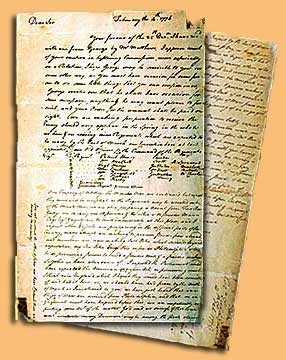
Knowing how desperate the Continental Army was for arms, Lewis penned a letter, on February 4, 1776, to George Washington in haste. Now the Commander-in-chief of the Continental Army, George received this letter from Fielding describing the developments of the factory and the formation of the army regiments they were establishing. Of note, in August of 1775, Patrick Henry was named Colonel of the 1st Regiment, and the 2nd Regiment was commanded by William Woodford with Alexander Spotswood serving as major. In January of 1777, Hugh Mercer was named Colonel of the 3rd Regiment.

fielding-lewis-letter-to-george-washington-on-the-building-of-the-gunnery
(Courtesy of The George Washington Foundation)

“…our Gunn Manufactory is now beginning & expect by New Years day to have near fifty Men imploy’d who will make about Twelve Gunns compleat a Day…”

The gunnery was close to the Hunter Iron Works, an important supplier. James Hunter, the owner, added the manufacturing of muskets to his production output, independent of government funding.  He also supplied regiments with axes, spades, shovels and mattocks.

The items produced at the Fredericksburg Gunnery were muskets, bayonets, flint locks, ramrods and more. The plant encompassed a main manufactory, a stone powder magazine, cartridge works, repair shops and a vegetable garden, for the benefit of the employees.

Charles Dick ran the day to day operations, hiring a master workman and artisans. Although, the very capable Mr. Dick never discussed his origins or even his birthdate; the self-made man wasn’t a member of the established gentry. However, he easily found his place amongst Fredericksburg’s leading citizens. Dick was a successful merchant, land owner, Mason and a well-respected member of the community. He served on several important civic organizations; the Committee of Correspondence and later the Committee of Safety.  A business partner and personal friend of Fielding Lewis, Dick was godfather to Lewis’ first son.

On September 22, 1775 an advertisement for locksmiths was published, most likely in the Virginia Gazette. Dick needed gunsmiths, artisans and a variety of other laborers to make the gunnery productive. It was evident, early on, that there was a deficiency of expert gunsmiths ready for hire. The House of Delegates passed an apprentice act so Dick could train a class of artisans from the white youth in the area. The young men would be housed, fed and clothed; all paid for by the government. Dick forbade the drinking of beer and rum at the establishment, a drastic change from Eighteenth Century practices. Three black men were engaged to cook, bake and do an assortment of odd jobs. Whether they were slave or free is unknown.

In an emergency the aristocrats of the town, women, too, worked at the factory stuffing cartridges, etc., for the more than one hundred guns hastily readied for the Fredericksburg and Spotsylvania militia. The most commonly used weapon at the time was the British Brown Bess, a muzzle-loading smoothbore musket. It fired a single shot ball or a cluster shot which fired multiple projectiles like a shotgun. About four shots per minute was the typical output from most soldiers. By May of 1777, the factory produced similar muskets to the British Brown Bess by the rate of twenty per week.

a-musket-produced-from-the-fredericksburg-gun-manufactory
(Courtesy of The George Washington Foundation)


Surrender at Yorktown

On this date, in 1781, the British army marched out of their entrenchments at Yorktown and surrendered to General George Washington and the combined Continental and French armies.

img_5983
Modern view of the “Surrender at Yorktown” site (P. Greenwalt)

Although the victory did not conclusively end the war, the victory prompted British Prime Minister, Lord Frederick North, to exclaim,

“Oh, God, it is all over!”

Approximately two years later, with the signing of the Treaty of Paris on September 3, 1783, the American Revolutionary War was truly over.

What is not truly over is the efforts to preserve, interpret, and educate the current and future generations about the importance of Yorktown and the American Revolution. In the spring, the new American Revolution Museum of Yorktown will open its doors, updating the Victory Center at Yorktown Museum.

From the Jamestown-Yorktown Foundation website, the museum’s goals are to;

“Through comprehensive, immersive indoor exhibits and outdoor living history, the American Revolution Museum at Yorktown offers a truly national perspective, conveying a sense of the transformational nature and epic scale of the Revolution and the richness and complexity of the country’s Revolutionary heritage.”

For more information about the museum, what it entails, and the opening date, click here.


Congratulations to William Griffith

Our enthusiastic congratulations to Emerging Revolutionary War’s William Griffith on the release of his new book, The Battle of Lake George, England’s First Triumph in the French and Indian War. The book, published by Arcadia Publishing and The History Press, is now available for sale in books stores and online.9781467119757

From the press release of the book,

“In the early morning of September 8, 1755, a force of French Regulars, Canadians and Indians crouched unseen in a ravine south of Lake George. Under the command of French general Jean-Armand, Baron de Dieskau, the men ambushed the approaching British forces, sparking a bloody conflict for control of the lake and its access to New York’s interior. Against all odds, British commander William Johnson rallied his men through the barrage of enemy fire to send the French retreating north to Ticonderoga. The stage was set for one of the most contested regions throughout the rest of the conflict. Historian William Griffith recounts the thrilling history behind the first major British battlefield victory of the French Indian War.”

Recently, ERW had the chance to sit down and talk with William about the book.

Q: This book fills an important gap in the French and Indian War, why has this campaign been overlooked for a publication like this?

W: I think that the Battle of Lake George has been overlooked for multiple reasons. When we think of the opening years of the French and Indian War we tend to immediately think of the events transpiring in western Pennsylvania (i.e. Jumonville Glen, Fort Necessity, and the Battle of the Monongahela), and do not really place Lake George at the forefront until the surrender of Fort William Henry in 1757. The significance of the Battle of Lake George has also been up for debate by historians, many whom believe it was a stalemate or inconsequential engagement, but in my opinion they are entirely incorrect. Because of these sentiments, when looking at the year 1755 the predominant focus has been placed on Braddock’s Defeat. Tragedy draws attention, and that is exactly what the Battle of the Monongahela was. Not only has scholarship relating to the Battle of Lake George been placed on the backburner to Edward Braddock, but it has also been pushed aside by the Siege of Fort William Henry and the subsequent “Massacre” – another tragic event. The Battle of Lake George is a prime example of history overshadowing history, and hopefully my book will be able to bring the event out of the darkness and into mainstream French and Indian War scholarship.

Q: Why did you choose the campaign to Lake George as your first book?

W: Even before I was born my family vacationed every year along the western shore of Lake George. When I was five years old my father brought me to my first historic site – Fort William Henry – and from then on my passion for history began to blossom. After that each trip to the lake during the summer caused my interest in upstate New York’s colonial history to grow and it soon became a big part of my life. There are some places on this earth that have the power to transport you to another time or place. Lake George is one of them. It truly forms a connection with people and for me, so did its history – especially the 1755 battle, which I could find no substantial work done on. In a quest for myself to learn more about the event, I determined in high school that when I was to write my first book it would be on the long neglected battle. I ended up writing it a lot sooner than I imagined I would.

Q:If there was only one thing a reader took away from this book, what would you want it to be?

W: An interest in the French and Indian War and a desire to learn more about this period in our history. If a visit to Amazon, the bookstore, or Lake George occurs after reading my work, then I succeeded.

Q:How accessible are the sites attributed to the campaign to visitation?

W:Extremely accessible. All three sites associated with the Battle of Lake George are preserved to some extent or at least enough so to interpret and visit. The battlefield of the main engagement fought during the afternoon is the largest and is preserved as the Lake George Battlefield Park at the southern end of the lake astride the reconstructed Fort William Henry and busy Lake George Village. Interpretation here is really bad though. Only one sign actually explains the 1755 battle although there is an impressive monument serving as the centerpiece of the site. Along present day Route 9 roughly three miles or so south of Lake George is the site of the morning engagement, the “Bloody Morning Scout,” and an obelisk dedicated to Colonel Ephraim Williams of the 3rd Massachusetts Regiment who was killed during the opening engagement. About a mile or so closer to the lake along Route 9 is a pond with signage interpreting it as “Bloody Pond,” the site of the final confrontation during the battle. It is possible that this could be the actual pond, but there is speculation that it was actually located several hundred yards further into the woods and is now dried up

Q:What is next book or publication you are working on?

W: I am currently not working on any publications. As I complete my master’s degree at Norwich University this next year and a half or so I plan on focusing on my studies, maybe doing a bit of research here and there when I am free. I do have aspirations to publish more, however, and would like to write a biography of George B. McClellan (my historical idol) focusing on his life from November 1862, when he was removed from command of the Army of the Potomac, to his death in 1885. I would also like to create some sort of guidebook for the Battle of Lake George, Siege of Fort William Henry, Battle of Carillon, and the 1759 British capture of Fort Ticonderoga.

Q:How does one get a copy?

W: The History Press usually distributes locally, so if you live in the upstate New York area near Albany/Lake George you can probably run down to your nearest bookstore and purchase one. If not, then it is available on Amazon and other major retailers online. If you happen to attend a signing or talk that I am doing then you can certainly also pick one up from me.


A Quick Trip to Fort Ticonderoga

Emerging Revolutionary War is honored to welcome guest historian David A. Powell to the blog. A biography of David is at the bottom of this post. 

The Hudson Valley in upstate New York is one of my favorite historical places – which might come as a surprise to some, given that my usual historical beat is the 1861-1865 time-frame. There are a handful of Civil War related sites along the Hudson, but not many.

But for two centuries before our war between the states, the region was the pathway for commerce, settlement, and conflict. The banks of the Hudson, Lakes George and Champlain, and the St. Lawrence are all dotted with crucial reminders of a violent historical past.

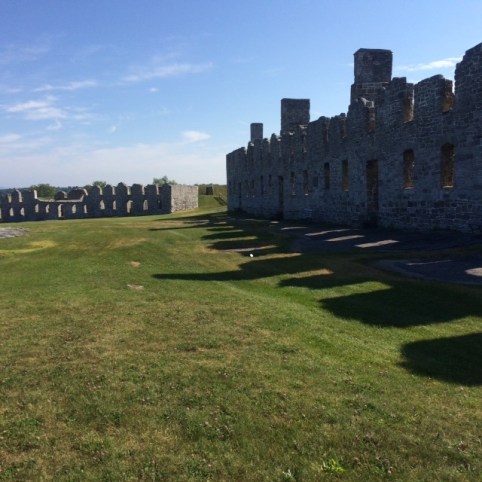
Ruins Crown Point
Ruins of Crown Point

I’ve been to most of these sites; West Point, Bennington and Saratoga battlefields, the site of Fort William Henry, Crown Point, and plenty of other locations. One of them, however, fixes my attention beyond all others:

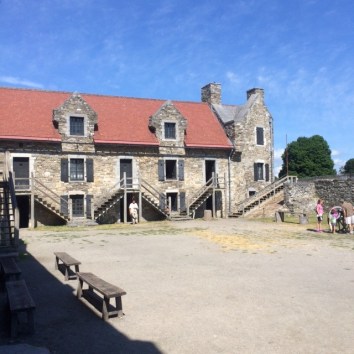
Fort Interior
Interior of Fort Ticonderoga

Fort Ticonderoga.

The fort occupies a strategic place on Lake Champlain, were a land portage connects Champlain to Lake George, and ultimately, the Hudson River.

<Lake Champlain from Fort, looking south>

Originally called Carrillon by the French, who built it in 1755; the fort changed hands several times during the ensuing 25 years. It was unsuccessfully attacked by the British in 1758, and finally captured the next year, part of the British “Annus Mirabilis,” that string of decisive triumphs over the French that reached their crescendo with Wolfe’s victory at Quebec. Two decades later, it figured in the American Revolution; it was wrested from British control by Ethan Allen and Benedict Arnold in 1775. Its heavy artillery was sledged across many miles of Wilderness snow and ice to reinforce the Rebel army besieging Boston by Henry Knox, which forced the British to abandon that city. In 1776 Ticonderoga was a bulwark of the Patriot defenses on Lake Champlain. In 1777, it was easily re-captured by the British under Burgoyne, but returned to American control after Burgoyne’s disasters of Bennington and Saratoga.

Ticonderoga is fully restored now, owned and maintained by a private foundation that has done an outstanding job of presenting and preserving the Fort’s history. The town and the fort grounds are also dotted with interesting monuments, many erected by British regiments, mainly placed to honor their troops who fought in the Fort’s bloodiest single battle, that of 1758.

British General James Abercrombie led 17,000 troops – colonials and British regulars – against a much smaller garrison of between 4,000 and 5,000 French, Canadian Militia, and Indian Allies. The French, under the Marquis de Montcalm, defended an entrenched line outside of the fort walls, which Abercrombie obligingly assaulted. The British lost 2,000 men, and Abercrombie retreated.

My favorite monument at Ticonderoga is actually paired with another monument erected by the American Colonists in Westminster Abbey (left to right in picture below). They both commemorate the death of Lord George Howe, a Brigadier General in Abercrombie’s army (and elder brother to the Howes of Revolutionary War fame) who embraced irregular warfare.


Go spend an afternoon at Ticonderoga. You won’t be disappointed.


*David A. Powell is a graduate of the Virginia Military Institute (1983) with a B.A. in history. He has published numerous articles in various magazines, and more than fifteen historical simulations of different battles.

For the past decade, David’s focus has been on the epic battle of Chickamauga, and he is nationally recognized for his tours of that important battlefield. The result of that study was his first published book, The Maps of Chickamauga (Savas Beatie, 2009).

His latest book is Failure In The Saddle: Nathan Bedford Forrest, Joe Wheeler, and the Confederate Cavalry In the Chickamauga Campaign (Savas Beatie, 2011). He is currently working on a full length monograph of the battle of Chickamauga. The first volume of that work, entitled The Chickamauga Campaign: A Mad Irregular Battle, is scheduled for a 2014 release.

David and his wife Anne live and work in the northwest suburbs of Chicago, Illinois. He is Vice President of Airsped, Inc., a specialized delivery firm.

Review: The French and Indian War and the Conquest of New France, by William R. Nester. Published by the University of Oklahoma Press, 2014 (paperback).

Both the American Revolutionary War and the French and Indian War (as it was called in North America) have been the subject of many history books.  The original American sources have been pretty much culled through, as have many of the British sources.  But French sources have not received the same scrutiny.  Why this is the case, is not clear.  Of course, the French language is a barrier to English-speaking historians.  I believe another factor is that French historians have not shown much interest in either war, and when they have, they have failed to use adequate footnotes, making it difficult for other historians to follow up on the sources they have used and confirm their credibility.  In the French and Indian War and the Conquest of New France, William R. Nester, a professor at St. John’s University in New York City, helps to address this imbalance.  His history of the French and Indian War (called the Seven Years’ War in Europe), which was fought from 1754 to 1763, is from the French perspective and he has relied on many original French sources.  Interestingly, despite the title of the book, about half of the book, if not more, occurs in France and the rest of Europe.   This decision is understandable; paraphrasing one contemporary, Canada was lost on the battlefields of Germany.

Nester
“The French and Indian War and the Conquest of New France”

Nester starts his history by explaining the disorganized and weak state of the French political system.  One might believe that because France had a monarchial system, its government was efficient, but the contrary was true.  For one, the French legislature, dominated by merchants, lawyers and the middling classes who suffered the burden of heavy taxation (aristocrats were not taxed), frequently hesitated or refused King Louis XV’s constant requests for more funds to fight his wars and pay for his extravagant lifestyle.  As a result, his administration was constantly deep in debt and always short of funds it needed to fight.

The court of King Louis XV was a convoluted maze of intrigue, dominated by the king’s beautiful but conniving mistress, Madame de Pompadour.  Due to her heavy influence on King Louis XV, if she did not approve of a general or a foreign diplomat, that individual would either never be retained or would eventually be fired.  This was no way to run a great country.  Continue reading “Review: The French and Indian War and the Conquest of New France, by William R. Nester. Published by the University of Oklahoma Press, 2014 (paperback).”

Part 2: The Defense in Depth as a Revolutionary War Battlefield Tactic

For part one, click here

Brig. Gen. Daniel Morgan, the “Old Wagoner,” as he was known, commanded a light infantry corps assigned to Maj. Gen. Nathanael Greene’s southern army. Morgan met with Greene in Charlotte, North Carolina on December 3, 1780.  Implementing a Fabian strategy, Greene split his army to harass the British while buying time to recruit additional soldiers. Greene ordered Morgan to use his 600-man command to forage and harass the enemy in the back country of South Carolina while avoiding battle with Lt. Gen. Charles Lord Cornwallis’ British army.

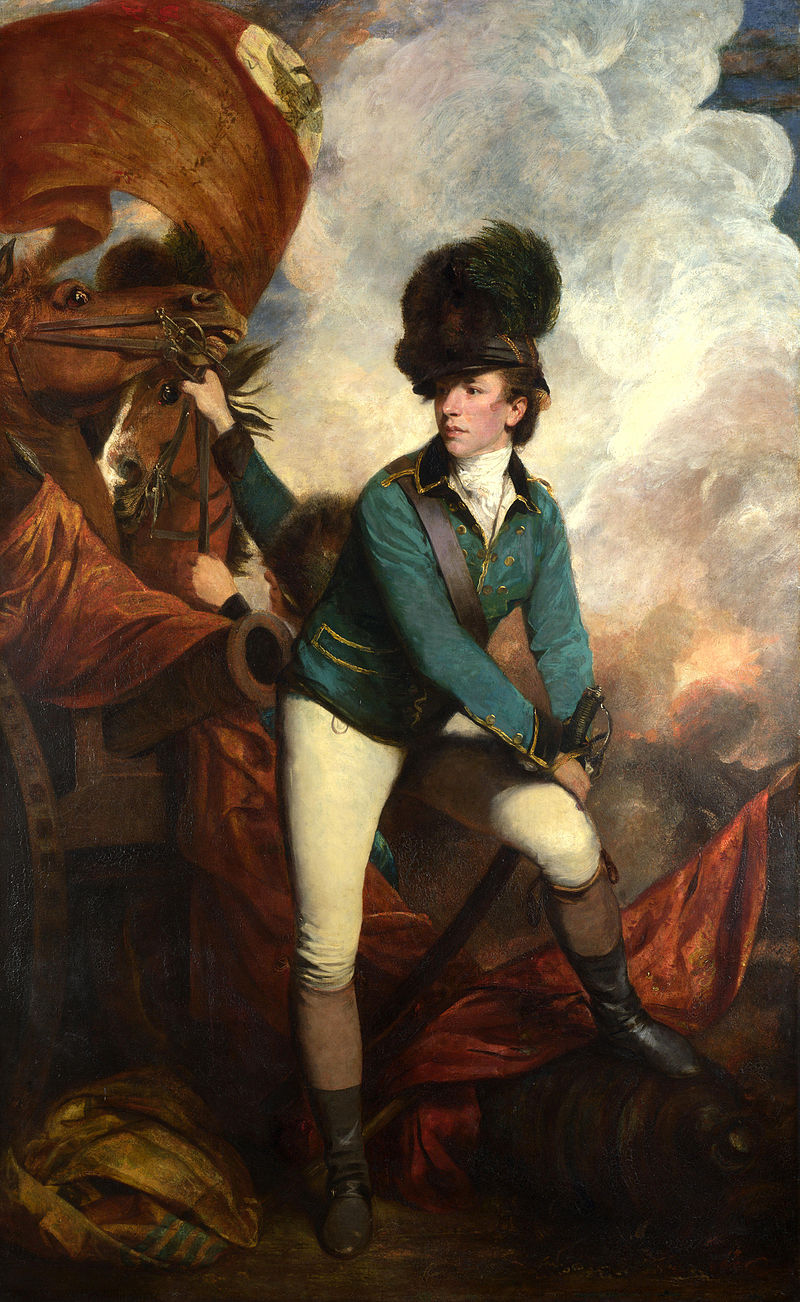
Once Cornwallis realized what was going on he dispatched Lt. Col. Banastre Tarleton’s British Legion to track down Morgan’s command and bring it to battle. Tarleton commanded a combined force of Loyalist American troops. The Legion consisted of fast-marching light infantry and dragoon units. At its peak strength, the Legion numbered approximately 200 infantry and 250 dragoons. It was known for its rapid movements and for its ruthless policy of giving the enemy no quarter. Patriot forces feared Tarleton and his Legion, and for good reason.

By January 12, Tarleton’s scouts had located Morgan’s army in the South Carolina back country, and Tarleton began an aggressive pursuit. Morgan hastily retreated to a position at the Cowpens, a prominent crossroads and pasturing grounds for cattle. The field was about 500 yards long and about as wide, dotted with trees, but devoid of undergrowth, which served as a food source for grazing battle.

Once Morgan learned that Tarleton was pursuing him, he spread the word for local militia units to rendezvous with him at the Cowpens. Through the night, South Carolina militiamen drifted into camp. Morgan visited their camps, encouraging them to stand and fight. Morgan’s words were particularly effective; the grizzled veteran knew how to motivate these men. They would need to be prepared, because they faced a stern task the next day.

January 17, 1781 dawned clear and very cold. After his scouts reported Tarleton’s approach, Morgan rode among his men, crying out, “Boys, get up! Benny’s coming!” Morgan designed a defense in depth that was intended to draw the British Legion in and then defeat them by pouncing on their exposed flanks. He knew that his militia had a reputation of being unreliable, and his ability to maneuver was limited, so he elected to design and implement a defense in depth that took advantage of the terrain features of the Cowpens.

Banastre Tartleton, British commander at Cowpens

Tarleton was overconfident. He believed that Morgan’s command was hemmed in by the nearby Broad River and also believed that the cleared fields of the Cowpens were ideal ground for his dragoons, and concluded that Morgan must be desperate to fight in such a place.

Morgan had prepared three defensive positions. Selected sharpshooters out front and hiding behind trees manned the first line. They picked off a number of Tarleton’s dragoons as they advance, specifically targeting officers. Traditional accounts indicate that they downed 15 of Tarleton’s dragoons this way. Confused, the dragoons retreated.

Having accomplished their initial goal, the sharpshooters then fell back about 150 yards or so to join the second line, which consisted of Brig. Gen. Andrew Pickens’ militiamen. Morgan asked these men to stand long enough to fire two volleys, after which they were to fall back to the third—and main line—manned by Col. John Eager Howard’s Continentals, another 150 yards or so in the rear of the second line. Thus, Morgan had designed a textbook example of a defense in depth.

Andrew Pickens, commanded some of the South Carolina militia at Cowpens

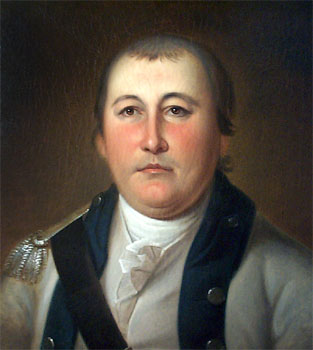
Some of the militia got off two volleys and then most of the militia fell back to a spot behind the third line. Tarleton orders his dragoons to pursue the retreating militiamen, and as the dragoons bore down on them with their sabres drawn, Col. William Washington’s Continental cavalry suddenly thundered onto the field, seemingly from nowhere. They routed the surprised Loyalist dragoons, who fled the field with heavy losses.

The infantry then engaged. With their drums beating and their fifes shrilling, the British infantry advanced at a trot. Recognizing that the moment of crisis had arrived, Morgan cheered his men on, rode to the front and rallied the militia, crying out, “form, form, my brave fellows! Old Morgan was never beaten!”

William Washington, commander of American cavalry at Cowpens and a distant relation to George Washington

Tarleton’s 71st Highlanders, a veteran unit made of Scotsmen, which had been held in reserved, now charged the Continental line, their skirling bagpipes adding to the cacophony of battle. Howard ordered his right flank to face slight right to counter a charge from that direction, but in the noise and chaos, was misunderstood as a call to retreat. As other companies along the line began to pull out, Morgan rode up to ask Howard if he had been beaten. Howard pointed at the orderly ranks of his retreat and assured Morgan that they had not been beaten. Morgan then put spurs to his horse and ordered the retreating units to face about and, on his order, to fire in unison. Their deadly volley dropped numerous British soldiers, who, sensing victory, had broken ranks in a determined charge. The combination of this volley and a determined bayonet charge by the Continentals turned the tide of battle in favor of the Americans.

At the moment, the rallied and re-formed militia and Washington’s cavalry attacked, leading to a double envelopment of the British, who began surrendering in masses. Tarleton and some his men fought on, but others refused to obey orders and fled the field in a panic. Finally, Tarleton realized that he had been badly beaten and fled down the Green River Toad with a handful of his men. Racing ahead of his cavalry, William Washington dashed forward and engaged Tarleton and two of his officers in hand-to-hand combat. Only a well-timed pistol shot by his young bugler saved Washington from the upraised saber of one of the British officers. Tarleton and his remaining forces escaped and galloped off to Cornwallis’ camp to report the bad news.

And bad news it was: Tarleton’s Legion lost 110 dead, over 200 wounded and 500 captured. By contrast, Morgan lost only 12 killed and 60 wounded. His perfectly designed and perfectly implemented defense had worked even beyond the Old Wagoner’s wildest dreams and highest hopes.

Knowing that Cornwallis would pursue him, Morgan buried the dead and then withdrew to the north to live and fight another day. Morgan reunited with Greene’s army and the combined force headed for North Carolina. Morgan, whose health was fragile, soon retired from further duty in the field, but he had left his mark. Cowpens was his finest moment, and set a precedent for Greene to follow two months later at Guilford Courthouse.

Battle of Cowpens (Courtesy of Campaign 1776/CWT)
Battle of Cowpens
(Courtesy of Campaign 1776/CWT)

*Suggestions for additional reading: for a superb book-length microtactical treatment of the Battle of Cowpens, see Lawrence E. Babits, A Devil of a Whipping: The Battle of Cowpens (Chapel Hill: University of North Carolina Press, 1998). This book is the primary resource consulted in drafting this article.

The Revolution’s Southwest Front

Emerging Revolutionary War is honored to welcome back historian Robert “Bert” Dunkerly. 

During a trip to Mobile, Alabama for some Civil War research, I came across a fascinating and lesser-known aspect of the American Revolution.  When I travel, I always keep my eye out for unusual finds and hidden history.  I was rewarded on my trip to Mobile with a great discovery.

Ft C
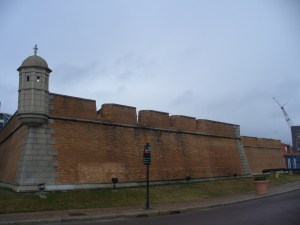
Fort Conde (author collection)

One of the main historic sites in downtown Mobile is the reconstructed Fort Conde.  This brick fort interprets the early history of Mobile and the region under the flags of France, Spain, and the United States.  Just outside the fort is a marker discussing the battle of Fort Charlotte.

Mobile was originally the capital of the French Louisiana Territory until the close of the French and Indian War.  As part of the settlement of that conflict in 1763, this French territory passed to the British.  Fort Conde, built in 1723, was renamed Fort Charlotte by its new owners.

Map
Map of Ft. Conde superimposed over modern Mobile streets, (photo by author)

Most of us know that the French were anxiously watching the American Revolution when the conflict broke out, hoping to score revenge against their English adversaries. Also watching with interest were the Spanish.

The British garrisons along the Gulf of Mexico coast (Pensacola, Mobile, Baton Rouge) were quite small and vulnerable.  The Spanish had been providing material aid and funds to the Americans, but finally declared war on Britain in 1779.  The Spanish were ambivalent about American independence, and unlike the French, did not recognize the United States, but did agree to help militarily.

Even before Spain’s entry into the war, New Orleans was a source of aid smuggled in for the American effort.  The Crescent City, and all the land west of the Mississippi, had been awarded to Spain at the close of the French and Indian War.  From here, supplies moved up the Mississippi to Fort Pitt at Pittsburgh, PA.  And from New Orleans, Governor Bernardo de Galvez attacked British posts up the Mississippi and along the Gulf Coast.

bernardo
General Bernardo de Galvez, (artist unknown)

A statue of the Spanish general who did much to wrest the Mississippi and Gulf coast areas away from the British stands near the World Trade Center in New Orleans.  A gift from Spain to the city of New Orleans, the statue is a reminder of this important but neglected aspect of the war.  A group known as Granaderos y Damas de Galvez are dedicated to preserving his memory and that of the Spanish role in the Revolution.

Oliver Pollock was a Philadelphia merchant with close ties in Cuba and New Orleans.  When the war broke out, he used his connections to aid the Revolutionary cause from the Crescent City.  In 1777 he was appointed “commercial agent of the United States at New Orleans” and used his fortune to finance American operations in the west, such as General George Rogers Clark.  When Spain entered the war he served as an aide to General Bernardo de Galvez.

Moving up from New Orleans, a force under General de Galvez, that included Spanish troops, American volunteers, Acadian settles, and free blacks, attacked and captured the British outpost of Fort Richmond at Baton Rouge on September 21, 1779.  Today a memorial with plaques and a cannon marks the site.

In February, 1780, Spanish troops and American volunteers under Governor Bernardo de  Galvez laid siege to the 300 British in Fort Charlotte at Mobile.  The siege lasted a month.  The garrison’s surrender gave the Spanish control of this important site, and removed all English military forces from the Gulf region.

This was one of the few actions of the war in which Spanish and American troops fought side by side.  Spain declared war on Britain but did not recognized the United States, their primary interest being to settle scores with the British.


For more information on these fascinating events, check the following websites: 

http://www.museumofmobile.com/ft_conde.php

http://granaderos.org/


The Greatest Leaders of the American Revolution You Have Never Heard Of

Sitting under a tree in north-central New York, suffering from a painful and mortal leg wound, yet still managing a successful defense after a powerful ambush, is a characteristic of a great military leader. All the while nonchalantly smoking his pipe!

OCHSherkimer200pix
General Nicholas Herkimer (courtesy of the NPS/Fort Stanwix and Oneida County (NY) Historical Society)

Nicholas Herkimer was the epitome of a successful militia commander. The Battle of Oriskany was a turning point. Herkimer, sitting on a once innocuous hillside, was a major reason why.

Even George Washington recognized the importance of Herkimer and made mention of his decision to not seek a commission in anything more than the militia of his home state. Not only that simple fact of service recognized by the commander-in-chief, but also his pivotal role in the Northern campaign of 1777.

“It was Herkimer who first reversed the gloomy  scene of the Northern campaign. The hero of the Mohawk Valley served from love of Country, not for reward. He did not want a Continental command or money.”

Herkimer would succumb to the mortal leg wound ten days after the battle, but his role in what was described as “one of the bloodiest battles of the war” solidified his place in the category of “greatest leaders of the American Revolution you have never heard of.”

Born in the Mohawk Valley of New York to Palatinate immigrants, Nicholas was described as a slender built, dark complexioned, dark haired individual. When he was finished growing, he stood near six feet tall, a rather tall height in 18th century Colonial America. He could also boast of being multilingual, fluently speaking English, German, and Iroquois.

He saw action in the French and Indian War, helping to repel the French and Native American attack on German Flatts, New York on November 12, 1757. Although a disastrous day for the German community, as many were taken prisoner by the French and Native Americans, Herkimer’s role led to his promotion to captain in the militia within two months of the fighting on January 5, 1758. Thirty-years after his promotion to captain the town would be renamed “Herkimer” for the actions of this New Yorker during the subsequent war.

In April of 1758, Herkimer was present and assisted in the successful repulse of the French and Indian force.

With peace established in 1763, Herkimer looked toward personal matters, building a house on the south side of the Mohawk River in 1764. He married two ladies, both named Maria. One died and the other would remarry and move north of the border to Canada, after Herkimer’s death in 1777.

With tensions increasing in the 1770s between Great Britain and the colonies, Herkimer led the Tryon County, New York Committee of Safety and was elected colonel of the local militia. The Provincial Congress on September 5, 1776 promoted him to brigadier general of the militia. One of his first roles was to meet with Joseph Brant, a Mohawk military and political leader in an effort to try and keep the Native Americans neutral in the conflict between the colonies and Great Britain. He was unsuccessful.

During the Northern Campaign of 1777, with the thrust southward by British General John Burgoyne being the main column on its way to its destiny at Saratoga, a secondary column entered the Mohawk Valley under British General Barrimore”Barry” St. Leger. The combined British, German, Loyalist, and Native American force laid siege to Fort Stanwix, in present-day Rome, New York.

Herkimer heard about this and marched his militia to help raise the siege. His force was ambushed on August 6, as they were nearing Fort Stanwix. After the initial surprise, in which Herkimer received his wound, the militia responded well and a drawn out battle ensued.

Part of the reason that the majority of the militia recovered from the shock and endured the ensuing bloody carnage was directly related to the inspired leadership of Colonel Samuel Campbell who led one of the militia regiments in the force and Herkimer himself.

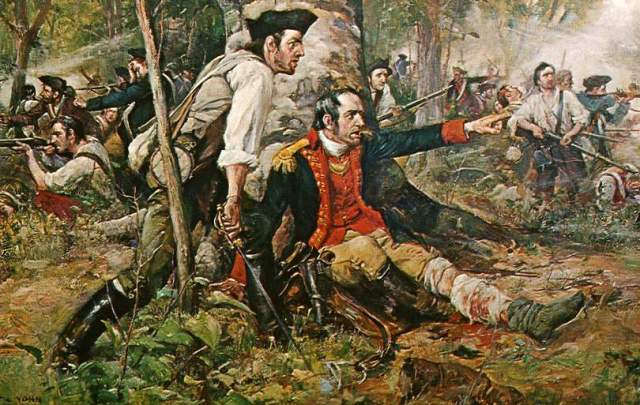
Herkimer, after having his horse shot and receiving his mortal wound in the opening shots of the engagement asked to be propped under a tree on the hillside his forces had utilized for their defensive stand He then calmly lit a pipe and with a continued cool demeanor directed the rest of the engagement.

Herkimer_at_oriskany
Famous painting depicting the mortally wounded General Nicholas Herkimer directing his militia from his position seated under a tree, during the Battle of Oriskany on August 6, 1777. (Painting by Frederick C. Yohn)

After the day-long battle, Herkimer ensured he was the last to leave the field, after all the wounded that could be collected had been removed.

Although his wound was dressed on the field, the injury became infected and amputation was the only course of action. In the woods of western New York, the surgeon doing the operation was inexperienced and the wound bled tremendously. Herkimer would succumb to the wound on August 16, at the age of 49. He was buried near Little Falls, where he had built his home in the 1760s. The cemetery today is known as the “Herkimer Home Burial Ground.”


*Nicholas Herkimer’s role in the war and the Battle of Oriskany and the St. Leger campaign is described wonderfully by Michael O. Logusz in Volume 2 of “With Musket and Tomahawk” published by Savas Beatie LLC in March 2012.*


Reflections of April 19, 1775

On this date, 241 years ago, the first salvo of what would become the American Revolutionary War, was fired on Lexington Green and North Bridge in Concord.

Historian John Galvin once wrote about the Battles of Lexington and Concord that they were the “least known of all American battles.” I never really understood what Galvin meant, as I had read extensively about April 19, 1775 and thought I understood the details of that day in history.

Yet, until this past weekend, when I spent the better part of four days touring the sites and walking the trails, talking to the historians around the towns, I did not realize how much more there is to what actually happened on that April day.

For starters, did you realize that Paul Revere did not go town-to-town calling out, “The British are Coming” to homesteads and roadside taverns? Instead, he was the catalyst that started a chain reaction of messengers and runners to different towns throughout the countryside that cast the alarm in a wide net.

He also would have told farmsteads and meetinghouses along the way that the “Regulars are Coming,” since the colonists still thought of themselves as British.

Or that the unofficial birth of the United States Army is attributed to the militia that followed Colonel James Barrett and Colonel John Buttrick down the hill toward the British at the North Bridge?

IMG_6903
The field where the militia under Colonel James Barrett and Colonel John Buttrick began their advance from toward the North Bridge. The militia would be coming toward us to descend toward the span.

That was the first time that men, formed in regiments with officers, made an advance against what they perceived as an enemy force, and did so in a “very military manner.”

What prompted the various militia companies, which came from other towns than just Concord, to sally forth from the hill toward the now infamous North Bridge? The main reason was what was happening in Concord was the mistaken reason behind the smoke emanating from the town?

In the town, the British were burning military supplies and the wooden gun carriages found in the hamlet. Sparks landed one of the nearby dwellings and British soldiers actually put down their muskets to form a bucket brigade, with civilians, to help put out the flames. The smoke that billowed from the doused fires is what prompted the militia and minutemen response.

With water being dumped on the flames, smoke billowed up, which prompted milita Adjutant Joseph Hosmer to ask the officers; “Will you let them burn the town down?” That prompted the forward movement of the militia down the hill and against the British.

Or did you realize that some of the militia, from the nearby town of Acton, suffered some of the first casualties at North Bridge, including their militia captain, Isaac Davis, who was one of the first killed in the engagement?

IMG_0087
View of the Old Manse, built in 1770 for Reverend William Emerson. View from the Concord River/North Bridge direction.

Somewhere in the midst of the action in Concord was Reverend William Emerson, the grandfather of Ralph Waldo Emerson who would later write that the action on April 19, would be known as the “shot heard round the world” years later.

These are just a few of the interesting tidbits that I picked up this past weekend. Altogether, they reinforce the historic events that I knew unfolded on this day in American History. However, along with reflecting on what transpired in my visit to Massachusetts, these new tidbits of valuable information underscore the important stories and accounts that shape this spring day that are beckoning to be told.

There is so much to be gained by walking the grounds, talking to the historians and historical enthusiasts of the area, and just taking time to appreciate what this day, April 19th, meant to the future of the United States and the era it was leaving behind as part of the British Empire.