Here is what our friend, Tom Hand was up to in August on his blog, Americana Corner. Be sure to join us on Sunday, September 5th at 7pm as we host our next ERW Happy Hour where we will talk with Tom about his passion for early American history, some of his thoughts on our Founders and learn more about his project Americana Corner.
August 24th: George Washington Discourages Debt and Foreign Entanglements
In his Farewell Address, President Washington shared his thoughts on several topics, including our national debt and the need for our country to remain fiscally prudent. Read it here.
August 17th: George Washington Calls for Unity in Farewell Address
After eight years in office, President Washington was ready to step down. He had planned to retire at the end of his first term but was talked out of it. During this second run at saying goodbye to public life, Washington was determined to finally retire. Read it here.
August 10th: Washington’s Farewell Address: One of Our Nation’s Most Significant Documents
George Washington’s Farewell Address is one of the greatest documents in our nation’s history. It was a letter written by President Washington to his fellow citizens as he neared the end of his second term as President. Read it here.
August 3rd: Pickney’s Treaty Opens Up the Mississippi, Encouraging Westward Expansion
The Treaty of San Lorenzo, also known as Pinckney’s Treaty, was an agreement signed on October 27, 1795 between the United States and Spain. It settled a dispute between the two nations over the boundary of Spanish Florida and granted navigation rights on the Mississippi River to Americans. Read it here.
Emerging Revolutionary War welcomes back guest historian Karl G. Elsea
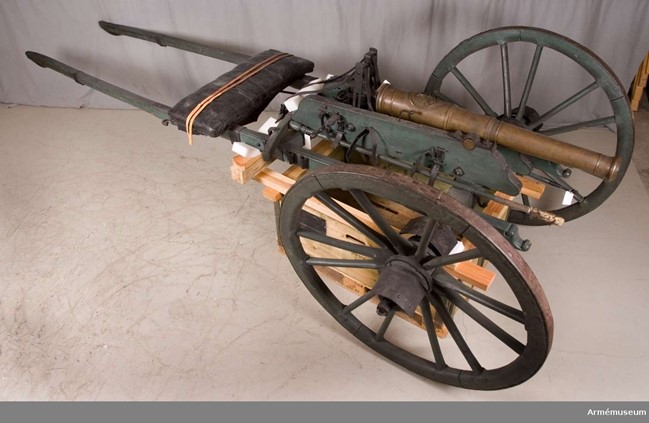
History can be fun; for example, when a war trophy in Sweden and the popular television series “Antiques Roadshow” can be combined to explain an American Revolutionary War legend. There are a number of books, articles, an actor impersonator, and even an U. S. Postal stamp from 1975 showing Peter Francisco carrying a cannon barrel to save it from falling into British hands at the Battle of Camden. Sadly, their stories of Peter carrying a barrel weighting 600 pounds, or even an amazing 1,100 pounds, are not close to true. Here is the likely story. The kind of barrel Peter actually carried is shown in the next picture. The barrel likely weighed between 200 and 300 pounds.
An original amusette is located at the Armémuseums’s magazine in Stockholm. This amusette was constructed in 1768 and captured by the Swedes in the battle at Berby in 1808. The following picture shows this amusette:
Like a modern-day Nathanael Greene or Edward Carrington, Andrew Waters spends his days trekking the waterways of the Carolina high country. Just like those famous military leaders, Andrew Waters does the surveying of these waterways and their tributaries for his day job; as a land and water conservationist.
During this career, Waters first learned about the “Race to the Dan” the pivotal retrograde movement in 1780 that saved Greene’s army from the pursuing British force under Lord Charles Cornwallis. Having the unique perspective from his training and an interest in the history of the time period, he had the perfect combination to pen a complete history of the “Race to the Dan.” Published by Westholme Publishing in October 2020, the title, To The End of the World, Nathanael Greene, Charles Cornwallis, and the Race to the Dan fills a much needed gap in the historiography of the the American Revolution in the southern theater.
This Sunday, at 7p.m. EDT, on Emerging Revolutionary War’s Facebook page, join us in an interview with Waters, discussing this book, Nathanael Greene’s leadership, and any questions you may have about this subject. Remember that favorite beverage and we look forward to you tuning as we welcome historian and author Andrew Waters to the next installment of the “Rev War Revelry.”
In the spring of 1778, General George Washington chose Major General Nathanael Greene to be the quartermaster general of the Continental army, replacing General Thomas Mifflin who had resigned the previous November. Greene was hesitant and wrote the quote that graces the title of this post. He was leery of giving up a field command to take a thankless job that faced a mountain of difficulties and was more administrative. From the start of his tenure in this important post, Greene brought about effective change. His never ending responsibilities included allocating resources, installing the right people into positions, and untangling contracts, transportation woes, and developing a concept, such as supply depots on potential campaign routes were vast improvements over what his predecessor accomplished.
Nathanael Greene
Greene though yearned to return to an active field command and through his close connection to Washington along with his due diligence as quartermaster, he was assigned command in the southern theater. His assignment was to replace Major General Horatio Gates as the head of Continental forces after the latter’s defeat at Camden, South Carolina in August 1780. Greene’s role in this position is well-documented and outside the scope of this post. One of the decisions he made, early on in his tenure as commander, paid huge dividends and is usually relegated to a passing few lines in most histories of the southern campaigns. What Greene wrote years earlier about “quartermaster in history” the quote that gives this piece its title, holds true in this instance as well.
On December 4, 1780, Greene wrote to Edward Carrington, then on assignment scouting the rivers and topography through North Carolina and southern Virginia, offering him a new assignment; that of quartermaster general for the southern army. After finishing his surveying of the rivers and water transportation, Carrington was ordered to head toward Greene’s forces, bringing supplies that had been gathered with him as well.
This decision, to place an officer of the caliber of Edward Carrington, in that position was a wise move. One that passes largely unheralded. A decision, though, that ultimately leads to success and eventual victory. In this case the momentous “Race to the Dan” that saved Continental forces, fatigued Lord Charles Cornwallis’ British forces, and played an early role in the latter’s move toward Virginia.
Earlier this year, three great historians, in their words, “took over” the “Rev War Revelry” in a discussion that they dubbed “Ladies Night.” That particular Sunday night historian happy hour was well received, so Emerging Revolutionary War historians Kate Gruber and Vanessa Smiley have decided to have another “Ladies Night” but this time discuss the role of Loyalist women during and after the American Revolution.
Joining this dynamic duo will be Dr. Stephanie Seal Walters, who is currently the Digital Liaison in the Humanities for the University of Southern Mississippi. She earned her bachelor’s and graduate degrees in history from the University of Southern Mississippi and a doctorate in United States History from George Mason University. You may also recognize her from the first annual Emerging Revolutionary War Symposium held in Historic Alexandria, Virginia in September 2019.
We hope that you can tune in, on Sunday night, at 7pm EDT, to catch the next installment of “Rev War Revelry” on our Facebook page.
As soon as one reads the title of this post, I am willing to bet a handful of names pop into your mind. This initial thought is most likely followed by a quick passing of puzzlement that the “Father of Modern Military History” would most likely been after the era of the American Revolution. More closely connected with the French Revolution or Prussia or even later after the unification of Germany in the 19th century.
None of those thoughts land on what European historians contend is the “Father of Modern Military History.” Bear with me a moment though before you click off this post. Have you ever browsed the aisles of Barnes and Noble? Of course you have, history enthusiasts tend to be book enthusiasts. A few weeks back that is what I was doing over my weekend. I strayed too far, however, and left the “United States History” section and ventured into the “World History” section. Ever done that?
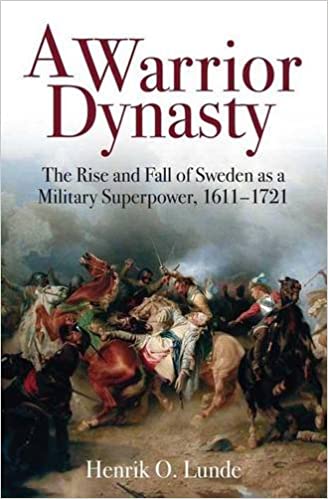
That is when this book caught my eye, “A Warrior Dynasty, The Rise and Fall of Sweden as a Military Superpower, 1611-1721.” I can safely say, I knew exactly nada about Sweden and their era of being a “military superpower.” So, I figured I would take the plunge. One more book in the personal library cannot hurt right?
After an introduction outlining the need for a book of this history in English and a brief overview of Sweden up to the 17th century, the author, who happens to reside in Southwest Florida now, introduced me to the monarch of Sweden. In addition to being the king, he was the greatest military mind in Europe during this time frame of the Thirty Years War.
Gustav II Adolf or his Latinized name, Gustavus Adolphus. He served as King of Sweden from 1611 to 1632, when he was killed in action and was the primary reason that Sweden rose to such military prominence during this time frame. After his premature death he was posthumously given the title Gustav Adolfden store which translated means Gustavus Adolphus the Great by the Riksdag, the Swedish Parliament.
Besides the other title he earned posthumously, “Father of Modern Military History.” Why is he deserving of this title? Let’s examine.
Emerging Revolutionary War welcomes guest historian Andrew Waters
Appearing this month at the Journal of the American Revolution (JAR) is an article I wrote on William “Bloody Bill” Cunningham and his infamous raid known as the “Bloody Scout.” The article attempts to provide a single-source narrative of the Bloody Scout and some of the contexts for it, although it is based on a previous article I wrote (though never published) that attempted to explore more deeply its sociological implications.
Anyone who comes to western South Carolina and has any interest in the American Revolution will soon encounter Bloody Bill. As I attempted to explain over at JAR, “without veering too deeply into sociological speculations, I can only say that his (Cunningham’s) presence is still palpable here, embedded in the cultural DNA. Though he may be only a curiosity in other parts of the United States, if he is known at all, in the South Carolina Upstate, it seems there will always be Bloody Bill.”
On both banks of the Hudson River, in 1776, sat two forts the patriots hoped would stop any British excursions up the waterway. Named for the top two military leaders of the Continental army–George Washington and Charles Lee–the fortifications both fell to the British by late November of that same year.
Join Emerging Revolutionary War this Sunday, at 7 p.m. EDT on our Facebook page as the forts become the focal point for this week’s “Rev War Revelry.” Joining ERW will be Charlie Dewey who will help break down and discuss the implications of these actions in November 1776.
Dewey, an officer in the New York Army National Guard and a graduate of the Virginia Military Institute has been a museum educator and special events coordinator for Fort Lee Historic Park since May 2018. He has been publishedin the Journal of the American Revolution along with being the author of various other scholarly articles on the Revolutionary time period.
Fort Washington, the last toehold of the Americans on Manhattan Island that fell and Fort Lee, the beginning of the long trek by Washington’s army across New Jersey late in 1776 have a unique part in American Revolutionary history. We look forward to you joining us this Sunday for this historian happy hour.
As July 4th approaches, many of us turn our thoughts to the Declaration of Independence and the early years of the Revolution. I do too, but I also recall another July 4th, the one in 1754 when a Virginia militia officer named George Washington surrendered the crudely built Fort Necessity to the French. The battle touched off the French and Indian War.
General George Washington looks back at us from marble statues or stiff paintings with a grim-faced and determined look. Known for his dignity, resolve, and sound leadership, he seems cold and reserved. Yet he was also quite sentimental. In the midst of a grueling campaign, with a massive British invasion force set to descend on him at New York City in July, 1776, Washington paused to pen these words: “I did not let the Anniversary of the 3rd or 9th of this Inst pas[s] of[f] without a grateful remembrance of the escape we had at the Meadows and on the Banks of the Monogahela. [T]he same Providence that protected us upon those occasions will, I hope, continue his Mercies, and make us happy instruments in restoring Peace & liberty to this once favour’d, but now distressed Country”.
Washington was writing to General Adam Stephens, his subordinate in the French and Indian War twenty years earlier, who now commanded a division in the Continental Army. These lines give us a unique insight into the mind of the Revolution’s commanding general.
The French and Indian War years were Washington’s formative years as a military officer. He learned the art of war on the Pennsylvania, Virginia, and Maryland frontier: tackling supply and logistical challenges, dealing with recruitment and discipline, and working patiently-though not always successfully- with elected officials.
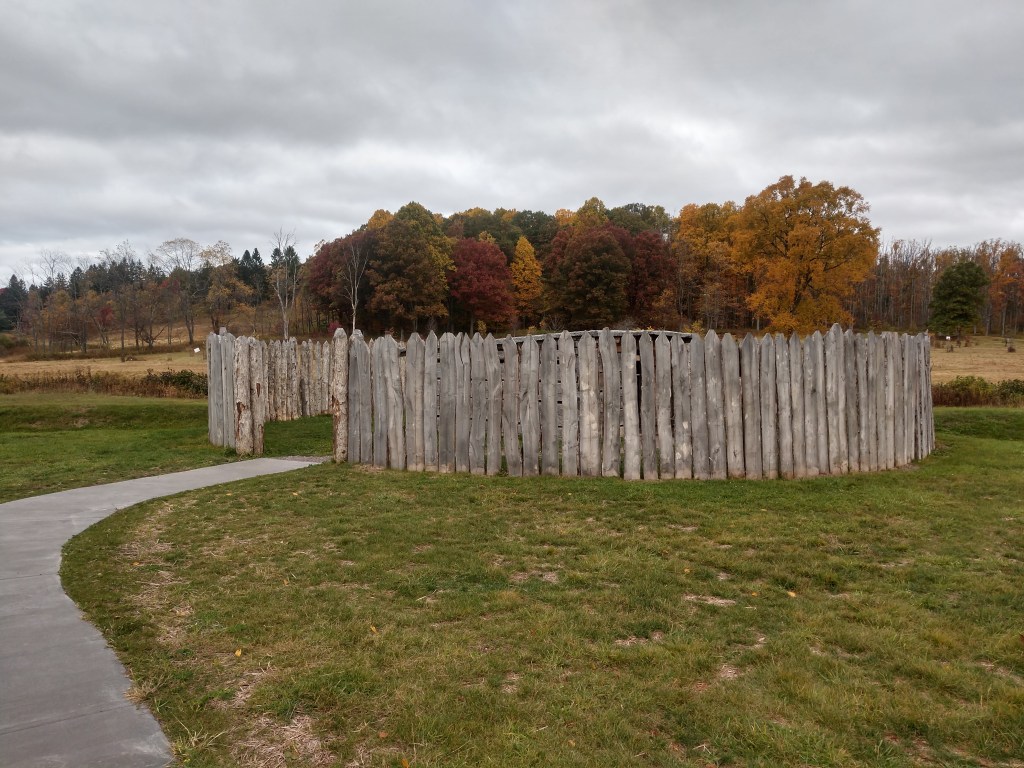
Fort Necessity. Author photo.
He lost his first major battle (Fort Necessity) to the French, fighting with the British. He won his last major battle (Yorktown) against the British, with the help of the French. The irony is deeper, for the surrender at Fort Necessity (the only time Washington ever surrendered), was July 4, 1754. Twenty years later, when celebrating American independence, he no doubt reflected on the juxtaposition.
The two battles Washington reflected upon, Fort Necessity (the Meadows) and Braddock’s Defeat (the Monongahela) were both defeats- disasters, really. Yet the experiences were powerful for the young Virginian; Braddock’s Campaign especially.
British troops and colonial forces were attempting to remove the French from western Pennsylvania and the Ohio country. The first few campaigns ended in failure, but Washington was able to participate in the final victorious effort in 1758.
Washington saw good and poor leadership, good and poor discipline, and good and poor coordination. When making decisions on conducting the war and running the army twenty years later, his decisions were informed by his earlier experiences.
He wrote of these experiences again later, and their impact on him was clearly profound. Washington also kept the sash and pistols that Braddock had given him before he died. These treasures reside in the collection at Mount Vernon today.
So strong were the memories of his youth in the woods of the frontier, that he even purchased the very land on which the battle of Fort Necessity was fought (How many Generals in American history can claim that?). In 1784 he visited the area, bought lands, and tried to find Braddock’s Grave. Washington wrote that he was “desirous of erecting a monument over it.” Unable to find the grave, Washington satisfied himself with viewing places where he learned the art of war three decades earlier.
A swivel gun at Fort Necessity. Author photo.
Washington himself was one of the new nation’s first battlefield tourists. He enjoyed visiting battlefields and retracing the movements of the armies. During his Presidency, he visited many Revolutionary battle sites, including some where he commanded. One has to wonder what ran through his mind as he re-examined the ground as a seasoned veteran and commander, without the urgency and chaos of battle unfolding around him.
Most of us have had close calls: an accident, medical emergency, or in military service. These events are life- changing. Reading Washington’s reflections allows us to better know the person, and understand his complex personality.
Being sentimental as he was, we might also wonder, what might Washington have thought of those battle sites today. Many are preserved as historic sites, though a good many have been lost to development. Hopefully he would applaud our current efforts at preservation, scholarship, and interpretation.
In June 1778, the Continental army marched out of their winter encampment in Valley Forge, Pennsylvania and headed toward New Jersey in pursuit of the retreating British army. The past six months, from December 1777 to June 1778, ushered in a period of suffering, renewal, and change.
Valley Forge is imprinted into the psyche of Americans as the the toughest winter of the entire American Revolution. In fairness, it was one of many tough winters that the Continental army survived. However, the reasons why this winter stands out will be part of the discussion of this Sunday evening’s “Rev War Revelry” which can be found on Emerging Revolutionary War’s Facebook page at 7 pm. EDT.
This week’s historian happy hour includes a discussion with Philip S. Greenwalt author of the recently released Emerging Revolutionary War Series title, The Winter that Won the War. This is the fourth volume in the series, with previous ones covering Lexington and Concord, Trenton and Princeton, and Monmouth.
Greenwalt will discuss how the Valley Forge winter was the intersection of various issues and how the decisions made and the determination of survival by the army made this the winter that won the war.
Tune in as well to hear how you can purchase a copy of this book to take with you as you plan that summer trip to Valley Forge and the Philadelphia area!







 Emerging Revolutionary War Era